Casks & Caskets: LFM Reviews Blood of the Vine Seasons 1 & 2

By Joe Bendel. Murder and vino have always gone together, ever since Montresor offed Fortunato in “A Cask of Amontillado,” so who would make a better amateur sleuth than an enologist (wine expert)? For a vintner accused of murder, Benjamin Lebel is the man to call in Blood of the Vine, seasons one and two, now available as two separate 2-DVD sets from MHz Networks.

In the series opener, Tears of Pasquin, the Bordeaux based Lebel puts the moves on an attractive colleague, France Pelletier. She is mature enough to consider his assistants, Mathilde and Silvère, wet-behind-the-ears kids, but she is still young enough to look good on his arm. Over the next two seasons, she will become accustomed to having romantic dinners and weekend getaways interrupted by murder.

Pasquin happens to be one of the series’ more intriguing crime stories. What appears to be a serial killer case ultimately involves the nasty legacy of Vichy era collaboration. That still seems bold for French television. Pasquin also introduces Lebel to Commander Barbaroux of the Bordeaux police force, who is admittedly befuddled by the rare bottles of Pasquin left at multiple murder scenes. He calls in Lebel as a consultant, but quickly has misgivings.

Loyal Silvère looks different in Le Coup de Jarnac, but replacement Yoann Denaive and the rest of the regulars will stick around for the balance of the first two seasons. Hired to audit the storied Aludel cognac distillery divided by feuding siblings, Lebel and his assistant receive a rather frosty reception at the chateau. However, Lebel is quite welcome at the tavern in town co-owned by his old flame, Shirley. Unfortunately, the legendary mixer and friendliest Aludel heir falls victim to an untimely accident.

From "Blood of the Vine."

Vine often features well known guest stars (at least to French audiences), such as Marisa Berenson, the co-star of films like Barry Lyndon and Cabaret, as well as a one-time guest host of The Muppet Show. As Shirley, she and series star Pierre Arditi have a nice wistfully flirtatious thing going on.

Likewise, Margaux’s Robe features another notable guest star, Arditi’s daughter Rachel, playing Lebel’s daughter, Margaux. Recently, returned from New York, Margaux Lebel has accepted a PR job with a new Chateau owner who is absolutely, positively not a member of the Russian mob. When sabotage kills Margaux’s co-worker-lover and badly injures her, the Soviet educated Swiss mogul puts pressure on Lebel to solve the case quickly or he will do it his way, which adds a good twist to elegant sleuthing.

Fittingly, the first season ends with one of the better crafted mysteries, while also challenging Lebel’s loyalties. When a former assistant’s struggling chateau is beset by a suspicious outbreak, Lebel comes to investigate. Knowing the grand dame who once fired him covets their land, Lebel pays a visit to the regal Mme. Newman. Both Arditi and Judith Magre (probably best known for Louis Malle’s The Lovers) clearly relish their affectionately acid-dripped banter.

Season two begins with A Question of Brandy . . . or Death. Once again, Lebel and his assistants have been hired to assess a struggling distillery. In this case, it is the Baron Castayrac who expects Lebel to simply sign off on his insurance claim, but the enologist does not play that game. Pretty much every key element of the series comes into play in this episode, with a union boss of questionable repute thrown in as an added bonus. Continue reading Casks & Caskets: LFM Reviews Blood of the Vine Seasons 1 & 2
The Other White Meat, on The Black Market: LFM Reviews A Pig Across Paris

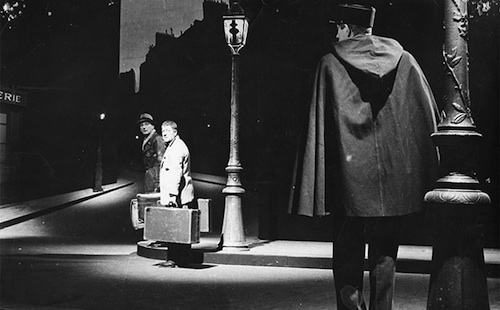
By Joe Bendel. This little piggy is supposed to go to the black market. It is Marcel Martin’s job to take him, but he cannot schlep four suitcases fully loaded with pork goodness on his own. He will have some dubious help from a mysterious stranger in Claude Autant-Lara’s classic A Pig Across Paris, which opens this Friday in New York at Film Forum.

Martin was once a taxi driver, but the German occupation has been bad for business – what with the curfews, rubber and gasoline rationing, and constant military patrols. Technically, he is unemployed, but Martin still provides for his somewhat out of his league wife through black market gigs. Skeptical of her fidelity, Martin button-holes Grandgil, a stranger he suspects of being her lover. When satisfied this is not the case, he recruits the stout fellow to help him carry his freshly slaughtered baggage across town.

Much to his surprise, his new companion more or less takes over the operation. He is resourceful but somewhat reckless. They bicker like an old married couple and the leaking baggage draws a pack of appreciative dogs, but somehow the two men proceed to navigate the nocturnal world of air raids and police check points. Yet, irony is always waiting just around the corner for them.

A Pig Across Paris (a.k.a. Four Bags Full, a.k.a. La traverse de Paris) is one of those films that almost got away. Surprisingly, it was a hit in France, but at the time, it snuck in and out of American theaters like a black-marketeer with a side of bacon stuffed in his trousers. Happily, it now returns to circulation with a newly translated set of subtitles. There is indeed a reason the Nouvelle Vague enfants terribles singled out Pig as one of their few worthy French predecessors. Autant-Lara’s depiction of occupied Paris is far bolder and more barbed than really any of the films they produced in the 1960’s.

From "A Pig Across Paris."

Adapted from a short story by Marcel Aymé, Pig presents a full spectrum of cowardly and/or opportunistic behavior. This is the black market after all, not the resistance. Indeed, the latter are nowhere to be found. As befitting Autant-Lara’s lefty inclinations, rather pronounced class differences emerge between the two men.

They are well paired though. As the more well-heeled Grandgil, Jean Gabin is both appropriately manly, in a Spencer Tracy kind of way, but also convincingly sophisticated and rather condescending. Likewise, Bourvil (as André Robert Raimbourg billed himself) perfectly balances broad comedy with tragic pathos as the increasingly put-upon Martin. They are one of the great big screen odd couples.

There are a lot of funny bits in Pig, but it never whitewashes the era. Frankly, Autant-Lara’s film is not so far removed from Jean-Pierre Melville’s Army of Shadows, both in terms of their morally ambiguous milieu and quality of execution. Highly recommended for general audiences, A Pig Across Paris opens this Friday (5/24) in New York at Film Forum.

LFM GRADE: A

May 21st, 2013 at 1:59pm.

Marriage, Korean-Chinese Rom-Com Co-Production Style: LFM Reviews A Wedding Invitation

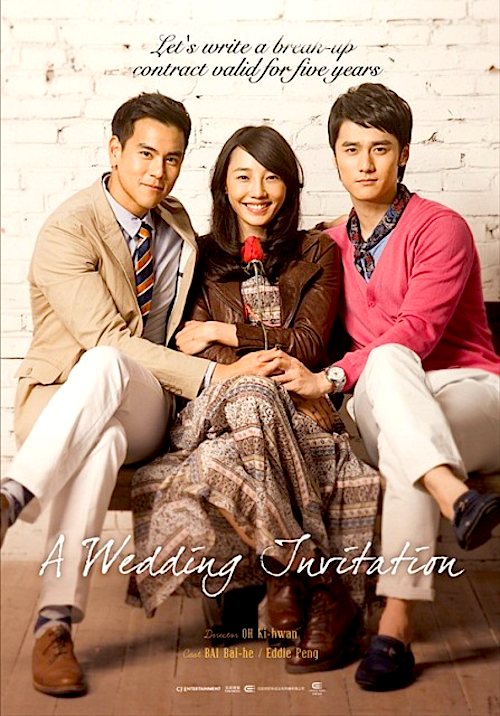
By Joe Bendel. Love means never having to ask: “where have you been for the last five years?” When dumping Li Xing, He Qaio Qaio thought they needed time to establish their careers. If they were still single five years later, then they should get married at that point. However, a lot can happen in five years, including his eleventh hour engagement to the boss’s daughter. As you might have guessed, He will try to win back her soul mate in Oh Ki-hwan’s A Wedding Invitation, which opens this Friday in New York.

Yes, you probably think you have seen this film before, just with a less attractive cast. He Qaio Qaio does indeed travel to Beijing, ostensibly to celebrate Li Xing’s wedding, but really with the intent to seduce and disrupt. She even enlists her gay best friend to pretend to be her lover, in hopes of making Li Xing jealous. Oh, but not so fast. In its third act, Invitation veers into three hanky territory, doing what commercial South Korean cinema does best.

Frankly, if you want to enjoy the guilty pleasure of a weepy melodrama, you have to look east. Hollywood does not do Affairs to Remember anymore. Everything has to be ironic or quirky these days. A multinational co-production, Wedding features a Mainland and Taiwanese cast and a largely Korean crew on the other side of the camera.

It is a division of labor that works relatively well. As He, the luminous Bai Bai-he is initially exasperating in the Julia Roberts portion of the film and then heartbreaking in the Il Mare-esque conclusion. Although Eddie Peng is no stranger to the rom-com genre (having been totally overshadowed by Shu Qi in Doze Niu’s Love, for instance), he really comes into his own with his work as Li Xing. While suitably earnest, there is also an edge to his Top Chef contending leading man turn. Pace Wu (a.k.a. We Pei Ci) does not get much dramatic heavy lifting, but she is far more charismatic than comparably inconvenient fiancées in rom-coms past.

In the opening screwball section, viewers are likely to wince at the flat-footed He, but down the stretch they are guaranteed to get a little misty-eyed for her. Sure, that is all very manipulative, but audiences will feel like they have been through a lot with these characters. Oh, the rom com specialist, deftly manages the frequent flashbacks and keeps the proceedings pleasantly pacey. Recommended for those not afraid of a little sentiment (or a lot), A Wedding Invitation opens this Friday (5/24) at the AMC Empire in New York and the AMC Metreon in San Francisco.

LFM GRADE: B-

Posted on May 21st, 2013 at 1:59pm.

Martial Arts On-Stage: LFM Reviews Deadly She-Wolf Assassin at Armageddon!

By Joe Bendel. Revenge is a family business for the characters of Lone Wolf and Cub. This is not exactly an official stage adaptation, but fans of the manga and films will recognize certain elements. The Rogue Assassin’s young Boy did indeed choose the sword over the ball. However, they might just meet their match in the form of the titular nemesis in Fred Ho & Ruth Margraff’s musical martial arts stage-production, Deadly She-Wolf Assassin at Armageddon!, which officially opened this weekend at La MaMa’s Ellen Stewart Theatre.

Once, the Rogue Assassin was the Shogun’s Kaishakunin, until the Imperial councilor, Iyagu of the ruthless Yagyu clan, convinced the old tyrant to turn against his loyal executioner. Iyagu’s assassins succeed in killing his wife, but the Shogun’s betrayed “second” escapes with his infant son. This proves to be a costly escapade. For ten years, the Rogue Assassin cuts through the Imperial assassins and ninjas like butter, depleting the Shogun’s treasury and undermining his ruling authority.

Rather sick of it all, the Shogun imports three super assassins from abroad, at considerable cost to Iyagu’s face. Not inclined to take matters lying down, the old conspirator plays his trump card, unleashing the She-Wolf Assassin. Raised from infancy to be Iyagu’s personal La Femme Nikita, her fate is mysteriously intertwined with that of the renegade father and son.

Much fighting ensues, impressively choreographed by lead actor Yoshi Amao for swords and Emanuel Brown (Electro in Broadway’s Spider-man: Turn Off the Dark) for martial arts beatdowns. The resulting spectacle is musically accompanied by the Afro Asian Music Ensemble, under the direction of conductor-multi-reed player Masaru Koga, performing Fred Ho’s funky Lone Wolf-inspired score. Incorporating elements of electric bass and baritone sax driven blaxploitation soundtracks and traditional koto and shakuhachi music, Ho’s themes are hip and propulsive, yet still fit the Jidaigeki action on-stage.

Unfortunately, Ho’s hardcore leftist ideology does not serve the story as well. Frankly, the Uncle Sam assassin caricature is just laughably didactic. A chicken fried colonialist, Colonel USA is hardly representative of the inward looking American foreign policy during the Edo era (1603-1868). Frankly, it is a bit of agitprop street theater that does not fit the otherwise dignified Noh-esque production.

Regardless, the stagecraft of She-Wolf is quite impressive. The lighting and smoke are suitably moody and the spare set is rather evocative. Likewise, the costumes provide the right period look without interfering with the fight choreography.

The cast holds up their end, too. Yoshio Amao is all kinds of brooding badness as the Rogue Assassin, but Ai Ikeda does him one better as the steely She-Wolf. Takemi Kitamura also shows some dramatic flair and action cred as She-Wolf’s sister (the most substantial of her three roles).   As is standard practice, two young actors rotate as the Boy. Bradley Fong showed real presence in the part Sunday afternoon, never drowning amid all the stage effects and melee unleashed around him. (His alternate, Jet Yung is surely quite good, as well.) With Perry Yung’s Iyagu chewing the scenery with admirably villainous glee, it is a strong ensemble all around.

This is one of the better martial arts themed productions to grace New York’s independent stages in a fair amount of time and the music is always very cool. There are certain awkward excesses to She-Wolf, but that is sort of par for the course in New York’s theater world. Hopefully, Mr. Ho is happy with director Sonoko Kawahara’s muscular staging, considering the program’s sad note regarding his ill health. Recommended for martial arts fans and soul-world fusion jazz listeners, She-Wolf Assassin at Armageddon! runs through June 2nd at La MaMa’s Ellen Stewart Theatre.

Posted on May 20th, 2013 at 2:17pm.

This Trip is No Fun: LFM Reviews Black Rock

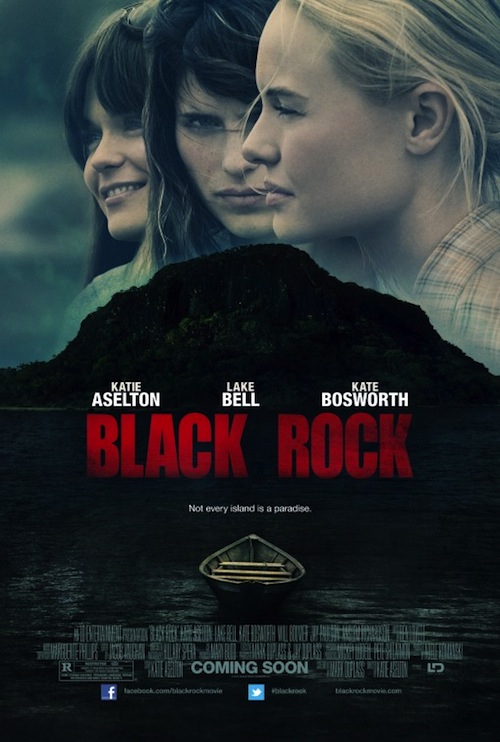
By Joe Bendel. Who goes camping on a remote coastal Maine isle during the off-season? Psycho killers and their made-to-order victims, that’s who. There is nothing inherently wrong with a traditional slasher movie set-up, but the execution is decidedly problematic throughout Katie Aselton’s Black Rock, which opens today in New York.

Sarah has tricked her childhood friends Abby and Lou into joining her on a camping trip, in hopes that they will bury the hatchet. Years ago, Lou bedded Abby’s boyfriend. Still nurturing her resentment, the soon-to-be divorced Abby is not ready to forgive and forget. When they run into three hunters, the thoroughly annoyed Abby gets sloppy drunk and flirty with Derek, the alpha male, who rather misconstrues her attentions. This leads to all kinds of trouble.

When one of the sullen hunters tells the women what a hero Derek was in Iraq, no matter what they said at the court martial, we know what kind of movie we’re in for. Yes, that’s right, they are unhinged veterans. You might have thought the sleazy psycho Vietnam Vet exploitation film was an embarrassing relic of the 1970’s, but evidently Aselton and her husband-screenwriter Mark Duplass are determined to revive it. Yes, this is how the Duplass household would like to thank all our men and women in uniform: by suggesting they are an inch removed from Richard Speck. Really, you shouldn’t have.

Oddly, the first ten minutes or so show a flash of promise thanks to some caustically catty dialogue. That promise is short lived. By the time the bound women goad the craziest of the crazies into letting them go so they can hunt them down like real men, audience emotional detachment should reach one hundred percent. Nor does Rock have the guts to go all in with its gender-based victimization and retribution themes, a la I Spit on Your Grave. Instead, Aselton and Duplass basically follow the Most Dangerous Game template, chapter and uninspired verse.

To be fair, Kate Bosworth has some nice moments as the somewhat likably goofy Sarah. However, Aselton and Lake Bell largely blend together as Abby and Lou (or Lou and Abby). As their three antagonists, Jay Poulson, Will Bouvier, and Anselm Richardson never transcend their characters’ cookie-cutter stereotypes. Of course, they are not supposed to.

As a horror film, Black Rock is a bore. Yet, it has the potential to be something far worse. It is easy to see unsavory elements repurposing the exploitation flick to demonize American servicemen. After all, we know the Frankfurt terror attack was inspired by Brian De Palma’s Redacted and for weeks the administration blamed Benghazi on a YouTube video. A disappointment on every level, Black Rock is not recommended for anyone under any circumstances when it opens today (5/17) at the Village East.

LFM GRADE: F

Posted on May 17th, 2013 at 11:08am.

MoMA’s Chinese Realities Series: LFM Reviews The Story of Qiu Ju

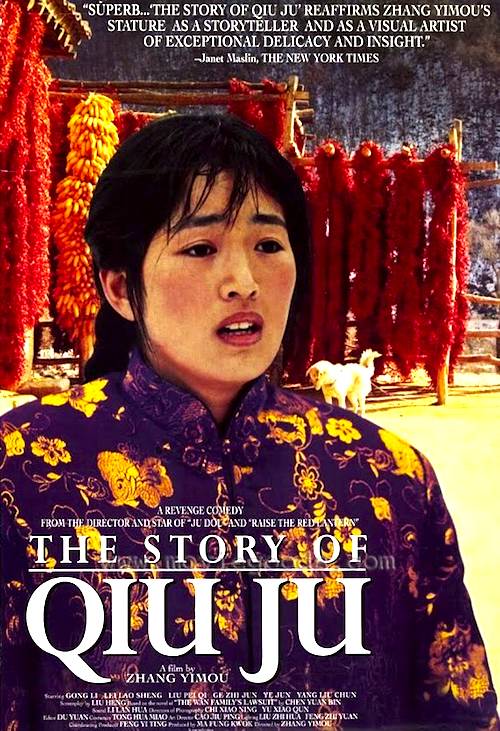
By Joe Bendel. It is hard to get around the symbolism of it all when a local village official deals a swift kick to a peasant’s family jewels. Technically, that is not considered proper behavior, but getting justice from the Party is a tricky undertaking. However, his pregnant wife is determined to extract an apology in Zhang Yimou’s The Story of Qiu Ju, which screens tomorrow as part of MoMA’s Chinese Realities/Documentary Visions film series.

A Golden Lion award winner at Venice, Zhang adapted Chen Yuanbin’s novella with a documentarian’s eye for realistic detail—hence its inclusion in MoMA’s current retrospective. Following Qiu Ju’s quest for redress, her Story makes a fitting companion film to Zhao Liang’s Petition (also screening at MoMA), even though it is considerably more ironic and less harrowing. Regardless, justice was clearly an elusive proposition in 1990’s China (and remains so today).

During a stupid argument, Wang Shantang applied said kick to Qinglai. While problematic under any circumstances, injury to Qinglai’s reproductive organ carries far greater implications for the couple due to China’s population control policies. Should Qiu Ju miscarry, they could be permanently out of luck. Regardless, Wang is not apologizing, so Qiu Ju presses her case up the administrative ladder, with little support from the sulking Qinglai.

Needless to say, Chinese officialdom is rather inclined to circle the wagons around one of its own. There is indeed a pronounced Kafkaesque element to the film. Yet, Qiu Ju is no standard issue victim. Her indomitable spirit is rather ennobling, in marked contrast to the typically depressing protagonists of Sixth Generation social issue dramas and some of their Fifth Generation forebears. Likewise, there is an unusual gender reversal afoot, in which Qiu Ju trudges from town to city for the sake of her principles, while the emasculated Qinglai hobbles about their cottage.

In a radical change-up from her glamorous image, Gong Li (an outspoken critic of Chinese censorship) looks, sounds, and carries herself like an out-of-her-depth peasant woman. Yet, her Qiu Ju has a quiet fierceness and an affecting innocence that are unforgettable. Likewise, Kesheng Lei’s Wang makes a worthy antagonist. It is one of those slippery performances that are hard to either categorize or forget.

The Story of Qiu Ju is a significant film in Zhang’s canon and the development of Chinese cinema in the 1990’s. In a way it bridges the Fifth and Sixth Generations, despite its multi-award winning star turn from the still charismatic Gong Li. It certainly focuses a withering spotlight on contemporary China’s bureaucracy and legal system. Highly recommended for China watchers and Gong Li fans, The Story of Qiu Ju screens tomorrow night as part of MoMA’s Chinese Realities.

LFM GRADE: A

Posted on May 16th, 2013 at 10:14am.