LFM Reviews When Sunny Gets Blue @ The 2013 Columbia University Film Festival

By Joe Bendel. Musicians are like athletes. An injury can potentially end a brilliant career. Like Evan Horne, the protagonist of Bill Moody’s jazz mysteries, Jonathan Clay is a pianist struggling with injured hands, who suddenly finds himself involved with the criminal element in Oded Naaman’s When Sunny Gets Blue, which screens in New York as part of the 2013 Columbia University Film Festival, an annual showcase for Columbia MFA students’ thesis films and screenplays.

Clay is not a good patient. Suffering from acute carpal tunnel syndrome, he is frustrated by the slow rehabilitation process. In fact, he has given up on physical therapy. When he returns from a session of self-pitying and boozing, he is surprised to find a woman in his apartment. She is there to warn him about the thugs who show up shortly thereafter.

Yes, her name is Sunny, as in the title Jack Segal & Martin Fisher standard that seems to have great meaning for Clay. It is a good one, recorded by the likes of Dexter Gordon, Sarah Vaughan, and Nat King Cole, but it is not exactly overplayed and fits the vibe of Naaman’s film quite well. (The credits inspired by Blue Note Records graphic designer Reid Miles are also a nice touch.)
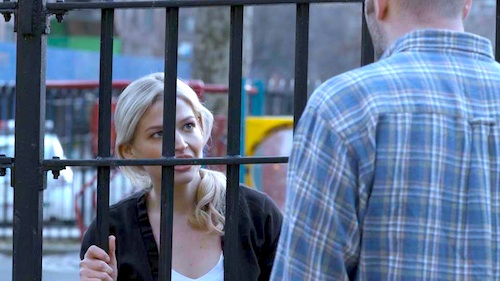
From "When Sunny Gets Blue."

Indeed, Sunny has a hip sensibility that should please jazz fans. In a strange way it manages to be both ambiguous and completely satisfying. Naaman deftly establishes a distinctive mood that is too light-hearted to be called noir, but too dark to be considered anything else. It certainly fits the jazz life, as does Jonathan Monro’s standout performance. He gets a convincing case of the blues, yet remains sincere and grounded, even when doing some odd things. As someone who knows a lot of musicians, his performance always feels right to me.

A great short film, the nineteen minute When Sunny Gets Blues is an Indiewire Project of the Week that actually panned out. It should serve as quite a positive representative for Columbia as it gets festival play. Highly recommended for jazz fans and film programmers, When Sunny Gets Blue screens this Saturday (5/4) as part of the Columbia Film Festival’s Program D at the Walter Reade Theater.

LFM GRADE: A

Posted on May 2nd, 2013 at 11:28am.
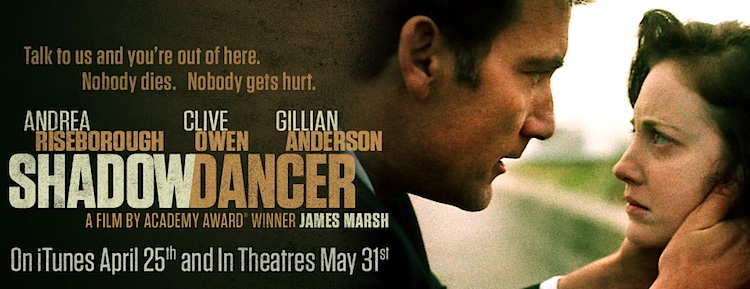
A Gripping and Timely Look at Terrorism: LFM Reviews Shadow Dancer; In Theaters May 31st, Available on Amazon, iTunes Now

By Patricia Ducey. Shadow Dancer takes place in 1993 Belfast during the fitful, bloody denouement of the conflict referred to delicately as The Troubles. In the opening minutes, we meet Colette McVeigh as a child. She sends her little brother out for cigarettes, when her father told her to go, and the boy is killed in a British/IRA crossfire.

The film then jumps to 1993 as the adult Colette, now played by Andrea Riseborough, steps into the London Tube, apparently going to work. After an uneventful ride, she alights and dashes towards street level, but not before leaving her purse on an empty staircase. We know, after Boston, in a shock of recognition, that this is a bomb. She escapes through a maze of maintenance tunnels, only to be grabbed outside by two men and hustled into a car.

But Colette is no lamb; she is a hardened IRA “volunteer” now and knows what will follow. As the agents drive her through London, she quietly disappears into herself, preparing for the expected interrogation. After all, her mission in London represents a new IRA tactic: by wreaking violence on the mainland, they hope to destroy the British people’s resolve to remain in Ireland, at all. This entire sequence is almost silent, which amps the suspense even further; no conversation or music distract from Colette’s cool, expressionless face as she hurries to complete her mission and then prepare for arrest.

The two agents deliver her to Mac (Clive Owen), the MI5 interrogator, and he tries to break her. He offers her the family dossier. In it she finds the forensic report from the killing of her little brother, the act which has radicalized her and her two surviving brothers. But the report identifies the bullet as coming from a known IRA weapon. In a rush, she pushes away the file — and the truth? — against a rising moral revulsion that she has never totally extinguished.

Finally, Mac presents her an ultimatum: return to Belfast and inform on her famous IRA family, or go to prison for decades and watch her little son delivered up to the foster care system. Of course, she relents, and the real suspense begins.

Continue reading A Gripping and Timely Look at Terrorism: LFM Reviews Shadow Dancer; In Theaters May 31st, Available on Amazon, iTunes Now

Euro Undead Vamping it up in America: LFM Reviews Kiss of the Damned; In Theaters May 3rd, Available on Amazon, iTunes Now

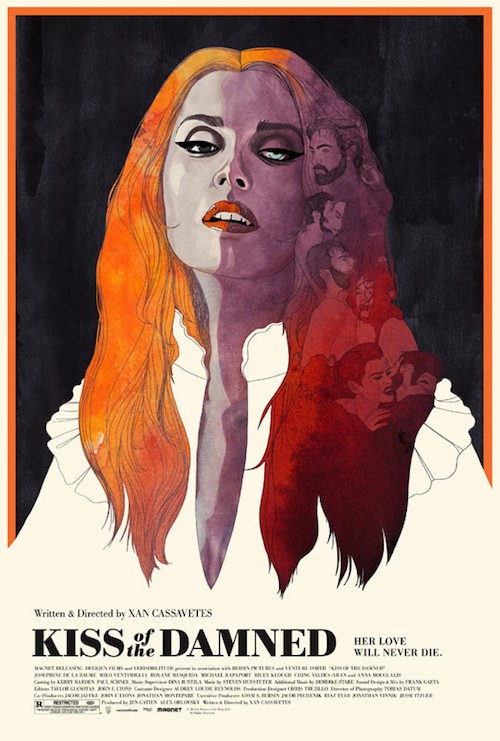
By Joe Bendel. Vampires are Old World creatures. They do not fit in so easily in America, or at least a big crowded city like New York. This is especially true of the reckless Mimi, who creates all sorts of complications for her sister Djuna and her undead sibling’s recently turned lover in Xan Cassavetes’ Kiss of the Damned, which opens this Friday in New York.

Most vampires keep to themselves, making do with animal blood. Of course, the human kind is the good stuff, but developing a taste for it is dangerous. Mimi has done just that. In contrast, Djuna is content living a quiet nocturnal existence in the isolated mansion owned by Xena, the grand dame of vampires. Then one night, she catches Paolo’s eye in a throwback video store (a vestige of the old).

Despite her concern for his well being, sparks fly between her and the slacking off screenwriter. She soon brings him over to the undead, so they can un-live happily ever after. Unfortunately, Xenia sends her blood-lusting sister Mimi to dry out with the blissful couple shortly thereafter. Not surprisingly, having an unstable nymphomaniac with a taste for human blood in their midst puts a strain on pretty much everything.

Yes, Xan Cassavetes is the daughter of John Cassavetes and Gena Rowlands. As one might expect, she knows her art cinema. While she is not afraid of a little blood, she patiently sets the scene and establishes her characters before getting down to the business end of vampirism. The result is an uber-stylish, devilishly indulgent film. Fittingly, cinematographer Tobias Datum renders it all with an evocative retro-Hammer color palette, luxuriating in shades of red.

As Djuna, Joséphine de la Baume is captivatingly elegant and sensual. Milo Ventimiglia is a bit stiff as Paolo, but Roxanne Mesquida’s Mimi is quite the hot undead mess. She just radiates trouble whenever she is on screen. Yet, the unlikely Michael Rapaport nearly steals the show in his brief but riotous appearances as Paolo’s crass agent.

Polished and seductive, Kiss of the Damned has a Euro art house sensibility, but it still delivers the goods for vampire fans. Clearly inspired by the Italian masters, Cassavetes demonstrates an appreciation of the look and form of the genre. Highly recommended for connoisseurs of continental horror and vampire films, Kiss of the Damned opens this Friday (5/3) in New York at the Landmark Sunshine.

LFM GRADE: B+

Posted on April 30th, 2013 at 1:19pm.

LFM Reviews Byzantium @ The 2013 Tribeca Film Festival; Film Opens June 28th

By Joe Bendel. Evidently, vampirism is supposed to be an old boys’ club. Eleanor and her sister Clara are certainly not boys. At least they are old, though they hardly look it. Immortality is a strange existence for them in Byzantium, Neil Jordan’s return to the world of the undead, which screens as a Spotlight selection of the 2013 Tribeca Film Festival.

For two hundred years, Eleanor has been a mixed up teenager. She routinely writes the story she is forbidden from telling, casting her words to the wind. Eleanor also drinks human blood to survive, but she only “takes” those who are ready and willing to go. She was whisked away from her orphanage and turned eternal by her “guardian” Clara. Ever since, they have not-lived on the run, eluding a cabal of vampires who never sanctioned either woman joining their ranks.

Clara does not have Eleanor’s scruples. She is a survivor, typically falling back on her old profession—the oldest one. At least she finds a decent enough chap to shack up with in Noel. He happens to have a vacant hotel they can use as a base of operations—the Byzantium. Despite Clara’s insistence on secrecy, Eleanor feels increasingly compelled to share her story, which is a dangerous proposition.

Adapted by Moira Buffini from her stage play A Vampire Story, Byzantium offer some intriguing twists on the familiar vampire mythos (the hat tips to Byron and Polidori are also nice touches). Yet this version is driven by the telling of the tale, which establishes quite a compelling fairy tale vibe. Jordan masterfully handles the flashbacks, while maintaining the eerie mood. He also deftly incorporates music into key scenes. There is an elegant lushness to Byzantium, much in the tradition of Jordan’s previous supernatural films and the better Hammer Horror productions.

Somehow, Saoirse Ronan projects both teen angst and world-weary resignation. It is a rather soulful portrayal of the soulless. A fully committed Gemma Arterton impressively vamps it up in every way possible as Clara. Sam Riley adds a Twilishness as the mysterious vampire Darvell (revisiting the seaside locale of Brighton Rock) with Thure Lindhardt (from Eddie the Sleepwalking Cannibal) and Uri Gavriel (the blind prisoner of the pit in Dark Knight Rises) bringing some global genre cred in supporting roles.

By supernatural genre standards, Byzantium is unusually engaging on an emotional level. It is a stylish production, bolstered by some evocative sets and locations. Highly recommended for those who prefer their vampire films moody and brooding rather than gory, Byzantium screened over the weekend at this year’s Tribeca Film Festival.

LFM GRADE: A

Posted on April 29th, 2013 at 3:19pm.

LFM Reviews The Machine @ The 2013 Tribeca Film Festival

By Joe Bendel. There is a second Cold War on and China is winning. Britain’s defense establishment is convinced that their only hope lies in devising killer androids enhanced with artificial intelligence. Oh, but perhaps they succeed too well in Caradog James’ The Machine (see clip above), which screened as a Midnight selection of the 2013 Tribeca Film Festival.

Vincent McCarthy could make bank in the private sector, but he has personal reasons for laboring in a subterranean government facility somewhere in Wales. When Ava’s AI program comes darn close to passing the Turing Test, he recruits her for his double-secret research. However, on her very first day she cannot help noticing the dodginess of the place, particularly the guards, who double as guinea pigs. There seems to be something weirdly unspoken going on with the twitchy veterans who accepted AI implants to counteract their brain trauma.

When Ava is murdered under suspiciously suspicious circumstances, her pre-mapped brain is imprinted on “The Machine.” McCarthy coaches her/it to be human and humane – but Thompson, the ruthless project director, orders a battery of more lethal instructions. This leads to conflict.

It would be nice to see a film that considered the British and American military and intelligence services to be the good guys for a change, especially compared to the oppressive and increasingly militaristic Communist regime in China. Sadly, The Machine is not that film. There really ought to be an epilogue showing how China enslaves the world because of the resulting setbacks to the Free World’s R&D. Instead, we just get Messianic themes warmed over from the Universal Soldier franchise, which in turn were cribbed from Metropolis, R.U.R. and a host of apocalyptically promethean science fiction morality tales.

Nonetheless, Caity Lotz earns favorable notice for her dual role as Ava and The Machine. She presents two distinct personas, yet still credibly hints at connections between the two. Toby Stephens works well enough as the brilliant but short-sighted McCarthy. Sadly, Star Wars alumnus Denis “Wedge” Lawson is completely wasted as the dastardly Thompson, who seems to engage in unnecessary villainy solely to precipitate McCarthy’s crisis of conscience.

Very little of The Machine makes sense, starting with the moody Miami Vice ambiance. One would think a research laboratory ought to be well lit, but evidently this is not the case. Despite Lotz’s interesting performances, The Machine is predictable and heavy-handed. A disappointment, it screened this past weekend at this year’s Tribeca Film Festival.

LFM GRADE: D+

Posted on April 29th, 2013 at 3:17pm.

LFM Reviews Möbius @ The 2013 Tribeca Film Festival

By Joe Bendel. In Russia, today’s captain of industry is tomorrow’s rogue oligarch. Even sponsoring the next head of the FSB is not enough to protect one tycoon. Instead, it makes him a liability. An agent specializing in sensitive assignments will target the shadowy money man through an attractive employee, leading to all sorts of complications in Eric Rochant’s Möbius, which screens at this year’s Tribeca Film Festival.

Gregory Lioubov commands an FSB team pretending to be a Monaco police task force, attempting to turn Alice Redmund, a brilliant trader for with a scandalous past. Redmund works for Ivan Rostovski’s multi-national firm, but she also secretly reports to an American handler. Realizing the Russians are putting a play on Rostovski, the CIA instructs Redmund to play along with the task force she still assumes are local cops.

When Lioubov accidentally picks up Redmund to protect his cover[s], it compromises them both. Suddenly, Redmund is hiding their burgeoning affair from the jealous Rostovski while Moïse, as Lioubov calls himself, scrambles to keep his incompetent subordinates in the dark. Then things really get tricky.

Möbius is pretty steamy stuff by espionage movie standards. These spies definitely come in out of the cold. As Lioubov (or whoever) and Redmund, co-leads Jean Dujardin and Cécile de France have real chemistry and are not afraid to go all in. However, the rest of the cloak-and-daggering is not bad, either. While there seems to be a bit of an anti-American bias, at least it is rather muddled. The FSB on the other hand is clearly portrayed as a nest of vipers indistinguishable from its previous incarnation as the dreaded KGB.

In a change-up from his Oscar winning turn in The Artist, Dujardin brings a dark, brooding physicality to Lioubov. De France is a respectable femme fatale-anti-heroine, but Tim Roth nearly steals the show as the erratic, British-educated Rostovski.

Rochant nicely juggles all the feints and double-crosses as the film alternates between romanticism and cynicism – and cinematographer Pierre Novion gives it all a stylish noir polish that should satisfy genre fans. Recommended for patrons of French cinema and cerebral spy thrillers, Möbius screened this past weekend as part of this year’s Tribeca Film Festival.

LFM GRADE: B+

Posted on April 29th, 2013 at 3:15pm.