LFM Reviews Whitewash @ The 2013 Tribeca Film Festival

By Joe Bendel. Remember kids, don’t drink and plow. We’re especially talking to you up north. It causes plenty of grief for a sadsack countryman in Emanuel Hoss-Desmarais’s Whitewash, winner of the Best New Narrative Director Award at the 2013 Tribeca Film Festival.

Bruce Landry had a pretty depressing life to begin with. The alcoholic Canadian widower’s only source of income was the occasional freelance snowplowing gig. One dark and snowy night, he jumps into his plow with his flask and proceeds to run down a man trudging along the side of the road. In a drunken panic, Landry scoops up the body and drives into the woods, eventually crashing into a sturdy trunk of old growth.

While Landry stews over his predicament, we learn via flashbacks, Landry had some complicated history with the man on the business end of his plow. After Landry convinces the soon-to-be-late Paul Blackburn not to kill himself they sort of become friends—for a while.

One would think Landry could hole up in his plow for only so long, yet his self-imposed imprisonment never seems to end. Whitewash vividly illustrates the old adages about how the mind can create its own Hell. Unfortunately, the audience is condemned along with Landry.

Granted, Hoss-Desmarais masterfully sets the scene and maintains the mood of profound melancholy, but Whitewash is still agonizingly slow to watch. The understated Thomas Haden Church nicely fits the tone of the picture and excels in the odd comic interludes without undermining the overall existential vibe. Nevertheless, there is only so much he can do to punch-up the material while staying in character.

Whitewash bears comparison to trapped-men movies like Detour and Buried, but its claustrophobic setting makes much less dramatic sense. THC admirably rises to the challenge of carrying the film almost single-handedly, but how long do you really want to watch him muttering to himself?

Tribeca’s juried award winners are often head-scratchers and this year is no exception. One can understand the recognition bestowed on Hoss-Desmarais for the atmosphere he creates, but not necessarily for his sense of pacing. Mostly recommended for nationalistic Canadians, Whitewash screened over the weekend as an award winner at this year’s Tribeca Film Festival.

LFM GRADE: C+

Posted on April 29th, 2013 at 3:14pm.
CIA Bingo: LFM Reviews The Numbers Station

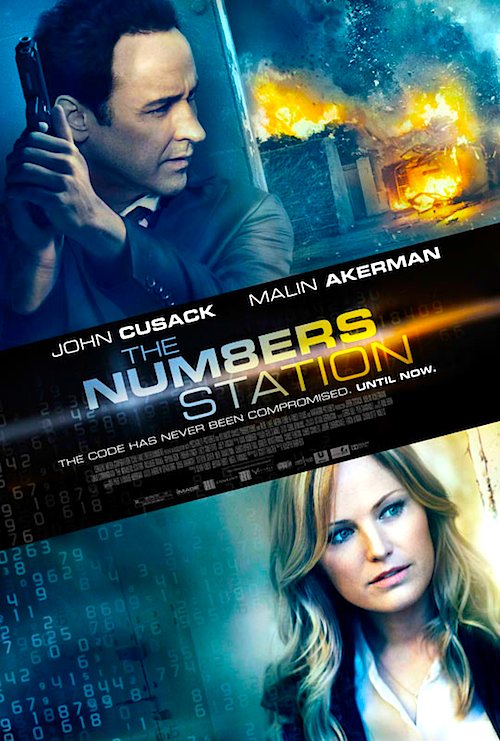
By Joe Bendel. Forget about the jocks, the CIA prefers to recruit math geniuses. If they happen to be drop-outs with socialization issues, so much the better. Of course, they still need people who can kill – but any old losers can do that, even someone who looks like John Cusack. Unexpectedly, one such field agent babysitting a remote code transmitter will have to do what he does best in Kasper Barfoed’s The Numbers Station, which opens tomorrow in New York.

Short wave radio is untraceable, making it the perfect format to convey messages to operatives in the field. Periodically, conspiracy nuts and Democracy Now listeners get all worked up about mysterious “Number Station” broadcasts. Typically, they are simply a series of numbers that have no meaning to listeners without the code. After a dirty job gets downright ugly, Emerson Kent is reassigned to a station somewhere in the English countryside. He provides personal security to Katherine, who analyzes incoming code and reads out the resulting number sequences. Neither he nor she has any idea what any of it means.

Typically, they alternate with the other team every three days. However, when they arrive a few hours early in accordance with their new schedule, they find the station under siege. Thanks to Kent’s skills they are able to hole-up in the station. Ominously, though, they discover fifteen unauthorized messages have been sent.

A film like Numbers Station would do so much more business if it actually celebrated CIA agents’ service and sacrifice for their country. There are now 103 stars on the Memorial Wall in Langley commemorating officers who have fallen in the line of duty. However, screenwriter F. Scott Frazier is unmoved by that, preferring to represent as the Agency in the person of Kent’s boss, the ruthless Michael Grey, who constantly growls euphemistically about tying up loose ends. Those 103 stars deserve better than that, Mr. Frazier.

It is a shame too, because Numbers Station is a pretty tightly executed cat-and-mouse-game thriller. Barfoeld uses the claustrophobic constraints of the station bunker to build tension, shying away from conventional action sequences. Both couples’ developing extracurricular attractions also ring true, given the intimacy of their working environment.

Frankly, John Cusack is pretty convincing as the guilt-ridden, clinically depressed black ops agent. Perhaps Barfoed was reading a list of his recent direct-to-DVD credits to him off-camera. Likewise, Malin Akerman proves she can credibly play smart and attractive simultaneously, which should put her on a short list for bigger and better roles. Unfortunately, the usually super-cool Liam Cunningham is largely wasted as the generically villainous Grey.

Numbers Station features some better than average chemistry and respectable thriller mechanics. However, the constant demonization of the intelligence service is clumsy, didactic, and clichéd. Frankly, it is so familiar it makes a film with a few new ideas still feel old hat. The victim of its own self-sabotage, The Numbers Station opens tomorrow (4/26) in New York at the AMC Empire.

LFM GRADE: C

Posted on April 25th, 2013 at 11:12am.

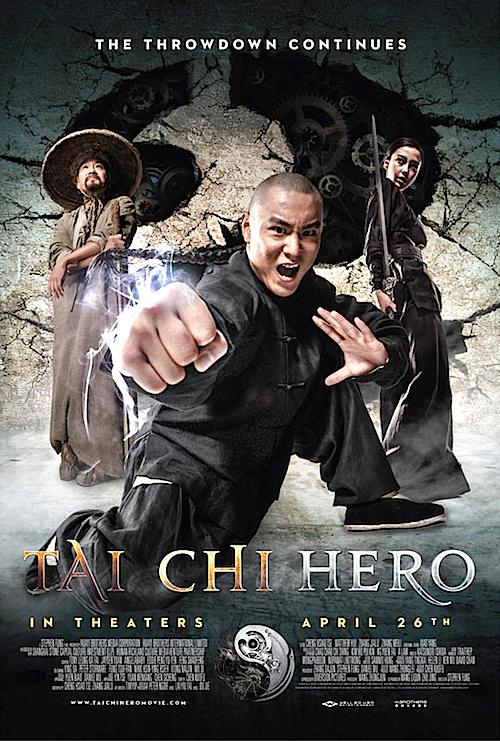
Stephen Fung Brings the Family Values: LFM Reviews Tai Chi Hero

By Joe Bendel. “Pushing Hands” style kung fu is an important Chen family tradition. For complicated reasons, Chen village is forbidden to teach their kung fu to outsiders. While they do not break this rule, they bend it considerably in Stephen Fung’s Tai Chi Hero, which opens this Friday in New York.

Yang Lu Chan, “the Freak,” sought to learn Chen-style kung fu to balance his karma and counteract the mutant berserker horn on his temple sapping his vital energy. Of course, everyone said no, but the earnest plodder kept trying. However, when Yang nearly dies defending Chen village from invaders, the Master’s daughter, Chen Yu Niang, takes pity on Yang, marrying him into the clan.

Initially, it is not much of a marriage, but he sure takes to Master Chen’s instructions. Yang should most likely live and thrive, but the future of Chen village is soon threatened again. Teaming up with a rogue British officer and the Chinese Imperial army, Yu Niang’s ex Fang Zijing (a Chen village outsider himself) means to capture Master Chen and his daughter and son-in-law. They are willing to give themselves up for the sake of the village, but not without a fight, which is spectacular.

In his follow-up to Tai Chi Zero, Fung doubles down on the steampunk trappings, introducing Master Chen’s prodigal son Zai – who never properly paid his kung fu dues, but has these flying machine inventions, a la Da Vinci’s Demons. While Hero lacks the breakneck lunacy of Zero, it is surprisingly warm and endearing. This is the family values installment of the franchise, featuring reconcilements between fathers and sons and wives and husbands—and it all works somehow. Of course, there is also the massive showdown with the Imperial Army.

Jayden Yuan comes into his own as the innocent Yang this time around, nicely portraying the maturation of the Freak’s character and his kung fu. Angelababy does not quite have as much screen time in Hero, which is a pity considering how charismatic she is as Yu Niang. Still, she has some dynamic action sequences in the big battle and should become a truly international superstar on the basis of her work in the franchise.

“Big” Tony Leung Ka Fai keeps doing his Zen thing as Master Chen and he’s as cool as ever. Somewhat bizarrely, though, as Duke Fleming, Swedish actor Peter Stormare (who has been reasonable comprehensible in English language features like Fargo and The Big Lebowski) seems to be channeling the sort of weird, affected sounding white-devil heavies of kung fu movie tradition.

Tai Chi Hero is nearly as much outrageous fun as Zero, but it has more heart. With the final film of the trilogy in the pipeline, Fung’s Tai Chi series should become a fan favorite. Enthusiastically recommended for martial arts fans, Tai Chi Hero opens this Friday (4/26) in New York at the AMC Empire.

LFM GRADE: B+

Posted on April 24th, 2013 at 2:42pm.

From Peru to Polynesia, the Hard Way: LFM Reviews Kon-Tiki

By Joe Bendel. In 1947 memories of WWII were still fresh, especially in once occupied Norway. However, the reckless courage of a Norwegian explorer would inspire not just his homeland, but generations of adventurers around the world (reportedly including American test pilots and astronauts). Thor Heyerdahl and his crew set sail from Peru to Polynesia without any modern technology in Joachim Roenning & Espen Sandberg’s Kon-Tiki, which opens this Friday in New York.

Although naturally restless, the time Thor Heyerdahl and his first wife Liv spend living among the Marquesas is quite happy. During this period, Heyerdahl becomes convinced the South Pacific islander’s original ancestors ventured east from Latin America rather than west from Asia. Yet, the academic establishment dismisses his theory (sadly, not excluding the fuddy-duddies at the Brooklyn Museum). Having absolute conviction in his research, Heyerdahl sets out to prove it – by sailing over 4,000 nautical miles from Peru on a balsawood raft, using no modern instruments except a radio to inform the media of their progress.

Somehow Heyerdahl recruits a crew of his countrymen for his dubious mission, including a dying-on-the-inside expat engineer and a conscience-plagued veteran of the resistance. They also have a parrot. The plan is pretty simple: launch the Kon-Tiki into the Pacific and hope the currents carry it to Polynesia. Of course, those waters are far from empty. Heyerdahl’s crew will contend with sharks, whales, and the greater dangers of stormy weather and dwindling supplies.

Filmed in both English and Norwegian versions, Kon-Tiki is old fashioned in a good way. It celebrates rather than apologizes for the daring-do of Heyerdahl and his mates. These are not average men, but they are unquestionably mortals. Watching Roenning & Sandberg (best known for the stirring war drama Max Manus) present their courage and camaraderie without hipster irony is quite refreshing.

Kon-Tiki also looks great, particularly the shark and whale sequences. The clarity of the underwater cinematography is quite striking, as is the sense of scale. Frankly, this is the perfect film for viewers intrigued by Life of Pi’s premise but put-off by its New Agey-ness.

It is well worth noting Kon-Tiki was produced by Jeremy Thomas, whose name in the credits means something to discerning viewers, having shepherded ambitious films like The Last Emperor, Merry Christmas Mr. Lawrence, and 13 Assassins through development to art house screens. Similarly, Kon-Tiki is an international production that is large in scope.

Nonetheless, it is easily accessible, not merely because of the English dialogue (which the Norwegian actors handle relatively well). This is a classic sea-faring adventure, vividly rendered by a talented cast and crew. Recommended for general audiences, particularly those who fondly remember Heyerdahl’s bestselling book and 1951 Academy Award winning documentary, Kon-Tiki opens this Friday (4/26) in New York at the Paris Theatre uptown and the Landmark Sunshine downtown.

LFM GRADE: B+

Posted on April 22nd, 2013 at 12:50pm.

LFM Reviews Honeymoon Suite @ The 2013 Tribeca Film Festival

By Joe Bendel. The Opposite House probably did not pay a promotional allowance, but it will get a heck of a plug at this year’s Tribeca Film Festival. That is because one of the short films commissioned by the chic Beijing boutique hotel was selected for the festival. It is not hard to see why. Zao Wang’s Honeymoon Suite is a small delight screening as part of the Deadbolt program at this year’s Tribeca.

This will be the first time Ally, the Opposite’s new guest services manager, will be on-duty while the mysterious Mr. Hirschfield stays in his regular titular room. He visits like clockwork once a month, for one night only. Even though his secret is revealed early in the film, it should not be spoiled ahead of time for those who do not guess. It is safe to say he is kind of a handful, in a genre sort of way.

The director certainly does his job, making the Opposite look like quite the hip, elegant space. He also cast a first-rate ensemble. As Ally, Zou Han-hong comes across like a smart professional, but she also has some rather touching moments down the stretch. She certainly makes you want to check into the Opposite.

Poor Cary Woodworth is largely buried under surprisingly impressive make-up effects, so give him credit for being a good sport. Nadia Hatta and Xi-tian also make an endearing mother-daughter tandem in the room beneath Hirschfield’s, with the latter providing some very cute reaction shots.

Man, if only all commercials were this fun, then we would be getting somewhere. Regardless of its origins, genre fans will be charmed by Honeymoon Suite. Recommended for general audiences, it screens as part of the 2013 Tribeca Film Festival’s Deadbolt shorts block tonight (4/22), Saturday (4/27), and Sunday (4/28).

LFM GRADE: A

Posted on April 22nd, 2013 at 12:48pm.

LFM Reviews Frankenstein’s Army @ The 2013 Tribeca Film Festival

By Joe Bendel. Okay, it’s a little creepy, but animating dead bodies has obvious military advantages. The National Socialists would be just the sort to develop such technology. In fact, the grandson of a certain controversial scientist has apparently cobbled together quite a monstrous division of soldiers in Richard Raaphorst’s Frankenstein’s Army, a midnight selection of this year’s Tribeca Film Festival.

Dimitri is a graduate of Soviet film school filming a small recon squad in the field. Less than thrilled to be shepherding the would-be documentarian and his nebbish assistant, the commanding officer busts their chops every chance he gets. Everyone is on edge since radio contact with headquarters was cut-off. Suddenly, a mysterious distress call lures them to a remote monastery, whose occupants were gruesomely murdered by a mysterious force. You can probably guess where things are headed from here, even if the Commies can’t.

The potential midnight movie appeal of Nazis vs. re-animated freaks needs no explanation, but Frankenstein’s Army is poorly served by its found footage structure. That it is in color frankly makes no sense. Hardcore cineastes will also be disappointed that Dimitri, the Soviet Tarantino, never nods towards the work of Eisenstein or Vertov that should supposedly have inspired him, not that this will be foremost in the minds of late night patrons. However, they will notice when he “cheats” with the conceit.

On the other hand, Raaphorst is on pretty solid ground in the manner he depicts the Red Army. Hardly liberators, they are more like marauders, committing war crimes against the local peasantry that the commander not so discretely censors. Likewise, it becomes clear that their Soviet masters do not care about the soldiers’ safety. In fact, they have a secret agenda in the whole horrific affair.

The Frankenstein monsters are also quite inventive in a ghoulish way, looking like a rogue’s gallery of Silent Hill creatures decked out in Nazi regalia. While Karel Roden has plenty of genre cred, his mad doctor’s character is sadly underdeveloped. There is an intriguing hint of a backstory involving the Frankenstein family’s complicated relationship with the German state, but Raaphorst never fully capitalizes on the Frankenstein legacy (after all, if he is the grandson, then Basil Rathbone’s Baron Wolf von Frankenstein must be his father, right?).

Army’s gory effects and make-up are definitely first-rate.  Cult movies fans looking for a few grisly thrills should find it adequate, but those hoping for more given its historical context will probably be disappointed. Earning points for its realistic portrayal of the Soviet war machine, Frankenstein’s Army is recommended for Silent Hill franchise fans (which it so resembles) when it screens again tonight (4/20) during the 2013 Tribeca Film Festival.

LFM GRADE: C+

Posted on April 20th, 2013 at 2:44pm.