LFM Reviews Deep Powder @ The 2013 Tribeca Film Festival

By Joe Bendel. Prepare to go back to the 1980’s to get your Bret Easton Ellis on again. The privileged kids of a New England prep school consume conspicuously and do mountains of blow. They even do a spot of smuggling, which predictably leads to trouble in Mo Ogrodnik’s Deep Powder, a Viewpoints selection of the 2013 Tribeca Film Festival.

Eight years ago the Deep Powder secret society was formed on campus by the elite of the elite. Ostensibly a ski club, every Christmas vacation a member is chosen to score a load of cocaine in Paraguay for the group to distribute over the coming year. Reckless senior Natasha Tabor conspires to take the place of her risk-averse middle class roommate because she just doesn’t care. Or at least she didn’t until she met the dirt-poor brooding ski-lift operator Danny.

A promising high school hockey player, his college career was derailed by an accident. However, a Division I coach has promised him a three year scholarship if he can cover the first year. Has anyone ever heard of a college making this kind of an offer, because it smells like a clumsy plot contrivance from here, but maybe that’s how NCAA Hockey rolls. Regardless, he needs money and his girlfriend just so happens to be making a drug run.

The good news is that Deep Powder is possibly the funniest movie screening at Tribeca this year. The bad news is that it probably isn’t supposed to be. The word “comedy” never appears in the film’s description, but if it was intended as a parody of overwrought indies, Ogrodnik nails it.

Unfortunately, the design team is rather wide of the mark in recreating the 1980’s. Aside from a nostalgic appearance of a handheld video game, everything feels wrong here, including the wardrobe and figures of speech. In one scene, Danny Ski Lift woos Tabor with a vintage soul 45 that sounds very cool, but is totally era inappropriate. Still, Deep Powder captures the vibe of cheesy 1980’s melodramas. Throughout the film, audiences will constantly expect a John Parr video to erupt. Perhaps “hope” is a more accurate term than “expect.”

In truth, St. Elmo’s Fire seems to be the standard on which the cast based their performances, getting about the same tepid results. Still, Haley Bennett brings an interesting presence to the film. It might not be a great star turn, but we certainly believe she is a messed up kid.

One can imagine the pitch for this film as Donna Tartt with a pinch of Miami Vice. If only that were on the screen. Instead, Deep Powder offers a surfeit of unintentional comedy. It is hard to recommend a film on that basis, but sometimes we have to take our entertainment where we find it. For those who are strangely intrigued, it screens again tomorrow (4/21), Monday (4/22), and Friday (4/26) as part of this year’s Tribeca Film Festival.

LFM GRADE: C-

Posted on April 20th, 2013 at 2:43pm.

LFM Reviews Odayaka @ The 2013 Tribeca Film Festival

By Joe Bendel. Judging solely on the American drive-by media’s coverage, one would assume Japan was nothing but a glowing wasteland after the March 11th earthquake and subsequent nuclear emergency. In contrast, the Japanese media was evidently restrained to a fault, leaving a vacuum for rumor, fear, and denial to run rampant. Rather than the all too familiar images of devastation, Nobuteru Uchida focuses on the messy uncertainties of the aftermath in Odayaka, which screens during the 2013 Tribeca Film Festival.

When the quake hit, Saeko’s husband Noboru was typically nowhere to be found. When he finally shows up, it is only to announce he is abandoning her and their daughter Kiyomi. Next door, Yukako’s husband Tatsuya also arrives well after the fact, having been toiling in his office, as per usual. Despite the government’s unconvincing assurances, both women become deeply concerned about Fukushima’s radiation. As neighbors and acquaintances belittle their worries, Saeko and Yukako agitation steadily increases. Saeko’s stress is understandably amplified by her husband’s desertion. Likewise, a recent painful episode Yukako and Tatsuya never properly dealt with acerbates her anxiety.

Filmed in a deliberately lo-fi, no frills style, Odayaka’s “you are there” vibe is often a genuinely uncomfortable to experience. This is no canned, made-for-TV movie building to a cheap triumph over adversity. Uchida portrays the emotional damage done to his characters in a relentlessly intimate fashion.Odayaka is a quiet film, but it stings.

Nonetheless, along with Chen’s Will You Still Love Me Tomorrow, Odayaka lends this year’s festival some major star power. It might be hard to believe anyone could walk out on Kiki Sugino, the darling of Japanese indie cinema (often dubbed Japan’s Parker Posey), but she is truly devastating as Saeko. Always convincing and never overly showy, her portrayal of a mother coming apart at the seams is absolutely harrowing.

Likewise, Yukiko Shinohara plums some dark places as the distressed Yukako. In a way, it is a much more off-putting part. However, she truly lowers the film’s dramatic boom in key sequences down the stretch. Ami Watanabe’s Kiyoshi is also remarkably affecting and natural in scenes that might well be confusing for a young child. Indeed, Odayaka boasts a strong supporting cast from stem to stern, especially Makiko Watanabe, who becomes the face of rigid Japanese social conformity as the queen bee mother at Kiyoshi’s nursery school.

Odayaka is packed with scenes that resonate acutely. When Uchida holds up a mirror to Japanese society, it is not always pretty. Yet, Odayaka is a profoundly humanistic film, anchored by Sugino’s unforgettable work. Recommended for those who appreciate a tough human drama, Odayaka screens today (4/18), this Saturday (4/20), Wednesday (4/24), and next Saturday (4/27) as a Viewpoints selection of this year’s Tribeca Film Festival.

LFM GRADE: A-

Posted on April 18th, 2013 at 11:28am.

LFM Reviews Will You Still Love Me Tomorrow? @ The 2013 Tribeca Film Festival

By Joe Bendel. Compared to its neighbors, Taiwan is quite tolerant of its GLTB citizens. Communist China not so much. Nonetheless, the gay marriage debate has yet to reach Taipei. To start a family, one middle-aged man went back into the closet, yet events cause him to question that decision in Arvin Chen’s Will You Still Love Me Tomorrow?, which screens during the 2013 Tribeca Film Festival.

It is hard to imagine Weichung hitting the club scene. The straight-laced optometrist is almost painfully reserved. He is a good father, though, and a dutiful husband. He thought he had buried his past, but much to his surprise, Stephen, one of his flamboyant former club buddies, is his sister Mandy’s wedding photographer. At least, he was supposed to be. During the rehearsal dinner, Mandy kind of loses it, calling off the wedding soon thereafter. Having reawakened Weichung’s memories of his younger, freer days, Stephen starts counseling Mandy’s nebbish jilted fiancé, while Weichung starts a tentative flirtation with a flight attendant customer.

Weichung might be finding himself, but he still has a wife likely to consider his actions a deep emotional betrayal. In fact, the relationship between him and Feng constitutes the guts of the film. To his credit, Chen does not take any easy outs. Feng is no shrew. In fact, she is played by Mavis Fan and happens to be a good mother and responsible bread-winner. All of which make things complicated both for the characters and viewers’ emotional responses.

Fan, the Taiwanese popstar successfully transitioning to the big screen, will be most familiar to American audiences from Tsui Hark’s all kinds of cool Flying Swords of Dragon Gate. She still has a cute screen presence, but the acute sensitivity and down-to-earth sensibilities she brings to bear as Feng are quite impressive. Johnnie To regular Richie Jen will also surprise viewers as the convincingly conflicted Weichung. Unfortunately, Lawrence Ko’s Stephen and his cronies are mostly shticky caricatures.

This is not a didactic message movie. Chen resists the Glee-like temptation to lecture his audience on tolerance, but he understandably spotlights Fan in a karaoke number, thereby boosting Tomorrow’s domestic commercial appeal. Like most of the film, it is actually quite well staged. While a few more broadly comic scenes fall flat, the film and its characters are surprisingly endearing, getting a nice assist from Hsu Wen’s lush, unabashedly sentimental score. Will You Still Love Me Tomorrow is not a towering cinematic experience, but it is extremely likable. Recommended for fans of Eat Drink Man Woman, it screens tomorrow (4/19), Saturday (4/20), Sunday (4/21), and next Thursday (4/25) during this year’s Tribeca Film Festival.

LFM GRADE: B+

Posted on April 18th, 2013 at 11:27am.

LFM Reviews The Bletchley Circle; Show Premieres on PBS Sunday, 4/21

By Joe Bendel. Susan Gray and her colleagues were not Rosie the Riveters, but they made enormous contributions to the war effort. They served at Bletchley Park in highly classified capacities, sifting through data and cracking enemy codes. Then the war ended and they returned to the lives they were expected to live. However, as a serial killer’s body count mounts, they start detecting patterns the cops invariably miss in the three-part British series The Bletchley Circle, which premieres on PBS this coming Sunday.

It is Gray, the profoundly bored housewife, who first applies Bletchley methods to a rash of murdered women. She soon recruits her former boss, Jean, now working as a librarian, and their colleagues, Millie a waitress with black market sidelines, and Lucy, a berated young wife with a photographic memory. Since their work at Bletchley was subject to the Official Secrets Act, they are honor bound not to explain to their husbands or the police why they think they have skills to bring to the investigation. As a result, they get a lot of head-patting and condescension as they narrow in on the killer.

Given the themes and post-war time period, Bletchley could be considered the mystery equivalent of Made in Dagenham. Aside from an old spook, none of the men seem to think the four women can walk and chew gum at the same time, which is the show’s real shortcoming. There ought to be at least one male character hip enough to say “the cops are idiots. I bet you and your friends can find something they missed. Just be careful.”

From "The Bletchley Circle."

Nevertheless, Bletchley’s criminal elements are smarter than average. Writer Guy Burt smoothly integrates numbers, patterns, and critical thinking into the story, while steadily raising the stakes in each episode. Their nemesis also turns out to be suitably diabolical, nicely played by Steven Robertson (a name so unremarkable it should not be spoilery). Yet, in a bit of a disappointment, it all ends in rather standard fashion.

Anna Maxwell Martin’s Gray is an earnest, down-to-earth protagonist. Yet of the quartet, it is Julie Graham who makes the strongest impression as their senior member, Jean. Rachael Stirling brings a bit of verve as Millie, but her character and backstory are the least developed, whereas the mousy, put-upon Lucy becomes tiresome over time.

Bletchley has a great concept and it nicely conveys the experience of unraveling a puzzle through logical analysis. Like many numbers people, it is a little weak when it comes to interpersonal relations. Still, it is a decent fix for British whodunit fans when it begins this Sunday (4/21), following Mr . Selfridge, on most PBS outlets nationwide.

LFM GRADE: B-

Posted April 18th, 2013 at 11:26am.

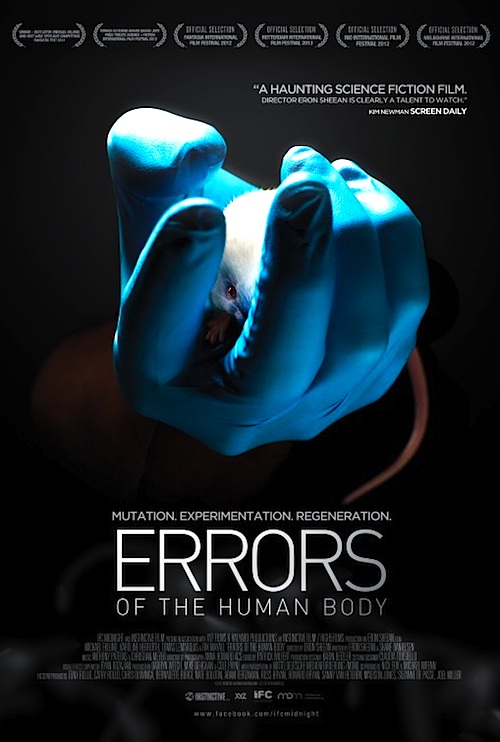
Lab Rats of Eastern Germany: LFM Reviews Errors of the Human Body

By Joe Bendel. Dresden was the center of East German research and technology. That did not make it any more fun than the rest of the country. Germany has since unified, but a visiting American scholar finds it still a rather sinister environment in Eron Sheenan’s Errors of the Human Body, which screens round midnights starting this Friday at the IFC Center.

Dr. Geoffrey Burton is known for once having a promising career. Forced out by his university, he has accepted a visiting scholar position at a non-profit German research institute. Fortunately, everyone there seems to speak English, including the British director, Samuel Mead, and Burton’s old flame, Dr. Rebekka Fiedler. They will reconnect, but Burton is not exactly good relationship material these days. He still obsessively calls his ex-wife and grieves over the infant they lost to a rare genetic disorder.

Understandably, Burton’s late son inspired his controversial research. Much to his surprise, it also motivated Fiedler’s recent work begun with her unstable former collaborator, Dr. Jarek Novak. She has had tremendous success regenerating salamanders, but has yet to apply it to anything with fur. However, Burton learns the salamander-looking scientist has secretly helped himself to her research. Gee, could all that sneaking around lead to a risk of infection?

Errors is not a bad dark science fiction cautionary tale. Since it is set in a non-profit, we are spared the clichéd corporate demonization. It is also has an effectively chilly vibe. While the particulars of Dresden’s GDR history do not factor in the narrative, the city is certainly portrayed as a severe, impersonal locale. (Those intrigued by the Dresden’s role in East German techno-industrial history should check out Dolores L. Augustine’s fascinating book Red Prometheus.) The make-up and visual effects are quite presentable by genre standards, but Sheenan’s story is more character and concept driven.

Cult TV veteran Michael Eklund (whose credits include Fringe and Alcatraz) shows a talent for physically and emotionally self-imploding as Burton. In contrast, Karoline Herfurth is almost tragically Teutonic as Fiedler. Fortunately, Tómas Lemarquis dives into Novak’s Faustian scientist villainy with admirable enthusiasm.  It is also amusing to see Rik Mayall (of The Young Ones) pop up as Mead, even if he plays it frustratingly straight.

If you want to see highly educated adults chasing mice around a lab Errors is the film for you. Frankly, the set-up is smarter than one might expect and the kicker has some bite. Recommended for genre fans, Errors of the Human Body begins a run of midnight screenings this Friday (4/19) in New York at the IFC Center.

LFM GRADE: B-

Posted on April 16th, 2013 at 8:23am.

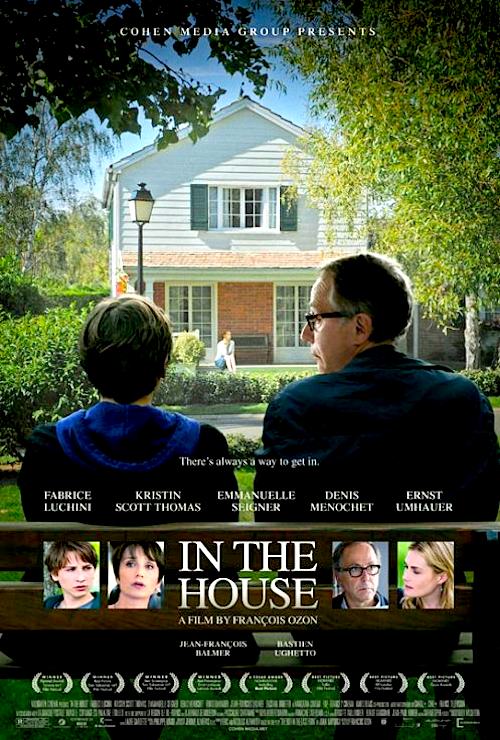
LFM Reviews François Ozon’s In the House

By Joe Bendel. Germain did not become a teacher to coddle teenagers’ self-esteem. He wanted to teach great French literature. That probably sounds nobler than it is in practice. In fact, the after-school tutoring he offers a talented pupil leads to unlikely scandal in François Ozon’s In the House, which opens this Friday in New York.

Germain begins the new academic year with his usual pessimism, but Claude Garcia’s first composition catches him off guard. It displays a voyeuristic fascination and caustic condescension toward his classmate, Rapha Artole, and the lad’s family. It also happens to be well written: B+. Using his natural talent for mathematics, Garcia insinuates himself into the Artole household as Rapha Junior’s trig study partner. After each visit, he writes what he claims are non-fiction accounts of the Artoles, but Germain analyzes as if they are part of a developing story.

It is hard to tell just how much of Garcia’s forays into the Artole house are truth or fiction, because the whole point is to keep the audience guessing. Ozon masterfully adapts Juan Mayorga’s play, toying with truth and reality in nearly every scene, yet keeping the film firmly rooted in its characters and their relationships. At times, it comes across like a comedy in the Annie Hall tradition, but it becomes steadily darker as the psychological gamesmanship intensifies.

Germain is the sort of arrogantly urbane character Fabrice Luchini was born to play. Perfectly exhibiting the cutting wit of a failed novelist, he could be the high-handed French cousin of Fraser Crane. Yet, it is really up to Ernst Umhauer’s Garcia to make it all work. He is convincingly creepy as the young master manipulator, but he also memorably expresses Garcia’s youthful insecurities at key moments.

The brilliant teacher-student tandem is backed-up by a big name French cast, including Emmanuelle Seigner (Mrs. Roman Polanski), playing against type as Rapha’s mother. A desperate housewife of an entirely different sort, she is surprisingly earthy and vulnerable. In contrast, Kristin Scott Thomas elevates the role of Germain’s gallerist wife Jeanne above a mere I-told-you-so commentator with her elegance and sly screen presence. Whenever you see KST on-screen you know you are in for something smart and sophisticated.

Ozon has similar credibility. Frankly, it is remarkable how postmodern In the House is on the page, yet how absorbing it is on the screen. Masterly controlling the mood and thoroughly undercutting one viewer assumption after another, Ozon wraps it all up in a note of near perfection. Very highly recommended for fans of French cinema and KST, In the House opens this Friday (4/19) in New York at the Lincoln Plaza Cinema.

LFM GRADE: A

Posted on April 16th, 2013 at 8:20am.