Dead Ringers: LFM Reviews Orphan Black on BBC America; Series Premieres Sat. 3/30

By Joe Bendel. Technically, she is the doppelganger taking over someone else’s life. When Sarah sees her exact double commit suicide, she lifts the woman’s purse and wallet. The very recently deceased is much better dressed, after all. However, when she temporarily assumes the dead woman’s identity, she gets considerably more than she bargained for in the opening episode of BBC America’s Orphan Black, which premieres this coming Saturday evening.

Angry and irresponsible, Sarah carries the baggage of a childhood spent entirely in the foster-care system. She wants to begin a new life with Felix, her foster-brother, and her daughter Kira, whom she has not had custody of in some time (and for good reason). Her dubious idea of a fresh start involves stealing some inferior grade cocaine from her pseudo-psycho-boyfriend for Felix to sell. Then she sees Beth throw herself in front of a train.

Making her way to Beth’s pad, Sarah finds out where her accounts are. She only intends to stay long enough to clean them out. Naturally, things do not go according to plan. It turns out Beth was a cop facing a disciplinary hearing for a questionable shooting. Of course, Sarah has no inkling of what really went down.  he is also somewhat at a loss for words when Beth’s romantic interest returns early from a business trip. It seems rather obvious, but Felix has to remind her she and Beth are probably connected in some way that could give her clues to her own past. Gee, you don’t suppose any more apparent twins might show up?

Essentially, Orphan is like a combination of Cinemax’s Banshee and Fox’s late but not terribly lamented John Doe. If the latter doesn’t mean anything to you, don’t worry about it. At least, Orphan starts with a jolt. It is not exactly Sion Sono’s Suicide Club, but the tightly staged and edited train station sequence is undeniably grabby. The first episode also has a promising grittiness. Viewers can readily accept Tatiana Maslany’s Sarah and Jordan Gavaris’s Felix are damaged people long accustomed to operating on the fringes of polite society.

Unfortunately, by the time the first episode’s mystery guest shows up, a familiar pattern begins to emerge. It is all too easy to foresee a covert government laboratory and a parade of sketchy informers in Orphan’s future. Frankly, we have been down that road many times in the past and it almost invariably leads nowhere.

It is impossible to render a final critical judgment on the basis of only one episode, but viewers do just that all the time. Orphan assembles a reasonably strong cast, but in service of a so-so premise. It might be a passable distraction, but it is nowhere near as entertaining as Banshee, with which it apparently shares some superficial cop-impersonating plot elements. Perhaps it will grow on genre fans when it takes its place in BBC America’s “Supernatural Saturday” (3/30) this weekend.

LFM GRADE: C+

Posted on March 27th, 2013 at 10:47am.
Czech Rotoscoped Noir: LFM Reviews Alois Nebel on Blu-ray/DVD

By Joe Bendel. He will be one of the last “patients” to witness the business end of a Communist era mental hospital. Ironically, the provincial train dispatcher could benefit from professional psychiatric treatment, but he will have to exorcise the ghosts from his past on his own in Tomáš Luňák’s Alois Nebel, which releases today on Blu-ray/DVD from Zeitgeist Films.

Based on the first Czech graphic novel published after the Velvet Revolution, AN begins during the waning days of Communism. A fugitive Mute has been captured at Alois Nebel’s sleepy station in Bílý Potok, much to the satisfaction of his scheming co-worker, Wachek. A black marketer and snitch, Wachek and his old sinister man are unnerved by news of the fall of the Berlin Wall. However, they still have extensive contacts with the local officials and the nearby Soviet garrison, which they intend to exploit while they still can.

Coveting Nebel’s position, it is rather easy for Wachek to have him institutionalized, especially since the dispatcher is legitimately disturbed. As a child, Nebel witnessed the forced post-war deportations of ethnic Germans from the Czechoslovakian Sudetenland, including very personal atrocities that continue to trouble his mind as dreams and hallucinations. Frankly, his deliriums are becoming more frequent and intense, but he will get little treatment in the sanitarium beyond some mind-numbing drugs. Yet he will find himself compulsively drawn to the mysterious Mute also incarcerated there.

Eventually, Communism will fall and Nebel will be released, but without the security of his former position. The lifelong railroad employee will spend months in the veritable wilderness, living amongst the homeless in Prague’s grand Central Station. Of course, all roads lead back to Bílý Potok for a reckoning of Biblical dimensions.

From "Alois Nebel."

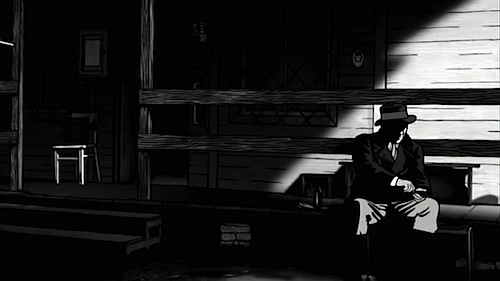
Rendered in the rotoscoping style notably employed by Richard Linklater’s A Scanner Darkly, the live action conversion technique is not universally embraced by animation fans. However, Luňák and head animator Pavla Dudová’s striking black-and-white application perfectly suits AN’s moral ambiguities and noir sensibilities. Every frame of this film looks absolutely beautiful, in a moody, atmospheric sort of way.

Indeed, this is a dark film in every conceivable manner. The railroad motif is no accident, representing a wide array of Twentieth Century horrors, including the Holocaust, troop transportation to the front, and the post-war vengeance taking. The rather militarist look of Nebel’s railroad uniform is also hard to miss, especially in light of his German surname (meaning “fog” or “life” spelled backwards).

Given the rotoscope method, real performances went into the making AN beyond mere voice-overs. Although modeled after the graphic novel character, Miroslav Krobot invests the animated Nebel with profoundly heavy world-weariness and guilt. Likewise, Karel Roden helps create a haunted and haunting portrait of the Mute.

Although Alois Nebel presents a decidedly pessimistic vision of human nature, it is not cynical. In fact, one could argue it is ultimately quite humanistic. Nonetheless, it is definitely an animated feature for connoisseurs who prefer their film noirs served straight, no chaser. Visually arresting with an unusually sophisticated narrative, Alois Nebel is highly recommended for fans of ambitious adult animation and Czech cinema. It is now available for home viewing as part of the Kimstim collection from Zeitgeist Films, along with Eric Khoo’s richly rewarding Tatsumi.

LFM GRADE: A-

Posted on March 26th, 2013 at 11:19am.

Artists and Models, Fathers and Sons: LFM Reviews Renoir

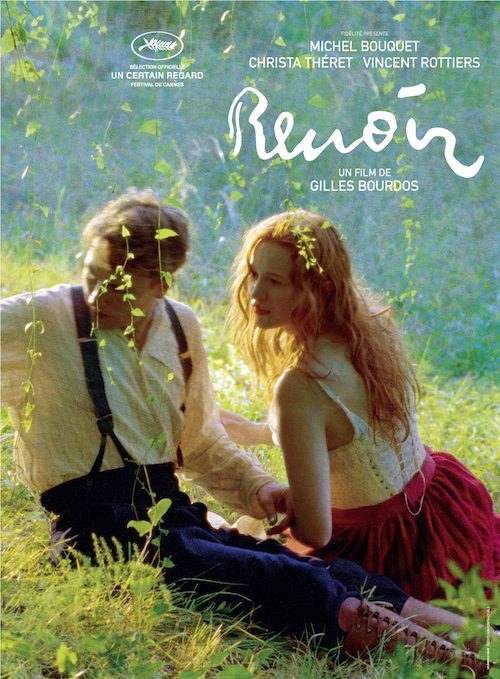
By Joe Bendel. The Renoirs were no ordinary family. Yet not even they were spared the horrors of WWI. At least the great painter’s middle son could convalesce amid the splendor of his family’s Riviera home. The future French auteur will meet his father’s last great model during his fateful homecoming in Gilles Bourdos’s Renoir, which opens this Friday in New York.

Referred to Renoir for potential modeling work, Andrée “Dédée” Heuschling finds an estate frozen in a state of near paradise, staffed by a veritable harem of her predecessors, doting on the arthritic artist. However, old man Renoir does not rest easy. He still mourns his late wife, while he waits for word of his two eldest sons injured on the battlefront. Yet Heuschling has the perfect Renoir look, inspiring him to begin painting outdoor nude studies once again. She also makes quite the impression on the Impressionist’s son Jean when he returns home on medical leave.

Based on the narrative biography of Jacques Renoir (Pierre-Auguste’s great-grandson and Jean’s great-nephew), Boudros’s film initially appears to be about the artist in his twilight years, but steadily shifts its focus to Jean, the future cinematic artist as a young man. Of course, Heuschling links father and son, eventually serving as muse to both.

Throughout Renoir, Boudros elevates fine art and evocative atmosphere high above messy dramatics. The resulting experience is quite a bit like taking an afternoon nap in the French countryside. It is quite luxurious, but there is not much to tell afterward. Nonetheless, Boudros crafts an elegant period production – even enlisting Guy Ribes, a convicted forger fresh out of the big house, to recreate Renoir’s style and method.

While Heuschling’s coquettish character deliberately remains something of cipher throughout Renoir, cinematographer Mark Ping Bing Lee’s lens absolutely loves Christa Théret, as do Ribes’ canvasses. Audiences will certainly understand the “Renoir look” from her photogenic turn. Vincent Rottiers largely carries the dramatic load as Jean Renoir, creating a convincing portrait of a somewhat confused young man trying to find his way in the world. Yet Michel Bouquet, the crafty old veteran thesp, eventually steals the film back for Pierre-Auguste with some wonderfully subtle but touching scenes of a father coming to terms with his sons. However, Thomas Doret (from the Dardenne Brothers’ The Kid with a Bike) never really gets to stretch beyond the surly wild child as Renoir’s youngest son, Claude (a.k.a. Coco).

Renoir is the sort of quiet but impeccably graceful film French cinema lovers swoon over. The combination of Renoir’s art, the lush natural beauty, Théret’s figure, and even a spot of hot jazz are wonderfully seductive. Recommended for Francophiles and admirers of Impressionism, Renoir opens this Friday (3/29) in New York at the Lincoln Plaza Cinema.

LFM GRADE: B+

Posted on March 25th, 2013 at 9:46am.

LFM Reviews Rengaine (Hold Back) @ MoMA’s New Directors/New Films 2013

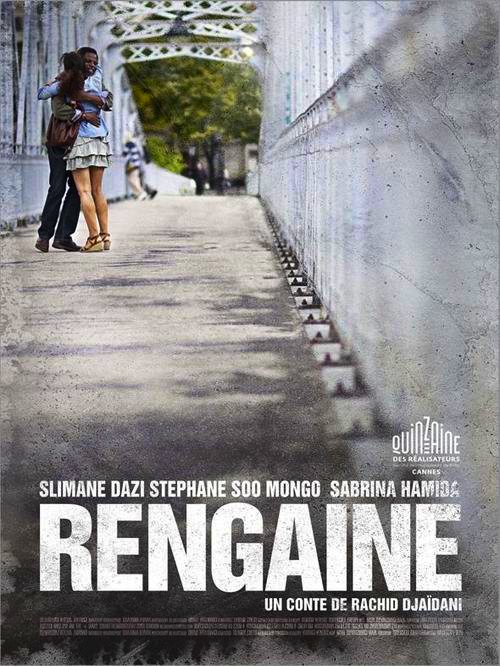
By Joe Bendel. Technically, Sabrina and Dorcy’s families both came from the same continent. Yet, for all practical purposes, they are a universe apart. The couple intends to marry just the same, whether or not their families approve in Rachid Djaïdani’s surprisingly witty Rengaine (a.k.a. Hold Back), which screens tomorrow during this year’s New Directors/New Films, co-presented by MoMA and the Film Society of Lincoln Center.

The son of Christian Africans, Dorcy is a struggling actor. Frankly, he does not seem to be very good at it, but at least he is trying. Sabrina has fallen in love with him nonetheless, but her forty—that’s right four-zero—Algerian immigrant brothers do not approve. At least that is true of the eldest, Slimane, who presumes to speak for the rest of his siblings.

Alarmed by Sabrina’s romantic transgression, Slimane proceeds to mobilize his brothers – but to their credit, some think he is just being a controlling jerk. However, probably a good two thirds are either inclined to agree with him or can be easily cowed by the self-appointed guardian of traditional Muslim values. Frankly, most of the latter are rather sketchy characters who might have stepped out of Le Pen campaign commercials. In contrast, the brothers who are more integrated into French society argue Slimane should mind his own business—and he has plenty to mind. Ironically the elder brother is engaged in his own romantic relationship with an alternative cabaret singer, who happens to be Jewish.

Filmed over a nine year stretch, the not quite eighty minute Rengaine was definitely a labor of love for French Algerian-Sudanese novelist Djaïdani, who clearly identifies with his lead characters and their various situations. The film has a whole lot of rough edges, yet that really is a large part of its charm. While some bits amount to little more than false starts, other scenes are wickedly droll and resound with the ring of truth.

As Dorcy, Stéphane Soo Mongo (whose credits include an episode of The Sopranos) is quite convincing as a terrible actor, which actually constitutes a nice bit of acting. He also gets most of the film’s laughs with his satirical misadventures in Parisian hipsterdom. Sabrina Hamida effectively expresses her namesake’s frustrations and outrages, but it is not as meaty a role as that of her two primary male co-stars. Indeed, Slimane Dazi (another of the cast’s few established professionals, recognizable from films like Free Men and A Prophet) really lowers the boom as Brother Slimane. Memorably world weary and conflicted, he takes the film to some dark places, including a riveting confrontation with the final brother.

Rengaine is short and messy, but unusually energetic. It is also unflinchingly honest in depicting the various forms of racism and intolerance within the immigrant Algerian Muslim community. Djaiani does not let Dorcy’s family off the hook either, but the Slimane’s hypocritical freakout is the film’s dramatic driver. Featuring a knock-out performance from Dazi and a stylish and stylistically diverse soundtrack, Rengaine is adventurous but well satisfying art cinema. Recommended for French film patrons, it screens this Sunday (3/24) at MoMA.

LFM GRADE: B+

Posted on March 23rd, 2013 at 11:50am.

Fraternal Ties That Bind: LFM Reviews My Brother the Devil

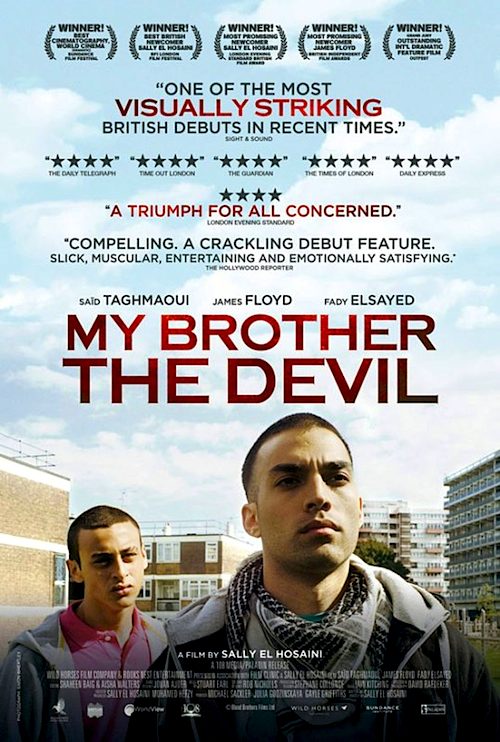
By Joe Bendel. Rashid engages in all sorts of activities at odds with his Islamic faith. He drinks, deals drugs, and beds girls in his housing estate. Yet, his younger brother Mo idolizes him for it all. However, when “Rash” finally gets in touch with his true nature, his sibling turns against him hard in Sally El Hosaini’s My Brother the Devil, which opens tomorrow in New York.

Rash is a small time Hackney gangster with a growing rep. To Mo, that is very cool. To his credit, though, Rash is dead set against his little brother following in his footsteps. On this much he agrees with their traditional Egyptian immigrant parents. When Rash takes over the route of his late running mate, he starts making regular deliveries to Sayyid, a successful hipster photographer. Feeling a connection, Sayyid makes a pass at Rash, who initially reacts rather badly. However, he soon returns.

Naturally, there is a lot of outside drama going on just as Rash starts wrestling with his sexuality. His gang is dead-set on retribution and they want Rash to do the dirty work. Yet, when Mo discovers Rash’s secret, matters really come to a head.

A trenchant social observer, El Hosaini attributes Mo’s homophobic freak-out both to his Muslim upbringing and to the macho prejudices of the thug life he aspires to join. It is chillingly telling when he finds it easier to claim Rash has become a terrorist than admit to his friends that his brother might be gay.

El Hosaini coaxes some completely natural feeling performances from her mostly neophyte cast. James Floyd is particularly dynamic and forceful as Rash. Yet, one wishes she had been a bit more adventurous in her approach to the material. One can hear echoes of Boyz n the Hood and subsequent urban dramas throughout the film, most definitely including the omnipresent rap soundtrack. Granted, the British import is coming from a similar socio-economic place, but there is still a formulaic predictability to her fraternal morality play.

Nonetheless, El Hosaini’s consistent honesty is commendable. Devil never alibis or walks back the prejudice it depicts, implying that these are deeply held sentiments in Rash’s community – rather than the manifestation of inadequate youth programs.

Yes, viewers will probably know where Devil is headed each step of the way. Yet, the unromanticized portrait of urban violence and intolerance is relatively fresh and forthright. Bolstered by Floyd’s bold performance, My Brother the Devil is worth considering for those whose tastes run towards gritty social issue dramas. It opens tomorrow (3/22) in New York at the Landmark Sunshine.

LFM GRADE: B-

Posted on March 21st, 2013 at 11:27am.

LFM Reviews Everybody Has A Plan

By Joe Bendel. You would think paranoia would run deep amongst identical twins. That whole doppelganger possibility is just unnerving. One existentially morose pediatrician does indeed assume his twin’s life under suitably shady circumstances in Ana Piterbarg’s Everybody has a Plan, which opens this Friday in New York.

Frankly, Agustín has no reason to be so miserable. He has a thriving practice in Buenos Aires and an intelligent professional wife. They are on the brink of adopting an infant, but it is safe to say she is far more enthusiastic than he. In fact, he rather precipitously puts the kibosh on their plans, falling into a depressive stupor shortly thereafter. However, relief arrives in the unlikeliest form when his prodigal twin Pedro unexpectedly pays a visit. Terminally ill, the deadbeat brother wants a final favor from Agustín.

Following the grass-is-greener line of reasoning, Agustín takes Pedro’s place in the hardscrabble Tigre Delta, but he did not exactly do his due diligence. Before long, Agustín learns that in addition to beekeeping, he is also now a part-time member of a ruthless gang of kidnappers. Still, it is not all bad. In fact, he quickly develops a relationship with Rosa, the young woman who helps tend his hives.

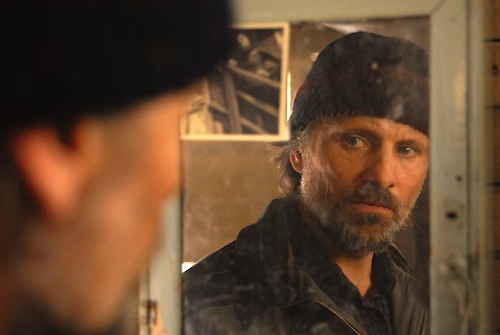
Viggo Mortensen in "Everyone Has A Plan."

Piterbarg really puts the “slow” in “slow burner.” She drenches the noir-ish morality tale in swampy atmosphere, but her pacing would generously be described as languid. Daniel Fanego provides a genuine sense of menace as the sociopathic ringleader, Adrián, but our anti-hero is far more inclined to rumination than action. Fortunately, brooding and seething are definitely well within Viggo Mortensen’s power zone. He keeps audiences vested and focused, despite the film’s determination to takes its sweet time. However, the question remains, does his morally problematic Agustín qualify as an “evil twin?”

Having lived in Argentina and Venezuela during his early years, co-producer Mortensen is clearly comfortable with the language and setting. PresumablyPiterbarg was aiming for a rustic suspense vibe somewhat in the tradition of Night of the Hunter, but the result is closer to contemporary Latin American art cinema – deeply rooted in its environment, but privileging character and tone above plot and dialogue. Stylish but often maddeningly reserved, Everybody has a Plan is recommended mostly for diehard fans of Mortensen and Argentine cinema when it opens this Friday (3/22) in New York at the Angelika Film Center and the AMC Empire.

LFM GRADE: C+

Posted on March 20th, 2013 at 9:57am.