LFM Reviews Takashi Miike’s Hara-Kiri in 3D

By Joe Bendel. Honor is not simply a matter of ritual and technicality, and samurai who have only known peace seem to have a tendency to forget the heart and spirit of their code. A ronin with a mysterious grievance intends to teach a noble house’s conceited retainers a hard lesson in Takeshi Miike’s Hara-Kiri: Death of a Samurai, now available on DVD and Blu-ray from New Video Group.

Yes, there is peace, but the Shogun’s devious maneuverings destroyed a once proud clan, leaving a glut of impoverished ronin (masterless samurai) at loose ends. The situation has given rise to a phenomenon known as “suicide bluffs,” where ronin ask for the use of the House of Ii’s courtyard to commit ritual seppuku in hopes they might receive a few coins and be sent on their way instead. Hanshirô Tsugumo has duly asked for such a favor from the head retainer Kageyu Saitou, but he seems to have his own agenda.
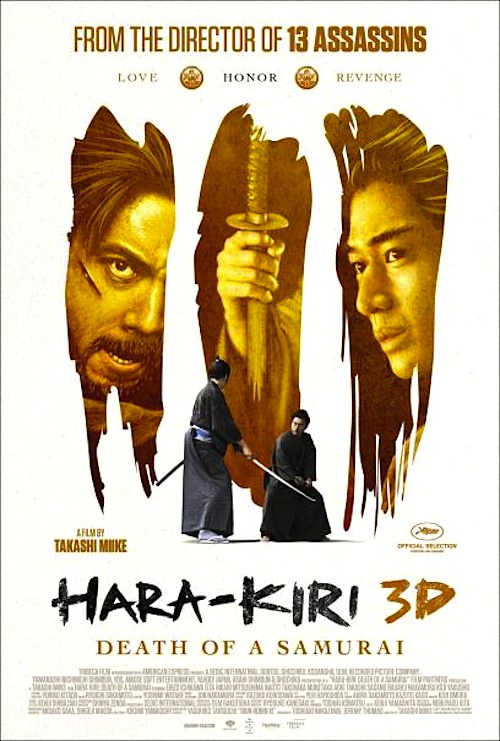
Hoping to dissuade him, Saitou tells him the pathetic story of the last ronin who came cold calling. Tired of indulging suicide bluffs, Saitou’s arrogant lieutenants forced the desperate young man to follow-through on his threat, in what quickly becomes a horrific display bearing little resemblance to any notion of honor. As it happens, Tsugumo already knows the gist of this tale. In fact, he is well acquainted with the sad young Motome Chiziiwa, as viewers learn in the next series of flashbacks.

Based on the novel famously adapted by Masaki Kobayashi in 1962, Miike’s film is not called Hara-Kiri for no reason. About the first masterfully tense quarter is largely dedicated to Chiziiwa’s involuntary disembowelment. While the middle section somewhat suffers in comparison, Miike nonetheless provides all the necessary context to appreciate the first and third acts and fully establishes his central characters as sympathetic, flesh-and-blood figures – particularly Miho, the frail woman linking the two ronin together.

Indeed, Hikari Mitsushima is deeply affecting as the ill-fated (who isn’t in a Miike film?) Miho, a character lightyears removed from the all kinds of scary schoolgirl-cultist she brought to life in Sion Sono’s Love Exposure. Likewise, Eita is an aching model of pathos as Chiziiwa. However, Hara-Kiri really belongs to the two steely-eyed old dogs circling each other right from the beginning.

Traditional kabuki actor Ebizo Ichikawa (or Ebizo IX) appropriately simmers and seethes like a seriously hard-nosed, world weary swordsman with a point to make. He is the real deal, commanding every scene he appears in, which is quite the trick considering he is paired up against Kôji Yakusho, the international paragon of middle-aged badness, as Saitou. Once again, Yakusho brings gravitas and a sense of ruthlessness to the proceedings. While not nearly as crowd-pleasing as his lead role in Miike’s hit 13 Assassins, he makes the most of it.

Where Assassins delivers the hack-and-slash, Hara-Kiri offers foreboding and tragedy. Frankly, the latter was far truer to the heroics of the samurai era, which Ivan Morris described as the “nobility of failure.” However, the awesomely action-driven Assassins would have been a more logical candidate to be Miike’s first 3D film, yet that distinction belongs to Hara-Kiri. Regardless, it translates to 2D viewing just fine. A stately period production that is amply rewarding on multiple levels, Hara-Kiri is highly recommended for fans of samurai films and historical dramas in general. It is available at all online retailers from New Video Group.

LFM GRADE: B+

Posted on February 14th, 2013 at 12:38pm.
The Marshall and the 16th President: LFM Reviews Saving Lincoln

By Joe Bendel. Ward Hill Lamon was a Southerner who opposed slavery. He was a lawyer, who packed a mean banjo and a plenty of guns. Before the creation of the Secret Service, he was a handy man for Lincoln to have around. The odd couple friendship between the president and his self-appointed but Federally-empowered bodyguard is dramatized in Salvador Litvak’s Saving Lincoln, which opens this Friday in New York.

As he explains in medias res to some of Lincoln’s rather disappointed supporters, Lamon was not at the Ford Theater on that fateful night. He was serving as a special Reconstruction envoy down south. Via flashbacks, we watch their whole story unfold. Both men shared a love of song that brought them together as friends and law partners. During the dark days of the Civil War, Lamon often raises Lincoln’s spirits with a hill country folk tune, like “Old Dan Tucker.” He also finds that foiling assassination attempts is a full time endeavor.

While not as epic as the Oscar favorite turned underdog, Saving Lincoln largely ignores (or spares) the less than edifying rhetoric of the rival Democratic Party, but conveys all the virulent invective flowing from the press (which were essentially one and the same, even then). However, the real eye-opener of Saving Lincoln is the sheer volume and increasing audacity of the attempts made on Lincoln’s life. Indeed, there are enough assassination bids to build a film around, which is essentially what Litvak has done.

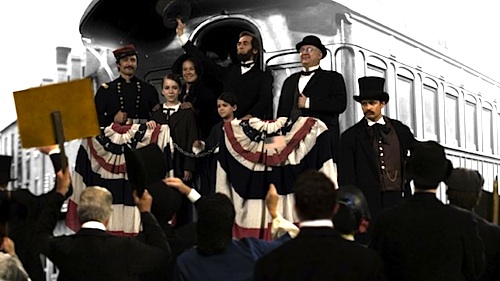
From "Saving Lincoln."

Stylistically, Saving Lincoln is also something else entirely. Shot entirely on a green-key soundstage, Litvak incorporated vintage era photographs into the CGI backdrop, creating the impression of Matthew Brady pictures come to life. Although not as artistically rendered, the nearest comparison might be Lech Majewski’s genre-defying The Mill & the Cross. While initially it looks a little weird (particularly in less stately settings, oddly enough), it is far less distracting over time than the high frame rate of Jackson’s Hobbit. In fact, the approach works quite well in big, momentous scenes, most notably including the Gettysburg Address.

Illinois’ own Tom Amandes is a bit short perhaps, but otherwise a good physical likeness as Lincoln. More importantly, he is quite good at tapping into the iconic president’s deep reservoirs of humility and humanity. This is a surprisingly touching performance. In contrast, Lea Coco’s work is rather mannered as Lamon. Yes, he is a Southerner and Coco is not about to let us forget it. Still, Penelope Ann Miller’s turn as Mary Todd Lincoln clearly suggests she is high strung, but in a nuanced rather than caricatured way.

From giving Sen. Ned Baker (Republican of Oregon) his due as a longtime Lincoln confidant and the only member of Congress to fall in battle as a uniformed officer, to exploring the role the 16th President’s Christian faith played in his life and opposition to slavery, Saving Lincoln is a worthy addition to the growing Lincoln film canon. It successfully evokes the look and feel of the Civil War era through its green screen effects and it is supported by a very fine lead performance from Amandes. Recommended for Presidents’ Day viewing, Saving Lincoln opens this Friday (2/15) in New York at the Quad Cinema.

LFM GRADE: B

Posted on February 12th, 2013 at 1:42pm.

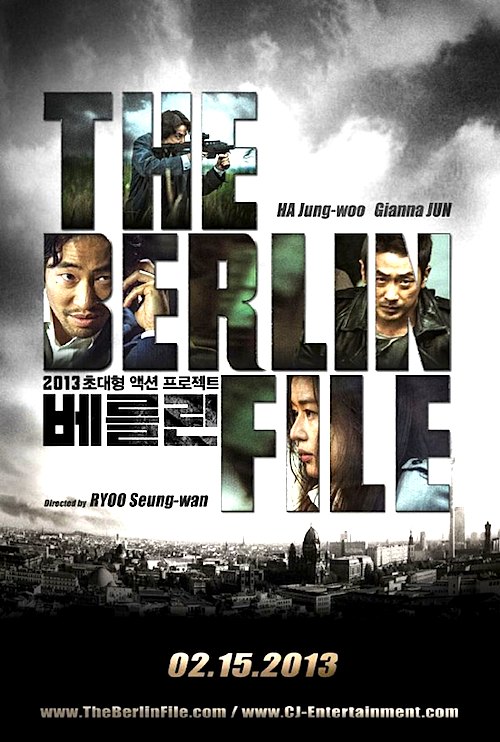
DPRK vs. ROK in a Unified Germany: LFM Reviews The Berlin File

By Joe Bendel. Like any good socialist system, power in the DPRK is transferred along hereditary lines. Kim Jong-un has just succeeded his father Kim Jong-il. However, a power struggle for day-to-day control over the country’s lucrative arms dealings, their only source of hard currency, will engulf at least four intelligence agencies in Ryoo Seung-wan’s The Berlin File, which opens this Friday in New York.

Officially, Pyo Jong-seong is a national hero of the People’s Republic. He is so good at his covert duties, he remains a “ghost” to western intelligence databases. Assigned to close an arms sale to an Islamist terrorist group brokered by the Russians, Pyo is quite put out when the Mossad crashes the party. Jung Jin-soo is also rather out of sorts, as well. The South Korean operative was hoping to bust the Northern Koreans, but the third party intervention blew his operation. One of the few remaining Cold Warriors in an office full of appeasers, Jung’s position becomes rather precarious politically. Of course, Pyo is in a tighter spot.

Technically, Pyo is above reproach, but his wife Ryun Jung-hee is not. As he learns from the Ambassador, Ryun has fallen under suspicion in Pyongyang. Dong Myung-soo, a well-connected special agent, has been dispatched to investigate her as the Israelis’ presumed informant. Pyo has some rather difficult history with Dong, so he cannot expect any favors from the Communist operative. Meanwhile, the South Korean Jung is out to get Pyo to avenge his comrades. A pariah in his own agency, Jung only trusts the council of his CIA contact, Marty, perhaps the film’s only genuinely likable character.

A pleasant surprise from Ryoo and the Korean film industry, Berlin File is one of the best espionage films since Tinker Tailor, in which the true villains are North Koreans and Islamic terrorists. America does not factor greatly in the story, aside from the sympathetic figure of Marty. While the South Korean intelligence service does not cover itself in glory, all their dubious actions are done with the intent of making nice with the North. In short, writer-director Ryoo basically nails the geo-political realities. He can also stage a wicked fight scene. Just watching Pyo’s concluding throw-down will make your back wail in pain.

There are indeed some impressive action sequences, but Ryoo is even more effective tapping into bone-deep themes of betrayal and loyalty. He really puts Pyo and Ryun through the wringer and doesn’t do Jung any favors either. As a result, Berlin should be tragic enough to be a monster hit in Korea and sophisticated enough to appeal to American fans of international intrigue.

Ha Jung-woo (who blew the doors off dark thrillers like Nameless Gangster, The Chaser, and Yellow Sea) is all kinds of bad as Pyo, convincingly portraying his conflicted loyalties and mounting disillusionment. Although international superstar Gianna Jun is almost entirely de-glamorized as Ryun, she is still quite a presence, surprisingly affecting in several key scenes. Berlin also boasts a great supporting ensemble, particularly including Lee Kyoung-young, who plays the Ambassador with a moral ambiguity that really keeps viewers off-balance, and John Keogh, appealingly cynical as the friendly neighborhood CIA agent (benefiting from the generous helpings of English dialogue, nicely punched-up by American screenwriter Ted Geoghegan).

Shot almost entirely on location in Berlin and Riga, Berlin File captures the chilly, paranoid vibe of old school Cold War thrillers. Ryoo manages to add the amped-up mayhem of his Korean action pictures (like Troublemaker, for instance), while maintaining the best of both worlds. Highly recommended for fans of action, espionage, and Ms. Jun, The Berlin File opens this Friday (2/15) in New York at the AMC Empire.

LFM GRADE: A

Posted on February 11th, 2013 at 3:22pm.

Kiarostami @ The Lincoln Center: LFM Reviews Five Dedicated to Ozu

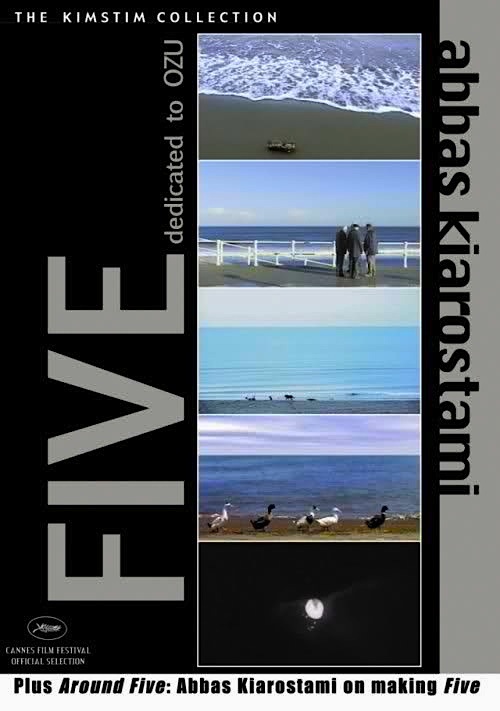
By Joe Bendel. Yasujiro Ozu had a deft touch when it came to directing children. It would therefore make perfect sense that the auteur’s work has deep resonance for Iranian filmmakers. Yet, it was the Japanese master’s so-called “pillow shots,” brief but peaceful still life transition images, that inspired Abbas Kiarostami’s tribute Five Dedicated to Ozu, which screens as part of the Film Society of Lincoln Center’s latest retrospective, A Close-Up of Abba Kiarostami.

Also known as Five Long Takes Dedicated to Yasujiro Ozu (or simply Five), Kiarostami’s homage deliberately eschews narrative and characterization in favor of pure composition. Having premiered as a museum installation, it is best considered as part of that experimental genre. Nonetheless, for admirers of Kiarostami and his protégé Jafar Panahi, it carries additional significance as the film the former shot while they were co-writing Panahi’s politically charged Crimson Gold.

Those five long takes show the Caspian Sea, almost entirely from a fixed vantage point. In the first scene, we watch the tide drag a piece of driftwood back and forth, for a lulling effect. The following boardwalk scene also features repetitive motion as indistinct pedestrians walk through the camera’s field of vision. However, viewers might wonder at various times if perhaps Panahi has just made his reported cameo. While one would think there is nothing conceivably objectionable in Five, the many uncovered female heads in this scene would most likely be problematic in Kiarostami’s native Iran. Of course, the pace and meditative vibe of Five provides plenty of time for the audience to wonder about such matters.

Considering the third take features dogs—unclean animals according to the ruling mullahs—Five probably has two strikes going against it. Presenting the frolicking canines as tiny figures on the horizon, it might be Kiarostami’s most interestingly framed shot, closely resembling an ECM album cover.

For kids who love ducks, Five might just be worth having for the fourth take of duckies waddling across the beach. Without question they are the most entertaining part of the film. For the concluding fifth take, it is frogs that are heard but not seen, as the moon rises and glimmers over the dark sea.

When most Ozu fans watch Five, their thoughts will probably wander to what those great films really mean to them. As pleasant as they might be, his work is not beloved for the pillow shots Kiarostami has so greatly expanded here. It is the exquisite dignity of Chishu Ryu’s many father figures, Keiko Kishi’s endearing sexuality in Early Spring, and most of all the legendary work of Setsuko Hara. To see her in the “Noriko” films is to fall head-over-heels madly in love with her. It is precisely that humanity that is missing from Five.

Regardless, Kiarostami most likely accomplishes what he set out to do with Five, so here it is. At least it presents an opportunity for viewers to reflect on their respect and affection for the films of Ozu and Panahi, which is something. Recommended primarily for patrons of the non-narrative avant-garde, Five Dedicated to Ozu screens this Thursday (2/14) at the Walter Reade Theater, as does his recent masterwork, the highly recommended Certified Copy starring the incomparable Juliette Binoche, as part of the Close-Up on Abbas Kiarostami career retrospective.

LFM GRADE: C

Posted on February 11th, 2013 at 3:19pm.

Bela Lugosi Gets His Voodoo On: LFM Reviews The Restored White Zombie on Blu-ray/DVD

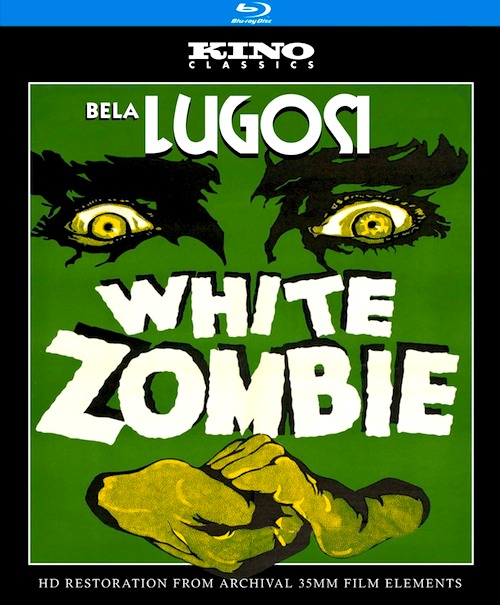
By Joe Bendel. Bela Lugosi got there first—before Val Lewton, George Romero, or the AMC network. Yet when he appeared in what is considered the very first zombie film, it was thought to be a rather odd career choice at the time (the first of many, as it turned out). Of course, Victor Helperin’s White Zombie would look like a prestige picture compared to his Ed Wood films. In fact, the Haitian voodoo chiller has always had its champions, very definitely including Rob Zombie, but the state of the public domain prints has made it difficult for mere mortals to embrace it. In a welcome turn of events, Kino Classics has released a crisp new restoration (produced by Holland Releasing) on DVD and Blu-ray, now available from online retailers everywhere.

Madeleine Short and Neil Parker are to be married in the manor house of Charles Beaumont, but they really shouldn’t. The plantation owner is really interested in taking Short for himself. Not exactly a seductive figure, Beaumont seeks the help of Murder Legendre, a voodoo master who runs his sugar mill entirely with zombie labor. With a name like that, Legendre has to be evil, but whether he has supernatural powers is a debatable point.

Unable to win over Short, Beaumont slips her Legendre’s zombie mickey on her wedding day. Soon after tying the knot, Short passes away—or so it seems. Of course, Legendre has her up on her feet and shambling about Beaumont’s estate in no time. Much to his disgust, the wealthy old planter finds her soulless body to be poor company. Can Parker save her, once he pulls himself out of the bottle? He will have some help from the missionary, Dr. Bruner, whose constant need of matches serves as the film’s annoying comic relief.

Lugosi is pretty darn sinister as Legendre, who does some really cool voodoo business with candle fetishes. Presumably the price of sugar is down, since he cannot seem to afford a full set of buttons for his tunic (even with a horde of unpaid zombie laborers at his disposal). Nonetheless, we should not let pedantry stand in the way of our appreciation of a great Lugosi performance.

While Lugosi delivers for his fans, his co-stars often sound like the former silent stars they were. At least, as Parker nee Short, Madge Bellamy spends a good portion of the film in the form of a speechless zombie. Likewise, fellow silent veteran John Harron’s over-acting will make viewers miss the mannered David Manners (the WASP-ish protagonist of Dracula, The Black Cat, and The Mummy).

So White Zombie offers Lugosi and zombies, which should be enough for viewers any day of the week. There is also an original rumba composed for the film by Xavier Cugat, heard in the unusually expressionistic scene of Parker’s mournful binge-drinking. Such sequences can be more fully appreciated when seen as part of the restoration, which looks tremendous on Blu-ray. Although independently produced by Edward Helperin, White Zombie could be considered an honorary Universal monster movie, since it was filmed on U’s back lot, with richly detailed sets and props leased from the studio. It also features the work of one of Universal’s biggest stars, Lugosi, and the studio’s make-up wizard, Jack Pierce.

It is ironic that Lugosi would lend his support to a comeback vehicle for former silent stars Bellamy, Harron, and Robert Frazer (who maintains his dignity as Beaumont) when his later filmography consists of one dubious attempt to re-ignite his career after another. He deserved better karma for appearing in White Zombie. It also happens to be nearly as stylish a horror film as The Black Cat. Affectionately recommended, White Zombie is a film any zombie fan or Lugosi admirer should know. It is now available in its fully restored glory, thanks to Kino Classics, with a vintage Lugosi interview included as a bonus.

LFM GRADE: B+

Posted on February 5th, 2012 at 2:03pm.

LFM Reviews Stoker @ The 2013 Sundance Film Festival

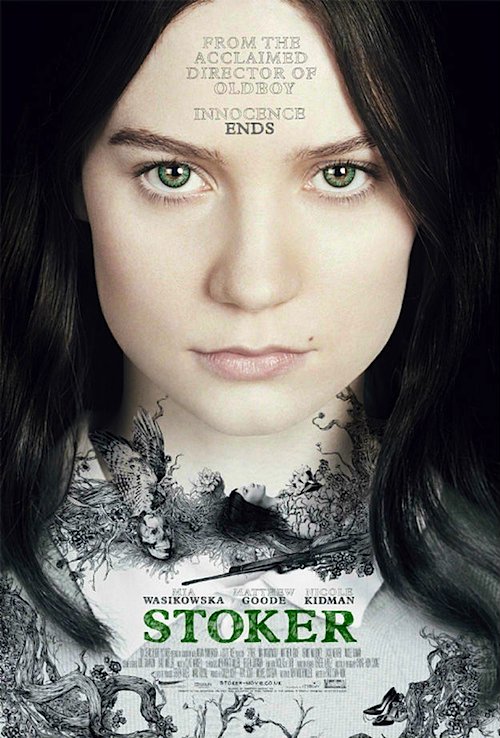
By Joe Bendel. India Stoker is sort of a female Hamlet. After her father died under mysterious circumstances, her mother is all eyes for her uncle. However, Uncle Charlie is more interested in replacing his brother as a pseudo-father-figure for India in Park Chan-wook’s first English language film, Stoker, which screened during the 2013 Sundance Film Festival.

India Stoker and her father were always very close, having bonded during their regular hunting trips. Yes, she is a gothic protagonist who can handle a firearm. Her relationship with her mother is another matter. Evelyn “Evie” Stoker is a woman so chilly and severe, by law she has to be played by Nicole Kidman. When Uncle Charlie shows up after the funeral, the widow turns to him for “comfort.” India is not impressed, rebuffing all her Uncle’s overtures of friendship. Kindly Aunt Gin appears quite alarmed by Charlie Stoker’s presence, but she disappears before she can explain why. People seem to do that around the Stoker family.

Stoker is exactly the sort of film Tim Burton’s Dark Shadows should have been, but totally wasn’t. Park’s mastery of mood is reflected in every scene, particularly in some visually arresting transitions. While the lurid nature of the material often approaches camp, Park emphasizes the repressed, brooding and eerie atmospherics. It also helps that Wentworth Miller’s screenplay tells a fully fledged story that mostly comes together down the stretch (rather than stringing together a series of gags).

It would be spoilery to explain why, but it is safe to say audiences have never seen Mia Wasikowska like this before. Yet in a way, India Stoker is something of a psychologically troubled cousin to Jane Eyre. Matthew Goode holds up his end, bringing all kinds of creepiness as Uncle Charlie. Although Kidman is often relegated to the sidelines, she perfectly delivers some scathing Mommie Dearest lines in the pivotal third act confrontation that audience members were quoting immediately after the screening.

Park’s accomplished hands have transformed a V.C. Andrews-ish yarn into an unusually stylish, dark fable. The Oldboy auteur’s admirers should be well pleased with his English debut and it also ought to earn Wasikowska a whole new level of fanboy appreciation. Elegantly sinister, Stoker is recommended for sophisticated genre patrons. It screened as a Premiere selection of this year’s Sundance Film Festival.

LFM GRADE: B+

Posted on January 30th, 2012 at 11:10am.