LFM Reviews Hank and Asha @ The 2013 Slamdance Film Festival

By Joe Bendel. Is technology stronger than social tradition and family expectations? That question will be put to the test when two aspiring filmmakers fall head-over-heels in “like” via online video messages in James E. Duff’s Hank and Asha, an Audience Award winner at the 2013 Slamdance Film Festival.

Hank had a short film accepted at a Czech film festival. Asha saw it there. She is studying at a Prague film school for a year, before returning to her regular life in India. Something about Hank’s film prompted her to send him a video message. Something about her question convinces Hank to respond in kind—and so on and so on. Soon their long distance flirtation becomes surprisingly serious. However, the inconvenient realities back in India drastically complicate any future they might have together.

The scenes filmed in Prague nicely capture its beauty and vibe, making viewers want to visit the city again. The New York scenes did not seem to have the same effect (but to be fair, I was only in Park City for a week, hardly enough time to get homesick). Regardless, the sense of place and displacement are a big part of what distinguishes H & A.
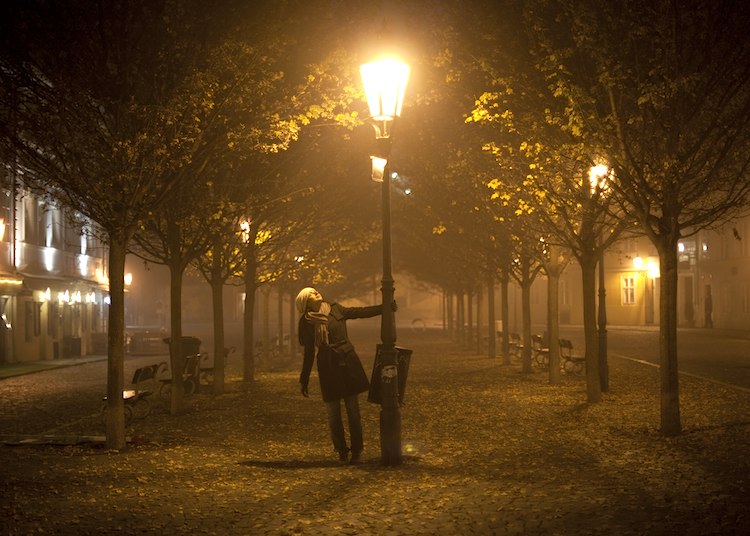
H & A is sort of like a hipster updating of sentimental favorites like A.R. Gurney’s Love Letters.Dramatically, it works relatively well because of its realistically appealing leads. Andrew Pastides is not afraid to look silly as the somewhat nebbish Hank. He also forcefully depicts the heartsick desperation of a smitten party with no leverage to make their sort of relationship work. Mahira Kakkar has a pixie-like charm as Asha. However, Duff and co-screenwriter Julia Morrison have her doing things that do not really make sense in light of her full situation. Still, both co-leads definitely convince viewers that each has a deep emotional attraction to the other, despite never appearing in the same scene together.

It is easy to see why Slamdance audiences responded to H & A. It offers some unabashed sentiment for the Facebook generation without feeling out of synch with the times. Small but nice, Hank and Asha is recommended for Williamsburg scenesters as a counter-intuitive date movie. Following its success at this year’s Slamdance Film Festival, it should have a long, fruitful festival life ahead of it.

LFM GRADE: B-

Posted on January 30th, 2012 at 11:07am.
LFM Reviews Big Sur @ The 2013 Sundance Film Festival

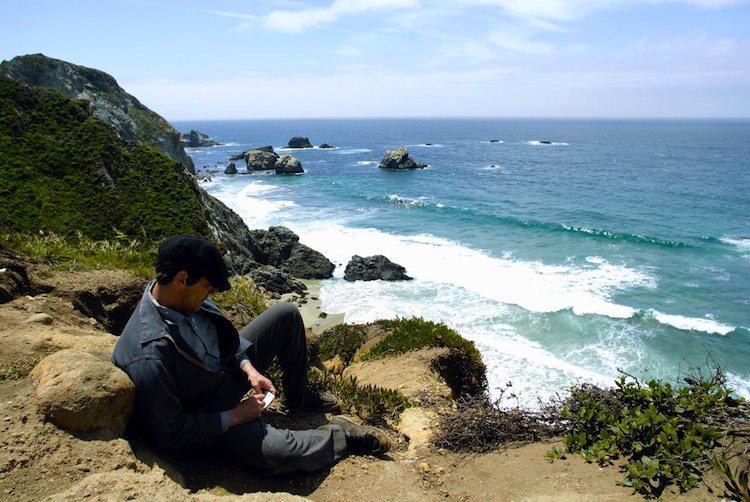
By Joe Bendel. Big Sur has a long history of inspiring artists, from Henry Miller to Charles Lloyd. Jack Keouac was also one of them, sort of. Adapting Kerouac’s autobiographical novel of his time spent along California’s scenic central coast, Michael Polish conveys an impressionistic sense of Kerouac’s language and the lonesome unspoiled environment in Big Sur, which screens during the 2013 Sundance Film Festival.

To protect the guilty (most definitely including himself), Kerouac changed the names of the Beat elite who appear in Big Sur. Polish changes them back, perhaps to make the film more commercial, but frankly there is no mistaking Kerouac or the Cassadys (or Ferlinghetti for that matter). Only a few years have passed since the publication of On the Road, but Kerouac is not dealing with success well. The literary rock star has come to California with the intention of holing up in Ferlinghetti’s Big Sur cabin to purge his soul. However, a typical Kerouac bender delays his arrival at City Lights.

Eventually, Ferlinghetti ensconces Kerouac in Big Sur, hoping his time spent in isolation will recharge his creative drive. For a few days Kerouac enjoys communing with nature, but he gets antsy quickly. Before long, he is reconnecting with Neal Cassady, launching into a doomed relationship with his friend’s soon-to-be-former mistress, and generally carousing with the usual suspects.

As plot goes, Big Sur leans to the sparse end of the spectrum, making it a real cinematic challenge. However, Polish arguably captures the rhythm and vibe of Kerouac’s language better than any other filmmaker, directly incorporating generous excerpts from Kerouac’s novel, read by Jean-Marc Barr in the persona of the author. Accompanied by images of natural beauty and underscored by a subtle but stylistically diverse score, Big Sur is not unlike a cinematic tone poem at times.

Yet the film is surprisingly peppy. Rather than hold one striking image for an interminable length of time, Polish shows the audience one after another, and yet another, in rapid succession. As result, Big Sur always feels like it is getting somewhere, even when it has little narrative business to show for itself.

A rich visual feast, Big Sur functions as a heck of a show-reel for cinematographer M. David Cullen (whose extensive credits include Jennifer’s Body). Barr also sounds great reciting Kerouac, but dramatically his work is something of a mixed bag. He lacks Kerouac’s considerable physicality and charm, but he certainly expresses the restlessness that defined the author, as well as his aura of danger and dissolute inclinations. Cullen’s lens also loves Kate Bosworth. Nonetheless, she is largely wasted as Kerouac’s increasingly exasperated lover Billie, but Anthony Edwards adds an appealing human dimension to the proceedings as Ferlinghetti.

With the choice to see one Beat Generation-related film from this year’s Sundance, it should be Big Sur rather than the over-hyped Kill Your Darlings. Granted, it might not completely pull it off, but Polish’s film comes far closer to translating Kerouac to the big screen than other recent attempts. There are even surprisingly playful moments that suggest the Pull My Daisy spirit.  Recommended for Beat fans, Big Sur screened as a Premiere selection of this year’s Sundance Film Festival.

LFM GRADE: B

Posted on January 30th, 2012 at 3:37pm.

LFM Reviews Google and the World Brain @ The 2013 Sundance Film Festival

By Joe Bendel. If you were to list corporations arrogant enough to initiate the Terminator franchise’s Skynet apocalypse, Google would have to rank at the top. In fact, they might be the entire extent of the list. Ben Lewis documents enough characteristic weirdness and secrecy surrounding the company’s controversial book-scanning initiative to provoke all sorts of paranoia with Google and the World Brain, which screened as part of the World Documentary Cinema Competition during the 2013 Sundance Film Festival.

It sounded innocent enough during the early stages. Google approached some of the greatest academic libraries, offering to scan their collections. For librarians, it offered the opportunity of digital preservation, without taxing their institutional budgets. However, many were surprised to find Google selling the resulting e-books online, including a considerable number of titles that were out-of-print, but not out of copyright.

To the considerable number of authors affected, this constituted theft of intellectual property. Yet, many tech tea leaf readers were even more concerned about the big G’s ultimate aim. Although not confirmed by the company, the book-scanning project is largely considered to be part of a larger undertaking to create a “World Brain” artificial intelligence.

Lewis employs the words of World Brain proponent H.G. Wells to introduce the concept, but you do not have to wear a tin foil hat to be uneasy with his “paternalistic” rationalizations. Likewise, given the big G’s history of collaborating with the Chinese government (briefly addressed in the doc), one does not have to be a conspiracy theorist to be uneasy with the company potentially keeping tabs on what books people read in the future.

Of course, it is hard to say just what the big G’s intentions are because they are not particular talkative about that. Despite his efforts, Lewis only gets a bit of corporate flackery from an official spokesman and some less than illuminating comments from the rather confused sounding head of Google Books in Spain (who evidently did not get the memo). One thing comes through loud and clear in G & WB:f you want to talk to the big G about a cup of coffee, you will quickly find yourself signing non-disclosure forms.

While not exclusively about the court challenge to the big G’s settlement agreement with the Authors Guild, this is unquestionably Lewis’s strongest material, becoming the dramatic backbone of the film. Plenty of those objecting to the arrangement talk on-camera about the complex court case and their wider reservations. We also hear from the usual futurist suspects, essentially picking up where they left off in Welcome to the Machine.

Further distinguishing it from other tech docs, G & WB sports some surprisingly cool graphics that nicely serve the film’s narrative clarity. In a minor quibble, the film commits a fallacy of composition when it lumps together several ongoing court cases related to e-books that are really more about commercial practices than control of information.

It takes guts to question a company with the resources and self-righteous image of the big G. In doing so, Lewis tells a great David vs. Goliath story and raises some pertinent ethical issues for the information age. Well thought out and lucidly presented, Google and the World Brain is recommended for the Wired set and book publishing dinosaurs as it makes the festival rounds following its world premiere at this year’s Sundance.

LFM GRADE: B+

Posted on January 29th, 2012 at 8:26pm.

LFM Reviews What Isn’t There (Ang Nawawala) @ The 2013 Slamdance Film Festival

By Joe Bendel. Alt-pop music used to be great at expressing young amour and heartsick yearning. Evidently, it still does in the Philippines. Some remarkably catchy tunes perfectly accompany a damaged teen’s first significant love in Marie Jamora’s What Isn’t There, which screens again today as part of the 2013 Slamdance Film Festival in Park City.

Gibson Bonifacio stopped speaking. He could if he wanted to, but he doesn’t. He blames himself for his twin brother’s death and assumes everyone else does, too. His mother’s overbearing behavior does not exactly help bring him out of his shell, either. Unfortunately, his beloved little sister Promise bears the brunt of her control freak parenting. Bonifacio’s only solace comes from his brother’s ghost conjured from his imagination and his vintage music, until he happens to meet Enid del Mundo.

Much to his surprise, del Mundo does not seem to mind his silent ways. She is also a vinyl collector, whose tastes include British New Wave and traditional Harana ballads. She is cute, too. Viewers can hardly blame Bonifacio for getting hung up on her, even though we know by now young love almost never runs smoothly.

You can dog WIT for being sentimental, but it takes its characters and situations refreshingly seriously. Jamora and co-writer Ramon De Veyra clearly think getting dumped is a pretty rotten thing to happen to a sensitive teenager, which indeed it is. She also has an ear for hummable and thematically appropriate pop songs and Haranas.

Dominic Roco’s Bonifacio is supposed to be introverted, but there are times when he seems to literally shrink on camera. In contrast, Annicka Dolonius lights up the screen as del Mundo. While the large supporting ensemble all looks right, Boboy Garovillo and Sabrina Man both add a memorable sense of earnest down-to-earth-ness as Bonifacio’s father and younger sister, respectively.

WIT is a lot like a Filipino John Hughes movie, but with less comedy. Those who like bittersweet teen dramas will really dig this one. Recommended accordingly, What Isn’t There screens again this afternoon (1/22) at Treasure Mountain Inn, as part of this year’s Slamdance.

LFM GRADE: B-

Posted on January 22nd, 2012 at 11:55pm.

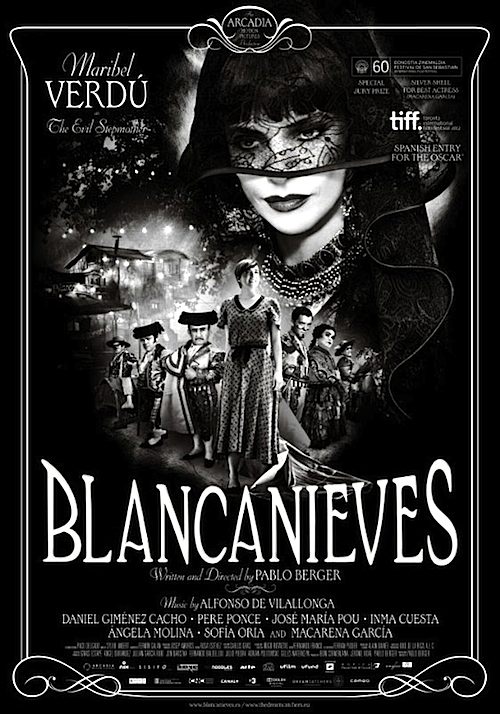
Snow White in the Bull Ring: LFM Reviews Blancanieves

By Joe Bendel. It often seems like the Academy’s rules for the best foreign language category are obscure and arbitrarily applied. Frankly, the only language spoken in Spain’s official submission is body language. Yet Pablo Berger’s silent film qualified. In fairness, it is about as Spanish as it gets, earning eighteen Goya nominations for combining the Snow White fairy tale with the rich tradition of bullfighting. Unfortunately, Blancanieves will not repeat The Artist’s Oscar success, failing to even reach the foreign language shortlist. However, it should still find considerable arthouse love when it opens this Friday in New York.

Antonio Villalta was a great matador, but one day he faced one bull too many. As the paralyzed Villalta lies upon the operating table, his beloved sadly dies in child birth. Recognizing a ticket to the easy life, the cold, calculating nurse Encarna sets her sites on the weakened widower. Yes, you could say she is an evil stepmother to young Carmen. Initially raised by her grandmother, Carmen is forced to become a servant on the Villalta estate after the kindly old woman’s death. Though forbidden to see her father, she starts paying furtive visits to the equally miserable Villalta. Even confined to his wheelchair, Villalta teaches her everything about the family business. It will be a useful skill when things come to a head with Encarna.

Suffering from amnesia, Carmen falls in with an itinerant company of diminutive novelty bullfighters. When her innate talent and extensive training are revealed, the troupe is quickly redubbed “Blancanieves and the Seven Dwarfs.” They seem to be one dwarf short, but they are never sticklers for details in Spain. Obviously, the act is a hit, which perturbs Encarna and you know what that means.

Blancanieves is the third Snow White adaptation in about a year’s time and by far the best. Yet it will draw far more comparisons to Michel Hazanavicius’s Artist than to Kristen Stewart’s home-wrecking Huntsman. Without question, Berger is a much richer visual stylist than the Oscar winning director. On the other hand Hazanavicius’s elegantly light touch, flair for physical comedy, and old fashioned romanticism are ultimately a tad more satisfying. Nonetheless, Berger frames some stunningly expressionistic tableaux and his transitions are a show unto themselves. However, he embraces all of the tragic heaviness of the Brothers Grimm and almost none of their macabre fantasy.

The cast is also quite strong (but again The Artist’s ensemble would narrowly take the honors in a face-off). Daniel Giménez Cacho’s work as Villalta is particularly poignant and the dwarfs stand head-and-shoulders above their more famous counterparts in Huntsman. Sofía Oria is also quite touching as young Carmen (while Macarena García’s older incarnation is somewhat less so).

Watching Blancanieves, one is struck by the painstaking composition of each shot and the care taken to perfectly match every note of Alfonso de Vilallonga’s score (featuring both sweeping orchestral pieces and some infectious flamenco-inspired songs). Furthermore, the lack of award season recognition for Kiko de la Rica’s gorgeous black-and-white cinematography is nothing less than a crime. A work of true cinematic artistry, Blancanieves is recommended for all real movie lovers when it opens this Friday (1/25) in New York.

LFM GRADE: B+

Posted on January 22nd, 2012 at 11:54pm.

LFM Reviews S-VHS @ The 2013 Sundance Film Festival

By Joe Bendel. Have you ever watched something so disturbing that you wish you could un-see it? Like maybe A Serbian Film or Barbra Streisand’s Guilt Trip? That is sort of the premise behind the follow-up to last year’s horror anthology V/H/S. While S-VHS is very definitely a film for horror diehards, it is not a similarly soul-shredding experience. In fact, it should be a heck of a fan-pleaser during its midnight screenings at the 2013 Sundance Film Festival.

The only place S-VHS repeats V/H/S is during Simon Barrett’s interstitial framing arc, Tape 47. Once again, strangers have broken into a sketchy looking house, finding a mysterious assortment of VHS tapes. This time around, a detective and his assistant, Ayesha, are looking for a missing college student, who evidently became obsessed with his collection of macabre found footage. It seems he believed the cumulative effect of watching certain tapes consecutively would have a transformative effect on the viewer. Naturally, Ayesha does exactly that, utilizing the monitors conveniently provided.

Adam Wingard’s Clinical Trials might be the most conventional of the four tapes the intruders watch, but it still delivers plenty of creeps and jolts. After an accident, a man has received a bionic optical implant to replace a lost eye. The experimental treatment is free, but his initial experiences will be recorded for analysis. (How such advanced technology was transferred to an obsolete VHS tape is not a question worth asking.) With his artificially boosted vision, the man starts seeing things he never could before, like the dead people haunting his home.

In a bit of a departure, Edúardo Sanchez & Gregg Hale’s A Ride in the Park aims more for gross-outs than edge-of-the-seat scares, but it delivers accordingly. Recorded through the protagonist’s bike helmet-cam, it could be described as the “zombie vomit” installment. What more do you need to know?

Not surprisingly, the strongest constituent film comes from Gareth Huw Evans, who helmed the spectacular martial arts shoot-out The Raid. Also set in Indonesia (a refreshing change of pace for the franchise), Safe Haven, co-directed with Timo Tjahjanto, consists of the footage shot by a documentary film crew visiting the compound of a reputed cult leader. Initially, the well-spoken guru cooperates in the apparent hope of counteracting some of his bad PR. However, their presence seems to ignite something evil.

Evans and Tjahjanto sure understand how to pace a film. Steadily escalating the degree of wtf-ness, they throw in just about everything but the kitchen sink, culminating with one of the best composed closing shots you could ever hope to see in a genre film. The ensemble cast is also first rate, from top to bottom.

While not quite as inspired as Haven, Jason Eisener’s Alien Abduction Slumber Party still ends S-VHS on a high note. This is truly a descriptive title. However, the dialogue and relationship dynamics are cleverly written, without sounding like an attempted Scream rip-off. It is also a good example of how brief, blurry images seen out of the corner of one’s eye can be far more unsettling than front-and-center special effects shots.

Like its predecessor, S-VHS is pretty scary stuff, but by offering more humor and gleeful gore, it happens to be more fun. A rare case of a sequel surpassing the original, S-VHS is enthusiastically recommended for midnight movie veterans (perhaps exclusively). It screens again Tuesday (1/22) and Thursday (1/24) in Park City and Sunday (1/26) in Salt Lake, as part of this year’s Sundance Film Festival.

LFM GRADE: A-

Posted on January 21st, 2012 at 9:57pm.