Weaponized ESP Down Under: LFM Reviews Crawlspace

By Joe Bendel. In the 1980’s, the Soviets really did launch an ambitious “remote viewing” program, training psychic spies to watch and perhaps even read the American President’s mind. It is hard to imagine any hostile powers bothering with such efforts now, unless they had no other access to the latest news from ESPN. Nonetheless, the “technology” was taken seriously and it is about to blow up in the face of a clandestine Australian research institute, becoming the Macguffin of Justin Dix’s Crawlspace, which debuts on VOD and begins a series of midnight screenings at the IFC Center beginning today.

Echo Companies 1, 2, and 3 are approaching the double-secret Pine Gap facility buried beneath the Australian desert (where there are no pine trees). They have two missions: terminate the dangerous inmates let loose during a power failure and rescue the scientific personnel. It seems like it is a bad idea to combine a maximum security prison with a research lab, so maybe these prisoners are not whom they are billed to be. Oddly enough, one of them also appears to be the late wife of company leader Romeo, who apparently harbors a wee bit of guilt over her assumed death.
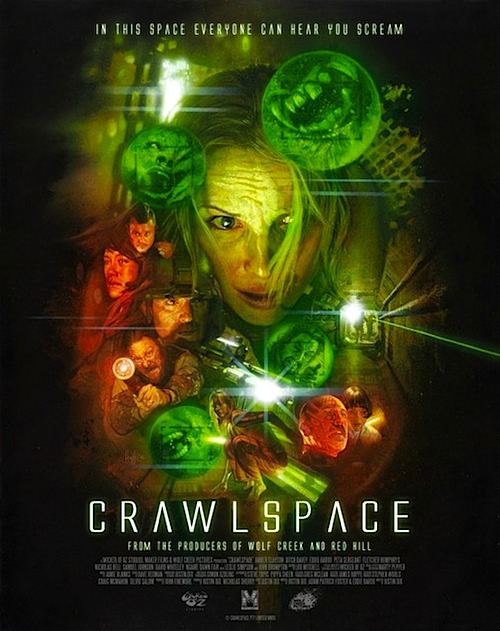
Much to his team’s surprise, Romeo goes rogue, deciding to protect E.V.E., as her wristband identifies her, rather than fulfill their mission objectives. This becomes particularly awkward when the monsters start attacking. It is not until they “rescue” a truly annoying group of scientists that the psychic battle unfolding around them is insufficiently explained. What does that make Eve? Dangerous.

The directorial debut of SFX artist Dix, Crawlspace liberally incorporates narrative elements from the original Alien and Solaris, but little of their artistry. It is long on atmosphere, though, taking viewers through air ducts, service tunnels, and all manner of passages requiring grown men to stoop. There are also several distinctively gruesome deaths for those who measure genre films by such standards.

Again, Crawlspace’s cast might not earn marks for distinction, but they get the job done. While not remarkably expressive, Ditch Davey (a name so awesome it must be Australian) is appropriately manly as Romeo. Strangely, both Peta Sargeant and Ngaire Dawn Fair exhibit more cinematic presences (as Wiki the commando and Emily the psychic blocker, respectively) than Eve, the pseudo-romantic co-lead, but Amber Clayton can at least act twitchy and roll her eyes back in her head when necessary.

Crawlspace is no genre classic but it is entertaining in a Big-Mac-with-fries kind of way. Basically, it is heavily armed people going nuts in confined spaces. Horror movie fans, particularly those with a taste for flicks with a light sci-fi seasoning, should have at it this Friday (1/4) when it screens Midnights at the IFC Center and hits VOD platforms.

LFM GRADE: B-

Posted on January 4th, 2012 at 12:35pm.
Accept No Substitutes: LFM Reviews Sergio Corbucci’s Original Django

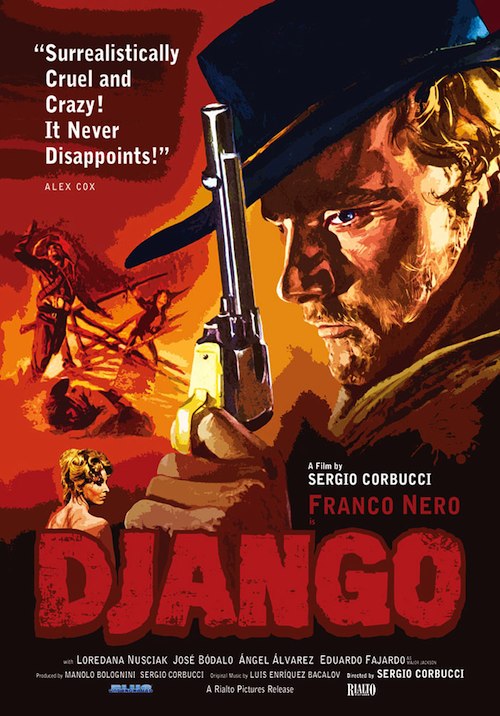
By Joe Bendel. Italian spaghetti western maestro Sergio Corbucci only helmed one official sequel to his classic 1966 western gundown Django, but scores of scruffy bootleg Django follow-ups were produced. In fact, they keep on coming, don’t they? None of them, including the recent homages from Takeshi Miike and Quentin Tarantino can hold a cigarillo to Corbucci’s original Django, which opens today in New York at Film Forum.

A stone cold killer comes to town wearing Union Blue and dragging a coffin. Much mayhem ensues. Basically, that is what the film boils down to. Like A Fistful of Dollars, there is an element of Yojimbo in Django, turning the title character loose in a town embroiled in a war between Maj. Jackson’s ex-Confederate white supremacists and a band of Mexican revolutionaries (who all look more or less the same), but attitude and action are more important than plot, per se.

Temporarily Django throws in his lot with his old associate, “General” Hugo Rodriguez, but that is only because he needs a few men to stage a daring gold heist from the Mexican army depot just across the border. He also holds a mysterious grudge against Jackson, whom he saves killing for last. Along the way, he rescues a fallen woman who duly falls for Django, but he is not really at a place in his life where he is looking for a serious relationship.

Notoriously violent in its day, Corbucci’s Django does not seem so shocking at a time when the Weinsteins will release Tarantino’s pseudo-reboot on Christmas Day (regardless of the unforeseeable national tragedy). However, its body count is still impressive. Django’s action scenes are not really shootouts, they are massacres. After all, that casket holds a heck of an equalizer, courtesy of Mr. Richard Gatling.

In a career defining role, Franco Nero is all kinds of steely badness as Django. There is something deeply existential about his presence, yet he is strictly business when it counts. Eduardo Fajardo is also thoroughly despicable as Jackson, providing the anti-hero with a worthy antagonist.

Frankly, some of the details do not make a lot of sense, like the racist Klansman Jackson being buddy-buddy with the Mexican army. At times, extras literally walk into the line of Gatling gunfire, which is awfully convenient of them. Yet, the metaphorically muddy environment and gritty action more than compensate for any pedantic grousing. Plus, it is truly impossible to watch Django and not hum the iconic theme song in your head for several days afterward.

Alex Cox suggests Django’s name is indeed a reference to the great Roma jazz guitarist Django Reinhardt, in a way that would be spoilerish to explain. If so, it adds another layer of cult weirdness to the film. Regardless, Django delivers enough unrepentant action to satisfy any genre fan. An essential Italian western, Corbucci’s 1966 original is the Django to see when it opens today (12/21) at Film Forum.

LFM GRADE: A

Posted on December 21st, 2012 at 10:29am.

The Long Shadow of North Korea: LFM Reviews Our Homeland, Submitted By Japan for the Oscars

By Joe Bendel. In the 1960’s and 1970’s, many Korean-Japanese immigrated back to their homeland. Unfortunately, they chose the wrong one. With family at risk in the DPRK, active members of Japanese-North Korean friendship associations had no choice but to tow the party line. Yet, the implications of the basic foodstuff care packages they sent to loved ones spoke volumes. Granted a special three month visit for medical reasons, one such “repatriated” North Korean reconnects with his guilt-ridden family in Yang Yonghi’s devastating Our Homeland, which has been selected by Japan as their official foreign language Academy Award submission.

Yun Sung-ho most likely has a brain tumor. Given the woeful inadequacies of the North Korean medical system, he is allowed to briefly return to Japan—after a five year waiting period. He is fortunate his father is the president of the North Korean society, but he will still be monitored the entire time by his minder, Mr. Yang. Regardless, his family is grateful to see him again, especially his poor mother. Likewise, Rie is delighted to see her beloved brother again, but she cannot ignore certain ironies, like her brother developing malnutrition in the “Workers’ Paradise.” Yes, she is our kind of free-thinker and the unambiguous conscience of Our Homeland.

Based on writer-director Yang Yonghi’s own family experiences recorded in Dear Pyongyang and a subsequent documentary, Homeland is even more direct in addressing conditions in North Korea. Perhaps liberated by the fictional context, the film explicitly blames the DPRK for the misery of its citizens. There is no inclination towards moral equivalency. In fact, there is a clear affection for the Ozu-like quiet serenity of Japan.

While Yang’s script is unusually honest and challenging, her leads really make it hit home. Dynamic and vivacious but deep as a river, Sakura Andô is simply remarkable as Rie. It is an award caliber performance. Conversely, it takes a while for Iura Arata’s pitch-perfect portrayal to sink in, striking uncomfortable chords between bitterness and resignation. Boasting a top flight ensemble from top to bottom, Homeland is also distinguished and humanized by memorable supporting turns from Kotomi Kyôno as Yun’s ex Suni and Tarô Suwa as his loving blacksheep capitalist Uncle Tejo.

An assured narrative debut, Yang masterfully controls the mood and tone, despite the almost complete lack of soundtrack music. Her approach is intimate and not surprisingly documentary-like, but Homeland never feels overly talky or draggy. Indeed, the emotional drama never slacks.

Our Homeland is a deeply compassionate film, but it is also somewhat angry, plainly calling an older generation to account for sacrificing their children on ideological grounds. Its unmistakable critique of North Korean Communism might not sound like Academy fodder, but the foreign language division can be surprising – in a good way. After all, The Lives of Others won the Oscar and Andrzej Wajda’s Katyn was nominated before it even had American distribution. Regardless, Our Homeland would be a worthy nominee that deserves an international audience.

LFM GRADE: A

Posted on December 18th, 2012 at 11:59am.

New Trailer for G.I. Joe: Retaliation; Film Opens in 3D on March 27th

A new trailer has been released for G.I. Joe: Retaliation, which was pulled from release this past summer just a month before it was set to open. This new, makeover edition of Retaliation will apparently be in 3D, and feature more of Channing Tatum.

G.I. Joe: Retaliation otherwise stars Dwayne Johnson, Bruce Willis, Adrianne Palicki, Jonathan Pryce and Ray Park and opens in 3D on March 27, 2013.

Posted on December 13th, 2012 at 10:34am.

LFM Reviews Wrinkles @ Spanish Cinema Now

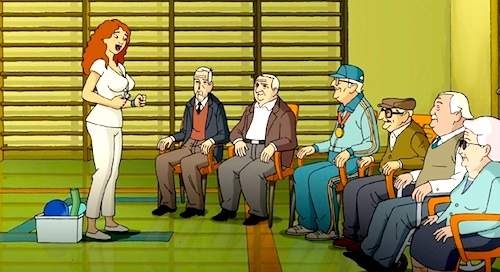
By Joe Bendel. Emilio is about to rediscover the joys of institutional food. The former banker has a hard time adjusting to life in an old folks home. Unfortunately, his fading faculties will eventually rob him of the relationships he forges in Ignacio Ferreas’s animated feature Wrinkles, which screens as part of the 2012 edition of Spanish Cinema Now.

Emilio has Alzheimer’s, but nobody will tell him that directly. Increasingly difficult to handle, his grown son has packed him off to a nursing home. His new roommate Miguel, an Argentinian scammer, has been down this road before. Still sharp as a tack, Miguel specializes in conning the more addled residents out of their pocket money and flirting hopelessly with the nursing staff. Initially, Emilio is quite appalled by his shameless roommate, but they warm to each other over time—sort of. Miguel insists he is actually doing good deeds by keeping his suckers emotionally engaged on some level. While completely at odds with his middle class morality, Emilio starts to see his point.

Adapted from Paco Roca’s graphic novel, Wrinkles is entirely honest to its characters and their circumstances, making it a bit of a tough sell commercially. Nonetheless, its deeply humanistic spirit is quite refreshing. Avoiding cheap melodrama, it has more quietly telling moments than most slice-of-life live action indies, let alone the typical animated tent-pole.

From "Wrinkles."

Ferreras, who served as an animator on Sylvain Chomet’s wonderfully wistful The Illusionist, employs a similarly sensitive 2D animation that feels reassuringly nostalgic. Some of his richly detailed flashback sequences are even quite lovely. While the narrative occasionally resorts to the odd cliché, like the defiant, doomed-to-fail road-trip, most of the notes Wrinkles hits ring true.

While its themes are about as “mature” as they get, there is absolutely nothing objectionable in Wrinkles for young viewers. Still, the vibe of sad resignation is probably best appreciated by somewhat older audiences. Featuring two very real cartoon characters and an elegant visual style, Wrinkles is recommended surprisingly strongly for fans of both animation and Spanish film. It screens this coming Sunday afternoon (12/16) as part of the Film Society of Lincoln Center’s annual Spanish Cinema Now series.

LFM GRADE: A-

Posted on December 13th, 2012 at 10:33am.

Animating Depression: LFM Reviews Consuming Spirits

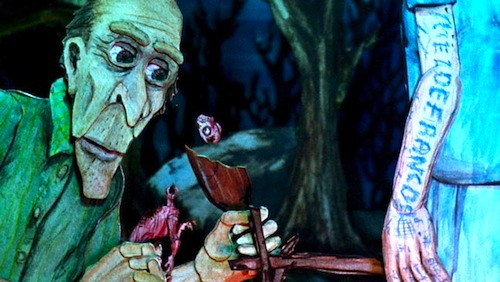
By Joe Bendel. It seems there are some things all newspapermen have in common: a taste for booze, and an abiding bitterness over the state of their lives. It is true at The Times and it is true at the Daily Suggester, a local broadsheet serving a profoundly depressed burg roughly situated where the Midwest meets Hill country. The scandalous history tying together three Suggester employees will come to light in Chris Sullivan’s years-in-the-making animated feature Consuming Spirits, which is now playing in New York at Film Forum.

As an evening talk radio host and columnist for the Suggester, former ladies man Earl Gray dispenses dark philosophical truths disguised as gardening tips. Victor Blue drudges along in a dreary back-office job at the paper with little hope of reclaiming control of his life from the social workers who have been mismanaging it since he was a child. He is semi-involved with Gentian Violet, the paper’s paste-up employee who lives with her senile mother. She has also just run over a nun, whom she has buried in a fit of panic, even though the sister was not yet dead. Yes, perhaps she was slightly under the influence, but who isn’t? This hit-and-run accident will reveal many secrets in a roundabout way.

Sullivan’s film is absolutely not animation for children. While there are spots of mature content here and there, it is the overwhelmingly fatalistic vibe that would most trouble younger viewers. Yet, that is also its greatest merit. Consuming is more closely akin to David Lynch’s vision of small town America (most notably Twin Peaks and Blue Velvet) than anything produced by the major animation studios. This is really not a genre picture in any sense and its revelations are easy to predict, but there is still something unsettling about it all that lingers with viewers well after the initial screening.

From "Consuming Spirits."

Consuming is also pretty notable for its cynical portrayal of social workers, more or less implying they often compound problems rather than solve them. On the other hand, those poor nuns really take it in the shins. Sullivan will spare them no anti-Catholic stereotype. Still, he nails the rust belt-Appalachian milieu (it smells a lot like Clark County, Ohio, but it could be any number of places).

Visually, Consuming is also quite distinctive, incorporating claymation and deliberately sketchy line animation for flashbacks. However, the bulk of the present day action is rendered 2D cut-out animation that seems to perfectly convey the broken souls inside their flat, crumpled bodies.

There are some wickedly funny moments in Consuming, often coming from the haunted Gray. Indeed, Robert Levy’s richly evocative voice-over performance as the “Gardeners Corners” host is one of the best you will hear in animated films in a month of Sundays. Yet, while Sullivan’s script has its inspired moments, its overall trajectory is disappointingly conventional. Recommended for animation fans who appreciate style, tone, and characterization more than narrative, Consuming Spirits runs through Christmas Day at Film Forum.

LFM GRADE: B-/C+

Posted on December 13th, 2012 at 10:31am.