The Cold War for American Public Opinion: LFM Reviews Restless

By Joe Bendel. Who would benefit from keeping America out of the war in Europe? It is a question that will preoccupy a former British secret agent all her life. She was supposed to be set-up in a manner that would badly discredit the British intelligence community with the American public. She was also supposed to be dead. However, the Russian exile has more lives than a cat in the Sundance Channel’s two part mini-series adaption of William Boyd’s Restless, which kicks off this Friday night.

When professional Cambridge student Ruth Gilmartin pays a visit to her mother’s country home, she finds the woman in the throes of paranoia, or so she presumes. Sally Gilmartin claims there are people watching the house from the surrounding tree-line. It all has something to do with her service as a spy during WWII. At the time, she went by her real name, Eva Delectorskya. Initially, this is all too much for Gilmartin to accept, but the site of a shadowy figure in the woods gives her pause. Reading her mother’s file, she gets the gist of the story viewers see in periodic flashbacks.

A former Russian aristocrat, Delectorskya is recruited by British intelligence in France after her brother is murdered by Fascist thugs. Lucas Romer will be her handler. Although he is not inclined towards any sort of emotional involvement, sparks will eventually fly between them. Delectorskya turns out to be a natural agent, but her missions are often rather dodgy. Yet somehow disaster always turns into success, at least within the agency bureaucracy.

Transferring to New York, they both assume roles at a dubious wire service that specializes in releasing disinformation to mislead the Germans. From time to time, a little field work is required to plant an especially sensitive story. Delectorskya assumed that was all she was doing when she accepts her fateful assignment to Albuquerque. Unfortunately, she soon discovers someone at the agency sold her out. The consequences of that ill-fated mission will linger for decades.

Hayley Atwell in "Restless."

What more can you ask of a miniseries that gives you Charlotte Rampling buying a shotgun? She plays Delectorskya/Gilmartin like the strong, intelligent woman she would have to be. Downton Abbey’s Michelle Dockery also looks the part of her daughter, but her shocked incredulity goes on far too long. In fact, the first installment does not lack for exposition, but the second part pays off with interest.

When the elements are all in place, Restless becomes quite a rich feast of skullduggery, helmed with a fair degree of style by Edward Hall. As young and old Romer respectively, Rufus Sewell and Michael Gambon might not exactly be the spitting image of each other, but they are definitely at home with the murky intrigue. A strong ensemble from top to bottom, character actor Adrian Scarborough makes a particularly strong impression as Delectorskya’s ally, Morris Devereux. However, as the resilient young Delectorskya, Hayley Atwell is a bit pedestrian, lacking the Mata Hari allure one would expect from her. Still, she becomes Charlotte Rampling, which is something.

While Boyd’s screen adaptation of his own novel is smart and tense down the stretch, his nondescript title never seems particular apt, but no matter.  Restless is a quality period production long on atmosphere that should satisfy for regular viewers of Masterpiece Mystery and BBC America’s mystery-thrillers. Recommended for fans of British television and espionage junkies, Restless begins this Friday (12/7) on the Sundance Channel and concludes one week later (12/14).

LFM GRADE: B

Posted on December 4th, 2012 at 2:49pm.

The Martial Arts Treasure Hunt is On: LFM Reviews Wu Dang

By Joe Bendel. Every five hundred years or so, a prestigious martial arts tournament is held at the Taoist monastery on Wu Dang Mountain. It might sound like the perfect set up for a kung fu movie, but it is really just a pretext to allow its sponsor to hunt for seven mystical treasures hidden throughout the exotic environs. Call it distraction by Kumite. Prof. Tang Yunlong might be an adventurer, but he has a pressing need for the mythic treasures in former John Woo protégé Patrick Leung’s Wu Dang, which Well Go USA releases today on DVD, Blu-ray, and various digital platforms.

A western dressing, modern man, Prof. Tang could be considered Republican China’s Indiana Jones, except for his daughter Tang Ning, whom he has schooled in the martial arts. He does not need the treasures for financial reasons. Instead, he hopes their storied power can cure the rare genetic disease his daughter inherited from her late mother.

Tian Xin is also after the treasures, or at least one of them. An Excalibur-like sword forged from a meteorite once belonged to her father and she is honor-bound to reclaim it. Prof. Tang will not need it for long, so he is happy to make a deal with her (especially since she is played by Yang Mi). Unfortunately, there are others after the treasures, whose motives are far less noble.

Action choreographer Corey Yuen (director of the original Transporter) really ups the ante with some spectacular fight scenes. There are some nifty matches staged for the tournament’s ring, picturesquely perched precariously on the edge the mountaintop. Yet, when Prof. Tang and Tian Xin start fighting together, in a scorching sort of martial arts tango, Wu Dang really puts films like Mr. & Mrs. Smith to shame. These are sequences genre fans will immediately re-watch and enjoy just as much a second and third time around.

Yang Mi in "Wu Dang."

Stepping out for the first time as the co-lead of a martial arts film, Yang is fantastic as Tian Xin. Deceptively flirty and all kinds of lethal, she puts her stamp on the action heroine role. In the rare event a Hollywood actress takes on such a part, it is hyped to the heavens as something extraordinary, but every HK and Mainland star of note eventually gets an opportunity to flex their kung fu chops. That’s one of the reasons we like these movies.

Likewise, as Tang Ning, Jiao (Josie) Hu kicks butt pretty darn well too, at the youthful age of thirteen. So endearing in Tom Shu-yu Lin’s Starry Starry Night, she is definitely a movie star of the future. While she looks somewhat older than her limited years, the admittedly chaste pseudo-romantic relationship between her and Louis Fan’s doofus novice still seems a bit inappropriate. However, the father-daughter rapport between her and Wenzhuo (Vincent) Zhao’s Prof. Tang is surprisingly touching. A veteran of the Once Upon a Time in China franchise, Zhao knows how to conduct himself in a fight scene and also develops real chemistry with effervescent Yang.

Granted, Wu Dang ends in a smorgasbord of New Agey sentimentality, but that happens sometimes. Yuen’s fight choreography and the two appealing central relationships more than compensate. A kung fu film more or less suitable for family viewing, Wu Dang will still thoroughly satisfy genre connoisseurs. Recommended with surprising affection, it is now available in home viewing formats from Well Go USA.

LFM GRADE: B+

Posted on December 4th, 2012 at 2:49pm.
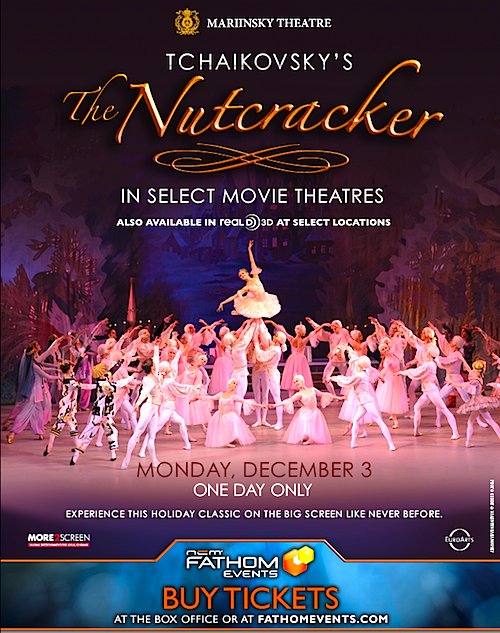
Tchaikovsky at the Mariinsky (Kirov): LFM Reviews The Nutcracker in 3D, Presented by Fathom Events Nationwide on 12/3

By Joe Bendel. We often overlook the Russianness of one of our most beloved Christmas traditions. It is Tchaikovsky’s Nutcracker, after all. Almost one hundred twenty years ago to the day, The Nutcracker premiered at the Mariinsky Theatre in St. Petersburg (known as the Kirov during darker Soviet days). At the time, reviews were rather mixed, but it caught on eventually. The Mariinsky Theatre Ballet Company and the Mariinsky Theatre Symphony Orchestra, under the direction of Valery Gergiev, once again perform the holiday favorite where it all began. The Sugar Plum Fairy will indeed dance when The Nutcracker screens in 3D nationwide, for one day and one day only, this coming Monday, via Fathom Events.

As everyone should know, young Masha’s eccentric godfather, Councilor Drosselmeyer, brings some remarkable toys to her family’s Christmas Eve festivities. However, only she has eyes for his wooden Nutcracker. Waking just before midnight, Masha witnesses an epic clash between the Mouse King’s rodent army and the gingerbread soldiers led by the Nutcracker. Thanks to her intervention, the Nutcracker prevails. Shortly thereafter, they are transformed into fully grown lead dancers and whisked off to a fantasy land. Much dancing ensues.

Directed for the screen by Andreas Morrell, the Mariinsky Nutcracker does not skimp on pageantry. The sets and costumes are as lavish and elegant as viewers would expect – except the mice soldiers, who are deliberately cartoony enough not to upset even the most sensitive of young viewers. Of course, the dancers are world class, particularly the striking Alina Somova as Princess Masha. Evidently, though, Mariinsky patrons are tough audience. They do not show much love until the principles reach the Land of Sweets. That must be a Russian thing.

Incorporating Vasily Vainonen’s acclaimed choreography, the Mariinsky Nutcracker should satisfy experienced ballet connoisseurs and first-time viewers. While only available in 2D for review attention, it should lend itself quite nicely to 3D, especially the whirling dances in the Land of Sweets, performed in long, flowing exotic garb. Indeed, Wim Wenders’ Pina proved the utility of 3D cinematography in conveying the spatial dynamics of dance.

There is a reason The Nutcracker has become a Christmas tradition. Tchaikovsky’s music and the fantastically bittersweet story, sort of adapted from E.T.A. Hoffman’s story, just always seem to work. With dancers of the Mariinsky’s caliber performing in such a storied venue, it can’t miss. Recommended for festive families and the cultured elite alike, the Mariinsky’s Nutcracker screens twice this coming Monday (12/3) at theaters throughout the country, including the AMC Empire and Regal Union Square here in New York.

LFM GRADE: B

Posted on November 30th, 2012 at 12:547pm.

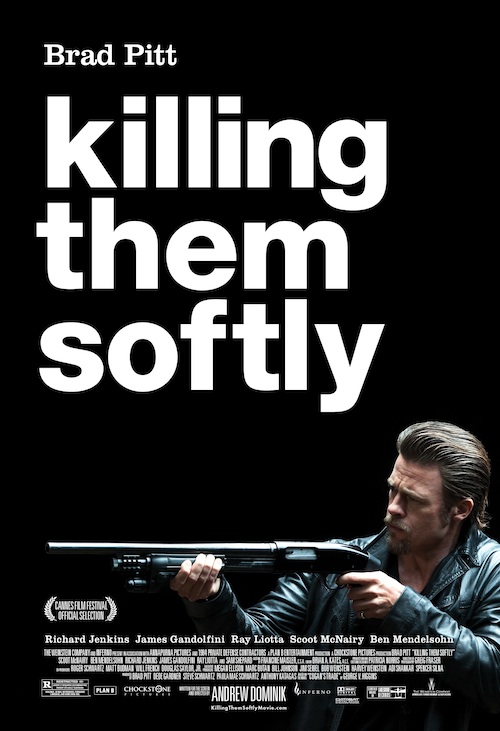
Even Criminals Need a Bailout: LFM Reviews Killing Them Softly

By Joe Bendel. Sometimes even criminals need a bailout. Of course, they can always help themselves to an involuntary one. That is what crime and government are all about. Yet, somehow Andrew Dominik turns a modest heist caper into a didactic statement on political economy in the frustrating lost opportunity titled Killing Them Softly, which opens today nationwide.

Killing reminds viewers how annoying it is to have to listen to CNN in an airport concourse. Say what you will about Tarantino, but at least his gangsters listen to vintage soul music. It is news radio all the way for Dominik’s low life thugs. At almost every point of Killing news reports of the 2007 financial crisis and Obama’s campaign speeches blare down on viewers like Big Brother in Oceania. The economy was bad. We get it, thank you. Here’s a newsflash—it’s still stalled.

Against this omnipresent backdrop, Frankie recruits his dog-napping buddy Russell to pull off a risky score. They are going to hold-up the mob-protected card game run by Markie Trattman. Ordinarily, knocking over a connected game is a losing proposition, but in this case someone else will automatically be blamed: Trattman. A while back, he conspired to take down his own game and blabbed about it afterward. Everyone likes Trattman, so they let it slide, once, but if it happens again things are sure to get ugly.

At first, everything seems to be going according to plan. Then fixer Jackie Cogan is called in to investigate. He intuitively knows Trattman has been set-up, but he does not have much sympathy for the man. Frankly, sentiment really is not his thing, not even for an old past-his-prime hitman chum he mistakenly brings in to help clean up the job.

You can see why Brad Pitt is a movie star in Killing. Even when chewing on over-the-top “America is a corporation not a community” dialogue that would make The Simpsons’ Mr. Burns snicker, he is an electric presence. For the most part, his scenes with Richard Jenkins’ Driver, the exasperated counselor to the mob’s corporate governing committee, are smartly written and bitingly witty. However, Dominik plays out his crime as a metaphor for capitalism well past the breaking point.

Yet, when you strip away Killing’s layers of ostensive “relevance,” one is left with a fairly routine crime drama. A score goes down and several people involved, one way or another, are subsequently dispatched, but it is difficult to care much about their fates. After all, Dominik scrupulously establishes the lack of innocence in this world. Still, Ray Liotta has his moments as the tragic Trattman, a self-defeating figure like so many of Killing’s characters.

There is no meaningful takeaway from Killing, because its premise is faulty. The mob is not like a corporation, it is like a government that can take what it wants and change the rules at its convenience. Dominik’s adaptation of George V. Higgins’ novel gives viewers a few clever lines and a couple of colorful scenes, but that is about the extent of it. A real disappointment, Killing Them Softly is not recommended when it opens today (11/30) in New York at the AMC Kips Bay and Regal Union Square.

LFM GRADE: D+

Posted on November 30th, 2012 at 12:46pm.

War and Famine in Henan Province: LFM Reviews Back to 1942

By Joe Bendel. Over the centuries, it has been tough to be a Chinese peasant. Famines have been a fact of life, but because they have been traditionally interpreted as a sign of heavenly displeasure with the ruling authorities, those in power have been more inclined towards denials than an activist response. Such was the case during the Great Leap Forward and such was the case during the Republican era, at least according to Feng Xiaogang’s latest historical epic, Back to 1942, which opens today in New York.

The war is not going well for the Nationalist forces, but Chiang Kai-shek is trying to keep up appearances with the Allies. He is looking to Henan’s granaries to support his beleaguered troops and his local administrators do not have the guts to explain the boots-on-the-ground reality to him. Faced with high taxes, drought, locusts, and the Imperial Japanese military, the peasants of Henan do what they have traditionally done: take flight to Shanxi.

It turns out the drought is a great leveler. Amongst the refugee contingent is Landlord Fan and his family, accompanied by their (sort of) faithful servant and their formerly resentful tenants. As they trudge towards an unwelcoming Shanxi, they are victimized by deserters and strafed by the Japanese, losing what little they had left. While the Nationalist government turns a blind eye, American journalist Theodore H. White sets out to shame them into action. Yet, even when relief is authorized, it is held up by graft and incompetence. So pervasive are the horrors, they might even cause the ardent Father Sim to lose his faith.

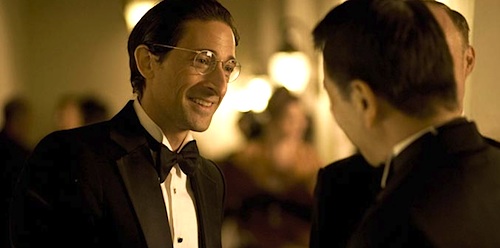
Adrien Brody as Theodore H. White in "Back to 1942."

Back is a tough film to take. Based on Liu Zhenyun’s memoir (adapted by the author), Feng’s film puts his characters through the ringer for precious little pay-off. Granted, it was a bleak period of history, but viewers are still left with the feeling of “all that for this?” As one would expect from Feng (whose jingoistic Assembly happens to be a ripping good war film), Chiang Kai-shek rather takes it in the shins. However, the film arguably has a soft spot for trouble-making Americans, like White (indeed, defying authority is what we’re best at, or at least it used to be).

Like the inverse of Iron Man 3 casting Andy Lau, Back to 1942 recruited some name actors to appeal to the American market, including a not half bad Adrien Brody as White. Unfortunately, Tim Robbins looks completely out of place as Father Thomas Morgan. Almost as if by design, the refugee characters largely blend together into a throng of downtrodden humanity, but Assembly star Zhang Hanyu stands out as the humbled Father Sim; for shell-shocked angst, he is the man to get. Likewise, Ziwen “Fiona” Wang has her moments as Xingxing, the disillusioned former daughter of privilege.

Although Feng is remarkably adept at staging big warfighting scenes, there is little of the spectacle of battle in Back. Instead, he concentrates on the overflowing transports and teeming masses of refugees. It is all quite a big, impressive production, but after a while it becomes exhausting overkill.  For hardy war movie enthusiasts, it opens today (11/30) at the AMC Empire and Village VII and in San Francisco at the AMC Mercado, courtesy of China Lion Entertainment.

LFM GRADE: C+

Posted on November 30th, 2012 at 12:46pm.

Scott Adkins Enlists: LFM Reviews Universal Soldier: Day of Reckoning

By Joe Bendel. How did Luc Deveraux go from being the hero of the original Universal Soldier to the messianic villain of the latest installment? One can hardly tell from the five previous of films. While only two or possibly three are considered “canonical,” none bear much narrative relationship to each, besides some shared names and unreconstructed 1980’s style action. At least 1999’s The Return had Kianna Tom, and the latest outing recruits Scott Adkins. Somewhat fittingly, the action star of the future is out for revenge against an action star of the past in John Hyams’ Universal Soldier: Day of Reckoning, which opens today in New York.

One night, Luc Deveraux broke into innocent citizen John’s home, killing his wife and daughter and leaving the man in a coma. When John comes to, he is interviewed by an FBI agent, who conveniently points him in Deveraux’s direction. Of course, the audience can immediately tell it is all an implanted memory designed to turn John into a vengeful tool of the government. Nonetheless, the opening segment’s violent cruelty is a definite buzz kill.

As John proceeds on his manipulated mission, Deveraux and his band of rogue Unisols try to stop him with a series of hallucinatory messages and some straight forward muscle provided by Magnus, one of the most recently “awakened” Unisols enlisted into Deveraux’s doomsday cult. While Deveraux and his apparently immortal former nemesis Andrew Scott have developed a serum to counteract the Unisol programming, it appears that its net effect merely switches their blind obedience to Deveraux, himself. Frankly, there seems to be plenty good reason for the Feds to be hunting Deveraux, regardless of their methods.

From "Universal Soldier: Day of Reckoning."

For some reason, a number of critics have embraced Reckoning even though it merely revisits the same sort of terrain John Frankenheimer’s infinitely superior Manchurian Candidate first staked out decades ago. At this point, the film’s moral ambiguity and government paranoia are so old hat, they are just plain boring.

Still, bringing in Adkins helps. He will be making action films long after his above-the-title Expendables 2 co-stars. Playing to his strengths, there are a few nifty fight sequences, including a particularly well choreographed melee in a sporting goods store. As Adkins’ baseball bat wielding opponent, former UFC Champ Andrei “The Pitbull” Arlovski nicely steps into the Randall “Tex” Cobb-ish role of Magnus.

Watching Adkins and Van Damme have another go at each other is certainly entertaining, but Reckoning lacks both the slickness and the self-awareness of a quality B-movie beatdown like the old school Assassination Games. Hyams (son of Peter) seems to want to do Universal Soldier as adapted by Philip K. Dick, but most fans would rather see the Golan-Globus version. Not nearly as original as it believes it is, Universal Soldier: Day of Reckoning (or UniSol 3½) is only recommended for hardcore Adkins and franchise die-hards when it opens today (11/30) in New York at the Village East.

LFM GRADE: C

Posted on November 30th, 2012 at 12:45pm.