Hippy Apocalypse: LFM Reviews First Winter

By Joe Bendel. When the end of the world comes, Manhattan will be the first to go. Some people may think that’s a blessing. By contrast, it would be a fate worse than death to be trapped with the yoga hippies communing upstate in Benjamin Dickinson’s slightly apocalyptic First Winter, which opens in Williamsburg (of course it does) this Friday.

There is only one reason Paul’s yoga groupies should not be considered a cult; that would imply a degree of organization they lack. Basically, he leads yoga sessions in between getting stoned and sleeping with the women of his choice, until the world ends. Caught up in their own little universe, the yoga minions sort of miss the big bang when it happens. They just see a bit of smoke and wonder what happened to their friends who never came back from town.

They try to carry on as usual, but sexual issues threaten to spoil the scene. For some reason, Paul dumps the cute (particularly for this group) Jen in favor of Marie, a comparatively drab old flame, who reappeared after the apocalypse. Oh, and their supplies are dwindling. Will the hippies be able to become self-sufficient? They live on a farm, after all. Or will they die a cold, hungry death?

Frankly, it is really hard to care – and why should we? Nobody seems too broken up about the unfathomable human tragedy that presumably happened around them. You might think the prospect of no more Phish tours or Deepak Chopra books would get them down, but everyone is more concerned about who is in Paul’s bed, including the jealous but drug addled Matt.

Why anyone would be attracted to the pasty white, scraggly-haired bargain basement guru remains a mystery throughout the film. It certainly cannot be explained by his self-absorbed personality. Unfortunately, the narrative does not offer much snap to distract viewers. In fact, the big climax comes and goes without viewers even realizing it at the time. Ordinarily, this would be a major dramatic shortcoming, but for First Winter, an abrupt ending is a happy surprise.

In all truth, the most interesting thing about First Winter is the controversy surrounding a deer the production reportedly shot out of season for the big hunting scene, without a proper license. Featuring shallow characters and a listless pace, First Winter is a hard, unpleasant slog. Jennifer Kim and Haruka Hashimoto bring some charisma to their namesakes, but it is arguably out of place amongst the rest of the dull cast of characters.

A failure on multiple levels, First Winter makes the presentable but not classic The Road seem like a masterpiece in retrospect. Both films are vague about the nature of “the end,” but in the case of John Hillcoat’s adaptation of the Cormac McCarthy novel, it works in context. In contrast, the Brooklyn hipster’s lack of curiosity is a conspicuous strain on viewer credibility. Not recommended in any way, shape, or form, First Winter begins a six day run at Videology this Friday (11/16) in the County of Kings.

LFM GRADE: F

Posted on November 14th, 2012 at 11:13am.

Rolling Russian War Machines: LFM Reviews White Tiger, Submitted By Russia for Oscar Consideration

By Joe Bendel. Ivan Naidyonov could be called the tank whisperer. He seems to have the mystical power to commune with armored vehicles, but his environment is pure blood and guts. War is still war, except more so on the Eastern Front in Karen Shakhnazarov’s White Tiger, which Russia has chosen as their official submission for this year’s foreign language Academy Award.

Hoping to put the debacle of last year’s submission (Friend of Putin Nikita Mikhalkov’s universally panned Burnt By the Sun 2: Citadel) behind them, Russia has opted for another well-connected standard bearer in Mosfilm head Shakhnazarov. However, in this case the quality of the film and the director’s critical reputation represent a considerable step up.

Picking through the remains of a routed Russian tank division, soldiers find a charred driver who is somehow still breathing. Despite suffering severe burns to ninety percent of his body, the tank mechanic makes a full recovery, except for his acute amnesia. Rechristened Ivan Naidoyonov (“found Ivan,” roughly), he is sent back to the tank corps. He is a whiz at fixing and operating tanks, but he is a little spooky. Naidyonov claims tanks speak to him and even starts praying to the “God of tanks” enthroned in the big garage in the sky. Yet he is just the man to track down and destroy the white German super tank that seemingly materializes out of nowhere to wreak destruction on blindsided armored columns.

For Naidyonov it is personal. The spirits of the destroyed tanks have spoken to him about the White Tiger. So perfect are its maneuvers, he is convinced its crew is “dead.” He can sense it before it appears and it seems to be hunting specifically for him.

White Tiger might sound like Life of Pi in a tank, but at every battlefield juncture, Shakhnazarov chooses grit over woo-woo. Everyone thinks Naidyonov is nuts, but they secretly suspect there might be something to him – particularly Major Fedotov, the counter-intelligence officer in charge of the hunt for the White Tiger. The resulting vibe is like The Big Red One as re-written and Russified by Melville.

With his studio’s resources at his disposal, Shakhnazarov stages some fantastic tank battles, vividly conveying their force – and also their limitations. During the first two acts, White Tiger is a completely original, totally engrossing war film. Strangely, though, the final third is largely dominated by completely unrelated scenes of the German surrender and Hitler’s ruminations in the face of defeat. It is like White Tiger won the war, but lost the peace. Still, since it is a war movie, the former is more important.

When Naidyonov and his obsession are center stage, White Tiger is genuinely riveting, with a good measure of credit due to its primary leads. Aleksey Vertkov is perfect as Naidyonov. Refraining from distractingly ticky or showy behavior, he is compellingly “off” in a way that could believably be recycled back into the Soviet war machine. Even though in reality his character would have probably been purged halfway through the film, Vitaliy Kishchenko’s work as the square-jawed Fedotov is similarly smart, understated, and intense.

It is hard to understand why Shakhnazarov would establish such a powerfully focused mood, only to break it up down the stretch. Still, White Tiger boasts two excellent performances and some impressive warfighting sequences, which is more than many of its fellow contenders can offer. Academy voters certainly love them some WWII, so it is probably worth keeping an eye on. Shakhnazarov has also had American distribution for past films like Vanished Empire, so White Tiger should have international legs. Regardless of its odd flaws, it is a film of considerable merit that ought to find an audience.

LFM GRADE: B

Posted on November 9th, 2012 at 2:20pm.

LFM Reviews In Another Country

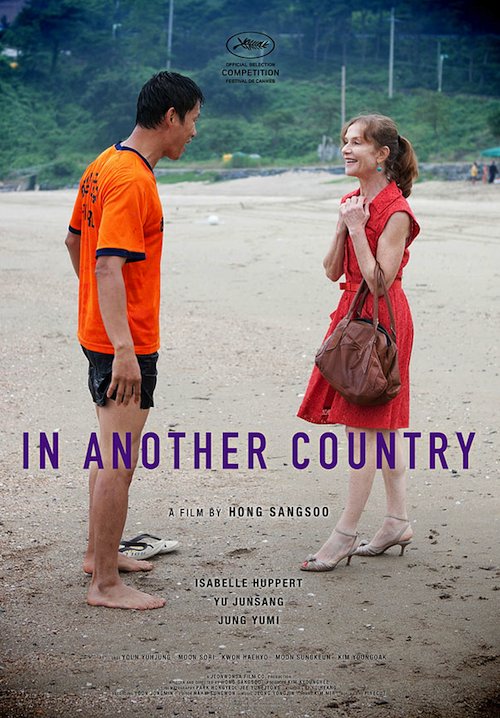
By Joe Bendel. In the working class seaside village of Mohang, there is not a lot to do except drink. Fortunately, that is what Hong Sang-soo’s characters do best. Intimacy, on the other hand is a problem – especially for a trio of French women stumbling through cultural and linguistic barriers. Isabelle Huppert plays all three of them in Hong’s sort-of English language debut, In Another Country, which opens today in New York.

Dodging debt collectors, film student Wonju and her mother are laying low in a sleepy Mohang inn. To pass the time, she starts writing a screenplay very much in the style of Hong Sang-soo. It is a triptych in which the French expat Anne comes to the very same hotel under different circumstances, yet has similar experiences each time.

The first Anne is an accomplished filmmaker, who tries to discourage the attentions of a drunken colleague with a very pregnant wife. The second Anne is cheating on her wealthy husband with an almost-famous film director. The third Anne bitterly resents her ex-husband leaving her for a Korean woman, but it is not hard to understand why he dumped her. In each case, she flirts with the meathead lifeguard with varying degrees of ambiguity, half communicating through their broken English.

Country is just so Hong Sang-soo, but the tone is a bit lighter than Oki’s Movie or The Day He Arrives. Nor is it as self-consciously post-modern in its approach to narrative. Each of the three Annes’ stories are discrete and completely self-contained (though take 2 includes a dream sequence that could almost count as a fourth strand). In fact, it is a rather sunny film, taking long walks on the beach and chatting amiably with the cute but shy Wonju, who also appears in each arc as the daughter of the hotel proprietor.

Still, it is rather fascinating to watch how Huppert brings successively darker shades to each Anne. Frankly, the third is a bit of a pill, whereas the flawed but self-aware second is the most fully developed. Yu Junsang, the only other constant besides Jung Yumi’s pleasant but rather inconsequential Wonju, is a perfectly believable lunk, but his best dramatic moments come during the first go-round. However, Youn Yuh-jung, the veteran leading lady of Korean television and cinema, is absolutely perfect as Anne #3’s academic friend Park Sook (and appearing as Wonju’s mother in the opening segment as well). Smart, somewhat tart tongued, and likably world-weary, she brings some real verve to the talking and drinking.

Indeed, Country is a chatty film, utilizing English as a second language, so communication is always an issue. The manner in which Hong repeats certain key phrases is often very droll, but there are no great profundities to be found here. That is not necessarily a bad thing. Watching Hong’s latest is like falling in with a group of strangers at a party who are amusing for an evening, but you don’t really want to make a habit of seeing afterward. Again, if they are good for some laughs, that is not so terrible. For Hong and Huppert’s fans, it works quite well. Recommended accordingly, In Another Country opens this Friday (11/9) at the Lincoln Plaza Cinema.

LFM GRADE: B

Posted on November 9th, 2012 at 2:20pm.

LFM Reviews Dangerous Liaisons, The 1930’s Shanghai Edition

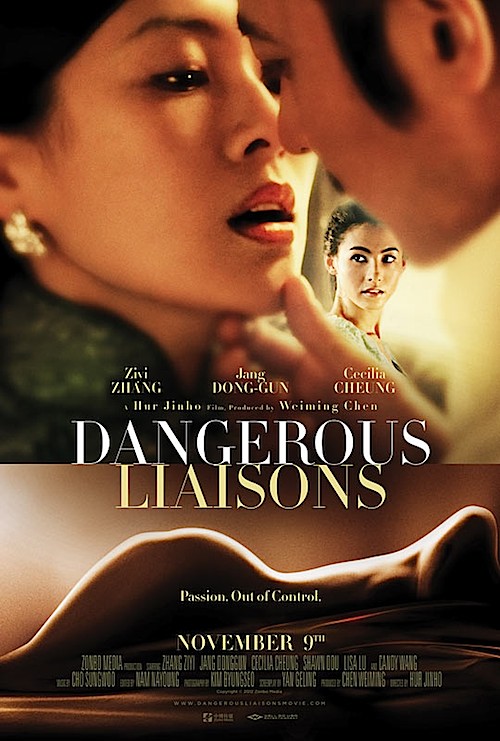
By Joe Bendel. In the 1930’s, Japan was gobbling up Manchuria, but Shanghai’s privileged class refused to let it spoil the party. Violence and foreboding hang in the air, but the cruel emotional games played by a merry widow and her dissolute ex will be more treacherous in the short term. This is indeed Pierre Choderlos de Laclos’ scandalous Eighteenth Century novel adapted to Republican era China. It makes the transition rather well in Hur Jin-ho’s Dangerous Liaisons, which opens this Friday in New York.

This time around, the Marquise de Merteuil is Mo Jieyu, the widowed chairwoman of a major banking concern and all around hedonist. She is slightly out of sorts after reading in the newspaper that her industrialist lover has dropped her in favor of his new sixteen year old fiancée, Beibei (the Cécile de Volanges). Seeking revenge, she turns to her former lover turned torch-carrying friend, playboy Xie Yifan, to corrupt her innocent rival. However, he has become preoccupied with the virtuous widow Du Fenyu (a.k.a. Madame de Tourvel). As most viewers will know, this leads to a fateful bet. If Xie cannot seduce and discard Du in reasonable period of time, he will do Mo’s bidding – whereas if he meets his challenge, she will finally yield to his advances.

Granted, the French tale of scandal has been told and retold many times in the past, but probably never with such an attractive ensemble cast (sure they are good actors, but Malkovich and Close as predatory seducers?). The chemistry between Xie/Valmont and Mo/Merteuil has rarely been as scorching either. Whenever Dong-gun Jang and Cecilia Cheung are on-screen together, it seems like they can barely resist ripping off each others’ clothes. It almost throws off the necessary dramatic dynamic between them, but it is certainly entertaining to watch. In contrast, Zhang Ziyi, somewhat playing against type, plays the indrawn Du/Tourvel with subtle power and genuine sensitivity. Not all the supporters players fare as well, but most eyes will squarely focused on Cheung and Zhang.

In fact, resetting Liaisons in Shanghai works quite well, because it establishes a fittingly dangerous backdrop, thereby raising the stakes. It also gives rise to an enjoyably era-appropriate big band jazz soundtrack, somewhat following in the tradition of Roger Vadim’s 1960 film adaptation, which featured the music of Thelonius Monk and Art Blakey.

There is truly nothing new under the sun. Hur Jin-ho’s Korean and Chinese cast and crew were not the first to produce an Asian Dangerous Liaisons. That distinction probably belongs to Lee Je-yong’s Untold Scandal. The real story of this Liaison is Cheung’s diva turn as the scheming but endlessly complex Mo/Merteuil. She is worth the price of admission in Manhattan by herself. Unapologetically melodramatic, Hur Jin-ho’s Dangerous Liaisons is recommended for fans of tragic Chinese and Korean period cinema when it opens this Friday (11/9) at the AMC Empire in New York and the AMC Metreon in San Francisco.

LFM GRADE: B

Posted on November 6th, 2012 at 9:42am.

Fear is the Whole Point: LFM Reviews Citadel

By Joe Bendel. They are not merely the misunderstood and marginalized. The hellions inhabiting a shunned Irish housing project thrive on fear. In fact, they can literally see it. Whether they are truly supernatural creatures or not is left rather ambiguous, but their feral savagery is beyond doubt throughout writer-director Ciarán Foy’s Citadel, which opens this Friday in New York.

Tommy Cowley and his pregnant wife were the last decent people to move out of their ominous looking housing project. Unfortunately, they waited too long. While trapped in the typically malfunctioning elevator, Cowley witnesses the fatal assault on his wife. However, their infant daughter Elsa survives. The incident deeply scars Cowley. An agoraphobic basket case, he becomes convinced that the hoodie shrouded thugs are after Elsa. He might be a nervous wreck, but he is not paranoid.

During several harrowing nighttime home invasions, Cowley barricades himself and Elsa in the bathroom as the hooded hooligans rampage through their flat. Cowley finds a sympathetic ear and temporary shelter with Marie, a kindly nurse. She insists that the delinquents living in the title high rise are just disadvantaged youths, who lash out to vent their frustration with the system. Unfortunately, she will be proved dead wrong. However, the misanthropic parish priest understands what they are only too well.

Aneurin Barnard is almost too convincing as Cowley. Every twitch of his body language screams victim. To see him is to want to mug him. He is so put-upon, viewers almost, but don’t quite lose patience with him. Conversely, James Cosmo tears into the scenery and everything not nailed down with rip-roaring relish as the caustic priest.

While Foy eventually drops some pretty clear hints regarding the nature of the Citadel dwellers, it hardly matters. They are simply mindless tormentors. As anyone who has watched Room 237 (the cinematic deconstruction of Kubrick’s The Shining) understands, authorial intent is irrelevant to critical theory. With that in mind, Citadel can clearly be interpreted as an allegory for the War on Terror, regardless of Foy’s conscious intent. Clearly.

So let’s have a little fun with this, shall we? Like al-Qaeda and their ilk, the hooded ones spread terror for its own sake. There is no reasoning with them. The West can lock itself in the bathroom and hope they go away, but that strategy is obviously doomed to failure over time. Marie is attractive and conciliatory, like a classic appeaser, but her course only leads to death. So to protect the future of liberal democracy for Elsa and the rest of our children, we need to follow the advice of the priest – call him the Dick Cheney figure – and hook up the plastic explosives to the car battery.

Right … or possibly not. Who’s to say? The point is that Citadel taps into some profound fears, burrowing under the skin like a bionic tick. It has to be the grittiest, grimiest, grimmest horror film you are likely to see in a good long time. Cinematographer Tim Fleming’s oppressively grey look sets the mood of foreboding right from the start, while Foy steadily builds the tension as he repeatedly cranks Cowley through the wringer. Despite the absence of a strong focal villain, it is a chillingly effective horror film. Highly recommended for genre fans, Citadel opens this Friday (11/9) in New York at the Angelika Film Center.

LFM GRADE: B+

Posted on November 6th, 2012 at 9:39am.

Ruan Lingyu, a True Diva of Chinese Cinema: LFM Reviews The Goddess

By Joe Bendel. Ruan Lingyu was often called the “Chinese Greta Garbo,” but unfortunately Marilyn Monroe might be a more tragically apt comparison. Dogged by scandal, the celebrated actress would take her own life in 1935. Awareness of her fate adds even more poignancy to her work in Wu Yonggang’s The Goddess (which can be seen in its entirety above), a classic of silent Chinese cinema, which inspired the title of the Asia Society’s latest film series, Goddess: Chinese Women on Screen. Fittingly, it launches their retrospective this Friday.

Ruan’s character has no name. Nor does she have a husband – but she has Shuiping, a baby boy for whom she will do anything. With no other resources, the woman is forced to sell herself on Shanghai’s predatory streets. There are no codes or euphemisms, here – she is a prostitute, plain and simple. Operating outside the law, she has no recourse when “the boss” appoints himself her pimp. While she tries to escape his clutches, he threatens to take the only bright spot in her life: Shuiping.

Nevertheless, as Shuiping matures, his mother sets aside money at great risk to pay for his education, at great personal risk. Unfortunately, intolerant parents complain to the progressive headmaster, claiming the presence of a prostitute’s son would threaten their children’s morals.

Released the year before Ruan’s sad demise, Goddess is arguably like an Oprah pick for 1930’s Shanghai. It forthrightly deals with issues of gender victimization and class exploitation, working towards a bittersweet conclusion, with the emphasis on the bitter. Yet Ruan elevates the film well beyond the realm of social issue melodrama.

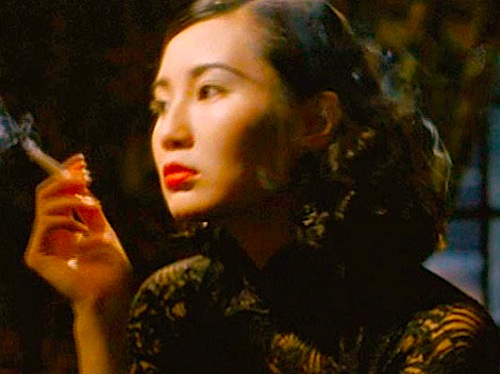
Classic Chinese cinema star Ruan Lingyu.

While the appeal of some silent stars, is not always compatible with contemporary tastes, Ruan has a timeless beauty and projects a devastating vulnerability as the unnamed woman. She also has heartbreakingly touching chemistry with young Li Keng as the sweet-tempered Shuiping. Li Juunpan, a stage actor who crossed over to silent movies, also brings remarkable presence and dignity to the film as the John Dewey-esque headmaster, while Zhang Zhizhi personifies sweaty odiousness as “the Boss.”

Ruan’s work in Goddess is so honest and powerful, it transcends time and fashion. In fact, there are none of the grossly exaggerated performances that often date silent cinema. A true classic in any era, The Goddess will leave viewers deeply moved, in a fully satisfying way. Highly recommended, it screens this Friday (11/9) at the Asia Society. The touchstone figure for the series, Ruan also stars in New Women screening this Sunday (11/11) and is the subject of Stanley Kwan’s biopic Center Stage, which concludes the series on Saturday, December 8th.

LFM GRADE: A+

Posted on November 5th, 2012 at 9:34am.