We like to keep an eye on short films here at Libertas, so check out this interesting new short above from director Dennis Liu and writer Ryan Condal called Plurality. It went live earlier this week and as of this post has already received over 110,000 views.
Here’s the official synopsis of the film: “After the state of New York gives the police access to ‘The Grid,’ a new technology that allows people to purchase anything with a quick scan of their fingerprint, crime drops almost instantly. However, they also discover that certain people are popping up in two places at once.”
Although the film’s references to Michel Foucault and Jeremy Bentham are a bit on-the-nose (somebody’s been reading Discipline and Punish), Plurality otherwise does a nice job of illustrating how technology may already be leading us down a road to dystopia. Congratulations to the filmmakers, and a hat tip to the folks at io9.
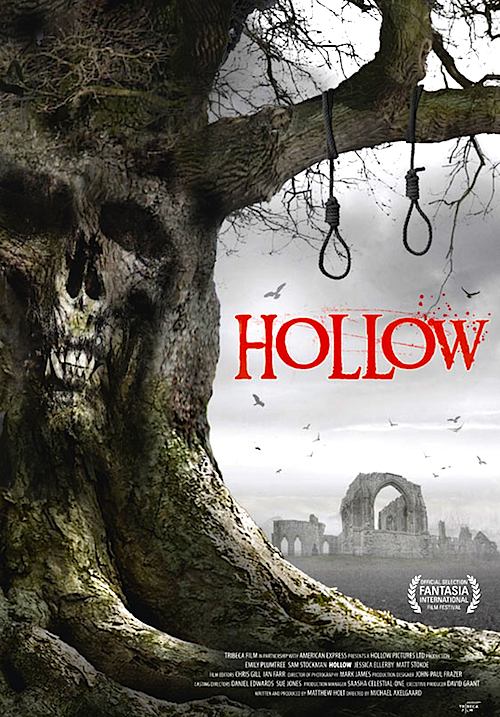
By Joe Bendel. For W.G. Sebald, Suffolk was the perfect place for the famous walk and literary digressions that became The Rings of Saturn. For two dysfunctional couples, it will become a place of supernatural menace. The hanging tree will get its due in Michael Axelgaard’s found footage shocker, Hollow, which is now available through Tribeca Films’ VOD platforms.
Emma has come to close the country cottage of her beloved late minister grandfather. For company, she has brought along her smug fiancé Scott, her torch-carrying childhood chum James, and Lynne, the girlfriend he hardly seems to know. Evidently for estate reasons, Emma wants James to document the process as her videographer. Considering we are watching footage recovered by the East Anglia constabulary, it is safe to say their weekend does not go well.
James’ camera was found in a large hollow tree that always gave Emma the creeps—and for good reason. According to legend, a monk and his illicit lover hung themselves there centuries ago. Ever since it has attracted suicidal couples like an evil magnet. Obviously, circumstances will lure the quartet back to the notorious spot, but not before they get high and indulge in a spot of strip poker. However, the power has already been shut off at the cottage, so they will rely on candles and the spotlight on James’ camera for illumination.
Frankly, the full backstory of Hollow is pretty distinctive and the sequences shot in the ruins of the nearby monastery are genuinely creepy. The James’ increasingly apparent instability further cranks up the tension. However, Axelgaard hews too closely to the Blair Witch playbook during the rather predictable third act. Still, producer-screenwriter Matthew Holt’s dialogue has a little snap to it (that’s a little, not a lot).
Whitechapel co-star Sam Stockman decently portrays James’ ambiguously off mental state without doing the full Norman Bates. As Scott, Matt Stokoe unleashes his inner cad, which is something. While Jessica Ellerby’s Lynne is not a total victim waiting to be strung-up, Emily Plumtree’s Emma sort of is, making the female characters a wash overall.
It is important to know Hollow is not exactly tactful in its treatment of religious themes. The late grandfather’s successor is definitely not portrayed in a sympathetic light. Likewise, Scott the hedonist shows a disrespect for the cross that would probably cause riots throughout the Muslim world had it been directed towards the Koran. Yet somehow, Americans will be able to shrug it off and get on to their lives (of course, there is also a strong likelihood he will pay for his excesses in proper E.C. Comics fashion).
Despite its flaws, Axelgaard shows a decent command of horror movie mechanics throughout Hollow. Flawed but watchable, it is now available for voracious genre fans via Tribeca’s on-demand services.
The Black Tulip, Afghanistan’s entry for the Best Foreign Language Film at the 83rd Academy Awards, comes to Comcast, Time Warner, Cox, iTunes, Amazon, Xbox, Vudu, and Google Play on October 26th.
Set after the Taliban was routed from Afghanistan in early 2001, The Black Tulip tells the story of how the Mansouri family took advantage of the new window of freedom by opening a restaurant called “The Poet’s Corner” – with an open microphone and an inviting platform for all to read poetry, perform music and tell their stories. A modern portrait of Afghanistan that captures the current plight and resilience of its people, The Black Tulip gives a voice to the people of Afghanistan by telling their story through the eyes of an everyday family from Kabul, who remain hopeful despite constant struggle and tragedy.
Watch the trailer for The Black Tulip above, and read here what LFM’s Joe Bendel said about the film.
Courtesy of Collider, six new clips have been released from director/star Ben Affleck’s new thriller Argo. Based on a true story, Argo centers on a CIA agent (Affleck) who attempts to rescue six Americans trapped in the home of the Canadian ambassador during the 1979 Iranian Revolution. The rescue mission went in under the auspices of filming a bogus science fiction movie entitled Argo.
Argo co-stars John Goodman, Alan Arkin and Bryan Cranston and opens October 12th.
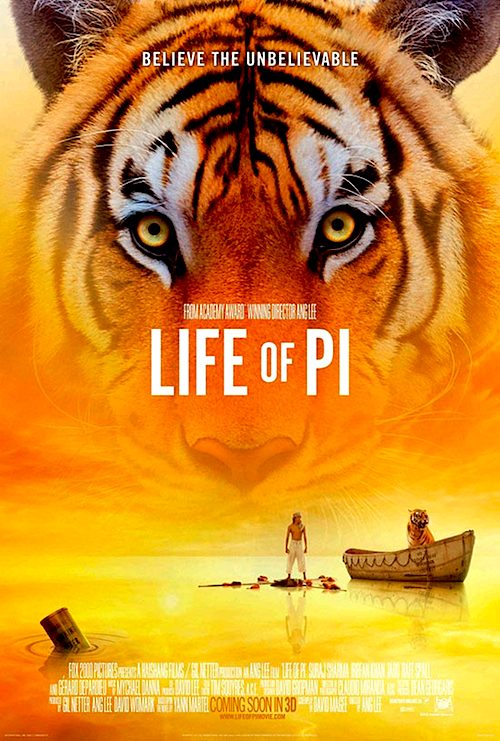
By Joe Bendel. In 3D, New Age platitudes look like they are coming straight at you. At least Taiwanese auteur Ang Lee makes them stunning to behold. The tiger does not hurt, either. Generating significant buzz, Lee’s they-said-it-couldn’t-be-done adaptation of Yann Martel’s Life of Pi officially opened the 50th New York Film Festival, now underway at several Lincoln Center venues.
Growing up in India’s French quarter, Pi Patel was named for a Parisian swimming pool, but embraced mathematics as a means of truncating the embarrassing Piscine. As a boy, religion was his hobby, practicing Hinduism, Christianity, and Islam Furr’s Cafeteria style (but no love for Buddhism, evidently). He also picks up a few animal training pointers from his zookeeper father, which will stand him in good stead.
Much to Patel’s chagrin, his father decides to immigrate to Canada, where he and his brother will enjoy better future opportunities. Tragically, their ship sinks en-route – which is how, through an unlikely set of circumstances, Patel finds himself sharing a life boat with the family’s ferocious Bengal tiger, Richard Parker.
Pi is not exactly a story of a boy and his tiger. Despite the character’s avowed spirituality, he never hopes to change the tiger’s nature. Richard Parker begins and ends the film as a wild beast. However, Patel will attempt to train him with the techniques he learned from his father, in order to survive. They will not cohabitate, though. Patel will spend most of his time in a makeshift raft lashed to the lifeboat, ceding the larger vessel to Richard Parker.
For those who were wondering where Ang Lee has been, he has spent the last four years or so in a wave tank in Taiwan. Not surprisingly, the man who helmed Crouching Tiger has a keen sense of how to incorporate 3D to best serve the on-screen action. As dramatic as the tiger sequences are, it is the way he realizes depth and scope that are particularly arresting. He and his team create a spectacular fantasy world in the middle of the ocean.
Unfortunately, the narrative settles into a second act doldrums, largely repeating its Robinson Crusoe-Grizzly Adams motifs in what seems like an endless loop. Yet, in contrast to the film’s frequent heavy-handedness, Lee’s payoff hits the mark, precisely because of his tasteful understatement.
Indeed, there are many elements that work quite well in Pi, particularly its nostalgic portrayal of French India. For many viewers conditioned by Jewel in the Crown to think of pre-1949 India solely in terms of the British Raj, this is fertile ground, worth exploring in further films. Lee also nicely establishes the Patel family history, especially the role played by his dashing honorary uncle, Mamaji (played by the distinctive Elie Alouf). The wrap-around framing device is also quite effective, featuring a relatively brief but moving performance from Irffan Khan as the adult Patel, relating his story to a Martel-like novelist. For hardcore film geeks, Pi even features an unusual aspect ratio shift.
Pi has its merits, but it also illustrates the perils inherent in films confined to lifeboats. Visually, it is quite the triumph, but Lee’s young cast-members are not all some more enthusiastic critics are billing them to be. Ultimately, much of Pi is like a 3D painting—dazzling to soak in, but rather static. Better filmmaking than story-telling, Life of Pi certainly deserves technical consideration during awards season. Recommended for those interested in 3D as legitimate creative medium, Life of Pi launched this year’s NYFF on Friday, with a theatrical opening already scheduled for November 21.
By Joe Bendel. Alina is either tragically co-dependent or possessed by the Devil. Radically different measures would be required depending on the diagnosis – but either way, she will visit a host of trials upon her girlfriend Voichita and her fellow Orthodox convent residents in Cristian Mungiu’s Beyond the Hills (see clip above), Romania’s latest official best foreign language Oscar submission, which screens as part of the main slate of the 50th New York Film Festival.
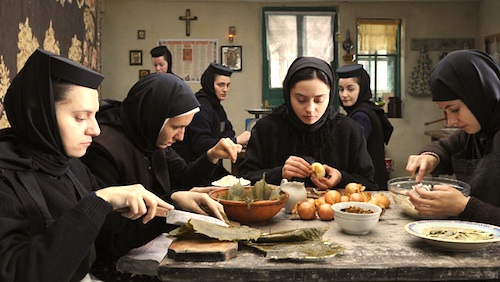
Meek and pious, Voichita appears perfectly suited to a cloistered life. Alina is a different story. However, since her former friend has no real family, Voichita arranges for her to stay temporarily in her quarters. Yet as soon as she arrives, Alina starts badgering her former friend to leave with her (see clip above). Gently rebuffing her, Voichita watches in alarm as her visitor’s behavior becomes increasingly erratic and disruptive, eventually manifesting in several public meltdowns. The priest and the nuns do not want to abandon a soul in need, but after the medical establishment washes their hands of Aline, there seems to be only one remaining course of action: exorcism.
Mungiu implies a great deal in Hills, very definitely including the nature of Aline and Voichita’s relationship, while leaving just as much open to interpretation. It would also have been very easy to portray the priest and good sisters as stereotypical zealots dangerously convinced of their own infallibility. However, Hills constantly reasserts the messy humanity of each character. In fact, the ambiguity of the “possession” gives the film quite a distinctive flavor. Frankly, after about two hours of Aline acting out, most viewers will be ready to throw their lot in with the nuns, holding down the devil-woman as the priest reads the purification scriptures over her.
From "Beyond the Hills."
With a running time of 150 minutes, Hills often feels like what it is: a product of the Romanian New Wave of independent filmmaking. It probably would not have killed anyone had Mungiu shaved off twenty minutes or so. Nonetheless, he elicits several riveting performances, the most notable being Cosmina Stratan as Voichita, the confused innocent. As Alina, Cristina Flutur is also scarily convincing engaging in all manner of aggressive, self-destructive behavior. Yet it is Valeriu Andriută’s work as the priest, simultaneously severe and sympathetic, that really forestalls snap audience judgments.
Based on a novelized account of a real life incident in Moldova, Hills is not a kneejerk attack on Eastern Orthodoxy. Nonetheless, as the Russian Orthodox Church hemorrhages international credibility due to its perceived alliance with the Putin regime, it is hard not to invest Hills with an additional layer of meaning, whether or not Mungiu intended it. Given its ambiguous but evocative treatment of monastic life and supernatural possession, Beyond the Hills would be a fascinating film to see in conjunction with Jerzy Kawalerowicz’s Mother Joan of the Angels. Challenging in multiple ways, Beyond the Hills is recommended for hardy cineastes with at least a couple of Romanian New Wave films already under their belts when it screens tomorrow (10/1), next Sunday (10/7), and the following Thursday (10/11), as part of the 2012 NYFF.