Here is the new ad for Total Recall. The film opens August 3rd.
Posted on July 30th, 2012 at 12:43pm.
Here is the new ad for Total Recall. The film opens August 3rd.
Posted on July 30th, 2012 at 12:43pm.
By Joe Bendel. It is 1997. The internet bubble has yet to burst and dial-up is still commonplace. Easton Denning is an internet expert who has seen the future. Unfortunately, he is not a part of it. Time will bend as the computer wonk challenges fate head on in Tim Connery’s high concept, low-gloss science fiction drama Easton’s Article, which screens at the 2012 Fantasia Festival.
After high school, Easton left Iowa and never looked back, until now. He had his reasons, which will be revealed as he deals with his current crisis. One night, his internet spiders retrieved a massive data dump. Most of it was just corrupted files and the like, but there was one document that spooked Denning: his future obituary.
Along with his death notice, the scanned file includes hand written notes instructing him to be at certain places at certain times. He will know why when he gets there. Obediently, Denning returns home, duly encountering the father and girlfriend of his close high school friend, who died under murky circumstances their senior year. Somehow, karma appears to be using the internet to do its thing.
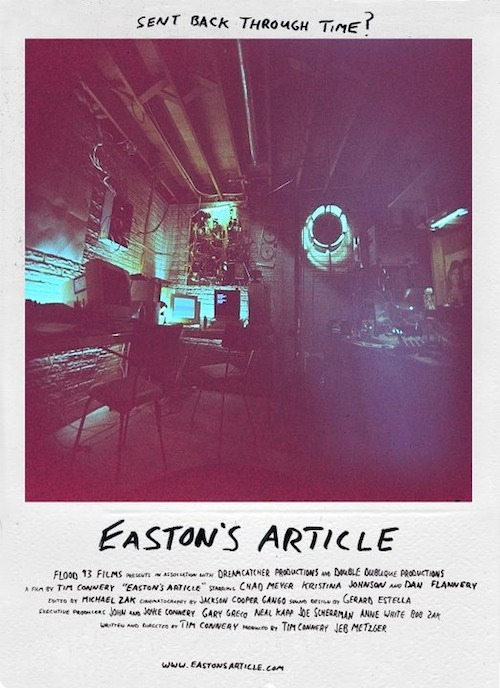 Frankly, the time travel elements in Article are basically hocus pocus, likening a digital information deluge to a flood of water, effectively spilling over into the past. However, the characterizations and the overriding vibe of tragically unfinished business are strong enough to overwhelm logical pedantry. Perhaps the closest comparison film would be John Weiner & Danny Kuchuck’s clever Cryptic, which deserved more attention when it played the festival circuit.
Indeed, Article represents the road not taken often enough in the science fiction genre, telling an intimate yet speculative story, with little or no special effects required. Connery’s completely linear script fits together the pieces without any distracting seams, while fully immersing viewers in his characters’ lives and Midwestern environment.
Looking like everyday regular people, the small ensemble is smart and engaging throughout Article. Given the anti-social protagonist’s myriad flaws, Chad Meyer has a somewhat tough road to hoe, but he portrays Easton as a haunted, fully dimensional human figure. Likewise, Kristina Johnson brings substance and sensitivity to Hayley Reed, Easton’s potential love interest. A more sharply drawn role than typically expected in low budget genre fare, Reed is a refreshingly active participant here and not simply stuck on the sidelines wringing her hands.
Easton’s Article might just be the definitive Iowan science fiction film. Moody and thoughtful, it is definitely for the high end of science fiction fandom’s bell curve, but by the same token it is also quite accessible to non-genre audiences. Recommended accordingly, Easton’s Article screens this coming Wednesday (8/1) at this year’s Fantasia Festival up north.
LFM GRADE: B+
Posted on July 30th, 2012 at 12:41pm.
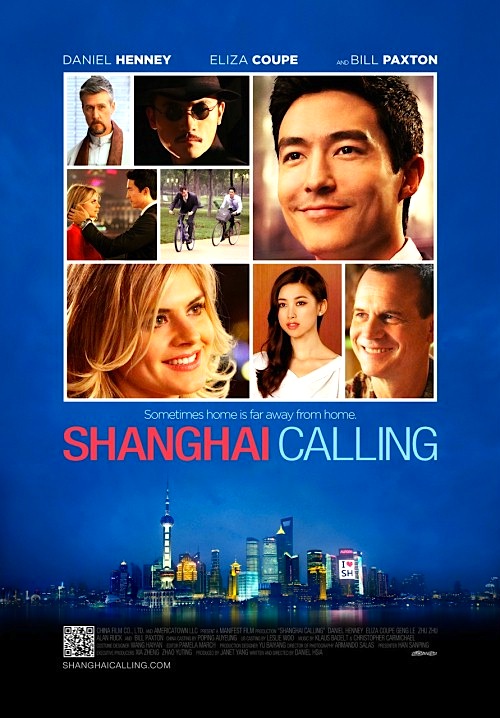
By Joe Bendel. Go-getting corporate attorney Sam Chao is used to doing things his way. So is China. China’s bigger. Temporarily posted to the go-go city on the East China Sea, Chao is in for a steady diet of culture clashes in director-screenwriter Daniel Hsia’s Shanghai Calling, the 2012 Asian American International Film Festival’s opening night film, produced by this year’s Asian American Media Award recipient, Janet Yang.
Chao is not thrilled with his new assignment, but it is clear the partnership he covets depends on his performance opening the Shanghai office. His firm has come to China because that is where their most important client, eccentric industrialist Marcus Groff, has relocated. Never really in touch with his Chinese heritage, Chao does his level best to offend all his new colleagues as quickly as possible, particularly his assistant Fang Fang and his expat relocation specialist, Amanda Wilson. Unfortunately, Chao is going to need their help when makes a hash of Groff’s latest deal.
 For reasons that remain elusive, Fang Fang has eyes for the boss, whereas Chao finds himself attracted to Wilson. That would also seem to be an odd choice on his part, but it fits with Chao’s cultural identity. He is the whitest guy in the room, especially compared to Wilson and expat business community leader Donald Cafferty, the “Mayor of Americatown.”
Hsia’s screenplay is quite astute observing the dynamics of the American business community in Shanghai, contrasting the old school old guard, represented by Cafferty, with the yuppie upstarts. It definitely feels like Calling reflects an insider’s perspective. However, the vibe of the romantic subplots are a bit too Gary Marshall (even the poster looks a bit reminiscent of New Year’s Eve). At least Hsia keeps the cast of characters manageable.
Daniel Henney (geek-famous as Agent Zero in X-Men Origins: Wolverine) maintains an easy likability, even when he is cruising for his ego bruising. Likewise, Eliza Coupe is like a cross between vintage Meg Ryan and Bonnie Hunt as Wilson, the harried single mother. However, some of the brightest lights are found in the supporting cast. In what could have easily been a shticky caricature, Bill Paxton brings out the wit and humanity of “Mayor” Cafferty. Not just window dressing, Zhu Zhu (of the Chinese remake of What Women Want) plays Fang Fang with real spirit and sensitivity, while Geng Le has a nice understated nerd charisma as Awesome Wang, a journalist-fixer often hired by the expats.
Clearly, Calling is not interested in muckraking. When Chao crashes the factory bootlegging Groff’s revolutionary cell-phone, it looks nothing like the Foxconn NPR describes. Nor does the film have anything to say about China’s internet freedoms, or lack thereof. That might limit its documentary value, but it is rather pleasant as an East-meets-West courtship (of both the personal and professional varieties). Though becoming more common, such American-Chinese co-productions still must present challenges (indeed, such is the basic premise of the film), so 2012 honoree Yang’s contributions as producer are surely considerable. Recommended for those who enjoy light cross-cultural rom-coms, Shanghai Calling screened last night as part of the 2012 AAIFF’s opening gala and also on Saturday (7/28), but both showings are sold out, so good luck queuing stand-by.
Posted on July 26th, 2012 at 9:49am.
By Joe Bendel. Seventy-three year-old British artist John Copley became the oldest Olympic medalist at the 1948 London Games, taking silver for his etchings. It would be the penultimate artistic competition of the modern-era games, all of which have since been segregated from the official medal counts. He might have made history (for a while, at least), but fortunately this will not be his story. Instead, BBC America takes viewers to the Thames, where a hastily assembled British sculling duo carries the hopes of their nation in Going for Gold: The ’48 Games, a one-shot airing this Wednesday as part of the current season of Dramaville.
Bert Bushnell and Dickie Burnell both competed for a spot on the 1948 Olympic team, but fell short. Pairing-up was not their fallback plan, but the brainchild of five-time British medalist and Olympic committeeman Jack Beresford. The double sculls is an event close to his heart, since he and his partner upset the favored Germans in front of Hitler at the 1936 Berlin Games.
The stakes are not quite so high for Bushnell and Burnell, but the malaise-ridden United Kingdom could use a lift. London could also use the tourist dollars generated by a successful Olympiad. However, with mere weeks to go, they’re still woefully behind on construction. Evidently its déjà vu all over again.

Likewise, Bushnell and Burnell have just started training together – and it shows. Socially and temperamentally quite different, the pair clash rather badly. In fact, the respectably middle class Bushnell’s class resentment of Burnell’s privileged background becomes tiresomely repetitive, perhaps saying more about screenwriter William Ivory (whose credits include the labor drama Made In Dagenham) than two athletes who fundamentally share so much in common. They both have a passion for their sport, similar last names, and persistent issues with their fathers.
For many viewers (as well as for BBC America) the most important thing to know about Gold is the presence of Doctor Who’s Matt Smith as Bushnell. He is credible enough as the tightly wound rower, but Sam Hoare certainly looks more athletic as Burnell. He also has some of the better turned straight dramatic scenes. However, for longtime TV anglophiles, it will be Geoffrey “As Time Goes By” Palmer who stands out as Burnell’s severely reserved father.
If rowing races is your thing, Going for the Gold (a.k.a. Bert & Dickie) is your tele-drama. Smoothly helmed by TV veteran David Blair, it still is hardly Chariots of Fire-on-the-Thames (notwithstanding one eyebrow raising quote), but it is about on par with most subsequent Summer Olympic movies. An appealing period production with a decent payoff, Going for the Gold is a pleasant enough warm-up for the London Games, recommended for sculling and Olympic enthusiasts when it airs this Wednesday night (7/25) on BBC America’s Dramaville showcase.
Posted on July 23rd, 2012 at 8:41pm.
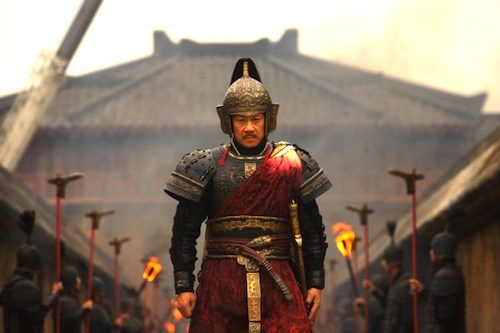
By Joe Bendel. Generally ascribed to Yuan Dynasty playwright Ji Junxiang, The Orphan of Zhao was the first Chinese play to be translated in Europe. It was even adapted (quite liberally) for the French stage by Voltaire. Profoundly tragic and also rather violent in places, it has timeless elements that continue to appeal to audiences. Celebrated auteur Chen Kaige vividly captures both qualities in his grand big screen version, Sacrifice, which opens this Friday in New York.
General Tu Angu is not a man to take the slights of the Zhao clan lightly. Framing the patriarch and his son, General Zhao Shuo, for the murder of the ruling Duke, Tu uses the outrage as pretext for wiping out the Zhao clan. A swifter, more awe-inspiring massacre you are not likely to see on film anytime soon. However, he misses two of the Zhaos, the young General’s wife, Princess Zhuang, and her newborn baby. Sacrificing herself for her child, Zhuang entrusts the infant heir to her doctor, respected commoner Cheng Ying.
As fate would dictate, Cheng’s wife has also recently delivered. Suddenly having a newborn is dangerous business and Cheng has two. In a truly Biblical turn of events, Tu orders all the town’s babies to be collected at his palace to be duly vetted. Through a catastrophically Shakespearean turn of events, the Zhao and Cheng babies essentially trade places.
Growing up as Cheng Wu, the presumed son of Dr. Cheng, the Zhao orphan knows nothing of his birthright. However, unbeknownst to the boy, the doctor is grooming him to take wreak his vengeance at the appropriate time. To do this he plays a dangerous game, entering the service of the Tu retinue, manipulating his nemesis into serving as Cheng Wu’s godfather. Needless to say, some rather messy issues of filial loyalty arise.
Some have often knocked Chen’s films as pretty but rather bloodless historical dramas, but this is absolutely not the case with Sacrifice. While the period trappings are as richly detailed as ever, there is also plenty of blood. In fact, the first act is quite a spectacle of mayhem, segueing into a tense cat-and-mouse game, in which the fate of the city’s infants hangs in the balance. The film ultimately settles into a stone cold revenge drama.
Featuring several of Chen’s semi-regulars, Sacrifice’s talented ensemble is equally adept at the stately tragedy and the gutty action sequences. As Tu Angu, Wang Xueqi is in his element. Ruthless yet charismatic, he is the sort of villain viewers find themselves identifying with, in spite of themselves. While Ge You might be better known to American audiences for his shticky work in Let the Bullets Fly, he wrings real pathos from his performance as Dr. Cheng. While her character is not long for the world, Fan Bingbing is a typically ethereal presence as Princess Zhuang. Yet it is Mainland TV star Hai Qing who really lowers the emotional boom as Cheng’s equally ill-fated wife.
Admirers of Chen’s Chinese Opera sagas Farewell My Concubine and Forever Enthralled should still appreciate the classical elegance of Sacrifice. It is based on a play, after all. Likewise, fans of more action-driven Asian cinema should never get bored with the relentless scheming and vigorous swordplay. Indeed, Chen integrates the intimate and the epic halves quite masterfully. Highly recommended for fans of literate historicals and the wuxia genre, Sacrifice opens this Friday (7/27) in New York at the Quad Cinema.
LFM GRADE: A
Posted on July 23rd, 2012 at 8:37pm.
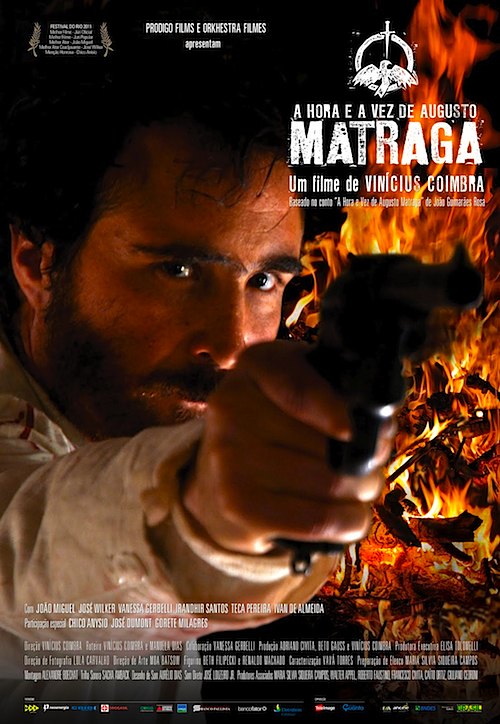
By Joe Bendel. Those who know their Brazilian cinema and literature will know Augusto Esteves, a.k.a. Matraga, is one bad cat. The protagonist of João Guimarães Rosa’s short story, adapted for the screen in 1965 by Roberto Santos, made a triumphant return, sweeping most of the prizes at the 2011 Rio International Film Festival, proving Brazilians appreciate a rugged convert. Once again, he sees the light in Vinícius Coimbra’s Matraga, which screens as part of the 2012 edition of Premiere Brazil!, now underway at MoMA.
Better at drinking and whoring than farming, Esteves has made his share of enemies, most definitely including Major Consilva. Eleven of the local land baron’s gunslingers got the jump on him out in the wild grasslands. It was a decent idea, but they did not bring enough men. They will learn from this mistake. Using the incident as a pretext to banish his wife and child, Esteves continues his reckless hedonism, pressing his luck. Beaten and branded, Esteves is left for dead after pitching head first into a rocky gorge. However, a devout elderly couple nurses his broken body back to health and puts his spirit on the path of righteous.
 Though sometimes tempted to give into his inner demons, Esteves holds to the Christian faith of his adopted parents, living with them in anonymous isolation. Eventually, the powerful landlord Joaozinho Bem-Bem and his extra-legal posse of enforcers ride into Esteves’ village, like a Brazilian John Tunstall and the Regulators, hoping to skirt a company of legitimate government troops. Much to their surprise, Matraga receives them in the spirit of Christian hospitality, welcoming them into his home. Recognizing a kindred spirit beneath Esteves’ pious exterior, Bem-Bem feels an instant rapport with the reformed killer. Indeed, their fates will be intertwined.
Matraga is often billed as a Brazilian spaghetti western, and that is fair to an extent. Yet Esteves is as much Paul on the Road to Damascus as the Man with No Name. In truth, it is quite a solid film, but it will be tricky finding the right audience for it beyond Brazilian cinema showcases, such as MoMA’s Premiere. This is a brooding film that treats issues of faith with deadly seriousness. Still, when its go time, everyone gets down to business as the bullets fly.
Glowering impressively, João is convincingly fierce and conflicted as Esteves. He handles the fight scenes quite credibly, but most importantly his depiction of the character’s hard won new faith is grittily realistic and in no way caricatured. Nonetheless, José Wilker earns most of the film’s style points as the smoothly lethal Bem-Bem.
Clearly, Coimbra and cinematographer Lula Carvalho were taken with the wide open vistas of the Minais Gerais countryside, giving it the full John Ford treatment. Yet what is most notable is the manner the film stays true to the expectations of the western genre and the integrity of Esteves’ post-conversion character. That is quite a trick. Partly a moody, unhurried art film and partly a violent western shootout, it is recommended fairly strongly for patrons of Brazilian cinema and those drawn to dark morality tales when it screens Tuesday (7/17) and the following Sunday (7/22) as part of the tenth annual Premiere Brazil! at MoMA.
Posted on July 17th, 2012 at 2:36pm.