Terrorism in Turkey: LFM Reviews Labyrinth @ The 2012 Brooklyn Film Festival

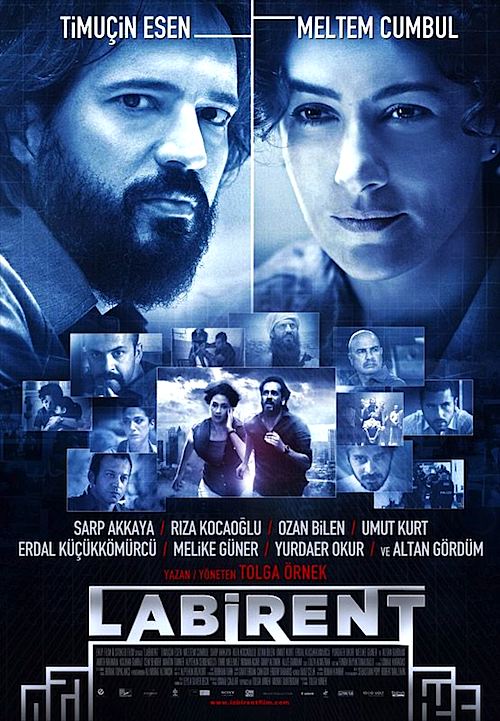
By Joe Bendel. Turkey is still the modern, secular republic founded by Ataturk, but there are those who would like to turn back the clock. Nobody understands that better than the agents of Turkey’s counter-terrorist agency. They will risk their lives to thwart a violent group of Islamist fanatics in Tolga Örnek’s Labyrinth, which screens during the 2012 Brooklyn Film Festival.

A horrific homicidal suicide bombing has murdered 95 innocent souls, including thirty Americans and five Brits. Unfortunately, the shadowy mastermind (who never delivers the bombs himself, mind you) is working on a more ambitious attack. For Fikret, the moody Turkish Jack Bauer, it is not just an assignment, it is personal. He is out to avenge the partner kidnapped and presumably murdered by the newly resurfaced terrorist ringleader.
Fikret has one ace card in his hand. He has been running a confidential informative more-or-less off the books, whose brother has fallen in with the elusive terror cell. He only trusts Rasim’s identity with his loyal colleague (and prospective romantic interest), Reyhan. A valuable source, Rasim is coveted by British intelligence, who offer information on Fikret’s missing partner in return for the mystery source. The proposition is not appreciated.

Frankly, the tension between the Turkish and British security services never escalates beyond trash talking. In point of fact, Labyrinth is a refreshing corrective to the notoriously anti-American and anti-Semitic Valley of the Wolves: Iraq, the Turkish Islamist agit-prop film co-starring Gary Busey and Billy Zane. Here, it is the Islamists who are explicitly identified as the terrorists, freely murdering their own more moderate co-religionists for the sake of their extreme agenda. Of course, their preferred target is Turkey’s Jewish community. They even use inconvenient terms such as “the caliphate” in the pre-bombing videotapes. The American military only appears in passing, productively collaborating with their Turkish counterparts on a mission in Northern Iraq.

While there are some moments of inspired movie violence, Labyrinth is more cerebral than action-oriented. As Fikret, Timuçin Esen power broods like nobody’s business, while also developing some nice chemistry with Meltem Cumbul’s smart and mature Reyhan. They make it clear they care about each other in ambiguous ways, without ripping their clothes off. As for their quarry, the effective supporting ensemble is flat-out chilling when portraying the face of Islamist terror.

We could be proud of Hollywood if it finally tackled terrorism with a film like Labyrinth. That it was produced in Turkey is downright shocking, in a good way. Engrossing and tragically realistic, Labyrinth is a standout selection of this year’s BFF. Highly recommended, it screens again this Sunday (6/10) at IndieScreen in Williamsburg.

LFM GRADE: A

Posted on June 7th, 2012 at 6:19pm.
LFM Reviews Japanese Shorts, Made in America, at the Asia Society

By Joe Bendel. Japan has long been a source of inspiration for American artists, and vice versa. In that spirit, the Asia Society hosts a screening of seven short films of varying degrees of Japanese-ness from filmmakers working in America. Diverse and intriguing, the New York Japan CineFest: Short Film Program will be a treat for short film connoisseurs this Friday night at the venerable Park Avenue institution.

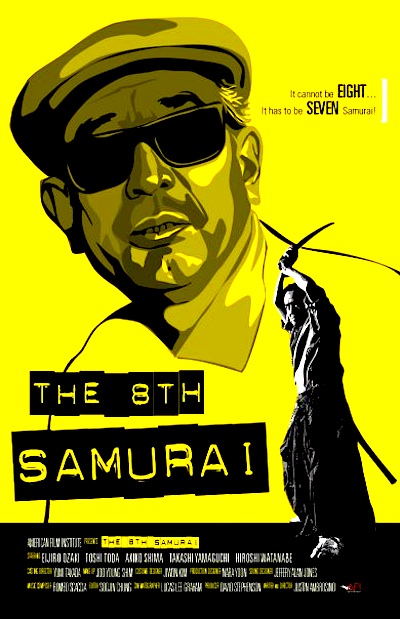
For diehard fans of Japanese cinema, the highlight of the evening will doubtless be Justin Ambrosino’s The 8th Samurai. Absolutely not purporting to tell the behind-the-scenes story of Kurosawa’s Seven Samurai, it speculates what might have happened if a cap and sunglasses donning director had a dream telling him to cut one of the eight samurai from his upcoming epic, just prior to the start of shooting. While Kurosawa’s film is an obvious inspiration, one luckless actor’s wickedly supernatural mother-issues suggest the influence of Kaneto Shindo, the director of ambiguous horror classics like Kuroneko and Onibaba, who recently passed away after reaching the century milestone.

Filmed in glorious black-and-white by cinematographer Lucas Lee Graham, the subtitled Samurai is a moody but loving valentine to Japanese cinema. Though Ambrosino is not anymore Japanese than he sounds, Samurai features almost the entire Japanese supporting cast of Eastwood’s Letters to Iwo Jima. The second longest selection of the program at twenty-eight minutes, it is a fully realized, enormously satisfying film, by any standard.

Yet, perhaps the best film of the evening is the hardest to describe, combining elements of narrative, essay, and experimental filmmaking. Observing the terms of his mother’s will, the introverted narrator of Ken Ociai’s Frog in the Well (trailer here) travels throughout Japan spreading her ashes, as directed. Sometimes employing quick-cut film stills to create a live-action flip book effect, Frog has a decidedly unusual visual style yet it never overshadows the emotional significance of the grown son’s travels. Indeed, it is surprisingly touching, while also enticing viewers to visit Japan. Frankly, considering how gorgeous it makes the country look, starting in the snowy north and traveling down to Okinawa, the Japanese tourism board ought to buy television air time for it around the industrialized world.

Though much simpler and more straight-forward, Chisa Hidaka’s three minute Together: Dancing with Spinner Dolphins is also lovely to look at, following a swimmer as she frolics underwater with the beloved marine mammals. It sounds great too, thanks to a shrewdly chosen excerpt from Ketil Bjørnstad’s The Sea, featuring ECM label mates Terje Rypdal, David Darling, and Jon Christensen.

Though something of a brief irony-driven short, Yoriko Murakami’s richly rendered stop-motion animated Corazon en Fuego / Heart on Fire puts a twist on the O. Henry twist, ultimately guiding its bereaved protagonist somewhere quite life-affirming. Yasu Suzuki’s New York set Radius Squared Times Heart is even more upbeat, depicting a shy Japanese scientist courting a fellow tango dancer through his skills in the kitchen. With its accessible, Friends-style humor, it could easily be the crowd favorite of the evening.

Far heavier, Haruhito Naka’s Into the New World rather awkwardly addresses big picture topics like God and 9-11 through half-baked magical realism. Fortunately, Kosuke Furukawa’s only slightly metaphysical Uguisu is much subtler. It also features an excellent supporting turn from Seiji Kakizaki, who has such presence as a diner customer getting under the skin of a hipster artist simply through his soft-spoken honesty, he sort of fools viewers into investing undue significance in his character. Furukawa’s sparing use of color is also quite distinctive, as are the sly hints at the fantastical.

Overall, the New York Japan CineFest night of shorts is very strong, including two excellent films, 8th Samurai and Frog in the Well, plus several other quality selections. Since most films are American productions, at least to an extent, it also represents an interesting change of pace for the Society, while still staying true to their mission and focus. It is another example why New York cineastes need to follow their programming closely. Definitely recommended, the short film program screens this Friday night (6/8) at the Asia Society.

Posted on June 7th, 2012 at 6:18pm.

LFM Reviews While We Were Here

By Govindini Murty. Kat Coiro’s While We Were Here (see a clip above) is the latest in a tradition of stories about travelers whose lives are transformed by Italy. From Goethe’s famous trip to Italy and its echoes in his Wilhelm Meister novels to William Wyler’s Roman Holiday, Merchant Ivory’s A Room With a View, and Mike Newell’s Enchanted April, Italy has long worked its magic on voyagers to its mythic shores.

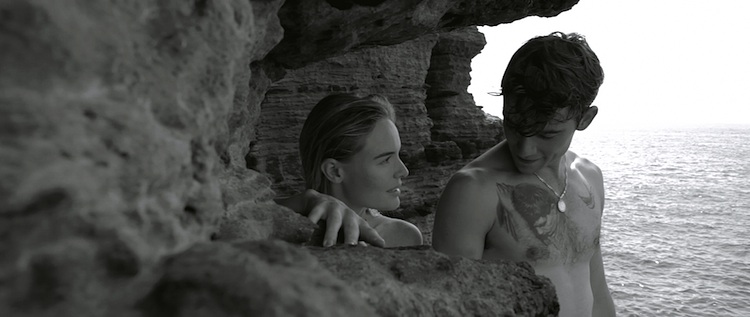
While We Were Here presents an understated variation on this familiar theme. Jane (Kate Bosworth), a quiet and somewhat melancholy writer, journeys to southern Italy with her husband, the dour Leonard (Iddo Goldberg). Leonard, a viola player, has been invited to perform in a concert in Naples. While Leonard spends his days in rehearsal, Jane wanders the streets of Naples, experiencing life at second-hand. The mediated nature of Jane’s existence is reinforced by the fact that rather than interact with any of the locals, she spends her time listening to tape-recorded conversations of her Grandmother Eves (Claire Bloom) discussing her experiences during WWII. All this is purportedly for a book that Jane is writing, but Grandma Eves’ lively reminiscences about life during the war form a pointed contrast to Jane’s anomie in the peace and plenty of the present. One day Jane makes an impulsive decision to take a ferry to the island of Ischia off the coast of Naples – and there falls into a romance with an American lad named Caleb (Jamie Blackley) living a carefree existence on the island.

Kate Bosworth and Jamie Blackley in "While We Were Here."

While We Were Here is essentially a three-character chamber drama that plays outdoors in the glorious settings of Naples and Ischia. All the character’s problems are of an internal nature. Jane and Leonard have marriage problems, but even as Jane tries to address them, the gloomy Leonard prefers to disappear into the work of his viola rehearsals. Jane wants to write a book about her grandmother’s experiences in WWII, but she’s worried she can’t make the book interesting because of a lack of engagement on her part.

Kate Bosworth as Jane.

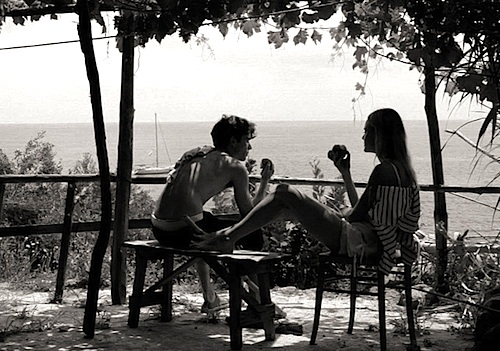
As for Caleb, his disruptive influence on Jane and Leonard’s lives is overtly likened to that of Dionysus, with one scene taking place in a grape arbor on Ischia and Caleb himself somewhat resembling Caravaggio’s portrait of the vine-bedecked god. However, even as Caleb pursues Jane, he has no job and no plans for his life. He quotes Vittoria Colonna’s sonnets to Michelangelo as he and Jane tour an Aragonese castle, he takes Jane riding on a scooter and swimming in the ocean, but their relationship doesn’t seem destined for much more than that. Indeed, it seems to be her grandmother’s voice-over about the fun she had with her American and Belgian boyfriends during WWII that spurs Jane on to her affair with Caleb in the first place. Ultimately, Jane makes her own choices, but the person having the most fun with life in the film may just be Claire Bloom’s earthy, albeit unseen, Grandma Eves.

While We Were Here is not only an homage to the great “voyage to Italy” films, but, with its black and white cinematography, also evokes the look of classic Italian Neorealist drama. As Jane wanders through the narrow streets of Spaccanapoli, one would almost expect a young Sophia Loren, in her role as a voluptuous pizza maker in De Sica’s The Gold of Naples, to appear around the corner. And though Kate Bosworth might be the physical opposite of Sophia Loren, her slim blonde beauty and reserved quality do resemble that of such ‘60s actresses as the pixyish Jean Seberg from Godard’s Breathless (even down to the striped sailor top) and the cool, lovely Monica Vitti in Antonioni’s masterpiece of alienation, L’Avventura. Beyond looks though, Bosworth’s strong, sensitive acting forms the emotional core of the film (in particular in one standout scene with Goldberg’s Leonard), and she and Blackley have a number of amusing scenes in which their easy banter make the movie eminently watchable.

Romance in Italy.

Regardless, it’s enough for me that the film is set in Naples and Ischia. Naples is one of my favorite cities, and although I haven’t yet made it to Ischia (I opted for Capri instead on a trip some years ago), it was delightful to see again the streets and sights of old Neapolis. I have many fond memories of wandering the narrow thoroughfares of Spaccanapoli (under which lie ancient Roman streets), down the long Via Toledo, through the 19th century glass and wrought iron Galleria Umberto I, and into the Cafe Gambrinus (den of literati and revolutionaries) for an espresso. Other favorite sights that appear in the film include the Teatro San Carlo, the vast hemispherical Piazza del Plebiscito with its Neoclassical church, and the impressive facade of the Bourbon-era Palazzo Real. The latter in particular has a charming old library surrounded by dusty palm trees that overlook the massive walls of the medieval Castel Nuovo (only in a land as ancient as Italy is a medieval castle described as ‘new’!). Even if the film’s characters don’t seem to revel in their surroundings, we certainly can.

While We Were Here is a pleasant diversion for a sunny summer day – which is hopefully when this film will be released. Screening at the 2012 Tribeca Film Festival, the film was produced by the same team behind the delightful With Great Power: The Stan Lee Story, and was recently picked up for distribution by Arclight Entertainment.

LFM GRADE: B+

June 6th, 2012 at 7:15pm.

Jaycee (Son of Jackie) Chan Takes Over the Family Business: LFM Reviews Double Trouble

By Joe Bendel. Some were skeptical when fifty-eight year old Jackie Chan announced his retirement from the action movie genre at Cannes. Whether this is one of those Depardieu retirements or he actually really means it, only time will tell. Regardless, the scheduling is fortuitous for the release of an old-fashioned action-comedy starring Chan’s son. Jaycee Chan steps into some big shoes as half of a pair of mismatched security guards trying to foil an art heist in David Hsun-wei Chang’s Double Trouble, which opens this Friday in New York.

Jay is a take-charge loose cannon, which earns him plenty of demerits for poor team-building skills. However, his reckless disregard for procedure is rooted in a tragic episode from an earlier period of his life. He is the one Taipei Palace museum guard an elite gang of art thieves would not want to tangle with, but he is the perfect candidate for a frame-up. Frankly, that was not part of the plan for two slinky Cat Woman-attired robbers, but the result of the bumbling interference of Ocean, the comic relief security guard-tourist visiting from Beijing. Dragging along Ocean is a lot like taking the proverbial accordion into battle, but Jay is forced to, for the sake of clearing his name.

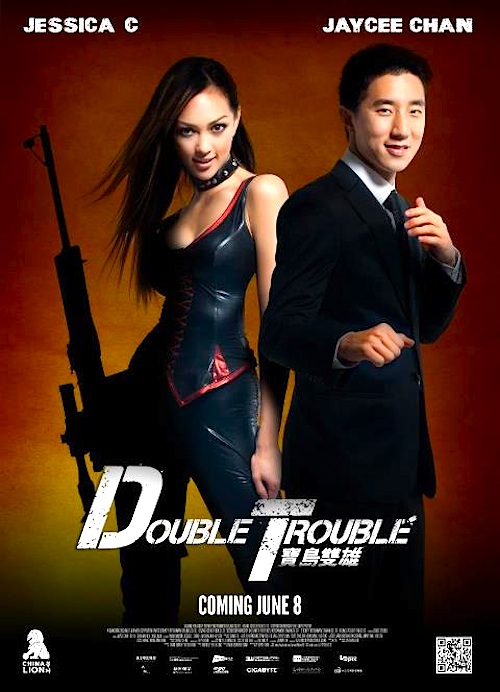
As the earnest Jay, Jaycee Chan exhibits something of the rubber face and rubber bones that made his father an international movie-star. He also has a similarly likable on-screen demeanor. Unfortunately, Double Trouble is a bit too much like late Hollywood period Jackie Chan than his early cult favorites for fans to pronounce the baton has been fully passed. However, it is safe to say HK model Jessica C. (a.k.a. Jessica Cambensy) has arrived as an action femme fatale. After all, there is a reason she is on the poster with Chan, even though they are bitter foes in the film. As for his reluctant crime-fighting partner, a little of Xia Yu’s Ocean goes a long way.

Indeed, the bickering bromance is laid on rather thick and the humor is almost entirely of the slapstick variety. Nonetheless, the depiction of border-crossing friendship (and maybe even romance with another member of Ocean’s tour group, appealingly played by Deng Jiajia) is rather pleasant, because it never feels overly soapboxey or clumsily forced.

There are some nice stunts in Double and it also has Jessica C. going for it. It sincerely aims to please, but it is hardly has the grit or heft of a Police Story or even the relatively recent Shinjuku Incident. A harmless distraction, Double Trouble may indeed be remembered as a stepping stone for its promising young cast. It opens this Friday (6/8) in New York at the AMC Empire and Village 7, as well as in San Francisco at the AMC Cupertino and Metreon, courtesy of China Lion Entertainment.

LFM GRADE: C+

Posted on June 6th, 2012 at 10:01pm.

Russia’s Bernie Madoff: LFM Reviews Pyrammmid @ The 2012 Brooklyn Film Festival

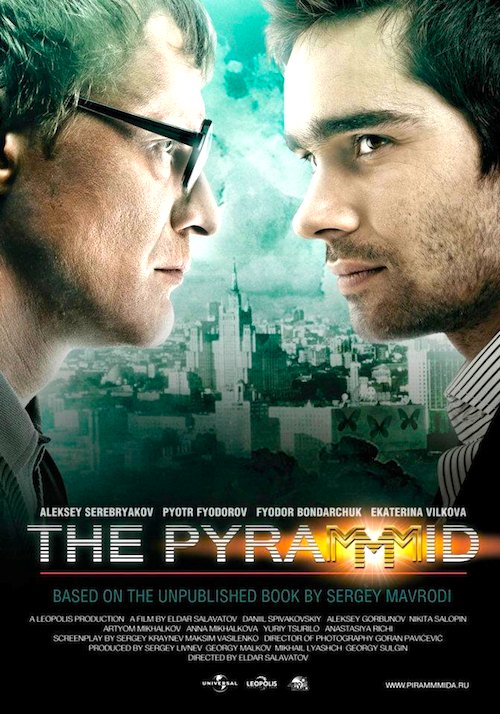
By Joe Bendel. Only Russia could celebrate a Ponzi scheme con artist as a national hero. It’s a complicated place. Transparently based on Sergei Mavrodi, the Russian Madoff, a bizarre episode of post-Soviet economic history is only slightly exaggerated in Eldar Salavatov’s Pyrammmid, which screens during the 2012 Brooklyn Film Festival.

Mavrodi’s dodgy financial empire was also known as MMM and its commercials promising forty percent returns on investment were a constant presence on Russian television during its heyday. Many Russians blamed its inevitable collapse on the government thanks to conspiracy theories no doubt nurtured by Mavrodi. However, the fictional Sergey Mamontov’s MMM really is the target of the corrupt national government and their oligarchic allies. Understand: Mamontov is no mere charlatan. He is scamming all that money in order to preserve Russian ownership of the old state-owned enterprises being sold to the well-connected at fire-sale prices, through a dubious privatization process. Well, that’s Pyrammmid’s story and its sticking to it.

It gets quite complicated, though. Raking in cash, Mamontov plans a fatal run on his major banking rival, while getting involved in weird sidelines, like buying the major Russian beauty pageant. Most of those distractions are the brainchild of maverick mathematician Anton who loses sight of the big picture. Frankly, the film is a bit overstuffed with plot, sacrificing the dead weight of transitions to fit it all in. As a result, audiences watching it in subtitles really have to keep on their toes.

Reportedly, Pyrammmid is based on an unpublished manuscript by Mavrodi, which must be considered either a novel or a memoir, depending on whether or not you happen to be Sergei Mavrodi. Ideologically, it is a bit of a head-scratcher, unambiguously lionizing exactly the sort of financial plunderer the current regime made its name inveighing against. Still, the symbolic significance of Mamontov’s choice of car is hard to miss: a vintage Soviet Chaika sedan. In fact, the film has nothing to say regarding the lack of consequences faced by the oppressive former Communist hardliners. Indeed, that refusal to account for the past has led the country precisely where it is now. The presence of Putin favorite Nikita Mikhalkov’s son Artyom and daughter Anna Mikhalkova in the ensemble cast further muddies the waters.

Having played more traditionally action-oriented protagonists in previous films (such as the Da Vinci Code-ish Golden Mean), Alexey Serebryakov is surprisingly convincing as the owlish Mamontov (those specs are another Mavrodi trademark). Unfortunately, he is largely surrounded by stock characters existing simply to serve the plot, like Gutov the shifty lawyer and Vera the ambitious muckraking photojournalist.

Frankly, the fact that this movie exists is downright mind-blowing. Imagine a slick, big budget American film positioning Bernie Madoff as a misunderstood hero, whom we should give good money to, for the sake of the country. That is about how Pyrammmid shakes out. It is a fast-moving big-canvas conspiracy thriller that does not always make a whole lot of sense. Yet, it is more stylistically grounded than the thematically related Generation P. Flawed but fascinating for Russia watchers, it screens again this Wednesday (5/6) at IndieScreen as part of this year’s Brooklyn Film Festival.

Posted on June 4th, 2012 at 9:31pm.

LFM Reviews Rose @ The 2012 Brooklyn Film Festival

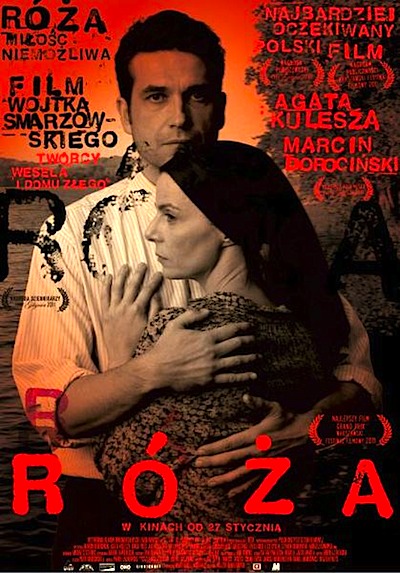
By Joe Bendel. The war is over, but for many Polish women it’s hard to call the aftermath “peace.” This is especially true for ethnic German Masurians, formerly of eastern Prussia, like Rose Kwiatkowska. Though Poland has been “liberated,” they are constantly reminded that “their side” lost, and are treated as treasonous pariahs, accordingly. Yet, Kwiatkowska’s situation is especially dire, as a mysterious Polish veteran slowly discovers in Wojtek Smarzowski’s uncompromising Rose, which opened the 2012 Brooklyn Film Festival Friday at the Brooklyn Heights Cinema.

Tadeusz Mazur is a world-weary Home Army veteran, who witnessed things during the Warsaw Uprising no man could forget. He watched as his wife was raped and murdered by the rampaging National Socialists, and was also present during the death of Kwiatkowska’s husband. She is not exactly welcoming when he turns up to deliver some of her husband’s effects, yet a bond slowly forms between them. Kwiatkowska needs protection from the Soviet-aligned bandits, who literally rape and pillage their way through the Masurian countryside. She could also use his help clearing the landmines from her fields, so they can harvest the potatoes. As for Mazur, he has his reasons to lay low, hoping not to attract the attention of the NKVD. However, Masuria is not the best place to be to avoid trouble.

Michał Szczerbic’s screenplay is brutally direct and honest about the treatment of women during wartime by the Germans, the Soviets, and their minions (indeed, they all seem to blend together throughout the film). The sheer volume of sexual assaults in Smarzowski’s historical drama is overwhelming, but they are never treated in a lurid or sensationalized fashion. Rather, it is a harrowing depiction of an ugly period of institutionalized score-settling.

Yet incredibly, Rose is a fundamentally a love story, sensitively bringing to life the brief but intense relationship that develops between Kwiatkowska and Mazur. There are no cute courtship rituals or romantic contrivances. They simply fall in love (or something near enough to it), while banding together to survive. It is definitely not pretty, but in a way, it is kind of beautiful.

Marcin Dorociński is riveting as Mazur, portraying him as both a flinty man of action and a tragic romantic hero. It is a bit surprising how thoroughly he dominates the film (since it is called Rose), but he does. Agata Kulesza is also quite haunting as Kiatkowska, creating a profile of herculean endurance. Their scenes together are quite special.

Despite somewhat rushing the third act (which features a few “wait, he did what?” moments), Smarzowski (previously represented at BFF with the gritty Martial Law-era noir The Dark House) deftly helms Rose, capturing the sweep of terrible historical forces, but maintaining an intimate focus. He forces viewers to confront the nature of the crimes committed against Kiatkowska and other Masurian women, up close and personal. Polish free jazz bass clarinetist Mikołaj Trzaska’s eerie minimalist score also heightens the unsettling mood.

Rose can be tough to watch, but it is an excellent film. Highly recommended, it screens again this coming Thursday (6/7) at IndieScreen, as part of this year’s Brooklyn Film Festival.

LFM GRADE: A

Posted on June 4th, 2012 at 9:30pm.