When Papa Met His Match: LFM Reviews HBO’s Hemingway & Gellhorn

By Joe Bendel. Ernest Hemingway deliberately cultivated his notoriously macho image – yet he somehow found four women willing to marry him at various points of his life. That was a lot of optimism, on everyone’s part. Though she had the shortest tenure as a “Mrs. Hemingway,” war correspondent Martha Gellhorn was the most notable. Matching and at times surpassing his feats of war zone journalistic daring, Gellhorn fired his passion and inspired his professional respect and jealousy. Their tempestuous relationship is dramatized in Philip Kaufman’s HBO Film Hemingway & Gellhorn now currently airing on the network.

When ambitious young magazine writer Martha Gellhorn first meets the funky, grungy Hemingway in a Key West bar, they can barely resist tearing the clothes off each other. The fact that he is married hardly matters to either of them. However, their animal attraction will have to briefly wait until they reunite covering the Spanish Civil War, at the behest of ardent Spanish Republican supporter John Dos Passos.

Working with Dutch Communist documentarian-propagandist Joris Ivens, Hemingway and Dos Passos film The Spanish Earth (with Gellhorn tagging along), for the purpose of rallying American audiences to the Republican cause. Frankly, it is considerable more compelling to watch their run-and-gun shooting process in H&G than the historical documentary itself. That adrenaline also fuels the war reporters’ torrid affair.

Just like Hemingway and Gellhorn’s relationship, the film really clicks during their time together in Spain. Viewers are served a liberal helping of Nationalist atrocities, but the portrayal of the Soviet forces is also refreshingly unvarnished, particularly with respects to the fatal purging of heroic Loyalist soldier Paco Zarra, a stand-in for Dos Passos’ doomed friend José Robles. While the literary power couple is shown fawning over Chou En-lai and sneering at the gauche Chiangs in China, Gellhorn also reports from Finland, unequivocally siding with the Finns against the Soviet invaders.
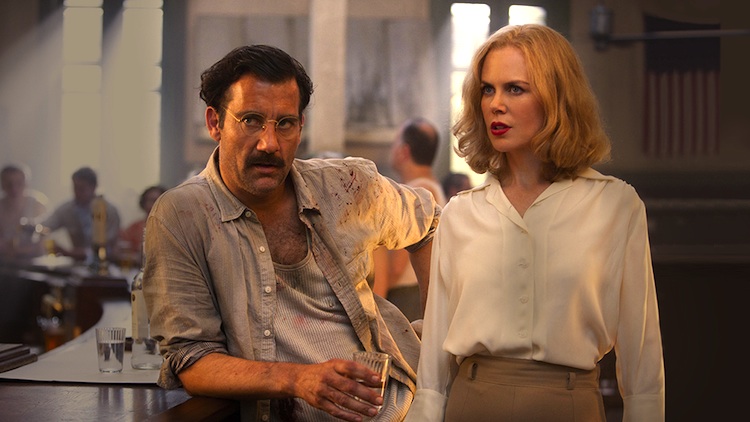
Clive Owen and Nicole Kidman in HBO's "Hemingway and Gellhorn."

Unfortunately, the film loses vitality with the aging Hemingway, sliding into the long denouement of his dubious u-boat chasing Cuban years and sad final days in Idaho. By the time America enters WWII, screenwriters Jerry Stahl and Barbara Turner clearly suggest Gellhorn was more of a man than Hemingway. Of course, this is a common problem with bio-pics. To be accurate, they can almost never end with the good stuff.

Regardless of his character arc, Clive Owen totally goes for broke as Hemingway. One of the few actors working today who can come across as both manly and literate, he bellows and carouses with relish. It is a larger than life performance, bordering on camp, yet he is still able to convey Hemingway’s inner demons and nagging self-doubts. He also manages to dial it down periodically for some saucy Tracy-and-Hepburn bantering with Nicole Kidman’s Gellhorn. Likewise, Kidman is on a very short list of actresses who can play smart, sophisticated, and alluring, simultaneously. In fact, she could be channeling Hepburn and the Rosalind Russell of His Girl Friday as the fast-talking, khaki-wearing journalist crusading against injustice, which is frankly pretty cool.
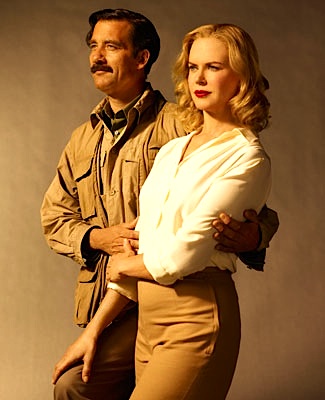
A tempestuous relationship.

In addition to the strong chemistry between the leads, H&G boasts a strong supporting ensemble. David Strathairn is particularly engaging as the disillusioned idealist, Dos Passos, serving as a subtle corrective to Hemingway’s ethical malleability. Metallica’s Lars Ulrich adds notable color as Ivens, while Tony Shaloub conveys a sense of both the menace and tragedy of the Stalinist true believer Mikhal Koltsov, who is considered to be the source for the Karkov character in For Whom the Bell Tolls. Again, the most inspired work comes during or prior to the Spanish Civil War sequences.

Frequently approximating the look of black-and-white news reels and Ivens’ documentary footage, H&G is highly cinematic (getting a vital assist from cinematographer Rogier Stoffers). Kaufman is a big canvas filmmaker, with sufficient artistic stature to merit a recent MoMA film retrospective—a high honor indeed. While steamier and gossipier than The Right Stuff, it is downright staid compared to his Henry & June and The Unbearable Lightness of Being.

An appropriately messy film sprawling all over the place, H&G is rowdily entertaining, capturing a good deal more historical insight than one would expect. Definitely recommended for those who appreciate the Hemingway oeuvre and persona (as well admirers of Gellhorn or Dos Passos), Hemingway & Gellhorn airs again on HBO June 2nd, 7th, 10th, 11th, 15th, and 19th and on HBO2 on June 4th, 6th, 12th, 17th, 21st, 25th, and 30th.

LFM GRADE: B

Posted on May 31st, 2012 at 9:21am.
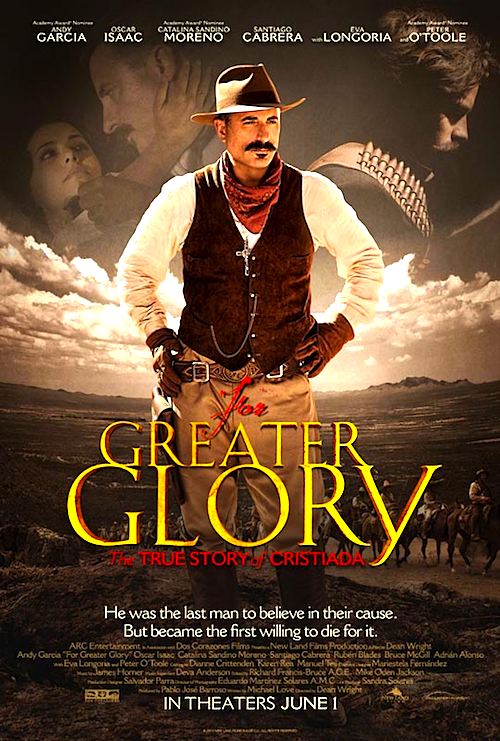
The Fight for Religious Liberty in Mexico: LFM Reviews For Greater Glory

By Joe Bendel. It could be said socialist “President” Plutarco Calles made Mexico a holier place. After all, he was ultimately responsible for the canonization of twenty-five Mexican saints, by martyring them during the Christero War. His brutal “anti-clerical” laws inspired a heroic rebellion, however, dramatized in Dean Wright’s For Greater Glory, which would have been thematically appropriate for Memorial Day weekend but which opens this Friday across the country instead.

General Enrique Gorostieta Velarde does not believe in the Catholic faith, but in religious liberty—perhaps enough to even die for it. He has also been offered an unusually high salary to take command of the hardscrabble Christero forces. Before his appointment, the Christero rebels had won embarrassing victories, but they were not considered a serious threat to the Calles regime. However, Gorostieta is a man to be reckoned with.

Calles is a duly elected dictator, who razes churches and executes foreign born priests like the kindly Father Christopher, played by Peter O’Toole (who must enjoy the irony of such a pious role, given his notoriously checkered private life). Glory is not shy about depicting the violent oppression meted out by the Calles forces, most notably with their treatment of José Luis Sánchez del Río, the captured mascot of Gorostieta’s army, who joined the Christeros after witnessing the state-sanctioned murder of Father Christopher. However, the film does not just wave the bloody shirt. Christeros like the legendary “El Catorce” take the battle to the Federales good and hard, heedless of their superior numbers, in several satisfying scenes of vintage warfighting.

Of course, Glory is a prime example of one of the fundamental laws of cinema: don’t mess with Andy Garcia. Perfectly cast as Gorostieta, he captures both the swagger and the gravitas of the principled man of action. It is easy to see why men would follow him into battle. Just as Garcia looks the part of Gorostieta, Ruben Blades is the near spitting image of Calles, aptly conveying his arrogance and ruthlessness.

Santiago Cabrera is also quite a riveting presence as Father Vega, a priest turned guerrilla general, while young Mauricio Kuri is surprisingly poised as Sánchez del Río. It is a strong and accomplished cast, even featuring Oscar nominee Catalina Sandino Morena (for Maria Full of Grace) as Christero fund-raiser Adriana. Though a bit of an undercooked role, she projects a strong presence nonetheless. However, Eva Longoria seems to be dropped into the film merely for decorative effect as Gorostieta’s wife, Tulita. Arguably the most intriguing supporting turn comes from the ever-reliable Bruce Greenwood as American Ambassador Dwight Morrow, sent to broker a deal to keep the petroleum flowing, duly fulfilling his brief despite the twinges of his conscience.

Indeed, Glory shines a spotlight on some conveniently overlooked Mexican and American history. Had Coolidge been more Reaganite and backed the Christeros, the Twentieth Century might have been much more prosperous and pleasant for Mexico. Instead, Calles’s PRI party would dominate Mexico for decades, whereas Calles himself briefly took refuge in America during a period of involuntary exile, where he fell in with the marginalized fascist movement (maybe he even met Morrow’s future son-in-law, Charles Lindbergh). Frankly, he ought to be regarded as one of history’s worst despots.

Granted, Glory is not exactly the most nuanced film, but there is not a lot of room for subtlety in such a brazen episode of religious persecution. Though director Dean Wright’s background is in special effects, he shows a strong aptitude for old school cavalry and artillery battles. (The English language dialogue is a bit of a misstep though, in contrast to the greater authenticity subtitled Spanish would have lent the film.) Pretty stirring stuff, For Greater Glory is earnestly recommended for everyone concerned about state encroachments on religious liberty,and who can still enjoy a sweeping historical tragedy. It opens nationwide this Friday (6/1), including at the AMC Empire and Village 7 theaters in New York.

LFM GRADE: B+

Posted on May 29th, 2012 at 2:58pm.

LFM Reviews The Last Man on Earth @ The 2012 Seattle International Film Festival

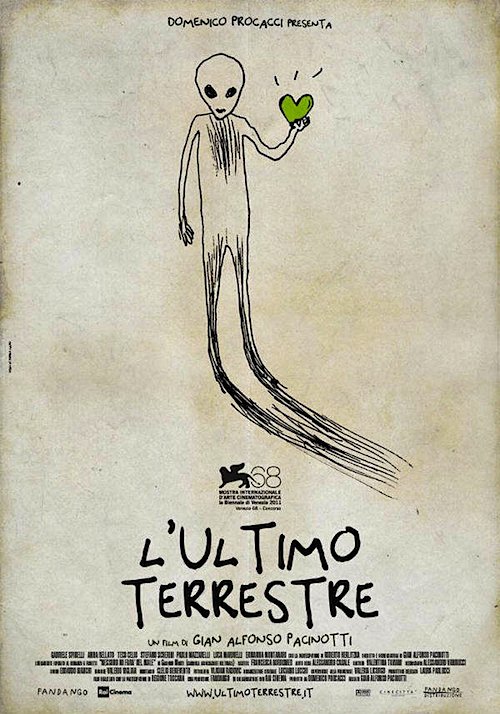
By Joe Bendel. It turns out there really are little grey aliens out there. The X-Files had them perfectly pegged physically, but the rest of their nature has yet to be determined. They are coming, though. A motley assortment of Italians await their anticipated arrival during the planet’s final pre-contact days in Gian Alfonso Pacinotti’s deceptively spoilerishly titled The Last Man on Earth, which screens as part of the 2012 Seattle International Film Festival.

Luca Bertacci is a miserable man leading a depressing life. The anti-social bingo parlor waiter has issues with women, but he is not too fond of men, either. Perhaps logically, his only friend (strictly platonic) is a transvestite prostitute. Still, there are understandable reasons for his emotional deep freeze. Despite his long nurtured resentments, he finds himself pining for Anna Luini, a pretty neighbor across the street.

Unlike the rest of the world, Bertacci tries not to think about the aliens, so he is rather surprised to find his elderly father cohabitating with an early arriver. It seems to be a chaste relationship, but her presence invigorates the old man. Bertacci even starts talking to Luini. It isn’t pretty, but it is a beginning. Unfortunately, mistakes in their private lives might have rather cosmic implications as first contact approaches.

Bertacci is hardly a typical sci-fi action protagonist. Rather than I Am Legend, think of him more like the guy in the “if you were the last man on Earth” expression. Still, the aliens really are coming, which serves as an amusing Rorschach for various characters’ neuroses. During the opening credits, one radio talk show caller even expresses concern for the impact on small market football teams. In a way, Last is like two (or perhaps one and a half) decidedly oddball love stories, connected by unrestrained existential dread.

Hardly kid-friendly space opera, Last lurches into some pretty ominous places, but Gabriele Spinelli solidly anchors it all as Bertacci. While sympathetic, there is clearly something off about the waiter that is never fixed with a neat psychological contrivance. Frankly, it is pretty engrossing just watching the dysfunctional gears turning in his head. Though she only has one really heavy scene, Anna Bellato is a dynamic presence as her namesake, while the makeup obscured Sara Rosa Losilla’s weirdly awkward body language perfectly suits the alien.

A distinctive work of cerebral social science fiction, Last would make a good double feature with Nacho Vigalondo’s Extraterrestrial, which also screens at SIFF this year. Of course, Pacinotti’s film would definitely be the darker half. Yet the comic artist (a.k.a. Gipi) turned director never allows the angst to overwhelm the story. Recommended for discerning genre fans, Last Man on Earth screens this Thursday (5/31) during SIFF.

LFM GRADE: B+

Posted on May 29th, 2012 at 2:21pm.

Corman-Style Cinema: LFM Reviews Attack of the Bat Monsters! @ Dances With Films

By Joe Bendel. Technically, there is only one bat monster in Francis Gordon’s latest B-movie, but it would hardly be the first time the zero-budget mogul delivered slightly less than promised. It will certainly attack though, rest assured. By hook or by crook, his cast and crew will pound out his next drive-in programmer in Attack of the Bat Monsters!, Graham Kelly Greene’s affectionate love letter to campy late 1950’s and early 1960’s monster movie-making, an alumni selection returning to officially open the 2012 Dances with Films this Thursday.

Attack is not about Roger Corman per se, but it would not have been made without his example. Gordon is definitely a grindhouse showman in the Corman mold. He is convinced he can fix anything in the editing room as long as they follow his cardinal rule: “when the monster’s dead, the movie is over.” Paralleling the genesis of Corman’s Little Shop of Horrors, Gordon wrapped production on his latest film early, but he still has three paid-up days in the southern California rock quarry he does not intend to waste.

From "Attack of the Bat Monsters!"

Suddenly, AD Chuck Grayson is rushing about lining up a screenwriter (the least important part), a pseudo-star, and a new monster (that would be the biggie). The beatnik poet Bobby Barnstone and his Barnstone method of Benzedrine-fueled stream-of-consciousness screenwriting looks like the best bet for generating fast pages. They don’t have to be good, after all. Larry “The Cat Creature” Meeker, Jr. seems to have fallen on hard enough times that he would consider a Francis Gordon movie; plus, a former creature-making colleague has just been fired by a major studio. However, he still harbors bad feelings over The Snake Woman, a Gordon production so notorious, the mere mention of the title sucks the air out of rooms.

All the Corman motifs are present and accounted for, including spaced-out beatniks, a jazzy soundtrack, and a ridiculously cheesy monster. What sets Attack apart from thematically similar B-movie pastiches is Greene’s confidence in the behind-the-scenes story. There will be no real life monsters or aliens invading their set, just the union goon extras from a studio gladiator movie sent to run the crew out of the quarry ahead of schedule.

Attack had its world premiere at DWF back in 2000. Frankly, the fact that the film has yet to develop its own cult following is downright mystifying, because it really delivers the goods. Greene knows the Corman lore inside-out and his cast of not exactly household names is way funnier than you would expect. There is also a real edge to his dialogue, as when Gordon indignantly defends his honor by declaring he always pays his taxes and pays-off his unions. Indeed, what more could one ask of a good Hollywood citizen?

Old-school schlock thriller.

There are some hilarious supporting assists here, particularly Robert Bassetti as Barnstone and Douglas Taylor as Meeker, Jr. Fred Ballard is also pitch-perfect as the prickly Gordon, while Michael Dalmon gamely holds the madness together as the put-upon Grayson.

Without question, Attack is generously stocked with goofy humor, but it can also be quite sly. Yet there is a real heart beneath the bedlam that cares about its characters, precisely because on some level they also care about the B-movies they are churning out, despite being fully aware of their schlockiness. A completely satisfying, all-around good show, Attack of the Bat Monsters is ripe for re/discovery when it opens this year’s Dances with Films this coming Thursday night (5/31) in Hollywood, USA.

LFM GRADE: A

Posted on May 29th, 2012 at 2:02pm.

The 35th Anniversary of Star Wars

By Jason Apuzzo. Star Wars was released 35 years ago today. It’s hard to believe it’s been so long! All these years later, the original Star Wars and Errol Flynn’s The Adventures of Robin Hood are still my favorite films of all time. Unlike with Robin Hood, however – which I first saw on TV – I had the good fortune of seeing Star Wars when it first came out in theaters back in 1977. My six year-old imagination was completely overwhelmed, and I was hooked on the movies for good.

If memory serves, the trailer above represents all that many of us knew about the film prior to its release – and it was pretty exciting stuff. And although a lot has changed about the Star Wars universe since that time, it’s worth remembering how fresh, original and imaginative the film seemed back in 1977. I know that watching Star Wars in 70mm Dolby stereo with excited crowds at the then-Plitt Century Theater in Century City (Los Angeles) still represents the most fun I’ve ever had at the movies. And really, the film hasn’t changed that much for me after all these years – the many special editions and digital revisions aside. I still love the film, and I don’t think it’s ever been topped.

Writer-director George Lucas did a marvelous job with this film, breaking a lot of new ground and opening up a whole new imaginative universe to audiences and filmmakers. I’d say even more about the film, but I have to go over to the Toshi station right now to pick up some power converters. 😉 Congratulations on Star Wars‘ 35th.

Posted on May 25th, 2012 at 10:56am.

LFM Reviews The Giant Mechanical Man @ Tribeca 2012; Available on VOD through June 19th

By Govindini Murty. In the midst of a movie season dominated by special-effects blockbusters, it’s nice to see smaller-scale indie films that celebrate the human within technology. Lee Kirk’s The Giant Mechanical Man, a selection of the 2012 Tribeca Film Festival currently available on VOD (video on demand), depicts two sensitive souls looking for meaning within the machinery of the modern city. Set in Detroit, the title also evokes the industrial heritage of the city, with elegant montages that resemble sequences from such classic ‘20s documentaries as Paul Strand and Charles Sheeler’s Manhatta or Walter Ruttman’s Berlin: Symphony of a City.

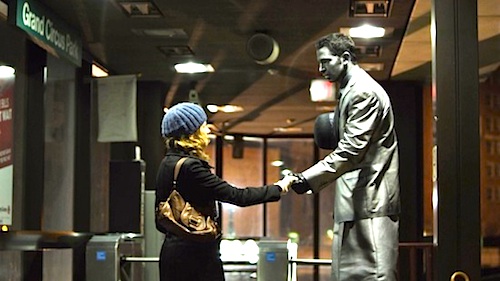
The Giant Mechanical Man stars Jenna Fischer as Janice, a shy and insecure thirty-something struggling to find purpose in her life. She works as a temp but her lack of focus gets her fired – forcing her to move in with her picture-perfect, blonde, ambitious sister Jill (Malin Akerman) and her dentist husband. Tim (Chris Messina) is also a thirty-something loner adrift in the big city. He spends his days as a performance artist on the streets of Detroit playing a robot-like figure on stilts known as the Giant Mechanical Man.

The opening of the film features a striking, almost avant-garde sequence. Tim dons silver face paint, a silver suit, and stilts, puts on a silver bowler hat and – grabbing a silver umbrella – heads down the streets with a purposeful stride that is an ironic commentary on the businessmen around him going to work. Tim’s Giant Mechanical Man is an exaggerated, postmodern version of The Man in the Gray Flannel Suit, the subject of the best-selling 1955 novel by Sloan Wilson about a businessman who struggles to find meaning in his career.

When a local news show asks Tim why he does his act, he explains:

“I thought that it might brighten people’s lives up. … I guess I feel like modern life can be alienating … you’re mindlessly walking through it like a robot and you can feel lost. … Maybe if you see a giant mechanical man wandering down the street towards you, it would help to put it into perspective, you know?”

Jenna Fischer and Chris Messina in "The Giant Mechanical Man."

Janice sees Tim performing on the street and feels a connection with him, recognizing in his mechanical motions her own sense of being just a cog in the machine of the city. Through serendipity, Janice and Tim then both get jobs at the Fillmore Zoo. The zoo serves as yet another metaphor for the entrapment of humans in modern city life, with Tim at one point even comically pretending to be one of the exhibits. Janice and Tim strike up a friendship that turns into romance, but Tim is unable to tell Janice that he is the mechanical man. All this is further complicated by her sister Jill’s efforts to set Janice up with a self-absorbed author of motivational books, played with gusto by Topher Grace.

Woven into the story is Janice and Tim’s love of silent movies. As in Martin Scorsese’s Hugo, a love of silent movies in Mechanical Man is used to indicate an affinity for the poetic and the romantic. Janice watches Charlie Chaplin’s The Kid and Buster Keaton’s The General – perhaps drawn to both films because they feature wistful, sensitive characters who resemble herself.

The Giant Mechanical Man is a sweet, feel-good alternative to this summer’s action-heavy movie fare. Jenna Fischer and Chris Messina are both charming in their roles, and the quirky cast of supporting characters deftly play their parts. I especially appreciate the fact that Chris Messina’s Tim is a gentleman, standing up at one point to some misogynistic yuppie characters at a business party. I would have liked to have seen more stylistic experimentation in the film to highlight the theme of mechanization, but director Lee Kirk nonetheless shows in his debut feature a nice touch for genuine emotion and humanistic values.

The movie’s air of romance carried over into real life, as well, with star Jenna Fischer and director Lee Kirk falling in love during the shoot and getting married – a sweet, real world ending to a charming movie tale. The Giant Mechanical Man is currently available from Tribeca Films on video on demand through June 19th.

LFM Grade B+

Posted on May 25th, 2012 at 9:57am.