LFM Reviews Wes Anderson’s Cannes Opener Moonrise Kingdom

By Joe Bendel. Two twelve year-old runaways would like to remake the generic sounding Mile 3.25 Tidal Inlet into a New England version of the Blue Lagoon, but they aim to maintain the cultural trappings of 1965 middle class America, as they relate to it, in the process. Unfortunately, the adult world keeps intruding on their private moments in Wes Anderson’s Moonrise Kingdom, the opening night film of this year’s Cannes Film Festival, which bows theatrically in New York tomorrow (Friday, 5/25).

Sam Shakusky is a terrible Khaki Scout. Actually, his skills are not that bad, but he does not fit in socially with Scout Master Ward’s troupe. Unbeknownst to Ward, Shakusky is an orphan, about to get the heave-ho from his foster family. However, the sensitive scout has successfully wooed Suzy Bishop, the eldest child of two self-absorbed yet profoundly unhappy attorneys.

When Shakusky fails to appear at revile one fateful morning, it sets off a manhunt throughout New Penzance Island, taxing the meager resources of Captain Sharp, Mrs. Bishop’s recently dumped lover. Chastely dedicated to each other, the two fugitives would like to permanently retreat from reality at the prosaically named inlet they duly redub “Moonrise Kingdom.” Instead, they will repeat a cycle of chase, apprehension, and escape, as a historic storm approaches New Penzance, as it always happens in an island-bound story.
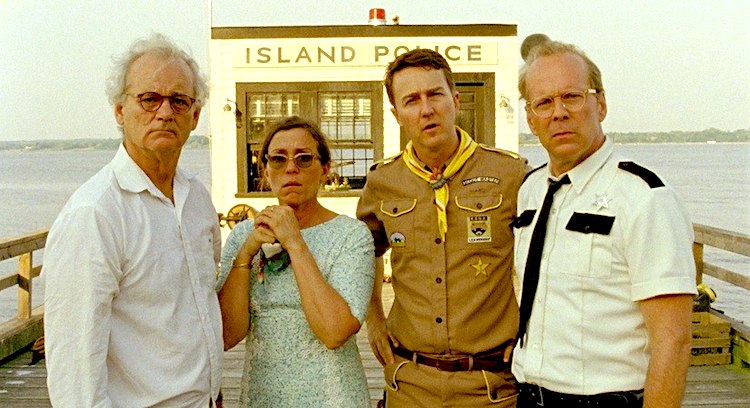
Bill Murray, Frances McDormand, Ed Norton and Bruce Willis in "Moonrise Kingdom."

It takes about ten seconds for Moonrise Kingdom to announce itself as a Wes Anderson film, through his constantly panning camera and the richly detailed vintage sets. Indeed, the attention to detail extends down to the covers of the chapter-books Bishop reads aloud to Shakusky. Yet, rather than detracting from his fable-like story, Anderson’s signature style is perfectly suited to the innocence of young love. Focusing on young POV characters is actually quite a shrewd strategy on his part, giving him the license to incorporate all kinds of nostalgic eccentricity (nod to Norman Rockwell? Check.) while staying faithful to their precocious worldview. Frankly, this is the sort of film a visual stylist like Tim Burton ought to be making, instead of aimless tent-poles like Dark Shadows.

As Mr. Bishop, Anderson mainstay Bill Murray once again plays a middle-aged depressive with deep-seated relationship woes. Fellow alumnus Jason Schwartzman is also back for more, getting some of Moonrise’s best comedy scenes as Cousin Ben, a slick operating senior Khaki Scout. Indeed, the film boasts several notably colorful supporting turns, including by Bruce Willis, acting his age and playing against his action hero persona as the put-upon Captain Sharp. Tilda Swinton also absolutely plays to the hilt the personification of bureaucracy known simply as “Social Services,” while the mere sight of Bob Balban’s “Narrator” in his bright crimson wardrobe generates laughter. Still, the dramatic load largely falls on the young newcomers, Jared Gilman and Kara Hayward, who are quite emotionally engaging leads, playing their scenes together scrupulously straight.

Essentially, Moonrise is a children’s movie for adults. Robert Yeoman’s cinematography gives it all a sensitive period sheen, while the soundtrack (dominated by the unlikely combination of Benjamin Britten and Hank Williams recordings, more than Alexandre Desplat’s original themes) effectively underscores the wistful vibe. Altogether, it is very Wes Anderson – but its gentle, humane spirit is quite winning. Recommended surprisingly highly (well beyond Anderson’s established circle of admirers), Moonrise opens tomorrow (5/25) in New York at the AMC Lincoln Square and Regal Union Square.

LFM GRADE: B+

Posted on May 24th, 2012 at 1:08pm.
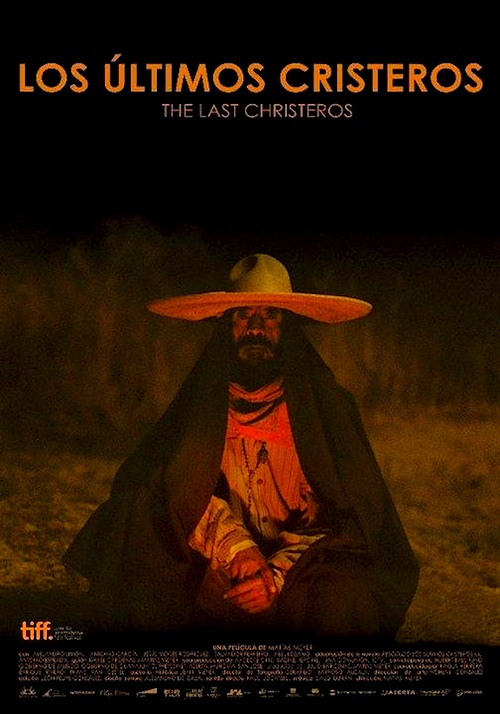
The Price of Liberty: LFM Reviews The Last Christeros @ The 2012 Seattle International Film Festival

By Joe Bendel. One of the twentieth century’s bloodiest assaults on religious freedom happened in the western hemisphere. It was perpetrated by “revolutionary” Mexican socialist president Plutarco Calles, whose iron-fisted anti-clerical policies inspired a real grassroots revolution. By the 1930’s an uneasy and imperfect peace had been brokered, but scattered bands of Cristero resistance fighters held out as best they could. One of the final squads grapples with their destiny in Matías Meyer’s The Last Christeros, which screens during the 2012 Seattle International Film Festival.

Mexico is still a land of wide vistas John Ford could love, but it is steadily closing in on the Cristero remnants. Pursued by a company of Federales, Col. Florencio Estrada’s troops are running low on everything, including bullets. Word reaches them of an amnesty, which some of the men are willing to consider. However, Estrada has been down that road before. Calles had violated the terms of truces before, and the period of his unelected “Maximato” was still underway. Though he misses his wife and daughters, Estrada has long since realized he will meet his end through this war, one way or another.

To establish the stakes of the Cristero revolution, Meyer opens the film with the 1969 oral history recording of Francisco Campos, who very well may have been the last Cristero. However, that is about as deeply as the film delves into the political, historical, and religious significance of the civil war. Instead, Last Christeros (for some reason, the international title carries the Anglicized “h,” while most references to the Cristeros maintain the original spelling) is an impressionistic depiction of the trying conditions endured by the weary freedom fighters. Theirs is not an existential life, though. Rather, they live for a purpose.

Though the ensemble consists largely of neophyte actors, they all look convincingly gaunt and weathered. Alejandro Limon is particularly haunting as the dedicated (and/or resigned to his fate) Estrada. Yet the picture’s defining work is that of cinematographer Gerardo Barroso, who creates painterly-like tableau of the rugged terrain and hardscrabble villages the Cristeros silently trudge through. Galo Duran’s evocative soundtrack also helps set an appropriately wistful mood.

For those thinking the Cristero revolt would also readily lend itself to a more traditional historical drama take heart—Andy Garcia rides into theaters with For Greater Glory on June 8th. This mini-boomlet of interest in the Cristeros is actually quite timely. In an election year, it reminds us of the price many have paid for liberty. If not exactly a work of advocacy cinema, Meyer certainly respects the Cristeros’ sacrifices. Recommended for open minded cineastes, The Last Christeros screens again next Wednesday following (5/30) as part of this year’s Seattle International Film Festival.

LFM GRADE: B

Posted on May 24th, 2012 at 1:08pm.
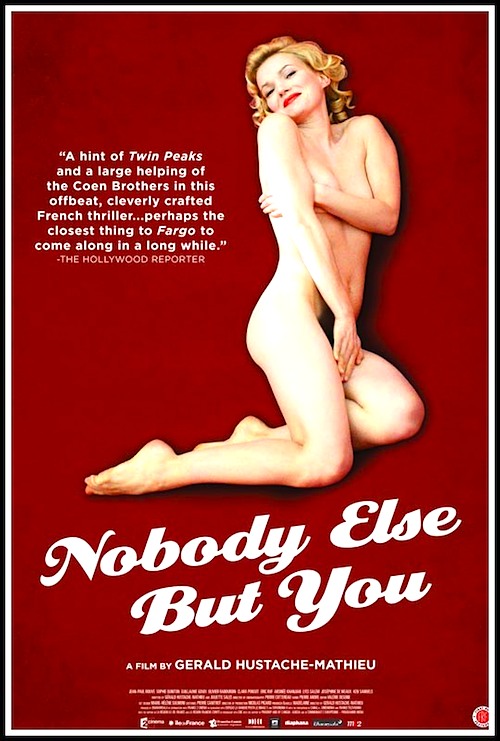
Channeling Marilyn: LFM Reviews Nobody Else But You

By Joe Bendel. Generally speaking, it is a bad idea to emulate self-destructive movie stars. However, the sexpot of Mouthe, the coldest town in France, does not have a lot of role models to follow. Unfortunately, she meets the same fate as her idol Marilyn Monroe in Gérald Hustache-Mathieu’s slyly inventive Nobody Else But You (a.k.a. Poupoupidou), which is now screening in New York.

David Rousseau is a series mystery author with a severe case of grinder-outer’s block. In Mouthe on a time-wasting errand (the sort of excuse editors refer to as “waxing the cat”), Rousseau is intrigued by a tragic local death. The body of weathergirl and aspiring actress Candice Lecoeur was found in the no man’s land between the French and Swiss borders. As a result, her death will not be properly investigated, unless he does it himself.

As he reconstructs Lecoeur’s life, largely by reading her diaries, Rousseau begins to fall for the woman who honestly believed she was the reincarnation of Norma Jean. Likewise, Lecoeur develops affectionate feelings for the hack writer turned sleuth. Yes, she serves as the real time spectral narrator of the film, just one of the many potential pitfalls Hustache-Mathieu nimbly skirts.

NEBY obviously suggests comparisons with Otto Preminger’s Laura, but Lecoeur really is dead. Even so, it really is a love story between Rousseau and Lecoeur, distinguished by if-only regrets rather than romantic courtship. Yet somehow Hustache-Mathieu manages to keep the tone relatively light and buoyant, which is a neat trick indeed. He also fully develops the Marilyn Monroe connection in a spirit similar to Kenneth Branagh’s Dead Again and clearly demarcates each of the many flashback sequences.

Looking like Michael Fassbender’s dissolute older brother, Jean-Paul Rouve is scruffily charismatic as Rousseau, but he has an undeniably intelligent screen presence. Appropriately not exactly a drop-dead beauty, Sophie Quinton still exudes unbridled sex appeal as Lecoeur, while conveying all her inner insecurities. Rarely together on-screen, they still develop their not-relationship quite convincingly.

A great noir thriller with a fair sprinkling of laughs and a hint of paranormal romance, NEBY is a wholly original and completely satisfying film. Cleverly written yet totally engaging and accessible, it is highly recommended for general (if somewhat adult) audiences. It is now playing in New York at the Cinema Village and opens in Los Angeles at the Landmark Nuart on June 8th.

LFM GRADE: A

Posted May 16th, 2012 at 11:59am.

Class Conflict in Today’s Russia: LFM Reviews Zvyagintsev’s Elena

By Joe Bendel. Elena could have been an old world Russian babushka. She even still wears the traditional head scarves. Yet, she has married into the world of oligarchic privilege. It is a pleasant if loveless marriage, but fundamental disagreements with her wealthy husband will take a dark turn in Andrey Zvyagintsev’s Elena, which begins a special two week engagement at New York’s Film Forum this Wednesday.

The working class Elena met the sophisticated Vladimir while working as a nurse during his convalescence two years ago. They have little in common except their dismal records as parents. His grown daughter Katerina is an entitled party girl emblematic of New Russia’s excesses. Elena’s slobby, unemployed son Sergey is only fit for queuing in lines and getting drunk. That might have been perfectly fine during the Soviet era, but it does not cut the mustard any more. While Vladimir readily underwrites Katerina’s high-flying lifestyle, he begrudges any support Elena offers her deadbeat family.

If anything, Elena’s thuggish grandson Sasha is even less accomplished than his father. In order to forestall his military service, Sergey will have to bribe Sasha’s way into college, but Vladimir is not having any of it. After collapsing in the gym, issues of inheritance come to the fore, provoking Elena to action for the sake of her proletariat family.

Such “action” is a relative term in Zvyagintsev’s deliberately paced film. He is much more interested contrasting the dramatic class distinctions of contemporary Russian than engaging in Double Indemnity style suspense. Frankly, viewers need to pay attention throughout Elena, because it is easy to miss the crossing of the Rubicon.

In contrast, it is impossible to not notice the differences between the two Russias. One is a world of glass and steel luxury (perfectly underscored by sparing excerpts from Philip Glass’s 1995 Symphony No. 3), whereas the other is a grubby suburb of Brutalistic socialist era architecture dominated by noxious looking nuclear containment domes. There is also a pronounced psychological difference, as well. Vladimir harshly dismisses Sergey as a lazy drunken slacker, but he is not exactly wrong.

Indeed, a mother’s love may oftentimes be blind (it might have been clever to have opened Elena over the weekend, but it is hard to imagine any son taking mom to see it) and Elena is arguably indulgent to a fault. However, it is her relationship with Vladimir that is most intriguing. Nadezhda Markina palpably conveys a complicated lifetime of struggle as the title protagonist, while developing some ambiguous yet very real chemistry with actor-director Andrey Smirnov’s Vladimir. The precise nature of their union remains hard to pigeonhole, with several scenes supporting disparate interpretations.

Elena certainly shines a spotlight on the inequalities of Putin’s Russian – still a playground for compliant oligarchs. Yet, as a film it is really a showcase for Markina’s remarkable, unadorned performance. Though the tempo is undeniably leisurely, there is a real point to it all, as it heads towards a very specific destination. Recommended for viewers with adult attention spans, Elena opens this Wednesday (5/16) at Film Forum.

LFM GRADE: B

Posted on May 15th, 2012 at 3:57pm.

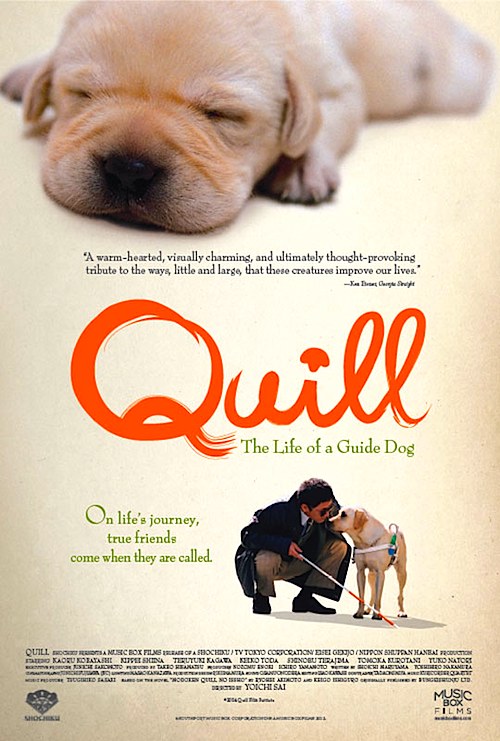
LFM Reviews Quill: The Life of a Guide Dog

By Joe Bendel. As cute as he is, Quill is a dog with a role in life. By virtue of his intelligence and empathetic intuition, the golden retriever will become a guide dog for the blind. His eventful dog’s life is lovingly depicted in Yoichi Sai’s Quill: the Life of a Guide Dog, which opens this Friday in New York.

Out of a litter of five pups, Quill is the shrewdest. His owner wanted them all to become guide dogs, but only Quill makes the grade. As a result, he will experience his first parting, leaving his puppy home to live with the Isamu and Mitsuko Nii, a couple who care for prospective guide dogs until they reach the age training commences. Considering how the Niis dote on him, Satoru Tawada’s training kennel requires quite an adjustment, but again Quill adapts.

Tawada has Quill in mind for Watanabe, the irascible chairman of a local nonprofit support organization, but the middle-aged man is resistant. Of course, Quill wins him over, but Watanabe’s health problems will complicate their time together.

Sai once served as an assistant director to Nagisa Ôshima on In the Realm of the Senses, a film about as dissimilar to Quill as one can possibly imagine. Not afraid of a little manipulative sentiment, Shoichi Maruyama and Yoshihiro Nakamura’s screenplay hits all the dog-lover bases good and hard. However, Quill’s adorableness at all ages is an undeniable ace in the hole. By the time the aged Quill comes full circle back to the Niis, even the brawniest of men will find themselves getting choked up.

No question, the canine cast is truly endearing, with the film’s trainer Tadami Miya maximizing their cinematic charm. The human ensemble is also rather pleasing, including Teruyuki Kagawa (recognizable from far darker Japanese imports, like Tokyo Sonata and the 20th Century Boys trilogy) and Shinobu Terajima (unforgettable in Wakamatsu’s disturbing Caterpillar), who are genuinely touching as the Niis.

Featuring a sensitive soundtrack by the Kuricorder Quartet, Quill has a gentle, humane vibe not unlike the work of Kore-eda. Though Sai’s film has been kicking around the festival circuit since 2004, its belated American release coincides with the dramatic increase in the social and commercial organization of U.S. dog lovers. Frankly, post-Marley and Me, it has enormous crossover potential. Recommended for canine fanciers and Japanese cinephiles, Quill opens this Friday (5/18) in New York at the Cinema Village.

LFM GRADE: B+

Posted on May 15th, 2012 at 3:55pm.