Horror in the Philippines: LFM Reviews The Road

By Joe Bendel. It is a familiar horror movie convention—one wrong turn can lead to a grisly death, so get yourself some GPS and join triple A. Alas, the misdirected teens who wander onto this stretch of pavement will become permanently lost in Yam Laranas’ Filipino horror film The Road, which opens this Friday in New York.

This has been going on for a while. In 1998, two sisters vanished without a trace on the road to nowhere. Ten years later, their grieving mother approaches a decorated rookie officer specializing in making everyone else look bad, convincing him to re-investigate the case. Yet, it quickly becomes apparent that the circumstances of their disappearance parallel an active, high priority investigation involving two cousins and their slacker guy friend.

As if two time frames were not sufficient, Laranas then flashes even further back, showing the audience how the tragic childhood of the thus far unseen psychopath destroyed his innocence and set in motion a chain reaction of bad karma. It turns out his father’s hyper-Christianity was a contributing factor. To be fair, dear old dad is really not a bad guy at heart, but the future killer’s shrewish mother enthusiastically adopted his strict rules governing the boy, simply out of meanness.

From "The Road."

Laranas actually sets the creepy scene quite well, hinting at the supernatural, but never quite delivering on it. Still, he palpably evokes the ominous dread of grudge-like remnants haunting the proceedings. His big twist also comes as something of a surprise, if only because it creates huge logical problems for the film in retrospect.

More fundamentally, it is just not a lot of fun to see the Roadie tormenting the young girls who fall into his web. These are not E.C. Comics characters that more or less have it coming. Frankly, horror movies like The Road would be much more entertaining if Laranas and his colleagues would pick on people more their size.

As the cop with chain-of-command issues, TJ Trinidad is an intense screen presence who sells the third act bedlam rather well. Unfortunately, the onerously slow pace becomes downright mind-numbing over time. Serving as his own cinematographer, Lanaras gives the film an interesting look and the dramatic work of his ensemble cast is considerably better than the genre standard, but that is about as far as The Road goes. A joyless and exhausting film, The Road is not recommended for horror movie fans. For those intrigued nonetheless, it opens today (5/11) in New York at the AMC Empire.

LFM GRADE: D+

Posted on May 11th, 2012 at 2:09pm.
Poland in the Communist Era: LFM Reviews The Dancing Hawk

By Joe Bendel. During Poland’s Communist era, there was no quicker way to an industrial minister’s heart than a spot of deforestation. Slavishly ambitious Michal Toporny learns this lesson as he rises through the bureaucratic ranks, jettisoning such trivialities as his family and his soul along the way. Not exactly a fable or a morality tale, Grzegorz Królikiewicz’s The Dancing Hawk is more like a visual barrage. It would not be the same film without Zbigniew Rybczyński’s inventive work behind the camera, making it the perfect companion to Gerald Kargl’s Angst during Shot by Rybczyński, the Spectacle Theater’s two-film tribute to the future Oscar winner’s cinematography starting this Thursday.

Hawk’s first twenty minutes or so are like the best cinematic adaptation of James Joyce never filmed. Toporny enters the cold, snowy world during a time of war. He comes from hardscrabble peasant stock, but evidently they were also minor property “holders,” an inconvenient fact that requires Toporny to be more Communist than thou in order to get ahead. He certainly has the necessary moral flexibility, throwing one wife overboard in favor of his politically connected classmate.

This opportunistic pattern of behavior will repeat throughout Hawk. In fact, there are repetitive loops throughout the film, intended to emphasize the Kafkaesque absurdity of the bureaucracy, or perhaps just to make the Communist censors’ heads explode. Frankly, it is rather staggering this one slipped past the state film authorities. Like matter and anti-matter, it seems impossible for Hawk and Socialist Realism to coexist in the same world.

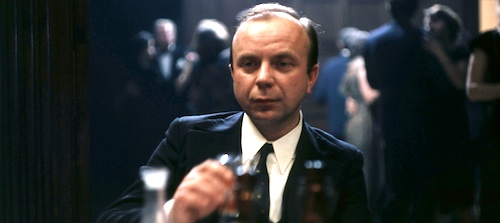
Franciszek Trzeciak as Toporny in "The Dancing Hawk."

Indeed, as feverish and bizarrely expressionistic as Rybczyński’s cinematography undeniably is, Królikiewicz’s critiques of the Socialist state remain impossible to miss. Central state planning takes it in the shins throughout the film, perhaps even harder than in Frank Beyer’s East German classic Trace of Stones. The Communist Youth of Toporny’s college years are also depicted as foaming-at-the-mouth bullies, who duly grow up to be vicious, petty, in-fighting apparatchiks.

As Toporny, Franciszek Trzeciak is surely small and banal, but he still finds a sad clown pathos within the character, even performing a surreal variation on the old Harpo Marx mirror gag. Toporny’s eventual realization that he has spent his entire life serving a cold and capricious master (much like the protagonist of Andrzej’s Wajda’s Without Anesthesia) is palpably heavy stuff, even with all the madness swirling around him.

Hawk represents incredibly bold filmmaking, in both stylistic and political terms. Defying conventional description, Rybczyński’s cinematography gives the loose narrative a hallucinatory shimmer with an appropriately drab socialist color scheme. A masterwork of protest cinema, The Dancing Hawk is a viscerally defiant product of its time: late 1970’s Poland, an era that would culminate with the imposition of Martial Law. Highly recommended, it screens this Thursday (5/10), Sunday (5/13), and Friday (5/25) as part of Shot by Rybczyński at the Spectacle Theater in the County of Kings.

Posted on May 8th, 2012 at 12:29pm.

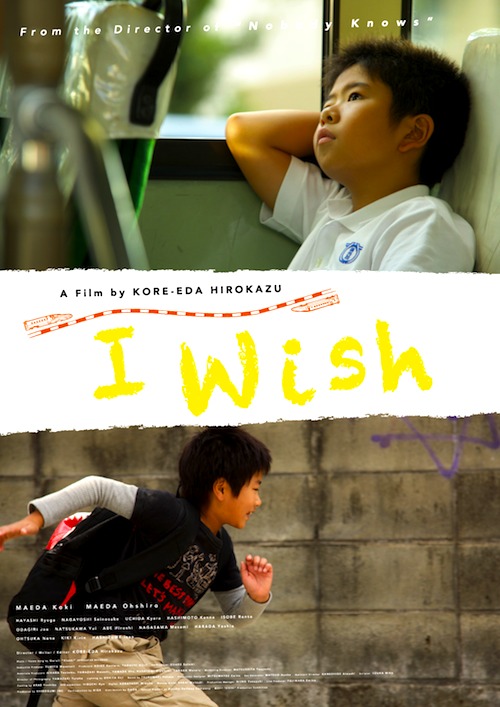
LFM Reviews Kore-eda’s I Wish

By Joe Bendel. Never dismiss the characters of Hirokazu Kore-eda’s latest film just because they are elementary school children. Unlike the parade of hipster man-children audiences see in indie after indie, many of these youngsters will amount to something in life. They are also facing some very real drama at a relatively early age in Kore-eda’s unusually wise and gentle I Wish, which opens this Friday in New York.

When their parents split up, Koichi decided to go with his mother to live with his grandparents in Southern Kyushu. His younger brother Ryunosuke opted to stay with their irresponsible garage-rocker father in the north. Always close, it is a difficult separation for the brothers, but they think their respective parents need them more. Still, it seems to weigh more heavily on Koichi, troubled to find himself not regularly fulfilling his duties as a big brother.

Koichi sees potential deliverance in the imminent opening of the new bullet train linking north and south Kyushu (completed in a mere fraction of the time needed for the still unfinished Second Avenue subway). Word has it that anyone standing on the exact spot where the maiden north and south bound trains cross will have their wish granted. Koichi convinces Ryunosuke to meet him there so they can both wish for their family to be reunited. (Finally, a real world application for those “two trains” math problems.) Of course, it is easier said than done. Arranging train tickets and school absences without the knowledge or consent of their parents will require caper-like planning.

As a result, both brothers bring along their co-conspirator friends, each of whom has a wish of their own. The way Kore-eda draws out their distinct personalities and captures their subtle interaction is a joy to behold. Likening Kore-eda to Ozu is a danger critics often succumb to, but I Wish particularly lends itself to such comparisons. He coaxes some remarkably rich and grounded performances from his youthful cast, placing them in situations of conflict with one another, but harboring malice for none.

Real life brother-performers Koki and Ohshiro Maeda clearly had an intuitive sense of how to distill the essence of their own fraternal relationship and infuse it into their on-screen roles. They are smart, resourceful, and sensitive, but never in an overly cloying way. Frankly, I Wish has a wealth of talented young actors, including the particularly noteworthy Kyara Uchida as Megumi, one of the older girls Ryunosuke befriends (remember, his dad is in a band). If, like her character, her driving ambition is to become an actress, she should be well on her way to a brilliant career.

As with Still Walking, Kore-eda’s last film to have significant American distribution, I Wish depicts serious family issues with a remarkably light touch, but it is the spirit of forgiveness and the acceptance of fate that make the films so special. Yet, the earnest young cast represents a potentially far greater crossover appeal for I Wish. Highly recommended, it opens this Friday (5/11) in New York at the Lincoln Plaza and Angelika Film Center.

LFM GRADE: A

Posted on May 8th, 2012 at 12:27pm.

Midnight Madness: LFM Reviews Asylum Blackout

By Joe Bendel. If the Beatles had worked as cooks in a maximum security mental hospital, they still would have been vastly more talented than George and his slacker bandmates. Yet, for a day job, the pay is pretty good and supposedly they are completely out of harm’s way. Of course, when the power goes out, all bets are off in Alexandre Courtès’ Asylum Blackout, which opened a week of midnight screenings last week at the IFC Center in New York and is also now available on IFC Film’s VOD platforms.

It is 1989, so nobody will spoil the fun by calling for help on their cell-phones. We will be rooting for George to live, because he is a nice enough guy to care how the patient-inmates’ food tastes. He also has a hot girlfriend, so he has something to live for. Regardless, it is going to be a long night when the blackout hits.

The chief guard, J.B., sounds totally cool, but he is actually an abusive hardnose, which makes the opportunity for some score-settling even more attractive. In something of a perfect storm for loony bins, George suspects the scariest prisoner, Harry Green, has convinced the rest of the inmates to stop taking their meds. From there, things descend into bedlam, so to speak, with hints of further eeriness lurking in the margins.

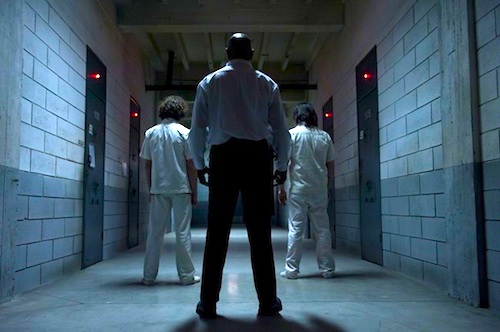
From "Asylum Breakout."

Just to recap, the descriptively titled Asylum Blackout (a.k.a. The Incident) combines a fully stocked nuthouse with a power outage. As long as the execution is serviceable, this is a bullet-proof concept. As it happens, Courtès’ work easily surpasses competent, approaching the outright stylish. The audience never gets any backstory on the loonies, but many at least have weird distinguishing tics. While Courtès eventually meets the gore quota for midnight movies, he takes his time setting the scene and building the tension—what might be considered horror movie foreplay.

Okay, Asylum Blackout is not The Shining, but it will still creep you out from time to time. Paul Rouschop’s design team makes the sanitarium feel like a very real and very ominous place to be, even with the lights on. Rupert Evans is a decent lead and Richard Brake is all kinds of sinister looking as the nefarious Green. Not nearly the gross-out fest you might expect, Asylum Blackout is a pretty good time at the midnight movies. It screens late nights this week at the IFC Center and is also available nationwide through IFC’s VOD services.

LFM GRADE: B

Posted on May 8th, 2012 at 11:04am.