Tribeca/San Francisco International Film Festival 2012: LFM Reviews Chicken with Plums

By Joe Bendel. Over an eight day period, Nasser-Ali Khan will become the anti-Scherezade. As he wills himself to die, stories from his past, narrated by the Angel of Death, will explain how the musician reached such a state of profound melancholy. Love and death become intimately intertwined in Marjane Satrapi & Vincent Paronnaud’s Chicken with Plums (trailer here), their fantastical but sophisticated live-action follow-up to the rightly acclaimed Persepolis, which screened at the 2012 Tribeca Film Festival and also unspooled yesterday at this year’s San Francisco International Film Festival.

Khan is widely regarded as the greatest Iranian violinist of his generation, but he has stopped playing. On the surface, his silence appears to be the fault of his wife Faringuisse, who destroyed his prized violin in one of their frequent squabbles. However, his depression is rooted in an elegantly tragic tale of love denied.

Technically proficient but never impassioned, Khan’s music took on uncommon richness after he was forbidden from seeing his true love Irâne, the traditional clockmaker’s daughter. Music never has been considered a stable profession by protective fathers. As Khan’s reputation rises, he acquiesces to his controlling mother’s wishes and marries Faringuisse. For him, it is a loveless union. For her, it is a marriage based on unrequited love.

Frankly, Khan is a crummy husband and a negligent father, but it is difficult to condemn him after witnessing his compounded heartache. Mathieu Amalric, with his big sad eyes, is perfectly cast as the exquisitely sensitive jerkweed. Viewers will sympathize with him, even as they shake their heads at his casual cruelty to Faringuisse. Likewise only more so, Maria de Medeiros (Bruce Willis’s girlfriend in Pulp Fiction) explodes the harpy exterior of his nagging wife, revealing the pain and vulnerability of Faringuisse.

Set in the late 1950’s pre-Shah, Western-leaning Iran, Satrapi and Paronnaud’s fable of star-crossed love would seem to hold limited political ramifications. However, it is not an accident that Khan’s forbidden love is named Irâne (as they confirmed in a post-screening Q&A). That she is played by Golshifteh Farahani is also clearly significant. The internationally acclaimed actress was barred from returning to Iran after (tastefully) posing nude in a French magazine to protest the Islamist regime’s misogynist policies. A radiantly beautiful woman, she also invests her character (and the film) with a graceful sadness.

Visually, Plums is also quite arresting, incorporating brief animated interludes, expressionistic sets, and highly stylized design elements. The inspired technical team definitely creates a seductive atmosphere of magical realism that is a pleasure to get caught up in. Highly recommended, Chicken with Plums was enthusiastically received by audiences at this year’s Tribeca Film Festival. For those in the Bay Area, it also screens Wednesday (5/2)  as part of the 2012 San Francisco International Film Festival, concluding this week.

LFM GRADE: A

Posted on May 1st, 2012 at 6:37pm.
Tribeca/San Francisco International Film Festival 2012: LFM Reviews Trishna

By Joe Bendel. Social class is a hard immutable fact of life in Thomas Hardy’s Tess of the D’Urbervilles. Plunking the classic story down in contemporary America would be highly problematic, but India is a different matter. Taking a few liberties here and there, Michael Winterbottom still captures the spirit of the original novel and its new setting in Trishna, which screened at the 2012 Tribeca Film Festival, with further screenings coming up this week as part of the San Francisco International Film Festival.

Jay will serve as both Trishna’s Angel and Alec. Touring the off-the-beaten-path attractions of Rajasthan, his head is turned by Trishna, the primary provider for her large family. The son of a British hotel mogul, Jay recruits the young woman for the resort he reluctantly manages. Things are quite pleasant for Trishna, making considerably more than she ever could in her village, while Jay harmlessly pines for her.

One night when her defenses are weakened, Trishna succumbs to Jay’s advances. Instinctively realizing a Rubicon has been crossed, Trishna retreats, but Jay pursues, whisking her off to Mumbai, where they are socially accepted as a couple. However, Trishna’s life and relationship will take a dark turn, paralleling Tess’s tragic history with men.

You never know what you’re going to get from Winterbottom, but he has emerged as the leading cinematic interpreter of Hardy’s novels, following up Jude and The Claim, very loosely based on The Mayor of Casterbridge. He is clearly comfortable navigating the film’s sexually charged power-dynamics, but Trishna also exhibits an affinity for India, even including musical montage sequences (with original songs composed by Amit Trivedi) that would not be out of place in high-end Bollywood cinema.

Winterbottom uses the subcontinent as a big canvas, covering a wide swath of geography, but his focus rarely strays from Frieda Pinto’s Trishna. While some might find her maddeningly passive, she is a product of her environment. Through Pinto’s haunted presence, viewers get a sense of the social and cultural weight crushing down on her. Thanks to Winterbottom’s streamlining, Riz Ahmed’s Jay has to turn on a dime from leading man to a cruel exploiter. Still, there are enough underlying consistencies in the impulsive, entitled persona he creates to maintain audience credibility. Pinto and Ahmed really carry the dramatic load, but veteran character actor Roshan Seth (Chattar Lal in Indiana Jones and the Temple of Doom) has some memorable moments as Jay’s stern but humanistic father.

Granted, everyone should have a pretty good idea where Trishna is headed. After all, Hardy is not exactly famous for his happy endings. However, Winterbottom’s treatment of Tess is boldly cinematic. (Incidentally, Polanski’s Tess will screen as a classics selection at this year’s Cannes, so cineastes might want to break out their Cliff Notes.) Literate and absorbing, Trishna is recommended for anglophiles and fans of Hindi cinema, alike. A strong selection of the recently wrapped 2012 Tribeca Film Festival, it screens Wednesday and Thursday (5/2 & 5/3) during this year’s San Francisco International Film Festival.

LFM GRADE: B

Posted on May 1st, 2012 at 6:37pm.

Tribeca 2012: LFM Reviews Michael Fassbender’s Pitch Black Heist

By Joe Bendel. Michael Fassbender is fully clothed, while Liam Cunningham is really drunk. Together, they are a mismatched pair of crooks hired to pull off a very dark caper in John Maclean’s Pitch Black Heist, the winner of the 2012 BAFTA Award for best short film, which screened over the weekend as part of the Status Update programming block at the 2012 Tribeca Film Festival.

Known simply as Michael and Liam, two safecrackers are meeting each other for the first time on a very unusual job. They are to retrieve some item (it hardly matters what) from a safe with a light-sensitive alarm. To prepare, they practice navigating a dummied-up room in complete darkness. On the day in question, they meet in a quiet pub and wait for their employer to send them the all-clear. However, they find themselves cooling their heels far longer than they expected, so they start doing what you’re supposed to do in a pub, lest they attract attention.

Pitch has a nice little twist at the end that Maclean adroitly lays the groundwork for, without glaringly telegraphing it. Frankly, this concept could be relatively easily expanded into a feature, which makes the economy of Maclean’s thirteen minute storytelling all the more noteworthy. Still, the real entertainment is watching the boozy interaction between co-executive producers Fassbender and Cunningham. Both actors have genuinely intense screen presences, perfectly suited to their roles in Pitch.

It all looks quite stylish as well, thanks to Robbie Ryan’s appropriately noir black-and-white cinematography. A neat little ironic crime drama, Pitch Black Heist is one of the overlooked treats of the Tribeca line-up. As per tradition, all short film blocks screened on the concluding day of this year’s festival.

Posted on May 1st, 2012 at 5:39pm.

Tribeca 2012: LFM Reviews The Fourth Dimension

By Joe Bendel. Representing the fourth dimension in 2D is quite the daunting challenge. Fortunately, none of the filmmakers participating in a new hipster sci-fi anthology take it seriously. Nor will annoying glasses be necessary when watching The Fourth Dimension, three short films produced and assembled by Vice and Grolsch Film Works (cheers, mate), which screened again this afternoon as part of the 2012 Tribeca Film Festival.

In the opening The Lotus Community Workshop, Harmony Korine (yes, but don’t panic) takes us to a world much like our own, where Val Kilmer plays a low rent motivational speaker named Val Kilmer. Addressing church groups in roller rinks, he passes off ego-centric tripe as New Agey pearls of wisdom. Occasionally hinting at the metaphysical, Lotus seems more like a confessional piece from Kilmer, admitting to his fans: “I realize I was once Iceman in Top Gun and now I’m kind of a slob, but at least I still don’t have to work at a real job.” This is a case where brevity is definitely Korine’s ally. Given the relatively short running time, the self-referential joke maintains its novelty better than one might expect.

Making a bit of a concession to the film’s umbrella premise, Alexey Fedorchenko’s Chronoeye involves indirect time travel. Employing some analog-style technology, a misanthropic Russian scientist (is there any other kind?) is able to glimpse into the past. However, there is an attractive neighbor above him to remind viewers not to lose sight of the present. Fedorchenko (probably best known for the strikingly austere road movie Silent Souls) maintains a fable-like vibe, preventing Chronoeye from descending into the realm of romantic cliché.

Jan Kwiecinski’s Fawns might come closest to revealing the fourth dimension, since it induces Armageddon. Much like Abel Ferrara’s meandering 4:44 Last Day on Earth, doomsday vaguely involves global warmish-ing, but here it is more Biblical. A cataclysmic flood has led to worldwide evacuation, but a group of Polish slackers are too cool to pay attention. Instead, they careen about a provincial town, hinting at the sexual tensions within their group. Suddenly though, the end of the world takes a serious turn for the aimless youth. Frankly, none of the Kwiecinski’s characters are particularly well defined, but as a mood piece, it is quite eerie.

Defiantly disregarding the theme that ostensibly holds it together, The Fourth Dimension lurches all over the place, but it is not without merit. Indeed, there should be enough eccentricity in each constituent short film to satisfy some strange subset of cult film fandom out there someplace. Recommended for those in search of a bit of bemusement, it screened yesterday as part of the 2012 Tribeca Film Festival.

LFM GRADE: B-

Posted on April 28th, 2012 at 8:56pm.

Tribeca 2012: LFM Reviews Cheerful Weather for the Wedding

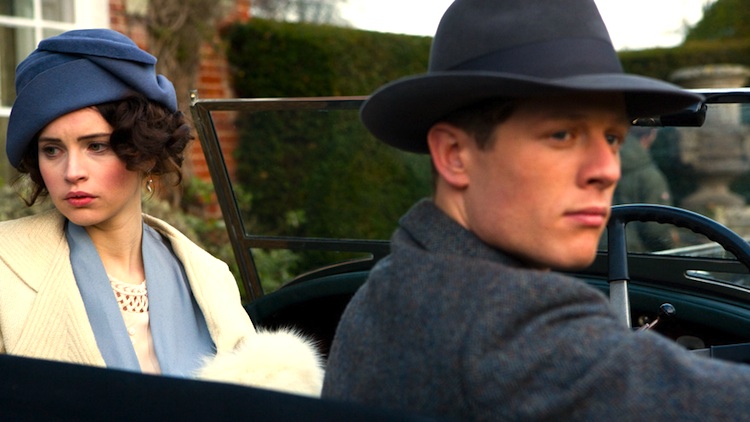
By Joe Bendel. In 1932, the British economy was also rather depressed, but appearances had to be kept up, nonetheless. A well-to-do widowed mother is determined to see her eldest daughter married in proper style, even if it kills the rest of her family in Donald Rice’s Cheerful Weather for the Wedding, which screens during the 2012 Tribeca Film Festival.

Dolly Thatcham became re-acquainted with her rich, twittish fiancé during a grand tour of Albania. She was most definitely on the rebound, following the end of her affair with Joseph Patten, a promising young academic. He was somewhat self-centered, but there was real passion between them, as the audience sees in multiple flashbacks. Her controlling mother could make the rest of the family sufficiently miserable on her own, but when the sullen Patten shows up at the house, it puts everyone further on edge. The fact that the bride has locked herself in her dressing room with a bottle of rum hardly helps matters either.

Based on the novella by Julia Strachey, a member of the Bloomsbury Group whose work has gained popularity in recent years, Cheerful Weather could be considered a lite beer version of Downton Abbey, but Rice and Mary Henley Magill’s adaptation clearly lacks Sir Julian’s delicious wit. Of course, the presence of Elizabeth Montgomery in the rather thankless role of Thatcham’s overbearing mother further invites such comparisons.

From "Cheerful Weather for the Wedding."

Still, Cheerful Weather offers a number of memorable moments, largely courtesy of its snappy supporting cast. Indeed, Mackenzie Crook and Fenella Woolgar steal scene after scene as the bickering Dakins, who largely reconcile through their shared distaste for his family. Julian Wadham also adds a humane touch to the film as the not-as-dumb-as-he-looks bumbling Uncle Bob, while Zoe Tapper brings considerable allure and even a bit of depth to Evelyn Graham, Thatcham’s fortune hunting maid of honor.

Unfortunately, Cheerful Weather’s weak romantically-doomed leads undermine the audience’s investment in the actual wedding. Looking rather dazed, even in the flashbacks, Felicity Jones’ turn as Thatcham is a pale shadow of Michelle Dockery’s Lady Mary Grantham. More baffling is the complete lack of screen presence displayed by Luke Treadaway as the morose Mr. Patten.

Frankly, it is hard to understand why Thatcham or Patten would pine for each other, but it is easy to see how this family would annoy the Dakins. Yet viewers can enjoy elements of the picture once they have shifted their sympathies accordingly. An okay but hardly exceptional period drama, Cheerful Weather seems best suited for PBS’s Masterpiece. For diehard Anglophiles, it screens again this Saturday (4/28) as this year’s Tribeca Film Festival enters its final weekend.

LFM GRADE: C+

Posted on April 27th, 2012 at 12:14am.