LFM Reviews Serangoon Road, Now Available on DVD

By Joe Bendel. If the boy from Empire of the Sun, grew up to be a hardboiled private detective, he would be a lot like Sam Callaghan. The Aussie expat is still haunted by his childhood experiences in a Japanese internment camp, but he toughened up considerably through his Malaya military service. He used to lend a hand to the late Winston Cheng on a freelance basis, but he reluctantly agrees to a more regular arrangement when his widow Patricia decides to keep the agency open. Thanks to the Secret Societies, terrorist bombings, and all sorts of garden variety smuggling, they will find no shortage of business in Serangoon Road, HBO Asia’s first original series production, which releases today on DVD from Acorn.

Callaghan sort of blames himself for Cheng’s death, but the elegant Mrs. Cheng plays the guilt card with restraint. Although she is from a “mainline” establishment Peranakan Chinese family, the childless widow still needs the agency as a means of support. With the help of Sam and her progressive niece Su Ling, she also hopes to catch her husband’s murderer.

Their first case seems to be a one-off with little long term implications, but it will introduce the large cast of characters. Fresh-faced CIA recruit Conrad Harrison and his shadowy boss “Wild Bill” need the Cheng Agency to track down an African American sailor accused of murdering his best mate. It is probably the series’ least flattering depiction of American spooks and servicemen, but at least Harrison, one of those “best and brightest,” seems to care about right and wrong. He is also very interested in Su Ling, but she initially wants nothing to do with a Yankee government employee.

The past will directly haunt the present in subsequent episodes, as when the Cheng Agency takes on an illegal refugee’s case in the second episode. Forced to take flight during the Japanese invasion, Ms. Feng has returned (undocumented) in search of the husband she left behind. The case looks pretty cold until Ms. Feng is mysteriously poisoned. As she clings to life, Callaghan scrambles to trace her beloved husband, empathizing with her deep sense of loss. He will become even more personally involved with a case later in the season, when the Aboriginal soldier who watched over him during the darkest hour of the war is accused of murdering an aspiring journalist.

Many of the Cheng Agency cases lead back to Kay Song, the heir apparent of Singapore’s most feared secret society (a gang primarily involved in crimes of sin). For some reason, the sinister gangster has it in for Kang, Callaghan’s compulsive gambling partner in a barely legal shipping operation. It is hard to see why he bothers, given Kang’s multitude of self-destructive flaws. Frankly, Kang subplots will become a tiresome distraction as the series progresses.

As befits a good period noir, everyone in Serangoon is compromised to some extent, particularly Callaghan, who is rather openly carrying on an affair with Claire Simpson, the wife of a junior executive assigned to a powerful western trading company’s Singapore office. Conveniently, Frank Simpson is often required to travel throughout Southeast Asia. Rather awkwardly, Callaghan is even hired to investigate his rival when Simpson is anonymously sullied with rumors of corruption.

During the course of the first season, the Cheng Agency will also deal with a mysterious foundling, a suspicious business leader with political aspirations, his nearly as suspicious trade unionist brother, two kidnapped Australian tourists, and a massive race riot that the bad guys will opportunistically exploit to the fullest. Structurally, each episode is reasonably self-contained, but they fit together to form a wider overall narrative arc.

Although many of the mid-sixties Singaporean details are quite intriguing, it is the strong ensemble cast that really distinguishes Serangoon. Even though he sometimes overdoes the heartsick brooding, Don Hany’s Callaghan still has an appropriately manly yet world weary screen presence. Of course Joan Chen adds plenty of class and sophistication as Patricia Cheng. It is easy to see why western bureaucrats would have confidence hiring her.
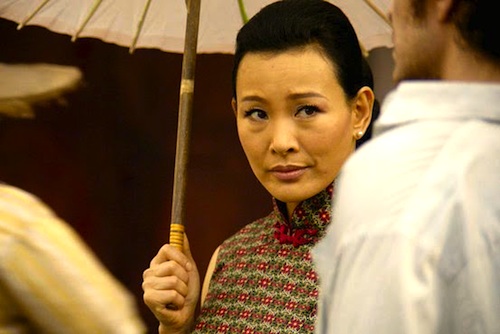
From "Serangoon Road."

Frankly, the real discovery is Pamelyn Chee (who maybe a handful of people saw in Wayne Wang’s Princess of Nebraska), stealing scene after scene with Su Ling’s wry sarcasm and slightly deceptive elegance. Chin Han chews the scenery like he enjoys the taste as the villainous Kay Song (just as he did in Marco Polo). Somewhat frustratingly, Indonesian superstar Ario Bayu does not get a lot of fun things to do this time around, but there is room for his character, Inspector Amran, to grow. However, Maeve Dermody’s hopelessly vanilla Simpson falls somewhat short in the scandalous femme fatale department. It is hard to get why Callaghan is so hung up on her. Maybe you just have to be there—in Singapore—circa 1964.

Regardless, there is more than enough mystery, betrayal, and colorful supporting characters to keep viewers engaged and increasingly invested. Frankly, it seems strange the American HBO did not pick it up to fill a slow spot in their calendar. In terms of production quality, it holds its own with most limited-event cable series and should equally satisfy Joan Chen fans who know her either from Twin Peaks or Xiao Hua (The Little Flower). Recommended for anyone who enjoys humid noir in serial form, Serangoon Road is now available on DVD from Acorn.

LFM GRADE: B+

Posted on February 25th, 2015 at 9:58pm.
Meeting the Parents: LFM Reviews Anita Ho

By Joe Bendel. What kid wouldn’t want to date a Power Ranger? What guy wouldn’t be interested in a woman like Anita Lee? Maybe one who has met her parents. Harry Ho is about to have the dubious pleasure, but since he is Korean rather than Chinese, it will be a difficult getting-to-know-you process in Steve Myung’s Anita Ho, which opens this Friday in Los Angeles.

Harry is really a Korean Oh, but when his family came through immigration, it was changed to a Chinese-sounding (and more easily mocked) Ho. After a while, they got tired of fighting it. Unfortunately, this leads to some initial awkwardness when he first meets his girlfriend Anita’s parents, the Lees—and it only goes downhill from there. Needless to say, they want their daughter to marry a good Chinese boy. That means a doctor or a lawyer. An unemployed writer just does not cut it.

Technically, Ho is a freelancer, who quit his gig on Lee’s “Power Raiders” kiddie action show to write his screenplay. That has not been working out so well. At least, his relationship with Lee has been fulfilling. In fact, he intends to pop the question while they are visiting for her special thirtieth birthday banquet, but her parents will do everything they can to belittle and undermine him.

Just about anyone who was ever raked over the coals by their date’s dad on prom night should be able to relate to Anita Ho on some level. Of course, they never had to face George Cheung (the notorious Lt. Tay in Rambo: First Blood II and senior member of the Awesome Asian Bad Guys). Unimpressed with the mild-mannered Ho, Mr. Lee will actually try to fix his daughter up with a former classmate. Yes, he happens to be a doctor.

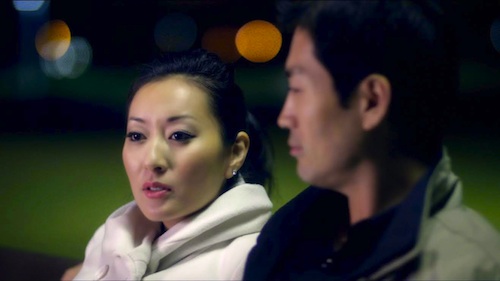
From "Anita Ho."

So maybe we have all been there, but director-co-writer Myung just cranks up the cringe factor when appearing as Ho. By the time the film is over that poor cat’s back is covered in “kick me” signs. He has some pleasant romantic chemistry with co-writer Lina So Myung, but it eventually becomes difficult to buy into them as a couple, while he wallows in humiliation and she essentially lets it happen. The Myungs also apparently dig romantic montages, because they are not stingy with them (though they really probably should have been).

Lina So Myung truly lights up the screen as Lee, while Cheung and Elizabeth Sung have their moments as the demanding parents. However, it is Kenny Waymack, Jr. who gives us something to latch onto as Lee’s Filipino brother-in-law and tough talking audience surrogate, Tyson Bautista. It is nice to see a film advocate inclusiveness, but some of the broad humor falls a bit flat. Frankly, the film would have been better served by a little more romantic courtship and a little less shtick. It is also cool to see the telegenic Myungs making their own opportunities. Nevertheless, Anita Ho is strictly a date-night kind of movie when it opens this Friday (2/27) at the Laemmle Playhouse 7 in Pasadena.

Posted on February 25th, 2015 at 9:57pm.

LFM Reviews Triumph in the Skies

By Joe Bendel. Where American networks failed with shows like Pan Am and LAX, Hong Kong found tremendous success with a prime time airliner drama. While it had the benefit of some star power from Francis Ng and Michelle Ye, it was really the multi-character romances that were powering the show. How big was it? Big enough to snag a New Year’s theatrical release for the big screen edition. Hearts will be broken on multiple continents in Wilson Yip & Matt Chow’s Triumph in the Skies, which is now playing in New York and select markets.

By-the-book Captain “Sam” Tong and his not-so-by-the-book co-pilot Jayden Koo used to be a regular flight crew, but they have split up. Tong is still the senior officer with Skylette, but the new boss’s son and heir apparent, Branson Cheung, has assigned him to serve as the technical advisor for their new commercial starring rock-star diva TM Tam. Nobody on-set wants to hear his quibbles, except maybe Tam. There are such polar opposites, they naturally start to attract.

Cheung, who also serves as a Skylette flight captain, is rather surprised to find his old flame Cassie Poon Ka-sze is part of the crew on his newly assigned plane. She is still disappointed he put their relationship on hold to please his father, but the sparks are still there. Meanwhile, Koo or “Captain Cool,” has landed a cushy job as the private pilot of a party plane, where he meets the seemingly ambitionless Kika Sit. However, he realizes almost too late there is far more to her story.

If you have seen a few Chinese romantic comedies you will basically know what to expect here, but Yip & Chow’s execution is wildly slick and lethally effective. You are not likely to see a sparklier movie anytime soon. Triumph has so much jet-setting, it makes Sex in the City look like EastEnders.

Sure, it is tons of manipulative, yet each of the three primary story arcs works surprising well, with the best being Tong’s halting flirtation with Tam. It is also the best written braided-storyline, featuring some wry, understated dialogue and terrific chemistry between series veteran Francis Ng and Sammi Cheng. You can almost think of it as an HK version of a James L. Brooks late middle-age relationship film. She also performs a catchy punk version of “Over the Rainbow” that will make you think that was what Harold Arlen & Yip Harburg really had in mind the whole time.

In contrast, Triumph totally goes for the tears with Captain Cool’s possibly tragic romance, but Amber Kuo just lights up the screen as Kika Sit. Of course, Julian Cheung is not exactly is not exactly a jowly sourpuss either—and they both know how to crank up the cute in their big feature spots.

From "Triumph in the Skies."

The third romance starring Louis Koo is a lot like an HK rom-com starring Louis Koo, but it is still one of the better ones. Again, he and Charmaine Sheh have surprisingly strong chemistry. However, the notion of an attractive working woman sitting around waiting for the man who walked out of her life to saunter back might not sit too well with American audiences.

Despite the vaguely Leni Riefenstahl-ish title, Triumph in the Skies is a pleasingly upbeat and colorful film. These days, it is just no fun whatsoever to fly on a commercial airliner or schlep through an airport, but it would be worth taking off your belt and shoes to fly with the ridiculously good looking crews of Skylette. Maybe it is a guilty pleasure, but it is fun. Recommended for those looking for an entertaining movie romance that pretty much covers all the bases, Triumph is now playing in New York at the AMC Empire.

LFM GRADE: B+

Posted on February 25th, 2015 at 9:57pm.

LFM Reviews Fires on the Plain @ The 2015 Film Comment Selects

By Joe Bendel. Joseph Heller’s Yossarian has nothing on Private Tamura. He is caught in a miserable catch-22 and the only thing that will dislodge him from his vicious cycle will be a further downturn in Japan’s fortunes of war. There is absolutely nothing heroic about combat throughout intense auteur Shinya Tsukamoto’s faithful but bloody remake of Kon Ichikawa’s Fires on the Plain, which screened during Film Comment Selects 2015.

Tamura is suffering from a nasty case of tuberculosis and maybe some mild shell shock. Deemed too sick to serve effectively by his arrogant commanding officer, Tamura is ordered to check into the nearest field hospital on Leyte. However, the medical staff refuses to admit him, considering him too healthy to merit a spot on their disease floor.

Back and forth he trudges between the camp and the hospital, repeatedly being turned away by each, until Allied attacks essentially eliminate either option. Receiving word the Imperial forces have belatedly ordered them all to regroup at Palompon, Tamura falls in and out of small ragtag bands of retreating Imperial soldiers, but his increasingly desperate countrymen might represent a more immediate danger than the Yanks he is supposedly fighting.

The 1959 Plain has to be Ichikawa’s darkest, bleakest film. Tsukamoto does not exactly match its dour existentialism, but he certainly never whitewashes its atmosphere or implications. In terms of tone, the recent Plain could be described as one part Samuel Beckett and two parts Apocalypse Now, but with liberal helpings of severed body parts. Tsukamoto’s Plain is definitely not for the faint of heart, but it is considerably more accessible than the full-on assault to the senses delivered by his Tetsuo series.

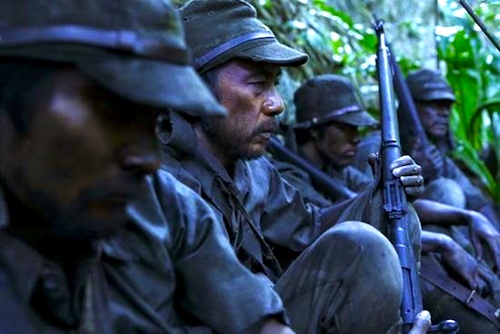
From "Fires on the Plain."

It is safe to say vanity had nothing to do with Tsukamoto’s decision to direct himself as Tamura. He is never flashy, but it is grimly compelling to watch the soul steadily seep out of him. You absolutely believe his is just a shell of a person, which is certainly some kind of performance.

Plain is truly serious stuff, intended for discerning audiences, but there might be enough gore to placate his loyal cult-following. It covers all the bases Ichikawa did, nearly beat for beat, yet it is unquestionably and readily identifiably a Tsukamoto film. Together with his co-cinematographer Satoshi Hayashi, Tsukamoto gives his slow descent into tropical madness a distinctively sweaty, feverish, and slightly surreal look that is equally transfixing and disconcerting. One of the better remakes of a genuine classic you will see in sometime, Tsukamoto’s Fires on the Plain is recommended for those who appreciate uncompromising anti-war cinematic statements after its screening at the Walter Reade, as part of this year’s Film Comment Selects.

LFM GRADE: B+

Posted on February 25th, 2015 at 9:55pm.

LFM Reviews The Last: Naruto the Movie

By Joe Bendel. Love hurts, especially for a ninja. Getting your chakra ripped out also kind of stings. Poor Naruto Uzumaki will just have to go through these things as a rite of passage (although he maybe could have skipped the latter). In fact, he is a bit older and perhaps fractionally wiser in the canonical capstone anime feature The Last: Naruto the Movie, which opens tomorrow in select cities.

For fans of the Naruto franchise, The Last pays off in a major way. This is no mere one-off shoehorned between the 72 volumes (or 700 chapters of manga), six hundred some television episodes, and ten feature films. It explains the manga’s final epilogue that was generally well received by fans, but came as a bit of a surprise nonetheless. What transpires in The Last will have a direct bearing on the course of Uzumaki’s life, but if that were not enough, the stakes are also apocalyptically high.

As the film opens, Uzumaki basks in his newfound popularity resulting from his heroic war service. Girls are finally talking to him—they are even getting pushy competing for his attention. This rather distresses the shy Hirata Hyuga, who has long carried a torch for the oblivious Uzumaki. Yet, when Hyuga’s younger sister Hanabi is kidnapped, she and Uzumaki are thrown together in the rescue party.

It seems her abduction is related to a doomsday plot launched by Toneri Otsutsuki, the last descendent of one of the great ancient clan leaders of the series’ intricate mythology. He intends to crash the moon into the Earth with the help of the Hyuga clan’s superhumanly enhanced eyes. Obviously, Uzumaki is super-motivated to stop Otsutsuki, especially when he realizes he is falling for his former classmate, Hyuga.

Unlike the previous Naruto film, The Road to Ninja, there is no jetting off to an alternate reality and back before anyone is the wiser. Everything counts this time around in a big way. It fills a major remaining gap in Naruto’s saga, wrapping it up in a way that keeps faith with the characters and their fans. For longtime readers and viewers, The Last is more closely akin to the MASH’s emotional sign-off than the wimpering final episode of Seinfeld.

From "The Last: Naruto the Movie."

There is considerable character development in The Last (especially by series shōnen anime standards) and a good deal of action. However, the old school hand-to-hand combat always looks far better on screen than the big fiery cosmic clashes, which all sort of blend together after a while. Nonetheless, the focus in The Last is particularly personal, freezing out many long-term supporting players in favor of Uzumaki and Hyuga.

Surely, the Naruto team can go back to the well for plenty more canonical adventures, but The Last would be a very satisfying place to definitively end it. It is a relatively self-contained story arc, so new arrivals should be able to follow and enjoy it well enough, but it really pays dividends to those who have invested in the series—and that’s actually pretty cool to see. A must-see for Naruto loyalists and a strong feature for shōnen enthusiasts in general, The Last: Naruto the Movie opens in select markets beginning this Friday (2/20), with a number of screenings scheduled in New York at the Village East starting this Saturday (2/21).

LFM GRADE: B

Posted on February 19th, 2015 at 7:40pm.

LFM Reviews Tales @ The 2015 Film Comment Selects

By Joe Bendel. Evidently, former Iranian megalomaniac Ahmadinejad did not think much of shorts. That was a good thing. Rather than compromising her artistic integrity to receive official state sanction for a feature, Rakshan Bani-Etemad embarked on a series of short films that were comparatively less regulated by the authorities. With his successor projecting a more conciliatory face, she has since joined them together into a braided narrative. You would hardly know it from watching the finished product, which flows together in an intricate Short Cuts kind of way. She presents a bracing vision of an Iran beset by all manner of social pathologies, but it is always most difficult for the women in Bani-Etemad’s Tales, which screens during the 2015 edition of Film Comment Selects.

In recent years, Bani-Etemad has largely worked as a documentarian for reasons explains above, but those who know her previous narratives will find even deeper meaning when her old characters return for call-backs in Tales, criss-crossing each other as they deal with life’s challenges. Fittingly, the two best segments, by far, are the first and the last, but there is still plenty of interesting material in between.

We will sort of see events unfold from the POV of an intrepid but much censored documentary filmmaker, who kinds of acts as Bani-Etemad’s surrogate. As some might know from Under the Skin of the City, the cabbie driving him into the city is deeply in debt from an ill-advised foray into crime. However, it will be his second fare, his sister’s childhood friend who has since been tarnished by scandal that delivers the first real jolt of stinging, naturalistic drama.

From there, we will witness the cabbie’s mother try to navigate the red tape of a Kafkaesque bureaucracy, eavesdrop on two grown children jokingly (we assume) planning to fake an abduction, and witness an abusive husband confront his acid-scarred wife (the eponymous character from Nargess) in her women’s shelter. Eventually, Bani-Etemad brings it home with an intimate but biting verbal sparring match conducted by one of the shelter’s reformed drug addict counselors and the organization’s mini-van driving, who is shuttling her and a new client back to their home base. In some ways, their exchanges are peculiarly Iranian, yet there is a universality to their increasingly heavy conversation that hits you on a deep level.

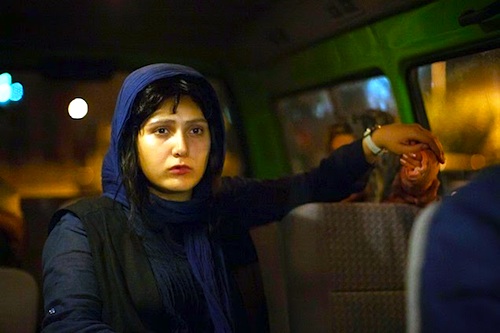
From "Tales."

In a strange way, the secondary tone of Tales constantly shifts between late night existentialism, free-wheeling absurdity, futile romanticism, and outright tragedy. Yet, the bedrock feeling of helplessness is always present. It features a consistently strong ensemble, especially Mohammadreza Forootan and Mehraveh Sharifinia as the cabbie and the fallen woman of the first tale and Baran Kosari and Peiman Moadi as the mismatched couple in the closer.

We like to think Iran has its own special problems rooted in its oppressive system of governance, which it clearly does, judging from the travails of Bani-Etemad’s characters. However, we generally presuppose they are immune to more worldly issues, like drugs, street crime, illiteracy, economic inequities, and AIDS as a result. Tales acts as a corrective to that assumption. They actually have both kinds of societal ills. It is also an engrossing film that really takes us into its characters’ long dark nights of the soul. Highly recommended, Tales screens this Friday (2/20) and Sunday (2/22) at the Walter Reade, as part of this year’s Film Comment Selects.

LFM GRADE: A-

Posted on February 18th, 2015 at 11:09am.