Statham Happens in Vegas: LFM Reviews Wild Card

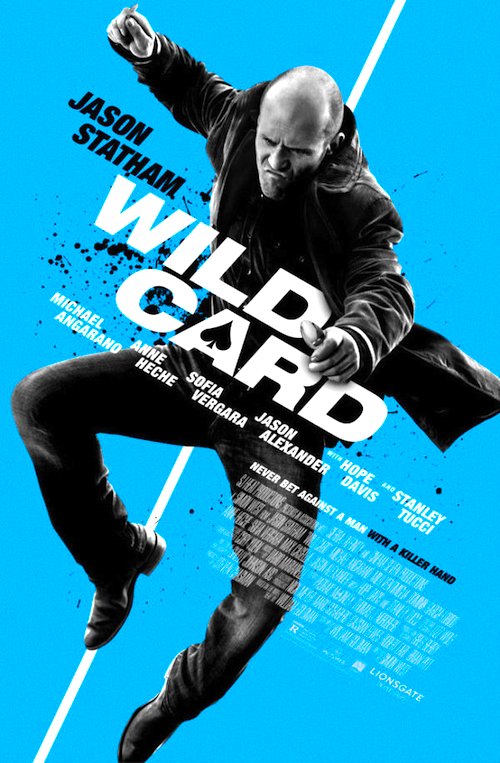
By Joe Bendel. It is not exactly a critic’s dream come true, but it rises to one of our frequent challenges. We often lament studios remaking classic movies, making them considerably worse, rather than redoing and hopefully improving less-than-great films. That sort of happens here when Jason Statham steps into a role originated by Burt Reynolds. It’s already sounding better, isn’t it? In fact, Statham is much more convincing as the lethal bodyguard with a gambling problem in Simon West’s Wild Card, which opens this Friday in New York.

Like the somewhat notorious 1986 film Heat, Wild Card was adapted by screenwriter William Goldman from his own novel. On the screen, it follows much the same structure, but off-screen, hopefully there will be far less litigation. Nick Wild has an uneasy truce with the Mafia. He stays on good terms with the mega-connected Baby, but for the most part, he does not bother them and they do not bother him. Most of his jobs are a little demeaning, like babysitting nickel-and-dime gambler Cyrus Kinnick, but he keeps hoping to hit it big at the tables and run off to Corsica (it was Venice before).
This equilibrium is disrupted when a visiting gangster brutalizes Holly, a prostitute Wild was formerly involved with. She wants him to get the creep’s name, so she can pursue legal action. However, Wild wants no part of anything connected to the Golden Nugget, which must be thrilled to be so explicitly identified as a mobster resort. Of course, as a good guy, Wild can’t help himself. Despite his hesitation, he lays quite a beating on the entitled Danny DeMarco and his henchmen and facilitates their further humiliation at Holly’s hands. From there, one thing leads to another.

Wild Card has a handful of spectacular fights (choreographed by Cory Yuen), sprinkled throughout long stretches of compulsive gambling and macho brooding. The gimmick for Wild (or Nick “Mex” Escalante as he was once known) is his facility for using commonplace items, such as credit cards and poker chips, as deadly weapons. Needless to say, this works so much better with Statham than Reynolds. Dominik García-Lorido (Andy Garcia’s daughter in the excellent Lost City and in real life) and Stanley Tucci also represent considerable upgrades as Holly and Baby, respectively. Indeed, the casting is nearly perfect this time around. Unfortunately, the Kinnick character still gums up the works with his unnecessary subplot.

Unlike the previous film’s revolving door-battery of directors, West keeps Wild Card moving along at a decent clip, even though it is more about gambling and gangster power games than action, per se. He also maintains a relatively upbeat mood, nicely underscored by some classic licensed blues and R&B tunes from artists like Magic Slim, Albert King, and Charles Brown. It still isn’t perfect but it is better, which is something. You could even say it’s not bad—but nowhere near Statham’s best work in The Bank Job and Redemption. For fans of old school Vegas, Wild Card opens this Friday (1/30) in New York.

LFM GRADE: C+

Posted on January 28th, 2015 at 5:36pm.

LFM Reviews True Story @ The 2015 Sundance Film Festival

By Joe Bendel. Who is the bigger user, the disgraced journalist or the alleged family murderer? It is a close call, but the “journalist” has no competition when it comes to willful self-deception. Mike Finkel’s strange and problematic relationship with Christian Longo provides the dramatic grist for British theater Rupert Goold’s ripped-from-the-tell-alls feature debut, True Story, which screens during the 2015 Sundance Film Festival.

For a while, Finkel was the golden boy at the New York Times, scoring numerous Sunday magazine covers. Then he was busted for “compositing” victims somewhat haphazardly in a human trafficking story. At least Christian Longo was still a fan. While on the lam, he used Finkel’s name as an alias. Intrigued by the connection, the real Finkel pays a jail house visit to the man accused of killing his wife and three children. Recognizing a story that could salvage his career, Finkel agrees to co-author a book with Longo. Of course, he assumes it will be exculpatory, but early trial developments leave him feeling confused and betrayed.

Clearly, this is not a film looking to rehabilitate the NYT’s scandal-plagued image. Gretchen Mol plays Finkel’s editor as an ice cold CYAing Machiavellian, which might be the truest aspect of True Story. The ironic postscript also serves as a final middle finger to the Gray Lady. However, Goold and co-screenwriter David Kajganich are not trying to do any favors for Finkel or Longo, either. In all honesty, everyone comes out of it looking badly, but that makes it fascinating to watch.

From "True Story."

Longo, the media savvy sociopath, just might be the role James Franco was born to play. He is so frighteningly convincing turning on the charm and manipulating everyone around him, it makes you wonder. Although it is a far less showy role, Jonah Hill’s Finkel is also believably slow on the uptake (so much so, it also makes you wonder). Mol is suitably severe, but True Story is not a great vehicle for actresses, completely wasting Felicity Jones as Finkel’s more guarded but nearly personality-less girlfriend.

Franco and Hill’s scenes together have fair degree of crackle, but the suspense never really rises above room temperature. Frankly, there are no miscarriages of justice in True Story, unless you count the Times getting off easy after yet another journalistic scandal. Yet, it is strangely refreshing to see a film that is not out to gin up cheap outrage. Recommended for those who appreciate adult drama, True Story screens again this Thursday (1/29) and Saturday (1/31) in Park City and Sunday (2/1) in Salt Lake, as part of this year’s Sundance.

LFM GRADE: B

Posted on January 28th, 2015 at 4:54pm.

Paginini at the Crossroads: LFM Reviews The Devil’s Violinist

By Joe Bendel. Niccolò Paginini was the Robert Johnson of classical music. His ferocious technique and unparalleled popular success were seriously considered the fruits of a Faustian bargain. The talent was always there. Getting people to listen was the hard part. In fact, it was such a tricky proposition, the materialist maestro gladly makes that deal in Bernard Rose’s The Devil’s Violinist, which opens this Friday in New York.

Sulfur has not numbed the Mephistophelean Urbani’s nose for talent. He immediately recognizes the gifts of an aspiring Don Juan violinist scuffling in grubby music halls. He pledges to guarantee Paginini’s career and serve as his personal servant in this world, if Paginini agrees to do the same for him in the next. Shortly after signing a contract he probably should have read more closely, Paginini’s career ignites. He becomes a figure of dark romance and veiled controversy, like an early nineteenth century heavy metal rock star.

Eventually, Paginini gets bored with it all, spending long hours brooding in the tub, doing his best to resemble The Death of Marat. Fortunately, Paginini somewhat snaps out of his lethargy when he accepts upstart promoter John Watson’s offer to produce and conduct his London debuts concerts. However, Paginini’s demands will stretch the limits of Watson’s resources. Met by a mob of moralizing progressive protestors, Watson and his diva mistress Elisabeth Wells are forced to quarter Paginini and Urbani in their home. Of course, Watson’s daughter Charlotte immediately catches Paginini’s eye, but she is not inclined to swoon over the maestro, at least not yet.

We always thought Jared Harris just might be the Devil, so Violinist practically feels like a confirmation. He is delightfully sinister chewing on the scenery. Yet ironically, Urbani (who seems to be more of a minion than Old Scratch himself) is not infrequently portrayed as a more empathetic fellow than Paginini. Regardless, it is great fun watching him lurk and glower.

From "The Devil’s Violinist."

Violin prodigy and classical crossover artist David Garrett can certainly play. Acting is a little iffier. Perhaps the many scenes of his Paginini huddling in bed sheets in a state of near catatonia was a shrewd strategic decision on Rose’s part. Fortunately, Harris has some terrific supporting players to engage with, including Christian McKay, unflaggingly earnest as Watson, as well as Joely Richardson suggesting Eliza Doolittle’s morally flexible cousin as tabloid music critic Ethel Langham.

In a way, Devil’s Violinist reconciles the classy Jekyll films Rose has helmed, such as the Beethoven bio-pic Immortal Beloved and the superior Sophie Marceau version of Anna Karenina, with his Hydish scare fare, like Candyman and SXTape. For obvious reasons, he leans towards the former, depicting Urbani more as a Svengali than a figure of satanic horror. It works relatively well, despite Garrett’s awkwardness, which sometimes even feels fitting in context. Harris certainly does his thing and Garrett’s musical chops are also quite cinematic. Recommended for classical connoisseurs who appreciate a bit of uncanny garnish, The Devil’s Violinist opens this Friday (1/30) in New York, at the Quad Cinema.

LFM GRADE: B-

Posted on January 28, 2015 at 4:53pm.

LFM Reviews Darkness on the Edge of Town @ The 2015 Slamdance Film Festival

By Joe Bendel. Young Cleo Callahan might not look like a vigilante, but she has the right skills. She is crack sharpshooter, particularly with a rifle-scope. Arguably, her investigative talents are somewhat subpar, but in such a small provincial village she is bound to find her sister’s killer sooner or later. However, the guilty party is closer than she could imagine in Patrick Ryan’s moody revenge drama Darkness on the Edge of Town, which screens during the 2015 Slamdance Film Festival.

Since the death of their parents, Callahan’s relationship with her older sister Aishling has been strained. She now lives with Foster parents, while Aishling lives the wild life—or at least she was. Although we see full well who the killer is, it feels like the sort of thing that should be held close to the vest. Regardless, Cleo Callahan soon sets out to even the score, presuming the murderer is one of the dodgy characters in her sister’s social circle.

Technically, they are innocent, but it is clearly implied they did sister Aishling wrong in more conventional ways, so there is no need to feel sympathy for their sorry hides. However, it is a different story when suspicion falls on Virgil O’Riley, the brother of her profoundly troubled best friend Robin.

The tone of Darkness is so dark, it is like Milton’s darkness visible. You do not want to know what goes on behind closed doors because it is sure to be awful. This is not a wish fulfillment vigilante movie like the later Death Wish films. It is scrupulously serious, even though there is a good deal of blood down the stretch. At times, Ryan plays with the themes and visual language of the western genre, but it is really more closely akin to a film like Heavenly Creatures, but executed in a drastically more naturalistic style.

From "Darkness on the Edge of Town."

Be that as it may, Darkness heralds the arrival of Emma Willis as a major new screen talent to watch. Her performance as Robin O’Riley is truly harrowing, riveting, and downright scary. It is bad luck for Emma Eliza Regan, whose intense slow-burning work as Callahan is likely to be overlooked, even though it is excellent, as well.

It is hard to classify Darkness as a thriller, because of its deliberate pacing and thoroughly realized sense of hardscrabble place. Still, this film has grit in abundance. Definitely recommended for patrons of Irish cinema and violent contemporary tragedies in general, Darkness on the Edge of Town screens again today (1/28) at Treasure Mountain Inn, as part of this year’s Slamdance.

LFM GRADE: B+

Posted on January 28th, 2015 at 4:53pm.

LFM Reviews Stereo @ The Berlin & Beyond Film Festival in San Francisco

By Joe Bendel. Film noir fans know when a tough motorcycle guy never talks about the past, there is usually a good reason. In truth, Erik is a little fuzzy on that score himself. Unfortunately, his past will catch up with him good and hard in Maximilian Erlenwein’s Stereo, which screens during the 19th Berlin & Beyond Film Festival in San Francisco.

Despite his “scoundrel” tattoo, Erik seems to have made a fresh start, opening a garage in a small, but welcoming provincial town. He has charmed his single mother girlfriend Julia and her adoring daughter Linda. Her cop father Wolfgang is considerably less impressed, but Erik can handle him. The man who will call himself Henry is another story.

The hooded mystery man appears alongside Gaspar, a suspicious looking type who seems to know Erik and some dangerous gangsters they supposedly did wrong. Gaspar has some sort of plan to finish them off, but Erik sends him packing. However, Henry refuses to leave, ever. It turns out he and Gaspar were not together. In fact, nobody can see him except the increasingly alarmed Erik. Eventually, the mechanic will seek non-traditional treatment, but he cannot shake off the antagonistic presence. As the underworld power struggle roughly invades Erik’s new life, Henry will reveal their secret connection. It will not be pretty.

Stereo is sort of a big twist movie, but the 800 pound shoe drops early in the third act, driving some bizarre dramatic dilemmas for Erik. It is fiendishly cleverly constructed by Erlenwein, who pulls off some brazen narrative sleight of hand right before our eyes. Yet, he is also patient enough to set the scene and establish his cast of sinister and straight characters. Erlenwein also gets a huge assist from Ngo The Chau’s carefully framed, visually hypnotic cinematography.

From "Stereo."

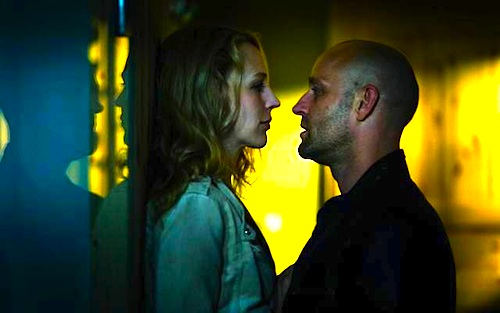
As Erik, Jürgen Vogel’s bald, beading head looks suitably intense through Ngo’s lens and he masterfully sells his wild ride of character development arc. Moritz Bleibtrau is more restrained as the ominous Henry, but he seems to relish the taunting and totally pulls the rug out from under the audience down the stretch. There are plenty of minor players orbiting them (Fabian Hinrichs as a young, not as dumb as he looks doctor scores considerable points in limited screen time), but it is the oppositional chemistry between Vogel and Bleibtrau that really makes the film tick.

It is hard to understand why a genre specialist like Magnet has not scooped up Stereo for distribution yet. It oozes noir style, while Erlenwein skillfully builds the tension organically, going from slow burn to fiery combustion. Highly recommended for fans of dark psychological thrillers, Stereo screens this Thursday (1/29) at the Castro Theatre in San Francisco, as part of this year’s Berlin & Beyond.

LFM GRADE: B+

Posted on January 26th, 2015 at 5:55pm.

LFM Reviews Body @ The 2015 Slamdance Film Festival

By Joe Bendel. It is sort of like an episode of Girls, but with Larry Fessenden. When three former high school friends break into a McMansion for some Christmas Eve partying, they wind up with some explaining to do in Dan Berk & Robert Olsen’s Body, which screens during the 2015 Slamdance Film Festival.

Home for the holidays and slightly stoned, Holly, Cali, and Mel are looking for something to do on a cold Christmas Eve. Cali suggests they kick up their heels in her rich uncle’s pad, because he doesn’t mind her having the run of the place. Holly and Mel agree, even though there is something funny about her story (they’re stoned, remember). After a little breaking and entering (seriously, he won’t mind), they start hit the rec room hard. Eventually, Holly has the sense to ask why there are so many pictures of an Asian family on the wall.

It turns out there is no rich uncle. Cali used to babysit for the owners years ago and knew they would be away for the holidays. As this uncomfortable truth sinks in, the girls are surprised by the creepy caretaker. Things get a bit confused, resulting in his apparently fatal accident. With no legal justification for their presence there, the three friends need to get their stories straight, but the circumstances and resulting moral dilemmas keep getting more complicated.

From "Body."

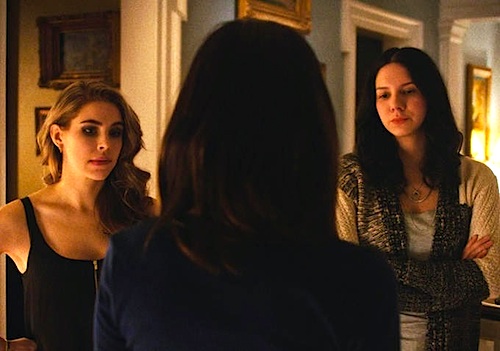
The good news for Larry Fessenden fans is that he has a new genre film at Slamdance. The bad news is that he spends nearly the entire film flat on his back. Still, let’s just say he has his moments. Nevertheless, the relationship between the three twentysomething women really forms the heart of the film. Berk & Olsen take a fair amount of time to establish their complicated relationships somewhere along the continuum between friends and frienemies. Viewers get the sense they have long histories together and are used to being around each other, even if their feelings are a bit ambiguous. There is also something vicariously enjoyable about watching them run amok in that swanky pad.

Inevitably, matters take a dark turn and get progressively darker, but Body is more closely akin to a claustrophobic stage-thriller than a horror movie. Helen Rogers anchors the film quite effectively as Holly, who passes for the film’s voice of reason and the closest thing it has to a conscience, whereas on the other hand, Alexandra Turshen clearly enjoys getting the film’s best opportunities for scenery chewing and most pointed lines as the mildly sociopathic Cali (hey, nobody’s perfect).

Oddly, Body feels a bit restrained, especially with Fessenden along for the ride, but it vividly captures the weird vibe of being somewhere rather isolated during a time of collective celebration, like the holidays. It is a clever and aesthetically economical dark thriller, recommended for genre fans when it screens again this Thursday (1/29) at Treasure Mountain Inn, as part of this year’s Slamdance.

LFM GRADE: B

Posted on January 26th, 2015 at 5:55pm.