LFM Reviews Once Upon a Time in Shanghai; Now on DVD/Blu-ray

By Joe Bendel. Ma Yongzhen is one of China’s favorite Robin Hood-ish gangsters. Film and television versions of his story (including the Shaw Brothers’ Boxer from Shantung) often transplant Ma to the wild and woolly Republican 1930s, but the first film version of the Nineteenth Century bumpkin-turned racketeer was the 1927 silent Shandong Ma Yongzhen. A new supercharged remake/reinvention of the 1972 Shaw Brothers fan favorite takes even more liberties with Ma’s story, but if he has any surviving descendants, they are not likely to object to the heroic portrayal of the martial artist in Wong Ching-po’s Once Upon a Time in Shanghai, which releases this week on DVD and Blu-ray, from Well Go USA.

Ma Yongzhen came from the dirt poor provinces to make his fortune in Shanghai. Ironically, he has exactly the sort of skills to make it in the go-go city, but he promised his sainted mother he would never become a gangster. To remind him to temper the power of his iron-fist, she gave him his only valuable possession: a jade bracelet.

Living in a slum watched over by the kindly Master Tie, Ma quickly gets a lay of the land. Through a series spectacular sparring sessions, Ma earns the trust and a legit job from Long Qi, a gangster-club owner more closely resembling the historical Ma Yongzhen. The brash Long Qi has taken over a sizable portion of the Ave Gang’s territory, but he is asking for trouble with his outspoken anti-Japanese sentiments. When the Axe Gang and the Japanese form an alliance, Ma will be pulled into the fray to protect everyone halfway decent.

OUATIS is definitely following the buddy movie playbook, but screenwriter Angela Wong somewhat inverts the formula, by having the naïve country boy stay strong and start to reform the hedonistic crime lord. Even so, the narrative is rather simplistic, but the film’s grit and tragic vibe will appeal to genre audiences nonetheless.

The martial arts sequences choreographed by Yuen Woo-ping and Yuen Cheung-yan are obviously the important thing here—and they deliver. Fortunately, Philip Ng and second lead Andy On have the skills and bearing for the often brutal but wildly cinematic beatdowns. There is no question they can carry this stuff off. Veteran martial arts stars Sammo Hung and Chen Kuen-tai (the 1972 Ma Yongzhen) lend the film further street cred.

From "Once Upon a Time in Shanghai."

After working his way up through a series of increasingly prominent supporting roles (Lionel, the undercover cop stepson in From Vegas to Macau), Ng gets his shot playing the hero here. His turn as Ma is not exactly a bases-clearing homerun, but Ng is not bad at all. He has a strong presence, develops some reasonably believable romantic chemistry with Michelle Hu’s Tie Ju (the somewhat judgmental daughter of Master Tie), and excels in the fight scenes. Although Andy On goes a bit over the top with Long Qi’s outrageous preening and weird bursts of laughter, it sort of works anyway, because this is a genre that rewards attitude – which he brings in generous servings.

Indeed, most action enthusiasts will want to see more of Ng and the more established On after Wong’s Ma Yongzhen reboot, which says a lot. If you are looking for impressive martial arts action and can easily overlook some predictably excessive anti-Japanese propaganda, then it is a safe bet. Recommended for martial arts and historical gangster fans, Once Upon a Time in Shanghai is now available for home viewing from Well Go USA.

LFM GRADE: B

Posted on January 14th, 2015 at 11:08pm.

LFM Reviews Pretty Rosebud

Pretty Rosebud Official Trailer from Devolver Digital Films on Vimeo.

By Joe Bendel. Cecilia “Sissy” Santos is a political consultant who feels deeply guilty when she succumbs to adulterous temptation. Yes, that sounds far-fetched, but if you can accept it, there are merits to be found in Oscar Torre’s Pretty Rosebud, written by and starring his real life wife Chuti Tiu, which opens this Friday in Los Angeles.

Apparently, Santos works for a combination boutique PR agency and political consulting firm, but it’s not clear what they do during odd numbered years. Regardless, she at least has a going career with opportunities for advancement. That is more than her lay-about husband Phil can say. He resents his wife’s status as the sole breadwinner, but he refuses to even consider anything less than his previous gig. In all honesty, his ambition has dried up and his sex drive essentially followed with it.

However, Sissy Santos has this boxing trainer (conveniently played by Torre, who looks the part). She regrets it afterward, but of course her husband is still his same insufferably entitled self. Time spent with her traditional Filipino family does not help much either, especially when they complain about her golden boy brother’s divorced Anglo girlfriend. To make matters worse, she has plenty of candidates for further adultery at work, including the congressional nominee, whose campaign she is assigned to.

Tiu might be writing from a Filipina perspective, but the issues Santos wrestles with should resonate with audiences from diverse ethnic backgrounds, with old school parents. Arguably, she really stacks the deck against dumb old Phil, but her scenes with the family’s Catholic priest are surprisingly well written and more than fair to the priest. In fact, the good Father just might have some helpful, nonjudgmental counsel to offer.

From "Pretty Rosebud."

Obviously, Rosebud was conceived as a showcase for Tiu (a former Miss Illinois), but she proves to be equal to the challenge of carrying the picture. She is a striking presence, but the maturity tempering her sexuality is something you almost never see on film. It is a bold, vulnerably exposed performance. While Torre has limited screen time as Alejandro the trainer, he helps generate the necessary heat to set in motion all the subsequent conflicts. Richard Yniguez’s Father Antonio also nicely bolsters the film’s forgiving tone. In contrast, Kipp Shiotani certainly makes viewers contemptuous of Phil, which seems to be his assignment, while the Santos parents are mostly played as broad, churchy stereotypes.

Rosebud is a small intimate film, but it juggles some heavy themes relatively dexterously. If nothing else, the gym scenes ought to convince DirecTV they need Tiu and Torre for the next season of Kingdom. Recommended for those who appreciate a frank, women’s POV adultery drama, Pretty Rosebud opens this Friday (1/16) in Los Angeles at the Arena Cinema.

LFM GRADE: B

Posted on January 14th, 2015 at 11:06pm.

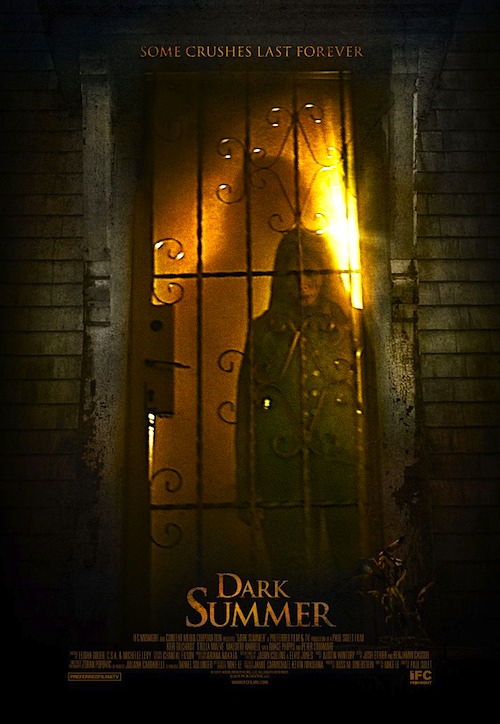
LFM Reviews Dark Summer

By Joe Bendel. Daniel Austin must spend his summer under house arrest, but he will be confined to a seriously broken home. Even though his absentee mother and absconded father will not be around, he will still have company. That will be a very bad thing in Paul Solet’s Dark Summer, which opens midnight-ish tonight in New York at the IFC Center.

Kids and the internet can be a bad combination, especially in Austin’s case. When he developed a crush on the slightly gothy, sad indie rock listening Mona Wilson, he hacked all her online accounts, because he is a socially stunted weirdo. Obviously, he was caught—hence the ankle bracelet and the regular drive-by visits from his P.O., the gruff but cranky Stokes. At least his outsider pals, Abby and Kevin, manage to smuggle him a laptop to catch a neighbor’s wifi. That night, a suicidal skype call from Wilson unleashes a whole mess of supernatural trouble.

Summer follows relatively close on the heels of Gerard Johnstone’s Housebound, but it turns out the world really did need two house arrest chillers, or at least midnight movie patrons will be nicely satisfied with them both. Housebound’s wickedly macabre sense of humor probably means it is more fun, but Summer establishes its own horror movie identity to a pleasantly surprising extent. Mike Le’s screenplay has some clever twists and turns, but it is really going somewhere specific, rather than just stringing together a series of jump-scares.

Summer also represents a major step up for Solet after the middling Grace. He picks up the pace this time around, but not at the expense of setting the scene and building the atmosphere. Wisely, Solet also refrains from showing too much in the early scenes, letting the uncertainty of Austin’s situation reinforce the claustrophobic vibe.

Clearly, Peter Stormare got the horror movie memo, because he hams it up just enough as Stokes. Whenever he pops-in, you know he will deliver some genre goodness. In contrast, Keir Gilchrist exudes anti-charisma, but it is appropriate for Austin. Oddly, he and Stella Maeve (pretty solid as Abby) look like they might be brother and sister. While their resemblance is not as (unfortunately) striking as Leonardo DiCaprio and Carey Mulligan in The Great Gatsby, the added layer of creepiness sort of works in context for Summer.

Yes, Austin is in for a darned dark summer, but that still probably sounds okay to New Yorkers invigorated by yesterday’s single digit temperatures. Regardless, horror genre fans should be impressed how Solet invigorates the conventions of Grudge-style horror. Indeed, it is way better than you would expect from the hum-drum one-sheet. Recommended pretty highly for anyone looking for a moody supernatural outing, Dark Summer opens late tonight (1/9) at the IFC Center.

LFM GRADE: B+

Posted on January 9th, 2014 at 1:01pm.

National History as Family Saga: LFM Reviews Ode to My Father

By Joe Bendel. Yoon Duk-soo twice found himself trying to outrun a rampaging Communist army, but he was never a secret commando. He was an average Korean, who just witnessed a lot of history from an uncomfortably close vantage point. With Yoon’s sweeping life story, director (JK) Youn Je-kyun pays tribute to his parents’ generation throughout Ode to My Father, which opens in New York this Friday.

Yoon and his family were originally from Hungnam in the North, but they had to flee the Chinese forces that had broken through the Allied defenses. Somehow, fourteen thousand Koreans found refuge on the SS Meredith Victory, captained by Leonard LaRue, after the Merchant Marine freighter dumped all of its munitions cargo to accommodate them. Yoon, his mother, his older sister, and their infant brother would make it. His father and the younger sister he was assigned to protect do not. It is not his fault, but Yoon will blame himself all his life and his passive-aggressive mother will let him.

The Meredith Victory’s evacuation is still considered the largest military humanitarian operation in history. Instead of the chaotic sequence depicted in the film, the actual loading process was reportedly quite orderly, lasting nearly a day. Frankly, it seems particularly unfair to depict Cap. LaRue as a cold fish who reluctantly acquiesces to Korean pleas for deliverance, given the fact he joined a Benedictine order after the war and was henceforth known as Brother Marinus. The entire crew of the Meredith Victory probably deserves better.

Regardless, life marches on for Yoon. To support his brother’s studies and his sister’s irresponsibleness, the duly appointed head of household accepts work as a German Gastarbeiter coalminer. The work is as punishing as it sounds, but the pay was considerable for 1963 ROK. Fortunately for Yoon, West Germany was also recruiting Gastarbeiter nurses, like his future wife, Youngja.

To save the family’s Gukje market and pay for his entitled sister’s wedding, Yoon will pack his bags again, signing on as a civilian technician supporting the American forces in Vietnam. Youn and screenwriter Park Soo-jin draw powerful parallels between the Hungnam evacuation and the chaos following the fall of Saigon, without belaboring their points or the audience’s patience. In fact, it is probably the strongest chapter of the necessarily episodic film. However, Yoon has at least one more Forrest Gump-ish date with destiny, as a participant in the landmark 1983 KBS broadcasts reuniting divided Korean families.

From "Ode to My Father."

Ode is currently a massive Korean box-office hit, so you know it will not be afraid of a little sentimentality. Wisely, experienced character actor Oh Dal-su is on hand to sprinkle about a little vinegar whenever things get too saccharine. In fact, as Yoon’s best pal Dal-goo, he develops some convincingly down-to-earth buddy chemistry with Hwang Jung-min. Staten Island’s Yunjin Kim, recognizable from American television shows like Lost and Mistresses, also has some nice moments as Youngja, but her screen time is nowhere near equal to that of the central Yoon.

It is too bad the treatment of Cap. LaRue is most likely to annoy those who are most familiar with him as a historical figure. Otherwise, Ode’s resilient story of family and friendship, featuring a network television star, might really resonate with American audiences, especially in military markets. Without that early anti-American veneer, it could have possibly generated far wider word of mouth, but instead it will just play to the established audience base. That is a shame, because the work of Hwang and Oh give it real heart. Recommended (with mild reservations) for loyal fans of the cast and Korean family dramas, Ode to My Father opens this Friday (1/9) in New York, at the Regal E-Walk.

LFM GRADE: B-

Posted on January 8th, 2014 at 10:08pm.

The People of the Niger Delta Deserve a Better Movie: LFM Reviews Black November

By Joe Bendel. It’s the spigot theory that says a developing nation is better off without the discovery of a precious natural resource like oil, because it allows a corrupt central government (is there any other kind?) to control all economic activity at the source. That is sort of what Jeta Amata’s newly revised agit-prop film argues, but it is more interested in assigning blame. Yes, the multinational oil companies are at fault and so is our government and the Nigerian government, as well as the former regime it replaced. However, you are most to blame as an American consumer guzzling Nigerian oil, so go hang your head in shame—and don’t even bother with Amata’s Black November (known in a previous incarnation as Black Gold), because it is not worth your guilt-tripping time when it opens tomorrow in New York.

Oil executive Tom Hudson must be evil, because he is played by Mickey Rourke. However, the tables have just been turned on him when a group of one-man’s-terrorists take him hostage, demanding he use his influence to save their spiritual leader Ebiere Perema from the noose. If you are expecting a tense kidnapping film, then just move along, because November is really just one interminably long flashback, allowing the men with guns to explain how special Perema is, starting with her birth, of course. Mercifully, Amata spares us the Michenerian prologue explaining how geological processes formed the oil deposits in the river delta. Still, at least that would have been educational.

It is possible for nakedly didactic films to engage the audience on a cinematic level. Iciar Bollain’s Even the Rain is not exactly subtle, but it is still a distinctive work. On the other hand, you can safely say Black November is no Battleship Potemkin. Frankly, it is simply not professional grade. Amata may have come out of the Nollywood scene, but the handful of Nollywood films covered here all feature sharper character development and more polished scripts than November, and there is little difference in the quality of performances.

From "Black November."

Embarrassingly, that includes a number of formerly big-name Hollywood actors turning up in small marginal roles, presumably so they could participate in a few press conferences to show they care. Nevertheless, November is notable for reuniting 9½ Weeks co-stars Rourke and Kim Basinger (playing “Kristy,” the journalist unwittingly filming Hudson’s kidnapping). One can imagine their on-set reminisces: “So, remember those ice cubes? Good times.”

According to the poster, Anne Heche is also in this movie. This is a pure guess, but maybe she plays one of the federal agents, as does Viveca Fox who briefly appears as “Angela,” the scoldy anti-terror agent constantly passing judgment on her superiors’ crassly Machiavellian ways.

November is counting on viewers cutting it a lot of slack, because of its supposedly good intentions, but when you are sitting through it, there is no getting around its low level of competency. It even fails on the fundamental level of propaganda. Perhaps out of some odd notion of narrative balance, Perema and her allies are constantly making inexplicably dubious decisions, but their cumulative effect is downright exasperating.

By the time it wraps up, the only lasting take-away from the film is the fact the hostage takers smuggled themselves and their guns up from Mexico, so it would seem the film is really advocating for increased border security. Black November is not recommended. It is not even presentable to a ticket-buying public, but it opens tomorrow (1/9) nonetheless at the Quad Cinema.

LFM GRADE: F

Posted on January 9th, 2014 at 10:08pm.

LFM Reviews Predestination

By Joe Bendel. If you have read The Moon is a Harsh Mistress, you know Robert Heinlein was more than willing to consider unconventional relationships. Still, the strange bonds holding together the characters of his story “All You Zombies” is definitely not what one would expect from the author of military science fiction like Starship Troopers and popular juveniles such as Space Cadet. Nevertheless, the Spierig Brothers (Michael and Peter) have faithfully adapted it for the big screen. After garnering nine Australian Academy Award nominations, the Spierig Brothers’ Predestination opens this Friday in New York.

A man walks into a bar in the 1970s, but the bartender is actually a Temporal Agent, charged with fighting crime across time. The man is a “true confessions” columnist who writes under the pen-name “The Unmarried Mother.” It turns out, he used to be one. The agent has been assigned to recruit the writer to help catch the Fizzle Bomber, a time terrorist who will perpetrate a horrendous attack sometime in the current time period, unless they can stop him in the past. As a bonus, the writer will get the opportunity to confront the man who abandoned her, before medical circumstances forced his transformation. The agent will also take time out to save himself from the Fizzle Bomber, which he obviously does, since he is able to go back and lend himself a hand.

That is nothing compared to how complicated things get when the characters’ backstories start unraveling and intertwining. In a way, part of this explanatory set-up is not really accurate, but it would be unforgivably spoilery to be scrupulously honest. Frankly, this is a devil of a film to write up, but the Spierigs somehow keep all the interconnected balls in the air. If one domino fell out of place, the film would be a train wreck, but they maintain the complicated narrative machinery with energy and style.

From "Predestination."

Ethan Hawke also provides an invaluable assist with his unclassifiable turn as the agent. It is rather fitting Predestination is a top Australian contender while Boyhood is considered an Oscar frontrunner, since both deal with time in very different ways. In fact, his two performances could be compared and contrasted for other murkier reasons. Regardless, it is superlative genre work, as is Sarah Snook’s breakout performance as the writer and his earlier self.

There are not a lot of special effects per se in Predestination, but production designer Matthew Putland’s team and costume designer Wendy Cork do a fantastic job recreating and exaggerating the swinging 1960s and gritty, grungy 1970s New York. Clearly, this is a scrappy little film, but it looks great and it lives up to Heinlein’s big mind-blowing ideas. In fact, the Spierigs add a clever wrinkle to make it even twistier. Highly recommended, Predestination opens this Friday (1/9) in New York, which means it will have to wait for the next award season go-round here in the U.S.

LFM GRADE: A-

Posted on January 8th, 2014 at 9:44pm.