To Live and Die in Appalachia: LFM Reviews The World Made Straight

By Joe Bendel. The very thought his ancestors might have been Unionists during the Civil War is almost too much for a rural white slacker like Travis Shelton to process. Yet, he slowly comes to learn family and land holdings (or lack thereof) had as much to do with one’s wartime alignment as geography for 1860s Appalachian citizens. In fact, he becomes preoccupied with a notorious Confederate massacre of Union POWs while getting ensnared in a contemporary feud during the course of David Burris’s The World Made Straight, which opens this Friday in New York.

Shelton’s prospects are limited, so when he stumbles onto a secluded marijuana grove in the backwoods, he foolishly decides to start harvesting it himself. He manages to sell one uprooted shrub to Leonard Shuler, a disgraced former school teacher who now deals dope for Carlton Toomey, the plant’s “rightful” owner. Despite Shuler’s warnings, Shelton pushes his luck, blundering into the bear-trap laid out for him.

To avoid trouble, Toomey spares Shelton’s life, but a cold war soon develops between them. Moving in with Shuler, Shelton becomes something of his student, learning the tragic local Civil War history, as well as the particulars of drug dealing. For a while, Shelton seems to reassert control over his life, but Shuler’s drug addled girlfriend Dena is a destabilizing wildcard, whom he knows will always betray him for a fix.

Despite all the guns and drugs, Straight offers a considerably more nuanced portrayal of the hardscrabble South than you typically see on film. It has a strong sense of the region and the 1970s era, forgiving most of its characters’ sins as products of their depressed economic circumstances and the depressing environment. It is also rather tricky to categorize, consisting of maybe three parts naturalistic drama and one part thriller. Regardless, it never feels exploitative, even when rather disturbing things happen on-screen.
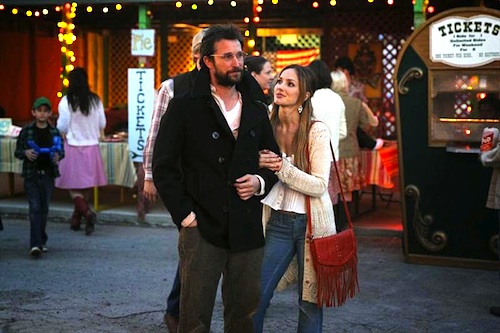
From "The World Made Straight."

After watching Noah Wylie mug through the Librarians series openers, it is nice to see he still has something like this in him. He is terrific as Shuler, convincingly balancing grit and nebbishness. Frankly, it is also somewhat remarkable how completely English actor Jeremy Irvine disappears into the role of Shelton. Since he is sometimes irresponsibly impulsive and other times passive, Shelton is a tough protag to get one’s arms around, but Irvine always comes across quite genuine, nonetheless. Still, he understandably wilts when confronted with the intense villainous force of Steve Earle’s Toomey. He conveys some frighteningly human dimensions to the hill country kingpin, who could have easily descended into caricature.

In fact, there are a number of cards screenwriter Shane Danielsen’s adaptation of Ron Rash’s novel might easily have overplayed, such as vaguely ghostly influence the historical massacre exerts on Shelton, but he maintains a balanced hand instead. As a result, it is a much better film than most viewers will expect. Recommended for those who appreciate dark Southern morality tales, The World Made Straight opens this Friday (1/9) in New York at the Quad Cinema.

LFM GRADE: B+

Posted on January 8th, 2014 9:44pm.
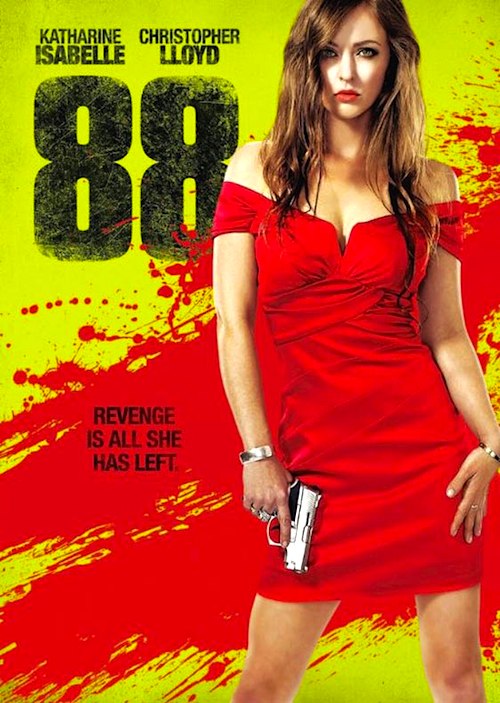
Katharine Isabelle is Out for Revenge: LFM Reviews 88

By Joe Bendel. In this case, that number does not refer to the number of keys on a piano. It could well be the number of times director-co-screenwriter April Mullen flashes forward or backward along her temporally fractured narrative. The number also seems to hold some significance for the black-out prone heroine of Mullen’s 88, which releases on DVD this week from Millennium Entertainment.

Her name is Gwen or perhaps Flamingo. She has just come into a roadhouse diner in front of a huge plate of food. We soon learn Gwen/Flamingo was on the warpath a short while ago, looking for some payback from the men who killed the love of her life. She knows her gangster employer Cyrus is somehow behind it all, but the exact details are sketchy. However, once she reached the diner, a switch was flipped in her head. She is now completely lost and confused, especially when she discovers the local sheriff’s deputies are highly upset with her. Ty, her apparent accomplice, will try to keep her at-large and on-target, as she waits for the world to start making sense again.

When a complicated time-skipping narrative structure works, it can be mind-spinningly rewarding, as with the Spierig Brothers’ Predestination, opening this week. When it doesn’t, it can be an awful headache. Admittedly, 88 sort of comes together down the stretch, but most of the film feels forced and unnecessarily convoluted. Even though it mostly makes sense at the end, Mullen and co-writer Tim Doiron lose sight of the whole point of a revenge thriller, denying us the vicarious satisfaction of vengeance taken good and hard. Frankly, the implications are rather messagey, making you wonder if Mike Bloomberg underwrote the film.

A simpler approach probably would have borne greater fruit, especially with up-and-coming cult star Katharine Isabelle (American Mary) as the traumatized vigilante. Keep it simple. Point her and Ty towards the bad guys and let them go. Indeed, you can see why Isabelle’s geek fanbase continues to grow. She is quite effective in both her assertive and passive timelines, while looking good in tight, bloodstained wardrobe.

Doiron might have over-complicated the script with Mullen, but he gives the film regular energy boosts as Ty. Likewise, Mullen chews the scenery quite enjoyably in her too brief appearance as Lemmy, the illicit gun dealer. Of course, Christophe Lloyd is no stranger to playing heavies, once again maintaining his standards of bug-eyed, erratic villainy as Cyrus. It is also cool to see Michael Ironside do his thing as the world weary sheriff.

There are a number of cleverly realized scenes in 88, but it labors under the weight of its temporal shifts and ultimately takes itself too seriously. Still, it has enough fan favorites, like Isabelle and Ironside, to justify some time-killing on Netflix, but it is not something you will feel compelled to add to your collection of physical media. For the faithful and the curious, 88 is now available on DVD and Blu-ray from Millennium Entertainment.

LFM GRADE: C+

Posted on January 8th, 2014 at 9:43pm.

The Darkness Never Breaks in Palermo: LFM Reviews Salvo

By Joe Bendel. Salvo Mancuso is not what you would call talkative, but he is a direct communicator. He is a mafia hitman-driver, because it suits his skill set and social aptitude. Any possible relationship with blind Rita is probably therefore destined to fail, especially since he is out to kill her brother in Fabio Grassadonia & Antonio Piazza’s Salvo, which releases on DVD this week from Film Movement.

Times are tough for the Sicilian mob. Mancuso’s boss is not exactly in hiding, but he is definitely hunkering down. Someone also decided it was a good time to try to take out Mancuso and his associate. He was wrong. After coolly dispatching the hit squad, Mancuso heads after the name they give up: Renato. Slightly complicating matters, the treacherous money-handler lives with his blind sister, who helps manage his back-office operation—but only slightly.

Salvo begins with a stone cold action sequence and segues into a virtuoso one-shot spectacle, following Mancuso as he stalks through the Renatos’ home, while Rita slowly realizes she is not alone. In a further twist, the extreme nature of Mancuso’s violent presence apparently gives her uncanny bouts of sightedness. It is inspired filmmaking—sort of like watching Wait Until Dark from the drug ring’s perspective. Grassadonia & Piazza masterful direct the intricate traffic patterns and cinematographer Daniele Ciprì captures it in all its claustrophobic glory.

Unfortunately, neither Mancuso the character nor the co-director-screenwriters really know what to do with Rita once he stashes her in an abandoned factory rather than killing her, as protocol would demand. As a result, the midsection gets rather bogged down, before everyone rouses themselves for a respectable climatic showdown.

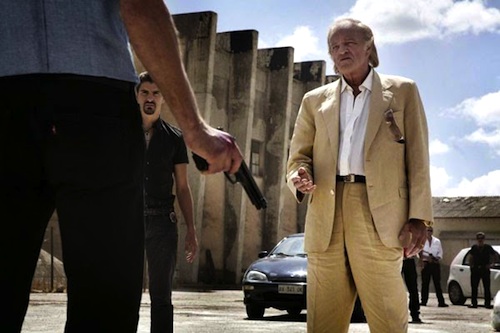
From "Salvo."

As Mancuso, Saleh Bakri broods and glowers like nobody’s business. Even with his minimal dialogue, he commands the picture. (Frankly, Bakri does not look Texan, but the press materials say he is Palestinian, so he must be.) Arguably, Sara Serraiocco has an even trickier part, portraying Rita from moments of unguarded vulnerability through her strange pseudo-empowerment. Nobody really talks much in Salvo, but Mario Pupella’s mob boss clearly relishes delivering all the best lines.

Hailing from Palermo themselves, Grassadonia & Piazza capitalize on the city’s depressed, post-industrial backdrops, using them to mirror the spiritual rot of their characters. It basically does for Sicily what Matteo Garrone’s Gomorrah did for Naples, but Salvo is considerably grabbier. While undeniably uneven, it is exactly the sort of film that is well worth catching up with on DVD. Recommended as the first feature from a conspicuously talented filmmaking partnership, Salvo goes on-sale this week.

LFM GRADE: B

Posted on January 8th, 2014 at 9:42pm.

A Strudel Western: LFM Reviews Dark Valley

By Joe Bendel. Old European feudalism is about to get a taste of revenge, served up in vintage American Western style. A stranger has come to a remote town high in the Austrian Alps and that means what it always does. Someone will pay for something in Andreas Prochaska’s Dark Valley, which releases on DVD this week from Film Movement.

Greider is an American, but he learned fluent German from his mother. He has come to the inhospitable town with his daguerreotype camera and an equalizer. He would have the locals believe he is an early forerunner of Ansel Adams, there to photograph nature, but they are not buying it. Nonetheless, he finds lodging with the reluctant Luzi and her widowed mother for the winter (which will be long, everyone ominously assures him). The entitled Brenner sons quickly key in on Greider as a target for their bullying. However, he also seems to take an interest in them, asking questions like “if someone were to start killing old Brenner’s sons, how busy would they be?”

Soon, a couple of Brenners turn up dead and Greider is not exactly disavowing responsibility. It turns out Brenner and his sons enforce the old feudal custom granting them wedding night privileges with all brides in the valley. That is why Luzi’s impending nuptials with the earnest but mild-mannered Lukas are more of a source of angst than joy, despite their mutual love for each other. Greider is familiar with the tradition and he has had enough of it.

So evidently you have to go to Austria to get a credible western these days. In fact, Austria selected Valley as its official foreign language Oscar submission, but it did not make the shortlist cut. Prochaska definitely understands the genre conventions, even though he realizes them in an austerely chilly, Teutonic style. Frankly, he executes a darned good shoot-out down the stretch, while capitalizing on the awesome Alpine backdrops (shot with fittingly dark majesty by cinematographer Thomas Kiennast).

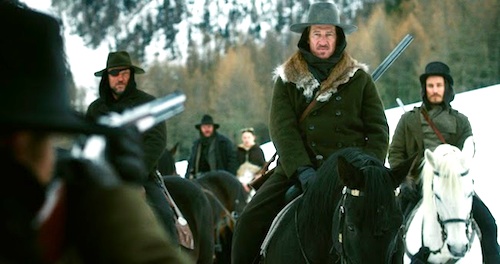
From "Dark Valley."

Sam Riley hardly looks like a killing machine, but his pale clamminess works well in context, nonetheless. Evidently, the crew referred to him as “Pale Greider” during shooting, in reference to the Eastwood film, which is not wholly inappropriate. Valley has a similar vibe to Eastwood’s later, slightly revisionist westerns. Regardless, the Brenners still need killing and when Greider obliges it is pretty satisfying.

Even though she is stuck with some plodding narration, Paula Beer is relatively forceful and dynamic as Luizi. Let’s be honest, this is not exactly the sort of premise that is conducive to strong female characters, but she does rather well given the circumstances. On the other hand, Tobias Moretti really cuts loose with the moustache-twisting villainy as the elder Brenner Brother, Hans.

Frankly, the Austrian Alps make a nice change of pace from Monument Valley. It is also good to see some life left in the western genre. Anyone who enjoys a rugged revenge tale should appreciate Prochaska’s Strudel Western. Highly recommended, Dark Valley launches on DVD today, from Film Movement.

LFM GRADE: B+

Posted on January 8th, 2014 at 9:42pm.

LFM Reviews The Monk @ The 2015 Palm Springs International Film Festival

By Joe Bendel. Serving as a Buddhist monk should be a calling rather than a mere job. However, employment prospects in Burma are so bleak, many take up robes for subsistence reasons. In Zawana’s case, he was adopted into the monastic life he seems so ill-suited for. However, his abbot’s illness will bring the novice to a crossroads in The Maw Naing’s The Monk, which screens during the 2015 Palm Springs International Film Festival.

Zawana enjoys exchanging flirtatious love notes with the cute village girl Marlar and listening to the rebellious monk Yewata’s mp3 player. Still, he feels a tie of loyalty to Abbot U Dahma, who found him starving on a park bench when just a young child. When Yewata decides to seek a less strict monastery in Yangon (a.k.a. Rangoon), Zawana nearly leaves with him. He somewhat regrets his lack of daring when Marlar also ventures to the big city, ostensibly to pursue her studies. Unfortunately, Zawana will soon follow them when the Abbot’s cancer demands treatment in a bigger hospital.

As is often the case, the change of environment helps Zawana put things in perspective, but the bustling capitol does alter the film’s quiet, defiantly naturalistic aesthetic. Indeed, it is easy to see how the director’s work as a poet and a documentarian influenced his stylistic approach. Viewers also get a sense of how the monks and novices do or don’t live in balance with nature and their more profane neighbors.

Many will need to acclimate themselves to The Monk’s contemplative pace, but there is an easily discernable narrative to follow, involving very real stakes. It truly transports viewers to the distant Burmese province, lushly lensed by cinematographer Vit Janecek, but it is considerably more character-driven than a travelogue or docu-essay. Novice Zawana is a classically conflicted figure, impressively brought to life by Kyaw Nyi Thu’s tremendous range and depth. Likewise, Han Newe Nyein shows uncommon presence and subtlety as Marlar, while Thein Swe Myint plays the Abbot with fitting gravitas.

From "The Monk."

It is a shame the modern-era Burmese film industry is still in its infancy, because the entire ensemble shows a natural talent for screen acting. Some reports bill The Monk as the first independent feature narrative produced inside Burma (as most citizens call it), but similar claims were made for the Burmese-raised, Taiwan-based Midi Z’s Return to Burma. In truth, it seems like an exaggeration in both cases, since Ohn Maung’s cautionary 1920 silent Love and Liquor would clearly predate them both.

That hardly matters, though. It is just encouraging to see Burmese filmmakers examining the country’s current condition through a cinematic prism. The even better news is The Monk is quite rewarding when considered strictly on its own cinematic merits. Recommended for those who appreciate meditative films with an understated but powerful emotional kicker, The Monk screened today as part of this year’s PSIFF.

LFM GRADE: B

Posted on January 9th, 2014 at 9:41pm.

LFM Reviews Today @ The Palm Springs International Film Festival

By Joe Bendel. Youness is the wrong man, in the wrong place, at the wrong time, but since Iran is still a man’s world, he could get away clean, nonetheless. However, the grouchy old cab-driver is too compassionate for that. A fateful fare could have serious long-term implications in Reza Mirkarimi’s Today, which screened during this year’s Palm Springs International Film Festival.

Youness is the type a cabbie who will just toss out customers if they rub him the wrong way. Yet, he takes pity on the extremely pregnant and considerably panicked Sedigheh. He will even schlep her into the hospital, despite suspecting she has no money for the fare. At this point, he could safely bolt according to Iranian law (as we are later told), but he stays nonetheless.

It is quickly apparent Sedigheh has been physically abused and has neglected her pre-natal care as a result. Naturally, the hospital staff silently accuses Youness. Despite the awkwardness and potential legal ramifications, he accepts their contempt, for Sedigheh’s sake, because as an unaccompanied pregnant woman, she would be even further marginalized by the Iranian medical system.

On its face, Today is a deceptively simple issue-oriented drama, but it makes a deeply eloquent statement on contemporary Iranian society. It is a lot like A Separation with a more fully developed social conscience. It is a bit surprising Iran selected it as their foreign language Oscar submission and utterly baffling how it could miss the shortlist cut. You would had to have seen a heck of a lot of films this year to find nine better than Today.

Perhaps it is too subtle. You really have to pay attention to what is said and what is left unsaid to fully appreciate the positions Youness and Sedigheh are in. It is also fascinating how ghosts from the past loom over the film in strange and unlikely ways. For instance, the hospital in question lacks the latest medical equipment, because it was once part of a larger triage center during the Iran-Iraq War, but has yet to be retrofitted after the adjoining building was closed.

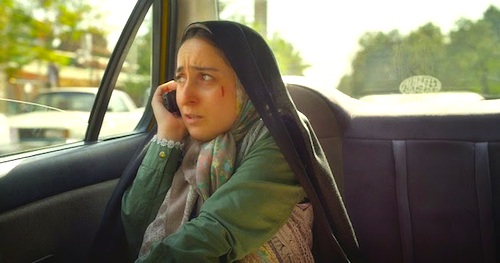
From "Today."

Eschewing cheap theatrics, Parviz Parastui puts on a clinic in how to say more with less as the taciturn Youness. It is a quiet performance, but he has the audience hanging on his every word and gesture. In contrast, Soheila Golestani’s guileless directness and vulnerability are quite arresting. Watching them feels like being there in that slightly shabby hospital in Tehran. That might not sound like a lot of fun, but the net effect is hard to shake off.

While Today is about as character-driven as films get, it is still quite an impressive feat of direction. Mirkarimi has quite a lot of traffic to manage, sort of like a stage farce, except it is deadly serious. It is too bad he will not be getting any Academy love this time around, especially since his previous film A Cube of Sugar had been selected as Iran’s Oscar submission two years ago, until the Islamist government decided to boycott in protest of a low rated YouTube video. This is a potent film that directly advocates breaking the pernicious cycle of abuse, but it is probably too complicated for daytime talk show hosts to understand. Highly recommended for everyone else, Today screens this Tuesday (1/6) as part of this year’s PSIFF.

LFM GRADE: A

Posted on January 5th, 2015 at 11:53am.