LFM’s Govindini Murty at The Huffington Post: Music Made by People, not Algorithms: a DVD Review of Frank

[Editor’s note: the post below appears today at The Huffington Post.]

By Govindini Murty. We’re told that in our digital future music will be created by computer algorithms. But could an algorithm make music anywhere near as weird and wonderful as Frank? Frank is the titular character of Lenny Abrahamson’s touching and funny new black-comedy Frank, an ode to the irreplaceable nature of quirky, individual human creativity.

Coming out on DVD/Blu-ray December 9th, Frank premiered at the Sundance Film Festival earlier this year to rave reviews. The movie is inspired by the true story of Chris Sievey, a British musician and comedian who performed wearing a large paper-mâché head under the pseudonym Frank Sidebottom.

If you’re seeking a cinematic antidote to our flattened-out, Big Data, crowd-sourced, mass conformist digital age, then take the time to see Frank. Frank is a paean to true creativity – the kind of creativity that can only come from an individual.

Frank stars Michael Fassbender as the eponymous musician – a mysterious, wildly talented singer-songwriter who wears a large paper-mâché head over his face at all times. Frank is supported in his musical efforts by a medley of eccentric band mates; these include nerdy keyboardist Jon (Domhnall Gleeson), surly theremin player Clara (Maggie Gyllenhaal), and troubled band manager Don (Scoot McNairy).

2014-12-08-fassbenderfrank1.jpeg
From "Frank."

The story is told from the point of view of Jon (Domhnall Gleeson), a would-be keyboardist and song-writer who spends his days searching for poetic inspiration in his quiet seaside town, while posting random updates on social media about what sandwiches he’s eaten, his humdrum home life, and so forth.

One day while staring blankly out at the ocean, Jon witnesses a man being rescued from an attempted drowning. It turns out the man is the keyboardist for an avant-garde band with the unpronounceable name of “The Soronprfbs.” Jon meets the band’s manager Don (Scoot McNairy) and is invited to play with the band that night.

Jon is enthralled by the chaotic creativity of the band – so different from his own dull existence- and in particular by the manic, oddly compelling performance of Frank, a figure wearing a large, round head with blank, staring eyes and a goofy, painted-on smile. Jon seems to make the right impression on Frank, and so Frank invites Jon to join the band at a remote country house in Ireland to record their next album.

Jon is over the moon with joy, convinced that being in close proximity to musical genius will finally unleash his own creativity. However he soon learns that the other band members are suspicious of him – especially Clara – because they think that he’s a mediocrity only out to exploit Frank’s talent.

Unbeknownst to them, Jon is also secretly videotaping the band’s offbeat practice sessions (in which they find inspiration in things as diverse as bird calls, pouring water, and slamming doors) and uploading them to social media, gaining them an online following. Continue reading LFM’s Govindini Murty at The Huffington Post: Music Made by People, not Algorithms: a DVD Review of Frank


LFM’s Govindini Murty & Jason Apuzzo at The Huffington Post: The Double and the Christmas Holidays

[Editor’s note: the post below appeared this weekend at The Huffington Post.]

By Govindini Murty & Jason Apuzzo. Do you feel like you’re turning into a different person over the holidays? How about your fellow citizens – do they appear to be morphing into unrecognizable automata? The holidays can do that to you – especially in Los Angeles. It’s a time when people get consumed with travel schedules, holiday parties, frenzied “gifting,” and trying to keep up with the Kardashians – and forget to act like real human beings.

Just this past week we saw a grown man bark at a Starbucks barista because his eggnog latte wasn’t hot enough, soccer moms body-check each other grabbing at Target discount wreaths, and senior citizens hydroplane in a Mercedes while trying to grab a parking spot at a rainy mall.

Fellow citizens, enough is enough. Get some perspective – before you become ersatz human beings even your nearest and dearest wouldn’t recognize.

This is where indie cinema can offer some timely lessons on the perils of modern dehumanization. One of our favorite films at the Sundance Film Festival earlier this year was The Double, starring Jesse Eisenberg and written and directed by Richard Ayoade. Currently out on DVD and VOD, the film is one of the smartest adaptations yet of Fyodor Dostoevsky’s The Double, the seminal novella of modern alienation.

Jesse Eisenberg plays Simon James, a meek office drone toiling away in a retro-futuristic dystopia of grimy office buildings and gray apartment flats. The bleak settings owe much to Terry Gilliam’s Brazil and George Orwell’s 1984, while Simon’s character recalls Anthony Perkins’ persecuted office worker in Orson Welles’ adaptation of Kafka’s The Trial.

2014-12-07-thedouble2014diner1.jpg
From "The Double."

The hapless, ineffectual Simon loves a fellow office worker, Hannah (Mia Wasikowska), but he is completely unable to assert himself with her or with his co-workers – indeed, at times he is barely able to make it out of the office elevator. For this he is treated as if he is of little more consequence than the paint on the dingy office walls.

A wrench is thrown in the works one day when Simon is introduced to a new co-worker: a fellow named James Simon (also played by Eisenberg) who strangely enough, looks exactly like him. In personality, however, James is the opposite of Simon – smooth, assertive, full of charm and slick maneuvering. In short order, James takes credit for Simon’s work, double-crosses him with his boss, and starts putting moves on the lovely Hannah before Simon’s horrified eyes.

Making matters worse, no one seems to notice the striking similarity between Simon and James – something that infuriates poor Simon. James taunts Simon by stealing more and more of his life, eventually driving Simon to take desperate measures before a final, surreal denouement. Continue reading LFM’s Govindini Murty & Jason Apuzzo at The Huffington Post: The Double and the Christmas Holidays

LFM Reviews TNT’s The Librarians; Premieres Sunday, 12/7

By Joe Bendel. Flynn Carsen is a librarian Kramer would approve of. He does not spend a lot of time putting newspapers on big wooden sticks for cheapskates trying to save a quarter and probably doesn’t even know the Dewey Decimal System. Instead, he spends his time tracking down magical items to keep them out of the hands of potential evil-doers. The protagonist of TNT’s hit television movie franchise The Librarian is now a recurring character in their new regular series, The Librarians, note the plural form, which debuts with back-to-back episodes (The Librarians and the Crown of King Arthur and The Librarians and the Sword and the Stone) this Sunday.

Carsen has two last names and twenty-two college degrees. The perennial student was chosen by “the Library,” the mystical apostolic successor to the great Library in Alexandria, now hidden beneath the Metropolitan Public Library in New York. Having held his own in a series of adventures, Carsen is rather put out when the Library recruits Col. Eve Baird, a no-nonsense counter-terrorism operative to be his Protector. However, he will reluctantly accept her help when the shadowy Serpent Brotherhood starts assassinating all the weird genius rivals he beat out for his current globe-trotting gig. In fact, the only former candidates still surviving are the three oddballs who never made it in for their interviews.

Jacob Stone is an unassuming laborer in the Oklahoma oil fields, who writes scholarly articles on medieval art and history under an assumed name. Ezekiel Jones is a thrill-seeker, who likes to steal the things Stone writes about. Cassandra Cillian has savant-like powers of memory and superhuman computation, but it might be linked to the tumor that will eventually kill her. Together with Carsen and Baird, they will track down several Arthurian relics the Brotherhood needs to control the magic they intend to let loose upon the world.

The Librarian one-offs might have been popular, but they must have skewed toward a decidedly younger demographic. While the premiere episodes, directed in a straight forward manner by Independence Day producer Dean Devlin, never descend into outright slapstick, the dominant acting style practiced is decidedly broad. This is especially so for Noah Wyle’s Carsen and hammy John Larroquette, joining the Librarian world as Jenkins, the curmudgeonly manager of the Library’s branch office (evidently in Portland of all places), who is clearly being set up to serve as the Giles-Watcher to the three new recruits. However, Rebecca Romijn demonstrates decent action chops and an appealingly down-to-business screen presence as Baird.

From "The Librarians."

The villains are not bad either. Matt Frewer returns to chew a bit of scenery as the Brotherhood’s immortal overlord, Dulaque and Lesley-Ann Brandt’s unfortunately named Lamia is a promising femme fatale. It is hard to judge from just two episodes, but John Kim and Christian Kane at least seem comfortable in the parts of Jones and Stone. In contrast, Lindy Booth may need some time to figure out how to breathe life into Cillian, a passive naïf character written somewhere between a door mouse and door mat.

Guys of my generation probably would have loved this show when we were twelve years old. There is magic and adventure, but it feels old fashioned in a 1980s network television kind of way. To an extent, it is like the Friday the 13th series, with fantasy trappings instead of the supernatural horror (it also lacks the evil antiquing show’s distinctive vibe). It is harmless and might serve as a productive stepping stone for Romijn, but it will underwhelm most adult genre audiences. For franchise fans, the first two episodes of The Librarians debut on TNT this Sunday (12/7).

Posted on December 5th, 2014 at 2:51pm.

Know When to Walk Away, Know When to Run: LFM Reviews Poker Night

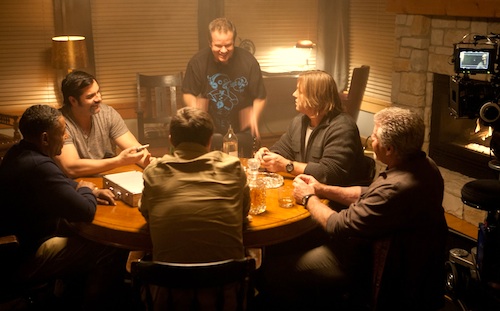
By Joe Bendel. In this case, poker is not a metaphor for thermonuclear war or anything else. It is a social convention. As a rookie detective in Warsaw, Indiana, the newbie is expected to lose money and listen to the stories of the crafty veterans to gain from their hard-earned experiences. Unfortunately, he will only have one night of lessons to apply before he is abducted by a serial killer in Greg Francis’s Poker Night, which releases on VOD and in select theaters today.

Jeter made a name for himself breaking a big case, but at least one of the grizzled detectives is not convinced the whippersnapper deserves his seat at the table. However, the legendary Det. Calabrese (played by Ron Perlman) is in his corner, so end of discussion. Each of the four greybeards relates an anecdote with practical applications that Jeter will realize over time, as he languishes chained up in the hooded maniac’s customized basement.

Much to Jeter’s distress, his captor is also holding Amy Maxwell, the daughter of his least welcoming colleague, with whom he has been carrying on a dangerously flirtatious but not yet criminal relationship. He quickly draws his first conclusion: his predicament is not random. It is personal.

Poker Night is about as uneven as a film can get. When it features great character actors like Perlman, Giancarlo Esposito, and Titus Welliver trash talking and telling sea stories, it is a lot of fun. Unfortunately, the vanilla Beau Mirchoff is no match for any of them, yet he carries the film’s dramatic load. He even takes their places on camera as he starts to envision their stories through his eyes.

From "Poker Night."

Still, there is a distinctive streak of pitch black humor running through the film. Francis also turns a few good twists, but he does not know when to stop. The ultimate ending (following several false stops) makes absolutely no sense within the film’s narrative context. Sensitive viewers should be further warned, Poker Night can get a little rough. Strictly speaking, it is more of a thriller than a horror film, but you can definitely see the Saw franchise from here.

Arguably, Poker Night’s concept would work better as an ongoing television show than a one-shot feature. Each week, a different reminiscence could illuminate dumb plodding Jeter’s latest case. It would also force the showrunner to keep things more focused and grounded, which would be all to the good. Nevertheless, it is hard to get really down on any film that lets Perlman and Esposito do their thing. Strictly for the cult stars’ fans, Poker Night launches on VOD and opens simultaneously in limited release today (12/5).

LFM GRADE: C+

Posted on December 5th, 2014 at 2:51pm.

China’s Injustice System on SundanceTV: LFM Reviews One Child

By Joe Bendel. The Chinese Communist Party has no shortage of criminal laws, but you wouldn’t call it a justice system. The guilty can freely buy their way out of prosecution and the wronged often spend decades fruitlessly petitioning the government for redress. Overturning an unjust capital conviction is not merely difficult, it is downright Kafkaesque. Nonetheless, that is the position a British adoptee finds herself in when she agrees to help her birthmother try to save the brother she never knew in the two-night mini-series One Child, which premieres on SundanceTV this Friday and Saturday.

Mei Ashley was put up for adoption as an infant, because she was a girl. Happily raised by her provincial middle class parents, Jim and Katherine Ashley, she is a rather well-adjusted, thoroughly English astrophysics student, until she gets a call out of the blue from China. Having traced her from the orphanage, journalist Qianyi implores her to come to China to help save her brother Li Jun. He happened to be at the wrong club on the wrong night, when the entitled son of a Guangzhou oligarch killed a Nigerian trader while on a drug-fueled rage. Ordinarily, his father would simply pay off the victim’s family, but since the Nigerian government demanded a prosecution, Li Jun was framed in his place.

Inconveniently, Ashley lacks the connections Qiangyi hoped for, but she comes to Guangzhou anyway, neglecting to explain the full circumstances of the trip to her protective parents. The first meeting with her birthmother is highly awkward, but when she visits her brother in prison, they share an instant connection. Much to the abject horror of the local British consular officer, Ashley gets involved with a group of dissident attorneys, hoping they can overturn Li Jun’s death sentence. To do so, they will have to convince eleven Chinese witnesses and four Nigerians to recant their testimony.

Screenwriter Guy Hibbert shows a keen understanding of the ruthlessness and arbitrary application of principle in the Party’s courts. There are scenes that directly echo Zhao Liang’s devastating documentary Petition, while the ticking clock generates just as much suspense as any well-executed (an unfortunate choice of words) death-row thriller. Yet frustratingly, One Child comes to a screeching halt whenever it cuts back to Mr. and Mrs. Ashley for another session of their hand-wringing.

From "One Child."

Katie Leung plays Mei Ashley as a reasonably down-to-earth fish-out-of-water, without becoming annoyingly helpless. As Qiangyi, Linh Dan Pham is a smart and intriguing screen presence, while Junix Inocian steals scene after scene as Mr. Lin, a dodgy private investigator. Kunjue Li will also make some viewers wish human rights attorney Cheng hua has more screen time. However, Mardy Ma delivers the real punch to the solar plexus as Ashley’s achingly distraught birthmother, a true proletarian repeatedly victimized by the Party’s policies and corruption.

Frankly, when the Ashleys are not whining, One Child is a tight, tense, and topical international legal drama.  Although One Child does not belabor the titular policy, the pain and guilt it causes are reflected with great sensitivity in every one of Ma’s scenes. It is also an opportune reminder of how dangerous it is to practice law in an honest and independent manner under the CCP. Just ask Ai Weiwei’s former lawyer Pu Zhiqiang, currently in prison, awaiting prosecution on highly specious charges. One Child gives viewers a sneak peak at the sort of challenges his defense team will face. Highly recommended as a gripping indictment of corruption and a complicated portrait of a post-“One Child Policy” family, One Child parts one and two air this Friday (12/5) and Saturday (12/6) on SundanceTV.

LFM GRADE: A-

Posted on December 3rd, 2014 at 3:59pm.

Diving for Oil: LFM Reviews Pioneer

By Joe Bendel. It makes perfect sense George Clooney would sign up for the remake of this Norwegian film. It includes two of his favorite activities: scuba diving and blaming America. It is the early 1980s, when Norway is poised to become enormously wealthy thanks to the discovery of oil in the North Sea. Evidently, that is a bad thing. Constructing a pipeline to reach it will be a tricky proposition. Two advanced deep sea diver brothers are supposed to do the hardest parts, but they will be engulfed by a shadowy conspiracy in Erik Skjoldbjærg’s Pioneer, which opens this Friday in New York.

As Pioneer opens, Petter is about to make history for enduring the deepest simulated dive. He will also start hallucinating. Can we ever really trust his perceptions going forward? It is hard to say, because Skjoldbjærg never overtly plays the ambiguous reality-untrustworthy POV cards. Near as we can tell, Petter just shakes off his light-headedness and moves on to the next mission. This time he and his brother Knut will be diving for real. However, since the American engineering firm has assumed operational control, they will now be breathing in the Yanks’ double-secret oxygen tank additive.

Of course, the dive goes spectacularly badly, culminating in Knut’s death. Frankly, it kind of-sort of looks like Petter’s fault, but others quite considerately step forward to take the blame. A-ha, it must be the additive. If he can just get a sample to a colleague, he will be able to prove, well he’s not quite sure what, but something really bad.

Forget the unreliable narrator, Pioneer gives us an unreliable script. Credited to Skjoldbjærg and a battery of three other screenwriters, it keeps the conspiracy ridiculously murky. Basically, all we can glean with certainty is that the Americans will do anything for oil and there is a man with a limp out there up to no good.

From "Pioneer."

On the plus side, Pioneer perfectly channels the atmosphere and vibe of paranoid 1970s thrillers, like Parallax View. As Petter (whose entire wardrobe seems to be corduroy), Aksel Hennie looks so Seventies, it is almost tragic. He also projects a quiet mania that really helps the film chug along. Wes Bentley and Stephen Lang chew a bit of scenery as the villainous Americans, but they never elevate their stock characters above the level of predictable cliché. Likewise, Miss Bala’s Stephanie Sigman is largely wasted as Knut’s widow Maria, who simply turns up from time to time to pretend she’s not guilt-tripping Petter when she really is.

Ambiguity can be a powerful element in cinema, but viewers should have a sense that it is all part of the filmmakers’ deliberate strategy. In the case of Pioneer, it just feels like they lost track of the possible implications of early scenes. Technically, it is an impressive package, especially the work of cinematographer Jallo Faber, who makes early 1980s Norway look so dingy and depressed, it pretty much justifies whatever whoever may or may not have done to hasten the oil boom. The result is an odd curio of a film that simply cannot justify Manhattan ticket prices. It opens this Friday (12/5) in New York at the Cinema Village.

LFM GRADE: C-

Posted on December 3rd,2014 at 3:58pm.