LFM Reviews Dying of the Light

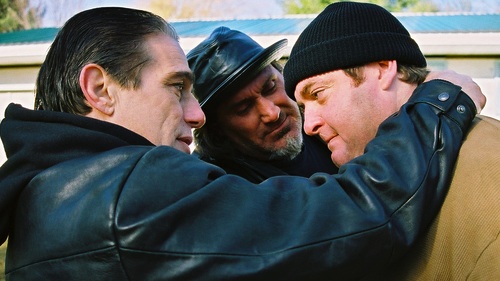
By Joe Bendel. Evan Lake is the CIA’s top motivational speaker. He also happens to be played by Nicolas Cage, so hold on tight, this will be a bumpy ride. While a station chief, Lake was captured and tortured by a notorious terrorist, but he lived to tell the tale, with honor. Fatefully, just as the physical and mental symptoms of a rare neurological disease start plaguing Lake, he gets a line on his old tormentor, Muhammad Banir. He might as well get his revenge or die trying in Paul Schrader’s Dying of the Light—although Schrader himself would reportedly prefer not to be so closely identified with the final producer-cut product. Regardless, it opens this Friday in New York.

Every year Lake gives a pep talk to the new recruits undergoing basic training and he projects to the back row of the theater—the theater next door. This might be his last hurrah. The agency just got wind his second opinion came back positive (in a bad way). However, his protégé, Milton Schultz has some interesting news. The rare pharmaceutical used to treat Banir’s degenerative disease has strangely surfaced during an incident in Romania. Yes, both men are slowly dying, betrayed by their own bodies.

Since the Agency still insists Banir is dead, Lake goes rogue, burning every possible bridge behind him. Yet, despite his increasingly erratic and anti-social behavior, he can count on the help of the loyal Schultz and Michelle Zuberain, an ambiguously close former Euro colleague. Meanwhile, the dastardly CIA bureaucrats keep trying to send Lake doctors and counselors.

Evidently, Schrader and several cast members are unhappy with the current theatrical cut, but it is hard to see why. It is a reasonably serviceable thriller with a bit of style here and there. Let’s be frank—this is the latest film from the director of The Canyons and the star of Left Behind. It’s just not that bad, especially compared to some of the recent gems in the Cage filmography. Frankly, it probably doesn’t even crack the bottom twenty (hello, The Wicker Man, Stolen, Seeking Justice, Trespass, Season of the Witch?)
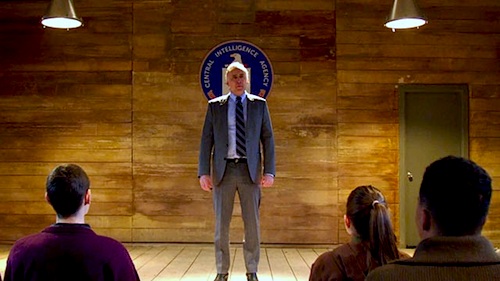
From "Dying of the Light."

Be that as it may, Cage sure does his thing as the tightly wound Lake. The man just doesn’t seem to have an inside voice. When he gorges on scenery, it is like watching a bull in a china shop, but at least he is nowhere near as embarrassing as Meryl Streep unconscionably overacting in Osage County. As Schultz, Anton Yelchin looks thoroughly freaked out, probably because he was. At least Irène Jacob does her best to class-up the joint as Zuberain.

Dying wrings plenty of atmosphere out of its Romanian locales and surprisingly, it is almost sympathetic in its treatment of the CIA (perhaps that is why some principals are unhappy). Say what you will, but they are dashed indulgent of Lake. In its current state, the film also portrays the Islamist terrorists as unambiguously vicious extremists. It is far from perfect and nobody would describe it as high art, but Dying of the Light is compulsively watchable, building a fair degree of suspense in its weird way. Recommended for fans of Cage’s flaring nostrils, it opens this Friday (12/5) in New York, at the AMC Empire.

LFM GRADE: C+

Posted on December 2nd, 2014 at 1:01pm.

LFM Reviews The Ugandan @ The 2014 African Diaspora International Film Festival

By Joe Bendel. Thirty five years after his ouster and eleven years after his death, military dictator and self-proclaimed “uncrowned King of Scotland” Idi Amin Dada still exerts a cancerous influence on his country. In 1972, Amin forcibly expelled 80,000 Asians (mostly of Indian origin) from Uganda. Several thousand Indo-Ugandans have since returned, filing claims for the property appropriated by the regime. Demagogues invoking Amin’s name are only too willing to capitalize on the resulting tensions. Two families are caught up in the racial and economic tensions escalating throughout Patrick Sekyaya’s ironically titled The Ugandan, which screens as part of the Indian Cinema sidebar at this year’s African Diaspora International Film Festival in New York.

Simon’s little brother was nearly suspended for protecting Sonia’s little sister from a bully. They met during the disciplinary aftermath and eventually fall in love. However, joining their two families will be a tricky proposition. Their home was once the property of Sonia’s father, Raman, who has instituted legal proceedings to retake possession. In fact, he is playing a nasty game of hardball, even though Simon’s sister Becky happens to be his secret mistress. Oh, but it gets even more complicated than that, especially when Becky’s other lover Tony takes advantage of a race riot to waylay her third brother Ralph and his ill-gotten loot. Naturally, the hot-headed Ralph will not take that lying down.

In many respects, The Ugandan is not so far removed from some of the more professional Nollywood films. The execution is a little rough and some of the performances are slightly awkward, but Sekyaya’s ambition is impressive. He tackles some big themes here, openly inviting an honest historical reckoning with the Amin legacy. Even with his budget constraints, Sekyaya also stages a pretty convincing riot, giving the film further ironic resonance in light of current events.

From "The Ugandan."

To be fair, Sekyaya’s cast plugs away rather gamely, including the director himself, who is suitably intense as Ralph. Peter Mayanja and Dora Mwima demonstrate the greatest screen presence, by far, as Simon and Becky, respectively. On the other hand, Arfaan Ahmed has a bit of a rough go of it as Raman, but Sekyaya gets him through it.

Frankly, Ugawood is still developing a talent pool, so Sekyaya makes do in some cases. Nevertheless, the film’s not so thinly veiled social and historical critiques are quite fascinating. His narrative also takes some odd turns, but the seemingly abrupt ending actually makes sense in retrospect. If you were one of his characters, you’d try to end things there as well. Hopefully, it will mark the beginning of a fruitful career, but anyone interested in contemporary Ugandan culture should see it now, because its subject matter will probably be too challenging for most festivals. Recommended for its plucky potential, The Ugandan screens tomorrow (11/28) and Tuesday (12/2) as part of this year’s ADIFF New York.

Posted on November 28th, 2014 at 12:55pm.

LFM Reviews Women Who Flirt

By Joe Bendel. Considering she looks like Zhou Xun, Angie really shouldn’t have to resort to a lot of game-playing. Unfortunately, she has carried a torch so long for Marco, her colleague and former classmate, he now takes her for granted. When a flirty game-player stakes a claim to the oblivious platonic friend, Angie will have to learn how to fight fire with fire. The battle will be joined in Pang Ho-cheung’s Women Who Flirt, which opens this Friday in New York.

Shocked to learn her longtime best friend is suddenly serious about a woman who is not herself, Angie calls on her eye-lash batting chum May to form a kitchen cabinet of proud Shanghai flirters to advise her. However, she finds their recommended baby talk and helpless damsel-in-distress routines absolutely vapid. She is just not equipped for this fight and her rival Hailey knows it. Still, if she can get dumb old Marco alone for a romantic getaway in Taiwan, she just might have a puncher’s chance.

Yes, there are similarities between Flirt and My Best Friend’s Wedding and its tragically romantic Chinese-Korean reconfiguration, A Wedding Invitation, but Zhou’s Angie is a protagonist we can really get behind. Her withering stares and palpable disgust at the Sex in the City antics going on around her are often quite funny and highly sympathetic. Frankly, she is just too cool for everyone else in the film.

From "Women Who Flirt."

Of course, Flirt will eventually settle into a sentimental rom-com, but at least it takes a rainy day trip to the Ju Ming Museum, which looks incredible (so good tourist tip there). In fact, Zhou and Ju are just about enough to carry the film across the finish line. Sonia Sui certainly looks like a deceptively cute femme fatale and shows some convincing claws when the time comes. Still, it is hard to see why they would fight over a blockhead like Marco, played rather woodenly by Huang Xiaoming. In contrast, Xie Yilin constantly kicks up the energy while inhaling scenery as May, the Obi-wan of flirters.

Pang’s films certainly come in a variety of flavors. Instead of a naughty screwball comedy like Vulgaria, a gory satire like Dream Home, or a sensitive family drama like Aberdeen, Flirt is most closely akin to his reasonably mature rom-coms, such as Love in the Buff. It is too bad this one does not depart further from genre conventions, because Zhou and her character deserve something more outside-the-box. Regardless, she still commands the screen. Recommended for fans of Zhou and romantic comedy in general, Women Who Flirt opens this Wednesday (11/26) in New York at the AMC Empire, from China Lion Entertainment.

LFM GRADE: B-

Posted on November 25th, 2014 at 9:36pm.

LFM Reviews Aftermath

By Joe Bendel. Tom Fiorini deals with contractors all day, so he can’t be a shrinking violet. The housing magnate has done very well for himself, but he is about to lose everything. We know, because he tells us in medias res. It all started with a bit of workplace trash talking. Labor relations hit an all-time low in Thomas Farone’s gritty thriller Aftermath, which opens this Friday in New York.

Fiorini is a cold and unreasonably demanding boss. We know, because his foreman tells us so. Still, everyone on his construction site stays, because work is heard to find in upstate New York, especially for an ex-con like Tony Bricker. Bricker is a sub-contracting framer, not a mason. Initially, he up-manages Fiorini fairly well. It is the foreman he has issues with—so much so, he takes a swing at him right in front of Fiorini. When said foreman mysteriously disappears shortly thereafter, suspicion naturally falls on Bricker.

Assuming the worst, Fiorini sacks Bricker. Words get heated, threats are made, and circumstances quickly escalate. The two detective working the missing person case are not much help, but at least the sheriff is on Fiorini’s side. In fact, the old lawman is much more effective than the dodgy muscle Fiorini hires to intimidate Bricker. Frankly, they only make matters worse.

Clearly, this film has been kicking around for a while, since it is billed as the final film of Chris Penn, who died in early 2006. Penn was always a reliable character actor and his work as Bricker is consistently forceful. However, one cannot help wondering if his unfortunate passing partly explains why the third act is considerably patchier than the hour or so that comes before it.

Aftermath is also notable as part of Anthony Michael Hall’s more successful-than-you-realize career reinvention. The kid best known for wearing panties on his head in John Hughes movies is now a rather credible hardnose. Roles like Fiorini and Jack, Du Pont’s troubleshooter in the disappointing Oscar contender Foxcatcher should solidify his professional evolution. Hey, this is America, anything can happen here.

From "Aftermath."

In a case of stunt-casting gone bizarrely right, Tony Danza chews the scenery quite entertainingly as King, an off-the-books gun dealer and freelance fixer. However, Leo Burmester upstages everyone as the cantankerous sheriff. On the other hand, Law & Order alumnus Elisabeth Röhm is wastefully underutilized as Fiorini’s largely disinterested and uninteresting wife, Rebecca.

Aftermath is definitely aiming for a dark, Blood Simple-A Simple Plan vibe, but it ends on a note so pitch black, it is a real buzz kill. Again, you have to wonder if that was the original plan or a salvageable solution. Still, for those who enjoy indie thrillers inspired by the likes of the Cohen Brothers and Tarantino, it is worth checking out just to watch Penn, Burmester, Hall, and Danza playing off each other. Recommended accordingly for jaded viewers, Aftermath opens this Friday (11/28) in New York, at the Quad Cinema.

LFM GRADE: B-

Posted on November 25th, 2014 at 9:36pm.

LFM Reviews The Whale: Revenge from the Deep

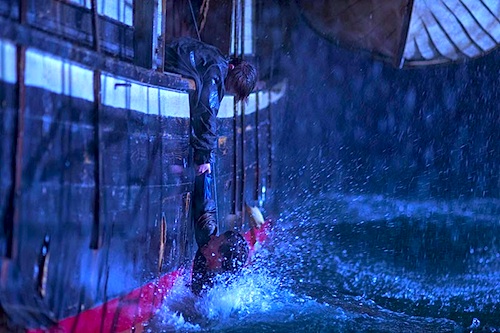
By Joe Bendel. The development of electricity and fossil fuels greatly improved the western standard of living, but it was even better news for whales. Demand for whale oil largely evaporated, but considerable damage to the whale population had already been done. By 1820, the Essex whaling ship had to venture far out into the Pacific Ocean to find their quarry, leaving them in a highly vulnerable position when disaster struck. Based on the misadventure that inspired Melville’s Moby-Dick, the Essex’s last voyage is now the subject of Animal Planet’s first scripted dramatic special, The Whale: Revenge from the Deep, which premieres on the network this Wednesday.

Old man Thomas Nickerson was a green cabin boy on the Essex and lived to tell the tale in flashbacks to his interlocutor and the audience. Although he lived on Nantucket, he was still considered an outsider by most of the crew. Initially, he finds more acceptance from the freed African American laborers than the crusty old “deckers.” However, first-time Captain George Pollard, Jr. takes a shine to the lad, perhaps out of solidarity. The demanding first mate Owen Chase grudgingly admits the boy rises to each challenge he gives him, but remains cold and aloof.

Still, things seem to be looking up when the Essex finally lands its first kill of their frustrating cruise. Ominously though, the hunters soon become the prey, when the freshly harpooned whale’s companion starts pursuing the Essex. Nobody aboard fully understands how serious the situation is, until it is too late. With the Essex crushed into kindling, a rag tag group of survivors, including Nickerson, Pollard, and Chase, will try to navigate three of the Essex’s twenty-foot whaleboats to civilization.

Although whales play a critical role in Revenge, they largely exit the stage at the midway point, leaving the desperate humans to their own folly devices. While Animal Planet viewers might expect something like the early beta version of Moby-Dick, it is actually a rather harrowing shipwreck story.

From "The Whale: Revenge from the Deep."

Tightly helmed by Alrick Riley within his British television budget constraints, The Whale gives viewers a vivid sense of the life-and-death struggle to survive on the high seas in open boats without provisions or any means of communication. While the whale attack effects pale in comparison to films like Life of Pi, the makeup team does first rate work representing the ravages of sun and elements. Frankly, it hurts just to look at their massively chapped lips and blistered faces.

Martin Sheen does his ancient mariner thing well enough, narrating as the old haunted Nickerson, while Charles Furness is convincingly earnest and over-awed playing his younger self. Nonetheless, John Boyega will likely get top-billing in future re-packagings, once viewers see him in the forthcoming Star Wars film. As Bond the cook, he exhibits the strong presence that made him a breakout star in Attack the Block, but it is still very definitely a supporting part. Frankly, Jonas Armstrong and Adam Rayner really carry the film as the complicated rivals, Chase and Pollard, respectively.

One thing comes through loud and clear in Revenge. If you ever see a whale bum-rushing your masted sailing ship, it means trouble. Although Animal Planet is presenting it in conjunction with their R.O.A.R. wildlife conservation campaign, the film itself wisely avoids an overly preachy tone. Pretty good for a television historical, The Whale: Revenge from the Deep airs this Wednesday (11/26) on Animal Planet.

LFM GRADE: B

Posted on November 24th, 2014 at 12:15pm.

LFM Reviews Dukhtar @ The 2014 South Asian International Film Festival

DUKHTAR Trailer from Zambeel Films on Vimeo.

By Joe Bendel. Zainab is supposed to be the child-bride daughter of a child-bride mother. At just fifteen years old (frankly, not so very young by Islamist standards), Allah Rakhi (meaning “God protects”) was married off to a much older tribal chieftain. Now her ten year old daughter is to be a peace-offering to any even older rival clan leader. Refusing to consign her daughter to a fate worse than her own, the mother flees with her child into the mountains in Afia Serena Nathaniel’s Dukhtar, Pakistan’s official foreign language Oscar submission, which screened at the 2014 South Asian International Film Festival.

Allah Rakhi’s initial escape is rather clever, but she does not have much a plan after that. She really has nobody to turn to, since her “husband” has prohibited any contact with her family since their marriage. Since Zainab is now considered the property of creepy old Tor Gul, both clans are out to capture her and kill her mother. That would be their idea of “honor.” Into this misogynist tribalism drives trucker and former mujahidin veteran Sohail. At first, he is reluctant to shelter the fugitive women, but he soon becomes their ardent protector. They will need him.

Let us be clear, nobody is terrorizing Allah Rakhi and their daughter because they are upset about drone strikes or resent America’s friendship with a democratic state like Israel. No, it is simply the thing to do for its own sake. This is a harrowing depiction of institutionalized misogyny and the pain and desperation it causes. Yet, as bracing as Dukhtar is, Nathaniel’s symbolic imagery often has a poetic beauty. She and her cinematographer tandem of Armughan Hassan and Najaf Bilgrami also vividly capture the vast splendor of the mountain vistas, so the film isn’t just a slap in the face.

Nathaniel gets a critical assist from her leads, who are surprisingly subtle, but still deeply expressive. It is particularly powerful to watch Samiya Mumtaz convey all the fear, confusion, and anger Allah Rakhi has been forced to guardedly bottle up. She also forges some ambiguous but genuinely touching chemistry with Mohib Mirza’s Sohail, who handles his own significant character development arc rather sure-footedly. Even young Saleha Aref is quite grounded and believably restrained as Zainab.

Watching Dukhtar leads one to abandon all hope for Pakistan, but the mere fact they submitted it for Academy Award consideration (and the likely attention that comes as a result) could be considered a hopeful sign. Despite a rough patch here or there, Dukhtar is a compelling narrative, featuring several mature, well-balanced performances. It is an important film for multiple reasons that demands a wider audience. Enthusiastically recommended, Dukhtar screened as part of this year’s SAIFF.

LFM GRADE: B+

Posted on November 24th, 2014 at 12:14pm.