LFM Reviews A Girl Walks Home Alone at Night

By Joe Bendel. This vampire wears a chador rather than a cape. She is clearly not an Anne Rice kind of vampire, but you will still find plenty of vice in Bad City, where she stalks her victims. Ana Lily Amirpour finally delivers the Iranian existential rock & roll vampire western the world has been waiting for with A Girl Walks Home Alone at Night, which opens this Friday in New York.

The dialogue is Persian, but it was shot in a California boom-and-bust oil town that easily passes for a lawless provincial corner of Iran. Although not explicitly political, there is no way the regime would ever cotton to a depiction of Iranian society rife with prostitutes, pimps, pushers, and junkies (frankly, they are just no fun whatsoever). Of course, this seedy environment makes a perfect hunting ground for “the Girl,” who prowls through Bad City’s dark streets late at night on her skate board.

Like an old school E.C. Comics blood-sucker, the Girl generally bites those who have it coming, such as “the Pimp,” who has been hassling “the Persian James Dean” over his junkie father’s debts. Or at least he had been. Yet, the Girl somehow develops a friendship with “the Prostitute” despite their very different temperaments. However, it is her halting mutual attraction to the Persian James Dean that really challenges her choice of undead lifestyle.
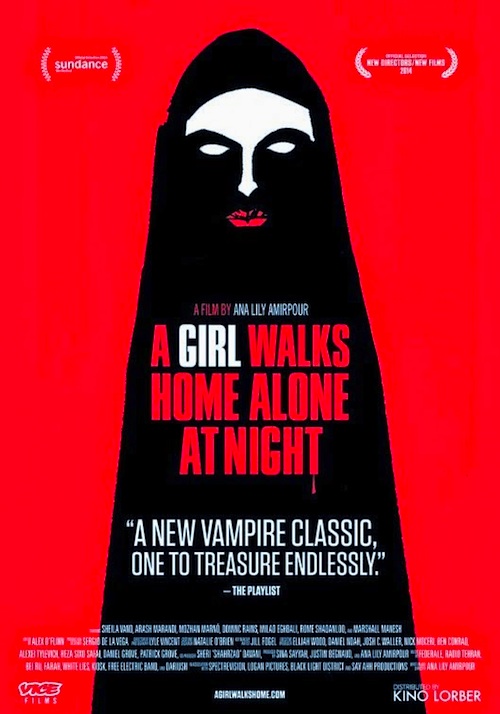
AGWHAAN sounds absolutely crazy on paper and indeed in many ways it is, but it is an art film through-and-through rather than a cult midnight movie. Amirpour’s pacing is slow and deliberate, in a seductive kind of way. If audiences are not careful, Bad City will anesthetize them. Fortunately, the driving alt rock-rockabilly soundtrack supplies plenty of aural caffeine (this is a case where a soundtrack album could easily out-perform the source film).

Regardless, viewers should stick with AGWHAAN, because it is a truly unique cinematic experience, starting with Lyle Vincent’s gobsmackingly arresting black-and-white cinematography. Arguably, the film is stylistically most closely akin to the work of Bruce Weber (best known for directing Calvin Klein commercials and the Chet Baker doc Let’s Get Lost).

AGWHAAN is the sort of film that washes over you, yet it still heralds the arrival of a major star in Sheila Vand. As the Girl, she gives a quiet but deeply expressive performance. Somehow she is able to look exquisitely vulnerable and eerily sinister at the same time, which is quite a trick. Likewise, Mozhan Marnò defies all clichés with her sensitive work as the prostitute.

There is something wonderfully subversive about a delicate looking lady vampire wreaking havoc on Iran’s low life men. Who wouldn’t love to see her take the bite to the oppressive theocrats in a sequel? A rich feast for eyes and ears, it is completely unlike any other vampire movie you have previously seen. Highly recommended for fans of ambitious genre film and Persian cinema, A Girl Walks Home Alone at Night opens this Friday (11/21) in New York at the IFC Center.

LFM GRADE: A

Posted on November 17th, 2014 at 7:49pm.
LFM Reviews Starry Eyes

By Joe Bendel. If only Astraeus Pictures employed the traditional Hollywood casting couch, Sarah Walker would be much better off. Instead, they will play sadistic games with her head and her life in Kevin Kölsch & Dennis Widmyer’s Starry Eyes, which opens today in New York.

Show business is a tough racket. Walker is reasonably talented and attractive, but she just cannot catch a break. It hardly helps when one of her so-called friends steals a gig out from under her. Frankly, they are not really her friends, they are her roommate’s friends. Her life is already like the darkside of Melrose Place and it will get steadily darker when she auditions for Astraeus.

Even though the indie studio has been somewhat off their game lately, scoring the lead in their latest horror movie would be a career-making coup. Unfortunately, Walker bombs during the weirdly confrontational audition, but when the casting director happens to witness her massively self-loathing breakdown in the ladies room, complete with hair-pulling and paroxysms, Astraeus is suddenly interested again.

Nonetheless, they will hardly fulfill all her dreams just like that. The callbacks will be truly sinister. Yet, each time Walker draws a line in the sand, she inevitably comes crawling back. Indeed, one of the most disturbing aspects of Starry is her willing complicity in her own damnation (for lack of a better word).

While there are teases of demonic horror in Starry (that the one-sheet duly capitalizes on), its first two thirds are more closely akin to a claustrophobic Polanski psycho-thriller. However, when the gloves come off in the final act, it gets spectacularly gory. Yet, in a way it comes as a relief, finally providing a break from the more realistically grounded and disturbing mental cat-and-mouse game that came before. It might even earn a laugh or two if you have a particularly evil sense of humor.

Starry will not be to everyone’s tastes (boy, is that safe to say), but the way it eviscerates Hollywood fakeness certainly sets it apart from the field. Being an insincere frenemy will get you painfully dead in Starry. As disturbing as Walker’s arc gets, Kölsch & Widmyer’s screenplay is a lot like a vintage E.C. comic—everybody who gets it probably had it coming.

As Walker, Alex Essoe absolutely goes for broke. She has moments that rival Isabel Adjani’s epic freak-out in Żuławski’s Possession. However, she cannot be accused of overly excessive histrionics (like say, Meryl Streep in Osage County, since we’re still not ready to let that one go), because the film’s dramatic context truly demands something viscerally explosive—and Essoe delivers in spades.

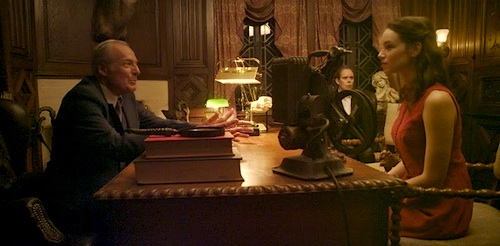
From "Starry Eyes."

Although the who’s-and-what’s of Astraeus remain murky, Louis Dezseran makes a distinctively sleazy patrician villain as the producer and implied studio boss, admirably gnawing on scenery in the old school Hammer tradition. Emerging indie genre star Pat Healy (Cheap Thrills, Compliance, The Innkeepers) also takes a memorable turn as Carl, Walker’s boss at a Hooters-style scarf-and-barf, who might be what passes for a likable character in Starry.

When Starry finally lowers the curtain, you are likely to hear loud exhaling throughout the theater. It is a darkly intense film, but also unusually well executed by genre standards. Arguably, there is even an element of Bergman-esque angst buried amid the body horror and bloody carnage. Recommended for adventurous cult cinema fans, Starry Eyes opens today (11/14) in New York at the Village East.

LFM GRADE: B+

Posted on November 14th, 2014 at 6:12pm.

LFM Reviews Aberdeen @ The SFFS’s HK Cinema Series

By Joe Bendel. Cheng Tung was once a fisherman in Aberdeen Harbor, but he now works as a Taoist priest, specializing in the “Breaking Hell” ceremony. Unfortunately, the patriarch cannot break the Hell of his own family. Resentments will be nursed and neuroses will run wild in Pang Ho-cheung’s Aberdeen, which screens during the San Francisco Film Society’s annual Hong Kong Cinema series.

All the Chengs have their own problems, particularly little Chloe. She is dealing with bullies at school and her ailing chameleon, Greenie. Her parents are outwardly supportive and engaged, but her father Cheng Wai-tao has come to privately doubt whether he truly is her father. She just doesn’t seem cute enough to be the daughter of the super-slick motivational speaker and his actress-model wife, Cici. At least, she was an actress-model. Gigs have become scarce and getting scarcer, as she proceeds to get steadily older.

Meanwhile, Chloe’s uncle Yau Kin-cheung is having a reckless affair with his much younger but increasingly codependent nurse, while his oblivious wife (Wai-tao’s older sister) struggles with her unresolvable mother issues. Unfortunately, Cheng Tung is not allowed to exercise much authority. Offended by his relationship with a bar hostess, his son has almost completely frozen the old man out.

For HK cinema fans who primarily know Pang for his naughty screwball comedy Vulgaria and the gory satire Dream Home, the sensitive family drama of Aberdeen will be quite a revelation. While there are distinctive fantastical interludes, particularly the Kaiju Greenie rampaging through the scale model streets of Hong Kong, it is still thoroughly grounded and often quite subtle. On paper, the beached whale that becomes a focal point for the Chengs and the unexploded WWII ordinance discovered near Yau’s flat sound like face-palmingly heavy handed symbolism, yet Pang never overplays them.

From "Aberdeen."

Regardless what her father says, young Lee Man-kwai’s Chloe is all kinds of cute and she anchors the film very effectively. However, it is Gigi Leung who really lands the knock-out punch as Cici. There have been a number of films about actresses struggling to maintain their careers as time flies, one of the most notable being Olivier Assayas’s Clouds of Sils Maria. Yet, as great as Juliette Binoche is in that film, the audience never comes to know and understand her character as we do Leung’s Cici. She has a few key scenes that will just cut your legs out from under you. She also looks great, as does Dada Chan who appears in an extended cameo playing a character much like her pre-Vulgaria persona, probably as a thank you to Pang for her award-winning breakout role.

It is rather remarkable how many interconnected relationships Pang and his all-star cast are able to fully flesh out. Surprisingly potent but never overbearing, Pang’s Aberdeen captures the messiness of life with honesty and affection. Highly recommended, it screens this Sunday (11/16) as part of the SFFS’s Hong Kong Cinema series.

LFM GRADE: A-

Posted on November 13th, 2014 at 1:51pm.

LFM Reviews Brahmin Bulls

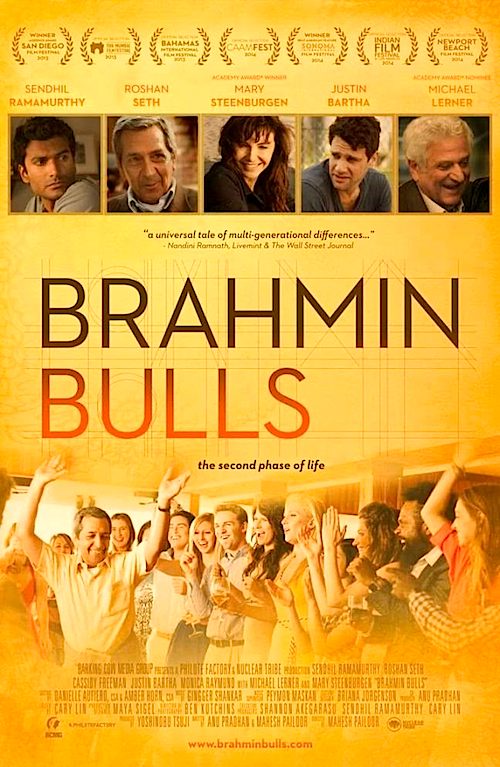
By Joe Bendel. Ashok Sharma once had grand ambitions of winning a Nobel Prize. Father of the Year, not so much. He came up empty on both counts. Sharma will try to reconnect with his grown architect son, but another face from his past will complicate matters in Mahesh Pailoor’s Brahmin Bulls, which opens this Friday in New York.

Sharma lives in Boston, but he doesn’t seem like such a bad guy. Nevertheless, Sid Sharma considers himself more of the heir to Richard Neutra than his father’s son. Unfortunately, that is not what clients are looking for, thereby causing him stress in his firm. (Frankly, he probably ought to feel a little heat, since it looks like he plays tennis all day and gets smashed in hipster bars every night). Dr. Sharma will use an academic conference as a pretext for visiting his more-or-less estranged son, but he might have an additional ulterior motive. It turns out his former mistress, Helen West, will be one of the conference speakers.

As viewers might expect, the reunion starts out massively awkward, but steadily thaws before getting predictably uncomfortable again. However, Pailoor skips the clichéd old world vs. new world clash of cultures. Frankly, the senior Sharma is just as westernized and modernized as his soon-to-be divorced son, if not more so. In fact, one of the most intriguing aspect of this film is the treatment of his arranged marriage (to Sid’s late mother, whom he cheated on). Obviously, it was a difficult marriage and he justly blames himself for the worst of it, but it is not like it was his idea in the first place. Indeed, it is rather complicated.

There is an awful lot of standard issue father-son melodrama in Brahmin (tennis, the game that pulled them apart might just bring them back together). Still, distinguished screen actor Roshan Seth (Nehru in Gandhi and villain Chattar Lal in Indiana Jones and the Temple of Doom) is refreshingly dignified and understated as Dr. Sharma. He and Sendhil Ramamurthy play off each other rather well, as father and son. For comic relief, Michael Lerner is a lot of fun hamming it up as his formerly hard-partying academic colleague, while Mary Steenburgen also hits the right note of graceful resignation as West. On the other hand, Sid’s office and social network seems to be populated with an awful lot of boring characters.

Be that as it may, you have to give credit to a film that loudly proclaims it love for Neutra’s houses. Even if Brahmin follows a formulaic narrative, it is far less manipulative and sentimental than its themes would suggest. There is nothing particularly special about its technical package, but at least the admirably restrained Pailoor keeps it moving along, so it goes down relatively smoothly overall. No cause for fireworks, but those looking for emerging talent might want to check it out, because Pailoor could well be building towards bigger and better things with subsequent films. It opens tomorrow (11/14) in New York at the AMC Empire.

LFM GRADE: C+

Posted on November 13th, 2014 at 1:49pm.

LFM Reviews Desert Lullabies @ MIX NYC 2014

Desert Lullabies Trailer-HD from Monely Soltani on Vimeo.

By Joe Bendel. It is tough to be a kid in Iran. It is also hard to live with dignity as a woman and hard to live at all as an LGBT Iranian. Human rights for everyone remains a serious issue in the country, but the potential wartime death of innocence has become an increasingly pressing and universal concern throughout global battlefields. However, California-based filmmaker Monely Soltani explores it from a distinctly Persian perspective in the narrative short film Desert Lullabies, which screens during MIX NYC: the 27th New York Queer Experimental Film Festival.

Tara’s mother Homa has a hard time explaining why her dissident father has not yet returned as he promised. She has an even harder time explaining why they must flee their home at dawn. She has just received a last-minute warning the government imminently plans to raze their rebellious village along with all its inhabitants, but that is an awful lot to burden a young child with.

As she slips into a feverish slumber, Tara will be visited by the spirit of her beloved grandmother and the goddess Anahita, but do not expect a happy ending, per se. Despite Desert’s fable-like vibe, reality still is what it is. Nonetheless, simply carrying on constitutes a victory.

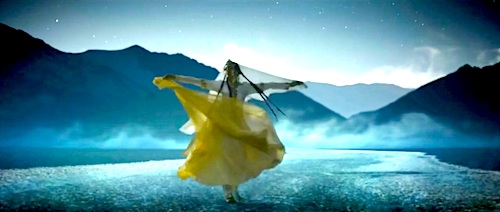
Shot on location in Death Valley, but utilizing extensive green screen work, Desert seems to exist eerily out of time, like some sort of near future-Medieval dystopia. Some of the effects might somewhat reflect Soltani’s presumed budget constraints, but the evocative interiors of Homa’s modest home have a Spartan but tangibly lived-in feel.

While Desert is only fifteen minutes long, Shila Ommi’s performance as Homa packs quite a punch. Based on Soltani’s own mother, she vividly conveys all of Homa’s motherly courage and desperation. As Tara, Ariana Molkara’s work is also unusually sensitive and unaffected. Viewers will definitely believe they are family—a tragically incomplete family.

From "Desert Lullabies."

Soltani does not belabor the particulars of the current regime, but there are enough Iranian signifiers, starting with the Persian dialogue, to cue viewers’ pre-existing context. In fact, it could be seen as part the leading edge of an emerging Persian-American cinema, along with Ana Lily Amirpour’s A Girl Walks Home Alone at Night.

Although Soltani’s previous short documentary won an award from USC’s Lambda Association, Desert would not seem to be a natural fit for MIX NYC, but cheers to them for not being stylistically or thematically dogmatic. Highly recommended, Desert Lullabies also looks like one of the more accessible films in the Ancient Futures program, which screens tonight (11/12) at the 27th MIX NYC.

LFM GRADE: B+

Posted on November 12th, 2014 at 1:16pm.

Jason Momoa Smells Fresh Blood: LFM Reviews Wolves

By Joe Bendel. Evidently, werewolves can be as snobby as anyone. Sure, some humans are turned through bites, but hereditary lycanthropes look down their snouts at them. You will find a large concentration of pure-bred wolves in Lupine Ridge. It might look like hill country, but it is the Philadelphia Main Line for werewolves. It is there that Cayden Richards will go searching for answers in David Hayter’s Wolves, which opens this Friday in New York.

Richards never knew he was adopted until he heard it on the TV news. Having discovered his parents ripped apart wolf-style after an inconvenient black-out, it is now too late for him to ask them any questions. Resigned to live as a fugitive from justice, Richards simply roams the highways, trying to keep his inner beast in check. However, a chance encounter with Wild Joe, a fellow pure-bred werewolf outcast, points him towards Lupine Ridge.

As soon as he blows into town, he seems to rub Connor, the town’s alpha-male/alpha-wolf, the wrong way. However, a wiry old farmer by the name of John Tollerman offers to take him on as a farmhand, no questions asked. Even the television reports about Richards’ previous misadventures do not seem to throw the good-hearted Tollermans. Nor does it scare off Angelina Timmons, who ought to be too young to tend the bar she inherited if she is roughly as old as Richards, the high school senior-dropout. Of course, the authorities never come to Lupine Ridge, because aside from a few humans like Mrs. Tollerman, they are all werewolves.

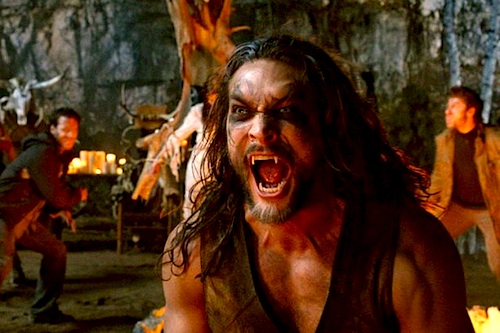
In terms of tone, Wolves aims to be something like the lycanthropic equivalent of The Lost Boys, with hit-or-miss results. On the plus side, Jason Momoa’s Connor makes a terrific hairy heavy and Stephen McHattie has the perfect Lance Henriksen-esque weather-beaten gravitas for Tollerson. Both come into Wolves with genre cred that they only further burnish.

From "Wolves."

The problem is that Lucas Till is horribly dull and awkwardly light weight as Richards. It is hard to see him as a high school quarterback—drama club president, maybe. Hayter had to notice how much verve Momoa and McHattie brought to the table (which they then proceeded to chew) and how slight Till’s presence is in contrast. Granted, dull horror movie heroes are a tradition dating back to mild David Manners in the original Dracula. However, in this case, the film depends on Richards’ fierceness, but it isn’t happening.

Despite the weak vanilla lead, there is a lot of fun stuff in Wolves. The werewolf makeup is not bad and the southern rock soundtrack nicely amplifies Momoa’s super-bad attitude. Unfortunately, too many of Till’s scenes feel like something out of Twilight instead of a werewolf movie with hair on its chest. If only there were less of him and more McHattie, but it is still kind of entertaining in a guilty pleasure sort of way. Recommended for fans of Momoa and McHattie, Wolves opens this Friday (11/14) in New York at the AMC Empire.

LFM GRADE: C-

Posted on November 11th, 2014 at 7:51pm.