LFM Reviews The Midnight After @ The SFFS’s HK Cinema Series

By Joe Bendel. It turns out a web novelist by the name of Pizza has captured Hong Kong’s current uneasy zeitgeist with a tale of the Armageddon. As adapted for the big screen, it also involves the challenges of commuting and David Bowie. Hang on tight, because Fruit Chan’s The Midnight After is one heck of a wild ride that screens during the San Francisco Film Society’s annual Hong Kong Cinema series.

Most of the twenty-two Hong Kongers aboard the fateful mini-bus were not planning to be there. Suet, the driver, is covering for a colleague whose wife went into labor. You Chi-chi was anticipating a date with his girlfriend, but she canceled at the last minute. Junkie Blind Fai got on the wrong bus by mistake, whereas the distraught Yuki left a work social outing early after her lecherous boss summarily fired her. Hong Kong is bustling as ever leaving Kowloon, but when they drive through Lion Rock Tunnel towards the New Territories, the teeming masses and incessant traffic mysteriously vanish.

It seems they are the last people left in Hong Kong and the four students who got off at the first stop probably will not last long judging from their sudden symptoms. Trading cell numbers, the core group agrees to reunite in the morning to take stock of the rather dire situation. Soon they are simultaneously receiving bizarre calls that turn out to be the lyrics of Bowie’s “Space Oddity” in Morse Code. Then things really start to get strange, as the apparent apocalypse takes on both metaphysical and science fictional dimensions.

Frankly, we never figure out what is going on with absolute certainty, but we get a pretty good lesson in Hong Kong geography before the zombies show up. Reportedly, the film is also loaded with vernacular puns and wordplay that would even be lost on Mainland audiences, let alone Yankees, but it hardly matters. As it is, Midnight is absolutely bursting with madness.

It is also fully stocked with big named stars, including Simon Yam, naturally playing Wong Man-fat, a low level gangster who more or less assumes leadership of the ragtag group, with characteristic flair. Johnnie To repertory player Lam Suet is also perfectly cast as Suet the driver. Ironically, he probably gets bloodier in Midnight than in his recent To outings. Janice Man (or JM as she is also known, catchy that) is by turns vulnerable and unnerving as the seemingly innocent Yuki. Kara Hui still looks great and maintains plenty of edginess as Mak Sau-ying, a fortune teller-slash-insurance agent determined to do some post-apocalyptic business one way or the other.

From "The Midnight After."

Throughout Midnight Chan creates an uncomfortably realistic sense of what the end of the world might really feel like, but unlike Abel Ferrara’s cratering 4:44 Last Day on Earth, he uses it as the foundation of a tense and compelling (though admittedly logic challenged) narrative. Chan Fai-hung and Kong Ho-yan’s adaption of Pizza’s descriptively titled Lost on a Red Mini Van to Taipo nicely balances pitch black humor with moments of deep-seated anxiety-ridden existential drama.

Midinight is unremittingly dark, yet somehow it is still wildly entertaining. It represents a triumphantly off-kilter return to form for Chan, a former stalwart of indie HK cinema who found success producing rom-coms. He certainly doesn’t end the world with a whimper. Highly recommended for a broad cross section of cult cinema fans, The Midnight After screens this Saturday (11/15) as part of the SFFS’s 2014 edition of Hong Kong Cinema.

LFM GRADE: A

Posted on November 11th, 2014 at 7:51pm.
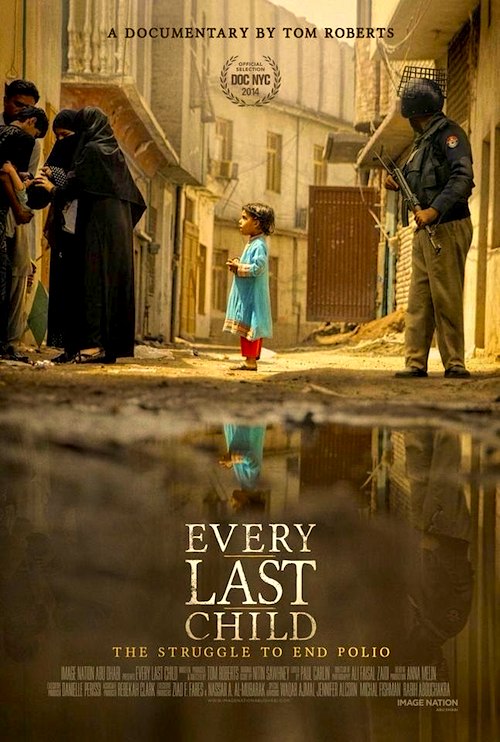
LFM Reviews Every Last Child @ DOC NYC

EVERY LAST CHILD TRAILER 2014 from Image Nation Abu Dhabi on Vimeo.

By Joe Bendel. It is a subject that the Taliban and Jenny McCarthy agree on. They both oppose vaccinations. Of course, the Taliban take it a bit further. In 2012, they declared war on the public health workers conducting Pakistan’s Polio vaccination campaign—and lo and behold, Polio contraction skyrocketed among Pakistani children. Threatened health official try to reverse the tide in Tom Roberts’ Every Last Child, which screens during this year’s DOC NYC.

There is no excuse for the volume of Polio cases sweeping Pakistan, but there is an explanation. Claiming it sterilizes boys and hastens the maturation of girls, the Taliban launched a perverse misinformation campaign against the national Polio vaccination program, finding an all too receptive audience amid the drone-obsessed fundamentalist population. As a result, Pakistan became an incubator of Polio, spreading the water-borne disease to neighboring countries through contaminated rivers.

Roberts takes the observational approach throughout ELC, so he rarely challenges anyone directly. It would be nice to see him confront smug vaccination opponents with the fruits of their demagoguery, but he presumably wanted to live. However, he never shies away from documenting the catastrophic repercussions. We watch an anguished father taking his Polio-stricken son for physical therapy and witness the vaccination volunteer mourning her assassinated sister and niece.

There is no shortage of galling human tragedy in ELC, but some of the most compelling sequences capture the World Health Organization point man’s attempts at crisis management. In a mind-boggling turn of events, they decide to drop the “discredited” word Polio, re-branding their campaign “Justice for Health,” which might be a winning strategy, but represents a crime against syntax.

The Pakistani and NGO health workers are remarkably brave and dedicated, but it would be nice to hear just one of them state the obvious: Islamist ideology is dangerous to public health. Despite the hopeful conclusion, the underlying dogma that precipitated the crisis has not gone away. In a way, Roberts focuses on a particularly problematic symptom rather than the disease. Still, it is a timely reminder why all children should be vaccinated (that’s something we shouldn’t need in contemporary America, but apparently we do). Recommended on balance for those concerned about anti-vaccination hysteria, Every Last Child screens this Friday (11/14) as part of DOC NYC 2014.

LFM GRADE: B-

Posted on November 11th, 2014 at 7:05pm.

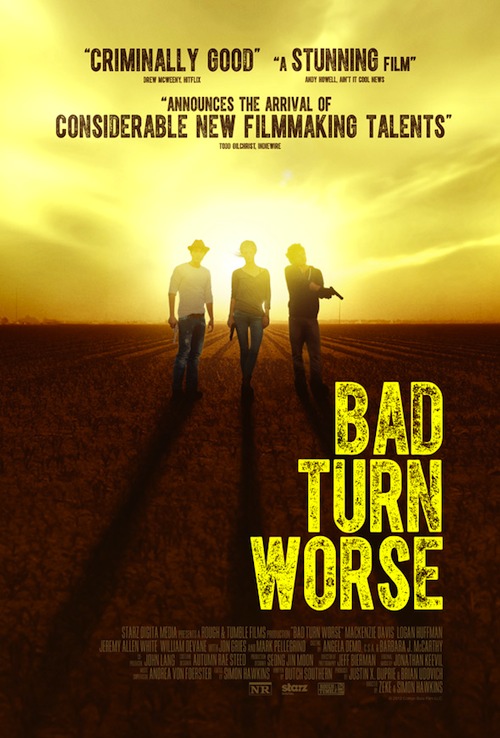
Texas Noir: LFM Reviews Bad Turn Worse

By Joe Bendel. Looking for work? You might consider moving to Texas. The state unemployment rate is a full point lower than New York and a cotton mill in the middle of scrub-grass nowhere is about to have a number of vacancies. It also happens to launder dirty money. Would that be a problem? It will be for the earnest but not too bright Bobby. He and his friends will be forced to waylay the next big cash delivery on behalf of their unscrupulous boss. Expect a double-cross or two in Simon & Zekie Hawkins’ Bad Turn Worse (a.k.a. We Gotta Get Out of this Place), which opens this Friday in New York.

Bobby is not as smart as his best frienemy B.J.’s girlfriend Sue, but they will both soon go off to college, leaving him and the town behind. For a last hurrah, B.J. boosts twenty grand from their boss Giff’s safe for a celebratory weekend in Corpus Christi. They have a wild time, in an awkward kind of way, but will have to pay for it when they return.

Although Bobby and Sue were not involved in the original theft, they are still on the hook with Giff. Technically, it was not his money B.J. pilfered. It belonged to Giff’s boss, Big Red. Rather than restitution, Giff demands a repeat performance on his behalf, but at a time when a major cash shipment will come through. Being the nice guy idiot he is, Bobby needs a bit of convincing, but Giff will pressure him at his weakest point: Sue. Of course, if Bobby knew of their feelings for each other, it would really lead to trouble.

Frankly, if Sue is so smart and reads so many crime novels (particularly Jim Thompson, whom the film name-checks in an early scene), you have to wonder what she is doing with a conspicuous heap of trouble like B.J. Still, if you can suspend disbelief that far, BTW is a pretty lean and mean little thriller. It has a humid sense of place, a few effective twists, and most importantly a terrific primary villain.

There is no question Mark Pellegrino steals the film out-right as the serpentine Giff. However, John Gries and William Devane also score in brief appearances as the corrupt Sheriff Shep and the dreaded Big Red, respectively.  This is the sort of film where the antagonists have the protagonists completely outclassed and over-matched, but that is not such a bad thing in film noir, or more specifically Texas Noir. Poor Jeremy Allen White’s Bobby and Logan Huffman’s B.J. are just buried in the East Texas dust, but at least Mackenzie Davis manages to hold up her end.

BTW asks for trouble by invoking Thompson, because it never quite rises to his level of hot-in-the-shade skullduggery. Nonetheless, it is considerably superior to most recent forays into Texas noir, like the wildly uneven Rushlights. Recommended for fans of dark, sweaty thrillers, Bad Turn Worse opens this Friday (11/14) in New York at the Village East.

LFM GRADE: B

Posted on November 11th, 2014 at 7:05pm.

LFM Reviews From Vegas to Macau @ The SFFS’s HK Cinema Series

By Joe Bendel. Chow Yun-fat is one of the biggest Hong Kong movie stars ever, especially when he plays a gambler. His latest Mr. Lucky character is quite a team player, assisting the Hong Kong, Chinese, and Macanese police take down an international money launderer. However, it might suddenly become difficult to watch on the Mainland following Chow’s statement of support for Hong Kong’s intrepid pro-democracy protestors. Even if he is banned in Chinese cinemas, Chow is an icon of HK cinema, perhaps even more so now. Fittingly, his latest gambling romp, Wong Jing’s From Vegas to Macau, opens the San Francisco Film Society’s annual Hong Kong Cinema film series.

“Magic Hands” Ken is a reportedly unbeatable gambler and former Vegas casino security expert who has just made a splashy return to Macau. He invites his old crony Benz, the patriarch of a family of conmen, to his lavish birthday party. Sparks soon fly between Ken’s daughter Rainbow and Benz’s son cool, despite nephew Karl’s awkward attempts at seduction.

Unfortunately, Benz’s undercover cop stepson Lionel’s cover is about to be blown. He was investigating the shadowy Mr. Ko, whose henchmen are now looking for the evidence he furtively recorded. That will bring them into conflict with Benz’s family and Magic Hands, in due turn. Naturally, he prefers to handle such matters alone, but he will start to coordinate somewhat with Lionel’s Chinese colleague, Det. Luo Xin, for obvious reasons.

In FVTM, Chow is a lot like vintage Burt Reynolds. He is having fun and he does not care how we take that. He still looks great in a tux, so more power to him. He definitely does his ring-a-ding-ding Rat Pack thing, leaving most of the fighting to Nicholas Tse’s brooding Cool. Tse doesn’t mug—period. However, Chow’s larger than life presence still provides the film’s jet fuel.

Jing Tian shows off her first class chops again as Luo Xin, but does not have the same featured spotlight that let her elevate Special I.D. above its functional ambitions. She makes an impression nonetheless as the hard-charging detective. While most of the comedy is broad but digestible, Chapman To gets a wee bit shticky as Karl, but he has also been rather outspoken in his support of the democracy movement, so we’ll give him a pass anyway.

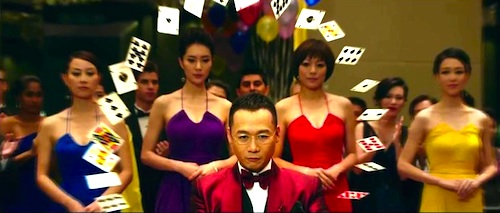
From "From Vegas to Macau."

Wong keeps the mood upbeat and the action skipping along, even though some pretty terrible tribulations befall several supporting characters. He also gives enough winking allusions to the God of Gamblers franchise to keep fans amused, before formally joining them together in a Marvel-style denouement.

FVTM certainly delivers the expected quota of action, slapstick, high living, and attractive cast members. Frankly, it ought to be an utterly apolitical film, but given the predictable invective aimed at Chow, patrons can feel strangely good about enjoying it. Recommended for fans of Chow and gambling/con game films, From Vegas to Macau opens the SFFS’s 2014 Hong Kong Cinema showcase this Friday (11/14) and screens again on Saturday (11/15).

LFM GRADE: B

Posted on November 11th, 2014 at 7:03pm.

LFM Reviews The Nightingale

By Joe Bendel. Like an MTV awards show, you can count on China’s official foreign language Oscar submission to generate unnecessary controversy. Usually, it comes from regime-friendly films submitted at the expense of internationally acclaimed festival favorites that do not slavishly toe the Party’s line. In 2008, nobody saw the Olympic doc Dream Weavers: Beijing 2008 outside of the Mainland, but it got the nod over Jia Zhangke’s 24 City. Again in 2013, the Chiang Kai-shek demonizing Back to 1942 was selected over Jia’s A Touch of Sin. See a pattern here? Ironically, the Chinese authorities went in the other direction this year, snubbing Diao Yinan’s Golden Lion winning Black Coal, Thin Ice in favor of an intergenerational road movie directed by a Frenchman. Playing it safe, China might actually win a bit of favor with older Academy members with this year’s official submission, Philippe Muyl’s The Nightingale.

For the second official French-Chinese co-production, Muyl “revisited” the themes from his 2002 film, The Butterfly. Instead of a butterfly collecting grand-père, Zhu Zhigen is spry old-timer, who longs to return his beloved late wife’s nightingale to their former village. Estranged from his son for dubious reasons, Zhu has never really known his privileged but lonely granddaughter Renxing. However, when her mother Qianying must leave on another business trip before her architect father Chongyi returns from his own, she is reluctantly left in Zhu’s care. Rather than just sit around the flat, he resolves to take her and the nightingale on a trip to his ancestral home, while he and the bird still have the time.

Of course, Renxing is initially quite a pill to travel with, but just as certainly, a bond will soon form between them. She will also start forging real friendships with children her own age when a series of detours forces them to make a long stop-over in an insanely picturesque village quite a bit out of their way. Eventually, Renxing’s parents will follow after them, having first resolved to divorce. Can the newly sensitive Renxing find some magic in Guangxi to keep them together?

Probably, but it all looks lovely on-screen regardless. While mostly rather apolitical, Nightingale’s journey can be interpreted as a celebration of traditional village life and a critique go-go urban values (like capitalism and democracy) by implication, making it quite compatible with current regime messaging.

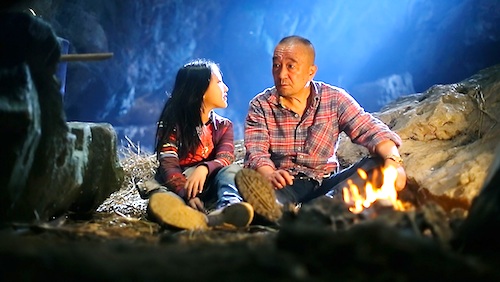
From "The Nightingale."

In all honesty, there are worse strategic choices than Nightingale when it comes to Oscar love. As Renxing, young Yang Xinyi is just relentlessly cute. Likewise, the veteran Li Baotian nicely balances stately dignity with a bit of scrappy attitude. Eric Qin and Li Xiaoran are also rather photogenic and reasonably engaging as the parents learning their predictable lessons. Yet, Renxing and Zhu’s most important co-star is the lush natural vistas cinematographer Sun Ming artfully frames.

On a technical level, Nightingale is quite accomplished, featuring one of Armand Amar’s best film scores to date (no, he’s not Chinese either). Still, it is undeniably conventional and sometimes shamelessly manipulative—neither of which are necessarily bad things for Oscar campaigning, but will leave more adventurous viewers wishing it had been slightly more ambitious. A major case of niceness, The Nightingale is now in contention for foreign language Oscar consideration, pretty much guaranteeing it a return engagement at next year’s Palm Spring International Film Festival and probably considerably more attention on the wider fest circuit.

LFM GRADE: B-

Posted on November 11th, 2014 at 7:03pm.

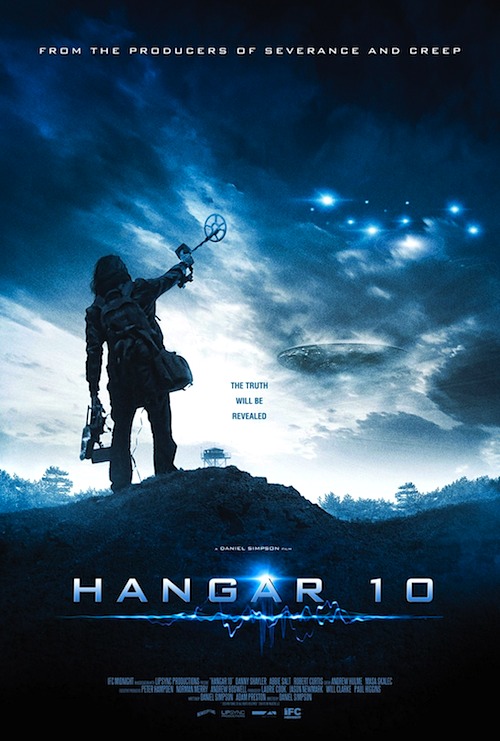
Rendle Sham: LFM Reviews Hangar 10

By Joe Bendel. The Rendlesham Forest “Incident” is often dubbed “Britain’s Roswell,” so you know it must be pure hokum. Nevertheless, ostensibly grown adults really believe there was some sort of UFO cover-up going on at the old RAF Woodbridge while the USAF was in residence. To feed conspiracy theorists’ persecution complexes, Rendlesham gets the found footage horror treatment in Daniel Simpson’s Hangar 10, which opens late night tonight in New York at the IFC Center.

Sometimes there is a good reason found footage was lost in the first place. In this case, Gus heads into the woods with his girlfriend Sally and her ex, would be filmmaker Jake, who will document their efforts prospecting Saxon gold for YouTube posterity. This has to be the first extreme metal-detecting film—and hopefully the last.

Of course, things are highly awkward from the start and get even edgier when strange lights start appearing. No abductions yet, just lights. Basically, for the first forty-five minutes, Gus and Jake stagger around saying things like: “Hey, did you just see that? But what’s with you and Sally anyway?” At this point, the audience would find alien abduction to be a relief.

That said, Simpson deserves credit for stepping up his game in the third act. The sequences shot in the not-so-abandoned Air Force base have a really stark look that pops off the screen. His special effects are surprisingly well rendered, but he does not show too much here, thereby maintaining the tension derived from uncertainty. It is a shame we can’t simply lop off the last twenty minutes or so and append it to a better movie.

Frankly, Simpson is already late to the found footage party, following up his middling Saw knock-off Spiderhole with a Roswellish abduct-and-probe horror show. Devin McGinn’s not-half-bad Skinwalker Ranch got there earlier and delivered more genre goods (it also co-stars the eternally cool Michael Horse). Throughout Hangar, Simpson does not get much help from his white-bread-and-mayonnaise cast, but the design team makes the base look huge and ominous, in a crummy government-issue kind of way.

An hour after Hangar ends, you will completely forget what Gus, Sally, and Jake look like, but some of Simpson’s Woodbridge visuals will stick for a while. There are much better found footage alternatives out there, such as The Taking of Deborah Logan and the VHS franchise. If you are in the West Village with friends hoping for a horror movie fix, it will suffice, but it is not worth seeking out when it starts its ‘round midnight screenings tonight (11/7) at the IFC Center.

LFM GRADE: C-

Posted on November 6th, 2014 at 10:28pm.