Politicians and Madmen: LFM Reviews Viva la Libertà

By Joe Bendel. Enrico Oliveri is as tired as his platform. The current leader of Italy’s leftwing opposition was considered the safe choice, pretty much guaranteeing their continued electoral futility. It hardly matters when Oliveri precipitously disappears. In fact, the party just might find itself in better hands when he is secretly replaced with his legitimately certifiable twin in Roberto Andò’s Viva la Libertà, which opens this Friday in New York.

The reserved and increasingly depressed Oliveri has become a convenient punching bag for frustrated party members. His business-like relationship with his wife Anna does not provide much joy either, so finally walks away from everything, turning up unannounced on his former lover Danielle’s doorstep in France.

With elections fast-approaching, Oliveri’s chief of staff Andrea Bottini stalls for time as best he can. As a temporary stop-gap, he recruits Oliveri’s lunatic identical twin to impersonate him until Oliveri returns. However, the recently de-institutionalized brother, who writes under the pseudonym Giovanni Ernani, demonstrates a far greater flair for politicking. Suddenly, Bottini is not so sure he wants his old boss back.

Ironically, it is unclear whether Andò realizes Ernani’s red meat demagoguery is just as substance-less as Oliveri’s mealy-mouthed prevarications. Aside from some class conscious blaming “the man,” there is really nothing to Ernani’s supposedly inspiring rhetoric, especially his third act recitation of Bertolt Brecht’s “To the Wavering,” which is a great way to say precisely nothing. It would all be rather clever if it were deliberate, but one gets the impression Andò accidentally satirized himself.
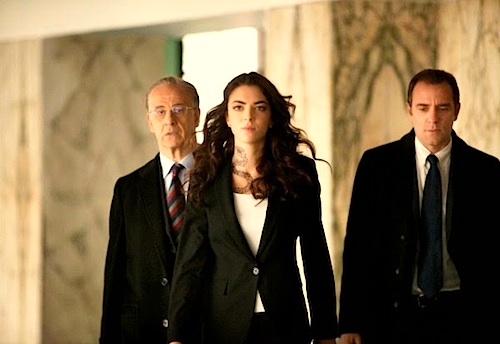
From "Viva la Libertà."

Regardless, Toni Servillo clearly has fun mugging and goofing as Ernani, but he is far more compelling as the world weary Oliveri, coming to grips with his personal and political failings. However, it is Valerio Mastandrea who supplies the film’s real heart and soul as Bottini, a tragic true believer not yet completely disillusioned. Unfortunately, most of the women are rather bland supporting characters, even the Machiavellians (although Giulia Andò’s snake tattoo certainly makes an impression, especially for a junior aide). Eric Trung Nguyen is similarly underutilized as Danielle’s filmmaker husband, but at least he adds some diversity.

Given Servillo’s remarkably accomplished work in films like Il Divo, Dormant Beauty and the Oscar winning Great Beauty, expectations will be high for Viva, but it is a surprisingly lukewarm affair. Nonetheless, its lack of ideological brass knuckles makes it relatively accessible to a wide spectrum of viewers, much like Ivan Reitman’s Dave, except even less pointed. Harmless and sometimes pleasant in a non-taxing way, Viva la Libertà is mostly just recommended for fans of Italian cinema (and Servillo in particular) pining for a fix, when it opens this Friday (11/7) in New York at the Quad Cinema.

LFM GRADE: C

Posted on November 6th, 2014 at 10:27pm.
LFM Reviews Crime Wave

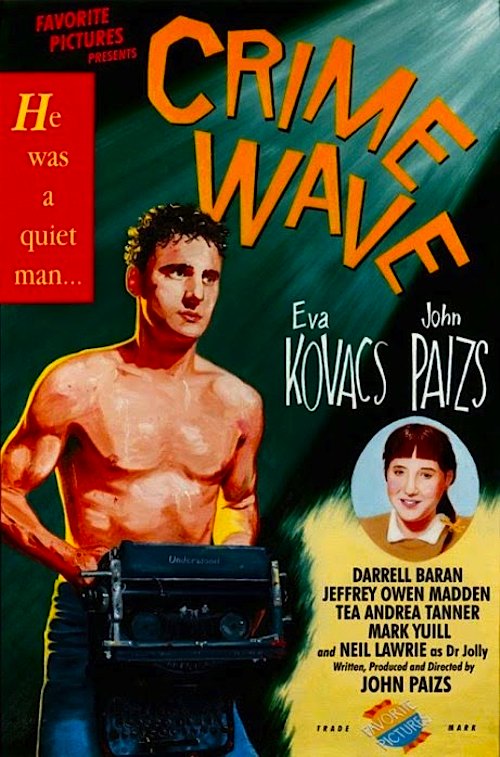
By Joe Bendel. In Winnipeg, they don’t care for black-and-white film noir. They prefer “color crime movies.” It is a strange city, as viewers should know from Guy Maddin’s My Winnipeg. Although Maddin is much better known today, John Paizs provided the Winnipeg auteur his early inspiration. One can see a kinship in their films, but Paizs’ magnum opus is truly singular unto itself. Color crime dreams turn into nightmares in Paizs’ Crime Wave, which has a special revival screening this Sunday at Anthology Film Archives.

Steven Penny is a shy loner, who rents a room from Kim’s parents above their garage. For some strange reason, the pre-teen becomes fascinated with their lodger and his ambition to write a great color crime screenplay. Each draft of Crime Wave he writes starts and ends the same way. Some eccentric field of employment (like celebrity tribute performers or self-help gurus) is dominated by a small clique that pretty much “has the racket sewn up,” until a brash upstart “from the north” blows into town “with a dream.” Apparently, they commence some sort of crime spree to usurp the competition, but just when they are poised on the brink of success, they are brought down by a violently confrontation.

How does Penny get from the beginning to the end? Unfortunately, he does not know either. Try as he might, he just can’t write middles. The frustration takes a toll on his psyche, even though Kim tries her best to be encouraging. In fact, he seems increasingly uncomfortable with her obsessive attention. However, when she finds him a potential screenwriting mentor in Kansas, the film really veers out into strange, dark territory.

With characters eventually interacting with their failed author, Crime Wave is more in the tradition of Borges or Pirandello than the early color melodramas it ostensibly spoofs. It is often quite funny, especially the successive takes of Penny’s middle-less screenplay we watch play out. Yet, there is something rather sad and slightly unsettling about Paizs’ taciturn performance as Penny. It is hard to describe the eccentric chord he strikes, but it is certainly distinctive.

The look of the film is also perfect in a perfectly idiosyncratic way. Whatever cameras and filmstock Paizs used aptly evoke the look of 1960s educational films as well as the contemporaneous color work of Douglas Sirk and Roger Corman. It is easily one of the most self-referential, postmodern films of the 1980s, but its sensibility not so far removed from a sketch comedy show like The Kids in the Hall, where Paizs did some segment directorial gigging.

It is really amazing how completely insane yet tightly controlled Crime Wave really is. It is clearly the work of a mad auteur that must be experienced from start to finish to truly get its scope and vibe. For obvious reasons, it has become cult favorite amongst Canadian cineastes. It is well worth seeing under any conditions, but especially when Paizs answers post-screening questions this Sunday (11/2) at Anthology Film Archives, because there are sure to be many and the answers will likely be a little odd. Indeed, Crime Wave is definitely recommended for color crime fanatics as a memorable way to wrap-up the weekend.

LFM GRADE: B+

Posted on October 30th, 2014 at 12:13pm.

More Found Footage for Halloween: LFM Reviews Hollows Grove

By Joe Bendel. Reality TV show crews make convenient grist for found footage horror films, because nobody will be terribly distraught when they are dispatched in supernatural fashion. That is particularly true of the on-air “talent” comprising S.P.I.T., the Spirit Paranormal Investigation Team. They will pick the wrong haunted orphanage for their ghost chasing in Craig Efros’ Hollows Grove, now available on VOD.

Grove starts out with a canned introduction from an FBI Agent thanking us for cooperating with their investigation by reviewing the footage to follow, which doesn’t make sense. Clearly, it is an attempt to shake up the found footage format, so whatever. What we will see is supposedly edited from the cameras of a S.P.I.T. crewmember and Harold Maxwell, a down-on-his-luck would-be filmmaker trying to produce a documentary on his old college buddies who made good in “reality” TV. Of course, Maxwell is quickly disillusioned when he meets retired Hollywood special effects artist Bill O’Neal, who stages all the spooky mayhem seen on the show.

To maintain spontaneity, they never know what surprises O’Neal has in store for them. This will be important to keep in mind when they start taping in Hollows Grove, an orphanage that became a dumping ground for special needs children. Residents were routinely abused, physically and sexually. At least two nurse committed suicide, in the same room, naturally enough. All that’s missing is a Nazi staff director performing black masses in the basement, but for all we know that happened too.

If the studio could successfully sue the distributors of Abby for infringing on The Exorcist, the Vicious Brothers ought to have a cast iron case to make against Grove for “paying homage” to Grave Encounters. However, Efros has a nice wrinkle with O’Neal’s presumed trickery. Since the lads assume all the weird stuff in the early stages is his handiwork, they mug for the cameras, while viewers realize they are majorly in for it. The crusty veteran FX hand also happens to be played by Lance Henriksen, who is as cool as ever in what is essentially a long cameo appearance.

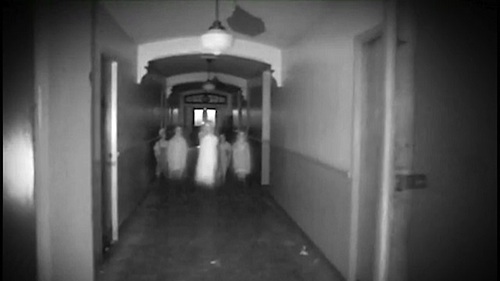
From "Hollows Grove."

So yes, we have seen this before—and seen it better in the recent Taking of Deborah Logan and the original Encounters. Nonetheless, the bickering and bantering of Matt Doherty and Sunkrish Bala as the show’s co-hosts helps keep it fresh. Bresha Webb also adds some style and attitude as their somewhat bemused segment producer, Julie Mercade.

Frankly, the entire ensemble sells the madness relatively well, but the stakes have definitely been raised in the found footage game. There are several creepy sequences in Grove, but the aforementioned films are more consistently scary. It is a passably diverting haunted institution movie, but fans should have better options during Halloween. Those who order it up anyway should be warned there is a stinger, so don’t log off when the credits start to roll. For diehard Henriksen fans (and we know you’re out there), Hollows Grove is now available via VOD platforms.

LFM GRADE: C+

Posted on October 29th, 2014 at 11:48am.

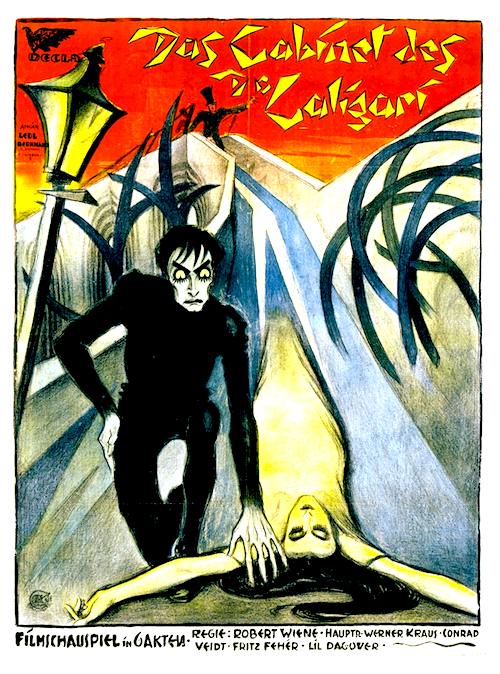
LFM Reviews The Newly Restored The Cabinet of Dr. Caligari

By Joe Bendel. Never ask a sideshow somnambulist when you will die. It is simply too easy for him to make his prophecies come true, especially when he is commanded by a psychotic Svengali with advanced psychiatric training. It is a mistake people still repeat in horror movies. There are a great many such genre motifs that can be traced back to this silent German classic, but the inferiority of public domain prints made it difficult to fully appreciate its feverish vision. Happily, Robert Weine’s ground-breaking The Cabinet of Dr. Caligari has been digitally restored to its original German expressionist glory, or as close to it as humanly possible. After playing to a packed house as part of MoMA’s annual To Save and Project film series, Weine’s restored Caligari opens this Friday at Film Forum.

Like the Ancient Mariner, Francis has a story that will disturb his elderly listener, but it needs to be told. It involves his rather distraught-looking fiancée Jane Olsen, and his best friend Alan. Like the German equivalent of Jules and Jim, both men openly courted Olsen, but resolved to remain friends regardless whom she chooses. Unfortunately, the choice will be made for her when the two friends attend the annual fair.

This year, Dr. Caligari has been granted a permit to exhibit his somnambulist, Cesare, by the soon to be deceased city clerk. According to Caligari, Cesare exists in a state of uncanny slumber, but can be temporarily roused to predict the future. “When will I die,” asks Alan. “At first dawn,” replies the zombie-like Cesare. Late that evening, a hulking figure roughly Cesare’s shape makes the prediction come true. Distraught over the death of his friend, Francis starts pursuing his killer, quickly focusing his suspicions on Caligari and Cesare.

Hans Janowitz & Carl Mayer’s screenplay is considerably more sophisticated than most silent era potboilers, but the ironic framing device was not their idea. In fact, it is largely thought to subvert their ideological intentions. Nevertheless, it is hard to feel comfortable with the authority Caligari represents, despite the eleventh hour twist. Indeed, Cabinet can be seen as an early example of subjective reality achieving equal standing with objective reality.

Regardless, Cabinet is a thoroughly otherworldly environment that only vaguely approximates the forms of our world. Aside from that titular box, you will hardly find any right angles in this town out of time. Instead, everything is made out of jagged lines and slanting diagonals. Janowitz and Mayer’s screenplay was conceived out of aesthetic notions of film as a truly collaborative, inter-disciplinary endeavor, where set designers would be as creatively engaged as actors, writers, and directors. Cabinet might the greatest realization of their egalitarian ideal.

Visually, it is an absolute wonder—and a disorienting horror show. The 4K restoration went back to the incomplete camera negative and the best extant prints available, adding footage typically not seen in PD cuts. The original inter-titles have been reinserted and the seemingly abrupt cuts have been augmented with previously missing frames. Gone are the hiss and scratches, replaced by a close approximation of the 1920 color tints and washes. It all looks great on the big screen—and the bigger the better.

Rather inconveniently, it is Werner Krause’s performance as Caligari that holds up best for contemporary viewers. He chews the scenery with villainous relish, shifting gears on a dime when necessary. Despite Cabinet’s lineage, Krause would become an outspoken supporter of the National Socialists and star in Veit Harlan’s notoriously anti-Semitic Jew Süss. On the other hand, Conrad Veidt would play Major Strasser in Casablanca, but he sleepwalks (in a literal sense) through the picture as Cesare. Still, the physicality and theatricality of his work have helped make Cabinet so iconic.

This is a true classic film that has lost none of its power to mesmerize, but the restoration makes it a much smoother and more lucid viewing experience. Almost a century later it remains vastly influential, even though for years it has not been shown in its true glory. Very highly recommended, The Cabinet of Dr. Caligari opens Halloween Friday (10/31) in New York at Film Forum.

LFM GRADE: A

Posted on October 28th, 2014 at 5:07pm.

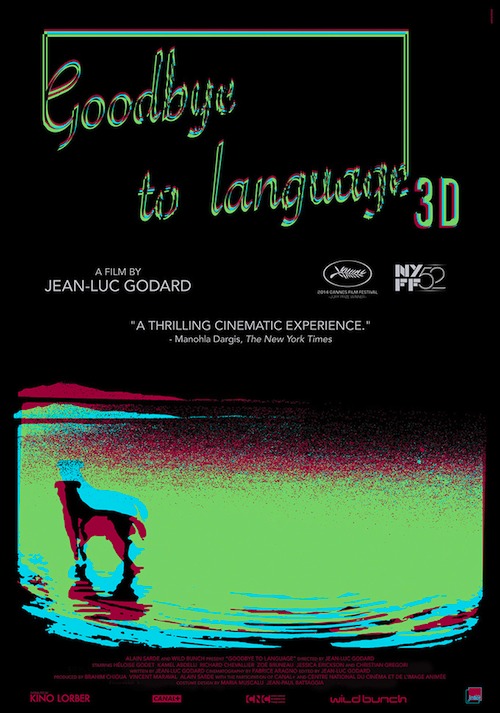
Same Old Godard Agenda, Now in 3D: LFM Reviews Godard’s Goodbye to Language

By Joe Bendel. Jean-Luc Godard might be using the latest in 3D technology, but it is in the service of his decades-old ideological and aesthetic program. He will strip away bourgeois affectations, like plot and characterization, in favor of wordplay and collage. However, all viewers are left with is Godard’s dog Miéville (playing Roxy) in Goodbye to Language, which opens this Wednesday in New York.

A single man and a married woman commence an affair. It is passionate at first, but eventually turns violent. It is a familiar story, but still promising dramatic grist in the right hands. Of course, Godard cannot be bothered to develop it. Instead, we will simply dole out fragments of the mercurial relationship, in between episodes of linguistic gamesmanship.

As is usually the case with recent Godard films, viewers had better come prepared to read, because the auteur will explicitly tell them just what and how they should think. That might sound problematic in a 3D film like Language, but Godard uses the effect to privilege certain words above others. It might be the only clever aspect of the film.

Much has been made of the superimposition of 3D images in one sequence, in which different scenes can be seen out of either eye. Unfortunately, neither is particularly interesting. Indeed, the film’s drably pedestrian visuals are arguably its greatest sin. For all of its gamesmanship, it looks stylistically similar to early 1980s experimental films, like Joan Jonas’s Volcano Saga or Double Lunar Dogs, but without similar hooks for the audience to grab onto.

Arguably, we are not supposed to luxuriate in lush imagery, because that too would be bourgeois. Godard would rather goad us with dashed off would-be profundities, such as the observation Hitler fulfilled all his promises (except, presumably that 1,000 year Reich thing), which only a Parisian Maoist could find provocative. There is so little in Godard’s kit bag this time around, he frequently resorts to the oldest, cheapest trick in the book: sudden deafening blasts of noise.

Frankly, this film has no reason for being, because Godard and his fellow traveling poststructuralists won the philosophic day decades ago. Language represents the state of critical and aesthetic thinking in today’s academia, chapter and verse. They just never had a plan for winning the peace, so the old discredited forms still hold sway over the popular culture. As if on cue, Lord Byron, Percy Shelley, and Mary Shelley (she wrote Frankenstein, get it?) pop up as representatives of the old order to be swept away. Yet, each has more currency to the lives of ordinary proletarians than any of Godard’s films have, since at least the 1980s.

3D aside, there is nothing in Language that has not been done before and done better. It is possible to jettison narrative and still produce something intriguing. Whether they speak to readers or not, the novels of Alain Robbe-Grillet are impressive, because he removes narrative and character, yet they still retain the form of mystery novels. In effect, he pulls the tablecloth out from under the place settings, without upsetting a glass. In contrast, with Language, Godard simply kicks over the table and then takes an ostentatious bow.

As a work of cinema, Language is dreadfully slight, but that is not really how it should be judged. It is really part of a wider piece of performance art, in which Godard keeps testing the limits of how little he can give the film festival intelligentsia while still maintaining their adulation. You’re being punked, so stop encouraging him. Not recommended, Goodbye to Language opens this Wednesday (10/29) at the IFC Center.

LFM GRADE: F

Posted on October 28th, 2014 at 5:06pm.

Brothers in Arms: LFM Reviews Private Peaceful

By Joe Bendel. When two movie brothers go off to war, it is a lead pipe cinch one of them is not coming back. The questions will be which one and under what circumstances. The answers will be revealed in a series of flashbacks throughout Pat O’Connor’s WWI drama, Private Peaceful, which opens this Friday in New York.

Adapted from the novel by War Horse author Michael Morpurgo, Private will incorporate the themes of Paths of Glory and Saving Private Ryan within the trenches of Flanders, but Simon Reade’s screenplay scrupulously takes its time establishing the Peaceful family dynamics before reaching that point. Charlie Peaceful is the older, brasher brother, who always looked out for the shier, more sensitive Thomas “Tommo” Peaceful. Poor Tommo will become increasingly withdrawn, first blaming himself for the death of their gamekeeper father and then watching Charlie marry Molly Monks, the childhood friend they both love, after getting her in the family way.

Initially, Tommo Peaceful volunteers as a way of escaping his broken heart, but he quickly learns the bitter realities of trench fighting and chemical warfare. Soon his brother enlists, despite his parental obligations, in order to keep Tommo alive. Naturally, Charlie Peaceful clashes badly with the gung ho Sgt. Hanley, ultimately leading to the court martial seen in deliberately cagey snippets throughout the film.

The notion that the officers and war boosters were blithely anticipating previous wars is hardly a new insight, but Private adds a clumsy element of class warfare in the person of the corpulent Colonel, who owns the estate employing the Peacefuls’ father and subsequently exploiting the Peaceful mother and brothers. “Guns and horses, that’s how we beat the Boers,” he blusters. As great as the late Richard Griffiths was (we prefer to remember him in Withnail & I rather than Harry Potter), his turn as the Colonel is total caricature.

On the other hand, the fraternal drama is rather honest stuff, quite nicely turned by two of the UK’s fastest rising stars. Private technically predates ’71 and For Those in Peril, clearly showing why Yann Demange picked Jack O’Connell as the young face of war’s chaos in the former, while George MacKay demonstrates an affinity for guilt-tormented brothers that would also manifest in the latter.

From "Private Peaceful."

In fact, O’Connell is considerably more dynamic here than he is convincingly portraying Demange’s overwhelmed fresh recruit. Indeed, it is the young cast members who carry Private, including the smaller supporting players, such as Eline Powell, who is terrific as Anna, Tommo’s potential French love interest.

While it lacks the tragic sweep of Galipoli, Private is an effectively micro-focused period anti-war film that should be considered a cut or two above standard PBS Masterpiece programming. O’Connor balances the familial drama with the horrors of war well enough in the third act, but tarries somewhat in the mid-section devoted to the difficult days following the senior Peaceful’s death. Earnest and respectable, Peaceful Private is recommended on balance for fans of British literary adaptations when it opens this Friday (10/31) in New York at the AMC Empire.

LFM GRADE: B-

Posted on October 28th, 2014 at 5:05pm.