LFM Reviews Night of the Living Dead @ The Anthology Film Archive

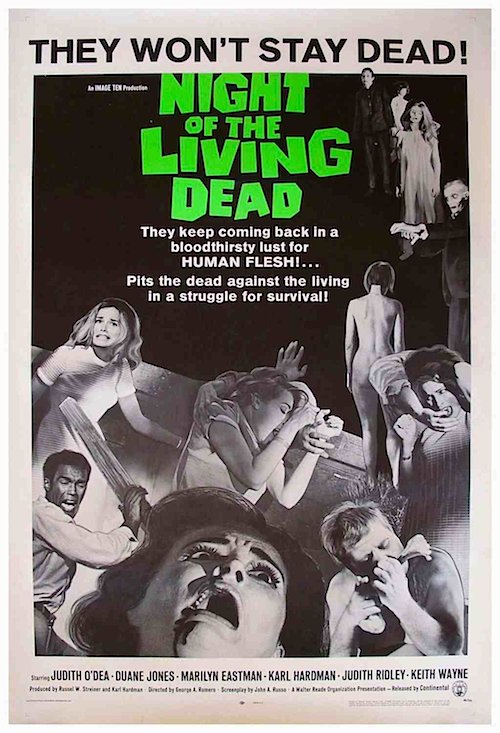
By Joe Bendel. It was the very last film ever screened at the late, lamented Two Boots Pioneer Theater. Obviously, they had no intentions of going quietly. It was also one the few films broadcast on MTV at the height of its 1980s cool cachet and now holds a richly deserved spot on the Library of Congress’s National Film Registry. Yet, the auteur who would inaugurate the zombie genre spent years whipping up commercials for Pittsburgh television as one of the principals of the Latent Image production house. Rightly and necessarily, George A. Romero’s The Night of the Living Dead screens together with a selection of his commercial work as part of Anthology Film Archive’s Industrial Terror film series.

Somehow this film is just as potent the twentieth or thirtieth time around. As you really ought to know, at least according to the LOC, the original Living Dead follows the plight of a group of strangers stranded in a farm house during a mysterious zombie apocalypse. Yet, despite the peril outside, they end up turning on each other.

It is a simple formula many have tried to replicate, but never with the same success. Romero masterfully doles out information via the unreliable media, using zombies sparingly in the second act. Instead, he relies on human nature to build the tension. Of course, he delivers the zombie cannibalism when he is good and ready.
On yet another repeat viewing, a few things jump out about Living Dead. After witnessing her brother’s death, the character of Barbra spends the rest of the film in a state of shock, which we rarely see in horror movies, but it is a much more believable response than dropping a series of ironic pop culture references.

While it has been said before, Duane Jones really should have become a much bigger star. He immediately instills viewer confidence as Ben and the subtle manner in which he takes a protective interest in Barbra is quite touching. A few more of him and things might have turned out better.

Keith Wayne’s Tom also serves as an effective audience surrogate. He is the sort of conciliator you want in your life boat and he is handy with tools. Yet, it is probably Bill Hinzman who truly made the film. As the first zombie in the cemetery, his gaunt face has become an iconic image of cinematic zombies.

Decades later, Living Dead’s conclusion remains the same stinging slap in the face. Indeed, it all holds up remarkably well. You have seen it before, but this is the perfect venue to see it again, along with some apt commercial selections, including a groovy riff on Fantastic Voyage for Calgon and a racially-themed presidential campaign spot, which should scare the willies out of everyone with the prospects of a McGovern administration. Highly recommended under any circumstances, the original black-and-white (non-colorized) Night of the Living Dead screens this Saturday (10/25) and Tuesday (10/28) at Anthology Film Archives, as part of Industrial Terror.

LFM GRADE: A

Posted on October 23rd, 2014 at 3:50pm.

LFM Reviews Viktor

By Joe Bendel. Perhaps for his next action picture, Gérard Depardieu could team up with fellow friend-of-Putin Steven Seagal to fight for lies, injustice, and the Neo-Soviet way. Best of all, he would not pay any French taxes on his earnings. Another strange chapter in the Depardieu saga opens with Philippe Martinez’s bizarrely watchable Russian payback thriller Viktor, which opens tomorrow in New York.

After doing a seven year stretch in his native France, expatriate art thief Viktor Lambert has returned to Russian to get to the bottom of his son Jeremy’s murder. Plutova, a hot Russian copper, immediately puts him on notice not to try any gangster stuff. She also requests his “assistance” tracking down a still missing masterwork heisted from the modern art museum. Of course, Lambert has different ideas.

With the help of his old art thief-choreographer crony Souliman, Lambert figures out his son was killed by an elite gang of gem smugglers, in about fifteen minutes of highly motivated asking-around. However, before he can go on the offensive, Lambert will need a place to stash his son’s pregnant girlfriend. Fortunately, his old flame Alexandra Ivanov has a country home and a couple of loyal retainers to spare. There will also be a day trip to Chechnya, where Jeremy Lambert is inexplicably buried.

From "Viktor."

Granted, Martinez rather forthrightly presents the gangsterism running rampant in Putin’s Russia, but watching Depardieu stomp through the streets of Moscow just makes the head spin. Wisely, most of his action scenes have him hunkered down behind the wheel of a speeding car or trading gun shots from a fixed cover position. At least we cannot hear him audibly wheeze, like in Chabrol’s Inspector Bellamy.

Regardless, nobody should ever doubt Elizabeth Hurley’s acting chops ever again, because as the sultry Ivanov, she never busts up laughing during her romantic afterglow scenes with Depardieu. In fact, she brings some spark and presence to the proceedings. Likewise, Eli Danker’s Souliman is hardly shy when it comes to fretfully chewing the scenery and Evgeniya Akhremenko is appealingly cool and severe as Plutova. Unfortunately, the villains are a rather dull, forgettable lot.

Technically, Viktor is perfectly presentable, sporting a suitably noir sheen thanks to cinematographer Jean-François Hensgens (whose credits include the super-charged District 13: Ultimatum). Still, it is awfully hard to get one’s head around Depardieu, the action hero, in Chechnya. Recommended for members of the U.S.-Putin Friendship Society, Viktor opens tomorrow (10/24) in New York at the Cinema Village.

LFM GRADE: D+

Posted on October 23rd, 2014 at 3:49pm.

LFM Reviews 1,000 Times Good Night

By Joe Bendel. Yes, women have also become homicide-suicide bombers in Afghanistan. An Irish photojournalist with the hints of a French accent has the photos to prove it. In fact, she could not stop taking them, contributing to a premature detonation while she was still within the general blast area. She survives, but the damage done to her family unit will be harder to patch-up in Erik Poppe’s 1,000 Times Good Night, which opens this Friday in New York.

If you find it problematic to compulsively document (and consequently somewhat fetishize) a terrorist bomber’s final hours, than congratulations. You had the appropriate human response. On the other hand, Rebecca argues that she is bearing witness to the inhumanity of the world, but at some point bearing witness will come to resemble abetting through inaction.

Good Night’s opening sequence consists of some truly provocative, visceral stuff, but to really understand it, you also have to see the symmetrically related conclusion. Ultimately, the film forces Rebecca to confront the ethics of her calling in gut-wrenching, soul-churning terms. However, to reach that point, we have to slog through some just okay family drama.

When Rebecca is finally discharged from the hospital, she has clearly lost a step physically and might be gun-shy for the first time in her career. Her marine-biologist husband Marcus is ready to divorce her and their daughters are emotionally reeling from the near permanent loss of their often absent mother. Frankly, the youngster bounces back faster than moody teenaged Steph, perhaps because the older girl better understood the circumstances. For the sake of her family, Rebecca resolves to retire, but maybe she can be convinced to take Steph on a bonding tour of a Kenyan refugee camp, because it’s absolutely, positively safe as houses.

From "1,000 Times Good Night."

If Juliette Binoche ever gave a bad performance, the sun might start orbiting the earth. In fact, she is admirably restrained, given the horrors her character witnesses and the bodily and spiritual wounds she suffers (had Meryl Streep overacted the part in her place, she would have been rending her garments and howling at the moon). Instead, Binoche smartly and convincingly portrays a woman forced to emotionally blinker herself, for survival’s sake.

While the mother-daughter melodrama becomes tiresome over time, Lauryn Canny is still quite impressive as Steph. Likewise, Game of Thrones’ Nikolaj Coster-Waldau does his best to scratch out something as the long suffering hubby. U2 fans should also keep their eyes open for Larry Mullen, Jr, who is perfectly respectable as Tom, a friend of the family.

1,000 Times is an uneven film, but when it does connect, it is with a haymaker. You have to keep with it, but it is worth it if you do. Recommended on balance, 1,000 Times Good Night opens this Friday (10/24) in New York, at the Quad Cinema.

LFM GRADE: B

Posted on October 22nd, 2014 at 8:32pm.

Bigfoot Returns: LFM Reviews Exists

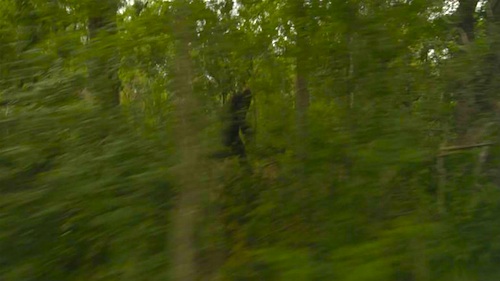
By Joe Bendel. It turns out Bigfoot is as big and blurry as he looks in photos. Frankly, it is probably smart not to show too much of your monster, too soon. Of course, if anyone knows their way around a found footage horror film it is Blair Witch and VHS2 co-director Eduardo Sánchez. An annoying camera geek will naturally have the tools to document the mayhem when a group of friends get on Sasquatch’s bad side in Sánchez’s Exists, which opens this Friday in New York.

For some reason, Uncle Bob stopped going to his rustic hunting cabin, so his nephews Matt and Brian had to steal the keys for a weekend getaway. Convinced it will be Shangri-La up there, they drag along Matt’s girlfriend, their pal Todd, and his girlfriend. Actually, their friends are more Matt’s than Brian’s. Matt is the brooding, popular brother, while Brian is the goofy one who hopes to post a Bigfoot video on YouTube. Oh, he’ll have some footage alright. However, he was asleep when their car hit some sort of mysterious furry object.

No, whatever it was, it was not a deer. The state of Uncle Bob’s cabin is also a bit of a buzz kill. It sure looks like he left in a hurry. Nevertheless, the five not-as-young-as-they-act partiers start drinking and getting on each other’s nerves before Bigfoot basically lays siege to the joint. Unfortunately, ‘Squatch is probably the smartest character in the film.

To be fair, Chris Osborn is not bad as Brian, nibbling on the scenery here and there. In contrast, the rest of the ensemble is so nondescript viewers will hardly remember them from scene to scene. Still, the Sasquatch could serve as a highly credible Wookie audition for big and athletic Brian Steele.

From "Exists."

Exists is like the Busch Beer of horror movies. If you want to sit back and savor a drink, there are much more refined options, but if you just want to get hammered, it will get the job done. We have seen found footage of plenty other cabins in the woods, but Sánchez has a strong command of the genre mechanics. Shrewdly, he keeps the big harry one under wraps in the early going, framing some rather effective what-did-we-just-see-out-of-the-corner-of-our-eyes shots.

Even if it does not break any new genre ground, Exists is a lean and brisk foray into the dark woods, thanks to Mike Elizalde’s creature design, Andrew Eckblad and Andy Jenkins’ tight editing, and Sánchez’s willingness to occasionally fudge the found-footage format. There are better Halloween selections screening during Anthology Film Archives’ Industrial Terror series, but there are far worse possibilities at the multiplex. It opens this Friday (10/24) in New York at the AMC Empire.

LFM GRADE: C+

Posted on October 22nd, 2014 at 8:32pm.

LFM Reviews White Bird in a Blizzard

By Joe Bendel. Tired of movies based on YA tearjerkers and dystopian potboilers? Refreshingly, Laura Kasischke writes novels for grown-ups. As for Gregg Araki, he often makes films about teenagers that only adults are old enough to watch. It might seem like an unlikely combination of sensibilities, but it mostly works in Araki’s adaptation of White Bird in a Blizzard, which opens this Friday in New York.

It is the late 1980s, but Eve Connor acts like she just walked out of a Douglas Sirk movie. Rather than dying on the inside, the ostensibly perfect homemaker makes her family miserable, particularly her husband, Brock. Their daughter Kat tries to stay out of the fray, preferring to hang with her hipster outcast friends and hook-up with Phil, her pseudo-boyfriend, who lives across the street. Yet, she still notices her mother’s increasingly erratic behavior in the days leading up to her mysterious disappearance.

Told in retrospect, sort of like a sexually charged, had-I-only-known Mary Roberts Rinehart novel, White Bird examines the ways Kat Connor deals with her mother’s absence—a process that definitely includes resentment and denial. Still, certain opportunities come with mystery, such as her semi-regular trysts with the investigating officer, Det. Scieziesciez. He has his own Nancy Grace-like theories regarding her mother’s fate, but she does not want to hear them. Yet, when she returns from her first semester of college, Connor suddenly starts to crave some closure.

Although White Bird is downright restrained compared to Araki’s wickedly entertaining Kaboom and most of his prior films, he is still working with familiar elements, especially the horny teenagers. He also goes for broke with the third acts twists that should satisfy his cult indie fanbase, but it is really a period domestic mystery and works rather well in that context.

It is hard to think of the late 1980s/early 1990s as a period setting, but Araki and the design team capture the era’s look, texture, music, and zeitgeist quite well. Connor’s frequently self-referential narration might take some viewers out of the film, but fans will understand a Gregg Araki joint is the perfect place for knowing sarcasm.

From "White Bird in a Blizzard."

He also has a perfect mouthpiece in Shailene Woodley. Forget about those love-struck teens with cancer, this should be considered her breakout star-vehicle, because she carries the film through sheer verve and attitude. Of course, Eva Green was born to play a hot mess like Eve Connor and she delivers accordingly. Christopher Meloni sneaks up on viewers quite efficaciously as the compliant but tightly wound Brock Connor, but unfortunately, Shiloh Fernandez’s vacuous presence becomes increasingly problematic for Phil from the block.

Instead of an over-the-top bacchanal, White Bird represents quite a richly realized accomplishment of mise-en-scène. Somehow Araki maintains a vibe that is simultaneously nostalgic and insidious, getting some suitably cagey work from his cast. Recommended for fans of subversive mystery-thrillers, White Bird in a Blizzard opens this Friday (10/24) in New York at the Landmark Sunshine.

LFM GRADE: B+

Posted on October 21st, 2014 at 11:51pm.

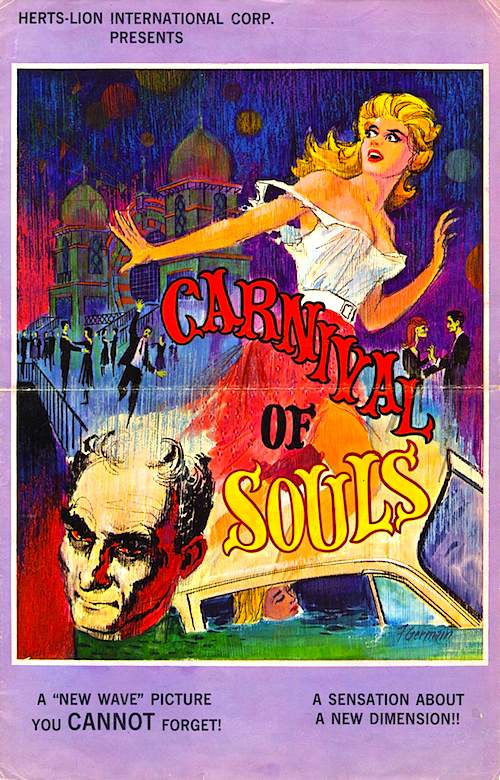
LFM Reviews Carnival of Souls @ The Anthology Film Archive

By Joe Bendel. It must be the only film selected for both the Criterion Collection and the Rifftrax treatment. Rightly or wrongly, it was largely ignored when first released and would be the only feature narrative helmed by its producer-director. Yet, Herk Harvey remained a prolific filmmaker, releasing scores of educational shorts through his Kansas-based Centron Corporation. Like Harvey, many future horror auteurs honed their craft and bided their time making educational and industrial films that often strangely foreshadow their macabre work to come. Fittingly, Harvey’s Carnival of Souls with the Centron short None for the Road screen together during Anthology Film Archive’s before-and-after film series, Industrial Terror.

When reluctant street racing passenger Mary Henry manages to walk away from a fatal accident, it ought to be an occasion for some soul searching. However, she seems determined not to process it. Always temperamentally aloof, she simply proceeds with her prior plans, accepting a church organist position in Utah arranged by the owner of the local pipe organ factory. In her new town, Henry tries her best to cut herself off from social contact, even though she dearly needs an emotional support system.

Beginning during her lonely drive into town, Henry has been haunted by visions of a ghoulish man. Perhaps even more troubling, she experiences episodes of time-stoppage, during which the townspeople around appear oblivious to her freaked-out presence. Spurning offers of help from the kindly priest and concerned Dr. Samuels, Henry becomes increasingly obsessed with the darkly picturesque abandoned carnival outside of town.

That carnival setting is definitely creepy, but most of Harvey’s film is a rather Edward Hopper-esque take on the horror movie genre. There is no gore at all, but the lighting and shadows are all kinds of eerie. Refreshingly, this is the sort of film where priests and factory owners are good people. Unfortunately for Henry, there is also very real supernatural business afoot.

Granted, some of the line readings are a little stilted, but Harvey’s visual style is remarkably accomplished, particularly his smooth jump-cut transitions. He patiently builds an atmosphere of foreboding, rather than resorting to sudden shock scares, perfectly supported and emphasized by Gene Moore’s unnerving organ score.

The performance of method-trained Candace Hilligoss (who bears some resemblance to Judith O’Dea in Romero’s original Night of the Living, another Industrial Terror selection) is almost too inwardly focused for the demands of the genre, but she is certainly convincingly brittle and standoffish. While the supporting ensemble is admittedly all over the place, Stan Levitt provides a solid anchor as Dr. Samuels and Harvey himself is effectively ghastly as the ashen apparition man.

Carnival will have its critical champions and detractors, but you can see its influence in scores of films, such as Adrian Lyne’s Jacob’s Ladder. It is a strong example of the greater efficacy of suggestiveness rather than splatter in horror movies. Thematically, it is also a good fit with None for the Road, in which a research scientist gets lab mice hammered and tries to balance them on metal dowels, while telling kids that if they are going to drink and drive, get so blitzed that the Highway Patrol is guaranteed to pull them over. Science is hardcore. Carnival of Souls is also weirdly potent stuff. Highly recommended, it screens this Friday (10/24) and next Tuesday (10/28) as part of Industrial Terror at Anthology Film Archives.

LFM GRADE: B+

Posted on October 21st, 2014 at 11:49pm.