LFM Reviews Alain Resnais’ Life of Riley @ The New York Film Festival

By Joe Bendel. George Riley is dying, but don’t worry, you will not get too attached to the old playboy. In fact, the title character never appears in Alan Ayckbourn’s play, but we hear plenty about him from his friends. It is exactly the sort of sly theatrical device that would appeal to the late great Alain Resnais. For his final film Resnais went back to the Ayckbourn well a third time, adapting Life of Riley, which screens as a Main Slate selection of the 52nd New York Film Festival.

Colin and Kathryn are rehearsing for their roles in the latest production of their amateur theatrical company (Ayckbourn’s Relatively Speaking, naturally enough), but he is clearly preoccupied. Kathryn quickly extracts the truth from her doctor husband: their beloved friend Riley has less than a year to live. In violation of his professional ethics, the couple discusses his condition with their mutual friends, Jack and Tamara, deciding the play is the thing to keep Riley’s spirits up.

They also resolve to broker some sort of rapprochement with his estranged wife Monica, who has taken up with Simeon, a considerably older gentleman farmer. Despite their history together, Monica is not sure she can handle a reunion with George. Yet, she suddenly agrees to comfort her not quite ex-husband in his final hours, when it becomes clear Kathryn and Tamara might harbor eleventh hour romantic interests in Ayckbourn’s absent character.

Indeed, it all sounds like the stuff of midsummer French farce—and French it is indeed, even though Resnais retains the English trappings and Yorkshire country setting. He emphasizes the theatricality of it all with conspicuous fabric backdrops that look deliberately stagey, but give the film a rich, warm vibe thanks to the bold saturated colors. The cast of Resnais regulars hold up quite well in this slightly surreal environment, embracing their characters’ broad bourgeoisie anxieties. While everyone projects to the back row, so to speak, Sandrine Kiberlain and Hippolyte Girardot still manage to really connect on an emotional level, as Monica and Colin, respectively.

From "Life of Riley."

Of course, verisimilitude was never an obsessive preoccupation for Resnais, who throws it completely out the window in Life of Riley. Instead, he offers us the elegant illustrated transitions sketched by French cartoonist Blutch and X-Files composer Mark Snow’s uncharacteristically nostalgic soundtrack. There is even an apparent tip of the hat to Caddyshack (in did-I-just-see-that moments nearly as random as Wild Grass’s closing scene). In short, Resnais was not long for the world, but he was still having fun.

Indeed, that is the key to understanding Riley. On paper, the masterful You Ain’t Seen Nothing Yet would seem to be the perfect career capstone, given its elegiac tone and its pseudo-resurrection made possible through the power of art. However, like George Riley, Resnais went out on his terms, having one last romp, damning the expectations of others. The result may not be a great film, like the late career masterwork YASNY, but it is a good film, which is always a welcome thing.

Even if Life of Riley is not Resnais’s greatest film, it might be perfectly representative of the auteur’s motifs and strategies. Regardless, it is appealingly wry and sophisticated. Recommended for fans of Resnais and Ayckbourn, Life of Riley screens this Saturday (10/11) at the Beale, as part of this year’s NYFF.

LFM GRADE: B

Posted on October 11th, 2014 at 2:43pm.
LFM Reviews Inherent Vice @ The New York Film Festival

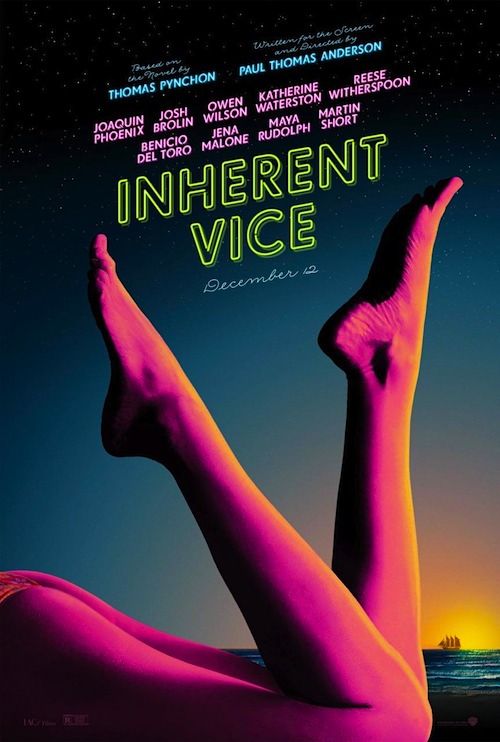
By Joe Bendel. Without question, the Thomas Pynchon character that most persistently arouses reader fascination is Pynchon himself. Already, we are seeing reports Pynchon makes a brief cameo appearance in Paul Thomas Anderson’s adaptation of his 2009 mystery novel (for lack of a more precise term) and attended the New York Film Festival’s press screening. Of course, it is dashed difficult to verify any of that, since nobody knows what he looks like. Regardless, Anderson’s Inherent Vice is guaranteed to be obsessively analyzed and debated after it screened as the Centerpiece of the 52nd New York Film Festival.

A woman furtively walks into stoner-detective Larry “Doc” Sportello’s beachfront crash-pad, but this is no lady. She is Shasta Fay Hepworth, the ex-girlfriend he still carries a torch for. She has need of his professional services, but would rather their meeting look like an assignation. Currently the kept woman of real estate mogul Mickey Wolfmann, Hepworth has been approached by his wife Sloane to co-conspire in a plan to have said sugar daddy committed. Soon thereafter, Sportello is serendipitously hired by Black Panther Tariq Khalil to collect a debt owed by Aryan Brother Glen Harlock, who now works as Wolfmann’s bodyguard.

Unfortunately, things really get complicated when Sportello is waylaid in brothel, waking up next to Harlock’s dead body and surrounded by a circle of cops, most inconveniently including his old nemesis Christian “Bigfoot” Bjornsen. Yes, Inherent is a film that prompts run-on sentences. It also has more name characters than Gone with the Wind and Berlin Alexanderplatz combined, nearly all of whom have back-stories. As Sportello works his vaguely defined case, he crosses paths with a missing musician forced to be a federal informer, his presumptive widow, a maritime attorney, a sex worker, the sexpot daughter of a former client, a lethal loan shark, a shady rehab clinic, multiple G-Men, and the drug-addled Dr. Rudy Blatnoid, DDS, played by the scene-stealing Martin Short.

If you can make heads or tails of the plot, you are doing better than Anderson, but he certainly captures the story’s inherent Pynchon-ness. You have the liberal supply of nicknames, the obsessive telling of tales, and the ever deepening but never illuminated mythology (but Pig Bodine is M.I.A.). Anderson also has a strong sense of the 1970s vibe and attitude, marking something of a return to his Boogie Nights roots. In fact, Vice comes across as so of the era, it ironically feels dated. The frequent but clumsy swipes at Pres. Nixon, Gov. Reagan, COINTELPRO, and Dirty Harry-style policing seem rather quaint and nostalgic now that we have the NSA rifling through our email and social networks.

Inherent certainly works to an extent, but it represents a triumph of form over substance. Anderson constantly proves just how much he gets Pynchon, channeling his breakneck anarchy. Although Abderrahmane Sissako’s Timbuktu is a vastly superior work, they are alike in that every scene of each film has its own unique significance. In the case of Inherent, sequence after sequence further deepens the mythology and features their discrete mini-arcs.

Unfortunately, the major principals are hard to fully embrace. Doc Sportello was clearly formulated for maximum likability, but the undeniably gifted Joaquin Phoenix often looks like he is uncomfortably laboring to let his freak flag fly. Instead, he makes a broody Lebowski. Frankly, Josh Brolin is even shtickier as Bjornsen, recycling all the worst elements of his turns in Men in Black III, W., and Gangster Squad. Fortunately, there is a rich feast of colorful supporting performances to keep things lively, including memorable contributions from Short, Jena Malone, Owen Wilson, Eric Roberts, Hong Chau, Bernicio Del Toro, and Serena Scott Thomas.

Considering how much works in Inherent, it is frustrating that the parts don’t snap together into a more satisfying whole. The period details crafted by the production design team are spot on and cinematographer Robert Elswit bathes it all in a noir Chinatown glow. At times, Thomas’s approach is inspired, particularly his narration, but key on-screen personnel do not always best serve the film’s interests. Recommended for Pynchon fans and those who appreciate self-consciously intricate noirs, Inherent Vice opens December 12th, following its premiere as the Centerpiece of this year’s NYFF.

LFM GRADE: B-

October 7th, 2014 at 9:47pm.

LFM Reviews Mr. Turner @ The New York Film Festival

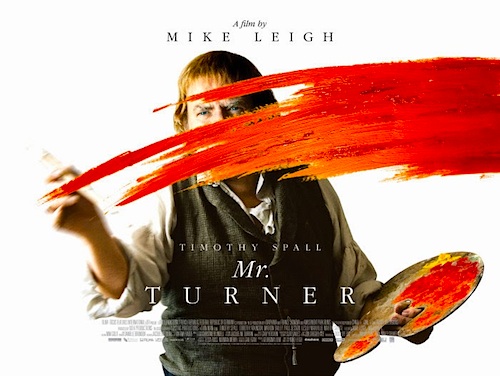
By Joe Bendel. Some of J.M.W. Turner’s most famous subjects include Hannibal traversing the Alps and a study of sea-monsters (or perhaps just fish, as the Tate prosaically insists), but he is best known for the maritime scenes that are now considered an early bridge to Impressionism. He was widely celebrated in his own lifetime, yet popular and critical opinion varied considerably, especially in his twilight years. Mike Leigh and his frequent ensemble player Timothy Spall lovingly paint a portrait of the artist’s irascibility in Mr. Turner, which screened as a Main Slate selection of the 52nd New York Film Festival.

By the late 1820s, Turner was a recognized master, who could get away with considerable eccentricities during the Royal Academy of Arts’ annual exhibitions. Despite a brief affair yielding two illegitimate daughters he had no use for, Turner was not much of a ladies’ man. He lived a bachelor life with his doting father, up until the senior Turner’s death, occasionally exploiting the unrequited affections of their housekeeper, Hannah Danby, the niece of his former mistress.

However, a halting romantic relationship slowly develops between Turner and Mrs. Booth, the twice widowed proprietress of a lodging-house in Margate, the coastal village that inspired many of Turner’s paintings. They find some late-life happiness secretly cohabitating, even while Turner struggles with his declining health and the sleights of the jealous establishment and fickle public.

Structurally, Mr. Turner initially seems rather episodic, skipping somewhat haphazardly down the last two decades of Turner’s life, but a bigger picture slowly slides into place. Granted, there is still a lot of character development coloring in the one hundred forty-nine minute running time, but those are usually the best parts.

J.M.W. Turner might well be the role Spall is forever linked to, like Sir Ben Kingsley and Gandhi. It is a virtuoso performance, but it is also great fun, especially when Turner slyly hams it up at Academy gatherings. Inevitably, someone will edit together a master-cut of all his grunts and guttural noises, which are rather eloquent within the film’s dramatic context.

Marion Bailey also takes an exquisitely sensitive and dignified turn as Mrs. Booth and Dorothy Atkinson piles on the pathos as poor cast-aside Hanna Danby, but after the contributions of Spall and Leigh, it is the work of cinematographer Dick Pope that most defines Mr. Turner. At times, the characters walk through landscapes that shimmer like Turner canvases, bringing to mind Lech Majewski’s The Mill & the Cross.

Obviously, Mr. Turner is more closely akin to Leigh’s Gilbert & Sullivan bio-pic Topsy-Turvy than his stridently class conscious films. There is even a pronounced strain of elitism to be teased out of Turner’s story, yet it is consistently forgiving of human foibles. It rather logically follows Mr. Turner is also one of his most inviting and accessible films. A strong Oscar contender for Spall (and probably for Pope, too), Mr. Turner is recommended for patrons of fine art and British cinema when it screened as part of this year’s NYFF.

LFM GRADE: B+

Posted on October 7th, 2014 at 9:46pm.

LFM Reviews Queen and Country @ The New York Film Festival

By Joe Bendel. In 1952, the commanding Winston Churchill was back in 10 Downing Street and war once again entangled the Allies, this time in Korea. He may not have understood it at the time, but the Korean War was a positive development for John Boorman, because it eventually provided the inspiration for his follow-up to the Oscar nominated Hope and Glory. Nine years later, Bill Rohan commences his compulsory military service in Boorman’s Queen and Country, which screens as a special Film Comment presentation at the 52nd New York Film Festival.

Nine year old Rohan would never say the National Socialists never did anything for him, after an errant bomb destroys his school in the end of Hope and Glory. Q&C picks up at that point, rapidly fast-forwarding to his service years. British troops are shipping out to Korea, but through a twist of fate, Rohan and his volatile mate Percy Hapgood are assigned to clerical duties on the base.

While this posting suits Rohan far better than the Korean Peninsula, he still has to contend with Sergeant Major Bradley, a by-the-book stickler, who is constantly bringing Rohan and Hapgood up before the increasingly weary Major Cross on minor rules violations. While Hapgood and the scrounging Private Redmond plot against the Sergeant Major, Rohan pursues an aristocratic beauty in town, whom he will call Ophelia until she corrects him. Scandals and controversies will erupt on the base as England prepares for the coronation of a new monarch, signifying the beginning of a new era.

While Q&C is rather episodically structurally, Boorman really ties it all together in the closing scenes. Clearly, the film is suffused with unabashed nostalgia, but there are also moments of grace and beauty. It is the sequel nobody was expecting, but it leaves us anticipating a third installment of the Rohan chronicles.

While we did not realize it when Hope and Glory was nominated for five Oscars, Rohan may now be aptly compared to Neil Simon’s Eugene Jerome. Just as Hope and Brighton Beach Memoirs cover their surrogates’ formative years, Q&C and Biloxi Blues follow their military stints. Of course, Jerome finds success as a comedy writer in Broadway Bound, whereas Rohan’s fascination with the Shepperton film studio not far from his family’s new home seems to foreshadow much.

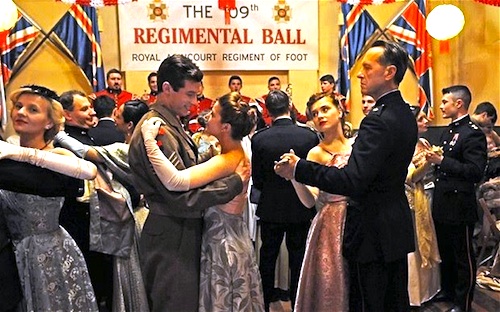
From "Queen and Country."

Unlike the genial wise-cracking Jerome, Rohan is undeniably the blandest figure in Q&C, but that is understandable. We always see ourselves as the dullest person in our own stories. We are the workaday pluggers and everyone else must be the cut-ups and cads. So it is with Boorman and Rohan, played serviceably by Callum Turner. In contrast, a nearly unrecognizable David Thewlis delivers a truly year’s best, Oscar worthy performance as the tightly wound Sergeant Major. Although he bears the brunt of most of the film’s comedic jibes, he also is its most potent source of pathos.

Frankly, Q&C is blessed with an embarrassment of riches when it comes to its supporting cast. Richard E. Grant is a delight as Major Cross, doing his usual sly, sophisticated thing, except even more so. Caleb Landry Jones’ Hapgood serves as a suitably destabilizing wild card, while Vanessa Kirby projects the allure and world weariness one could only expect from a young woman who had lived through the emotional travails of war.

Yes, Q&C is old fashioned, but it is wholly satisfying. It is a lovingly crafted period production that perfectly recreates the still distressed look of post-war Britain. It is also a pleasure to watch the accomplished ensemble bring their humanly flawed characters to life. Enthusiastically recommended, Queen and Country screened tonight (10/7) at the Walter Reade, as part of this year’s NYFF.

LFM GRADE: A-

Posted on October 7th, 2014 at 9:46pm.

LFM Reviews For Those in Peril

By Joe Bendel. Whenever the sea is personified, it is always in a malevolent way. For many seafaring Scottish villagers, there is a devil in the ocean. They are mostly speaking figuratively, but the suggestion takes root in the grieving teenage protagonist of Paul Wright’s For Those in Peril, which opens today in Los Angeles.

Aaron’s older brother Michael was always popular with their peers, while he was the awkward one. Yet, somehow when their fishing boat encountered some sort of mishap at sea, only Aaron returned. With no memory of what happened to the others, he faces the village’s superstitious doubt and scorn as best he can, but his own survivor’s guilt is even harder to bear. As time passes with little social or emotional relief for the young man, he becomes convinced his brother is still out there, waiting for Aaron to rescue him from the sea.

Aside from his wrung-out mother, only Michael’s almost-fiancée Jane offers Aaron any support. However, that sort of compassion does not sit well with her loutish father. Increasingly isolated and alienated, Aaron starts planning some desperate and probably hopeless measures.

Even though Peril always stays safely north of the Mendoza line separating proper cinema from genre film, a profound sense of spiritual uneasiness permeates the film. It is an earthly tragedy, yet like Aaron, we keep holding out hope for some sort of magical realism deliverance. Wright compellingly evokes the feeling you can almost step outside of time to correct some cosmic mistake if you only try hard enough, which those who have experienced deep remorse will recognize only too well.

From "For Those in Peril."

Of course, we cannot undo what is done, which makes it so painful to watch George MacKay’s powerfully brittle lead performance. It is a quiet turn, but so intense you can practically see the gaping wound in his psyche. Likewise, Kate Dickie is nearly as devastating as the mother mourning her first son while trying to save the second, However, one of the greatest surprises is the soul and depth of Nichola Burley’s work as Jane, representing a quantum step up from her party girl roles in movies like Donkey Punch.

If ever there was a film that could be described as “moody,” it would be Peril, with considerable credit due to the sad beauty of cinematography Benjamin Kracun’s forlorn seascapes and penetrating close-ups. Wright masterfully controls the vibe, but he might overdo the perceptual stylization a tad, here and there. Regardless, it thunderously announces the arrival of its youngish talent, including Wright behind the camera and MacKay and Burley in front of it. Recommended for discerning audiences, For Those in Peril opened yesterday (10/3) in Los Angeles at the Arena Cinema.

LFM GRADE: A-

Posted on October 4th, 2014 at 3:35pm.

MMA Family Values: LFM Reviews Kingdom on DirecTV

By Joe Bendel. This is one family drama that could not take place in New York, because that pesky ban on mixed martial arts bouts remains in effect. Instead, the Kulina family weighs-in in Venice, California, where hardnoses and stoners live in close proximity. Time will tell whether the family that cage-fights together stays together in creator-showrunner Byron Balasco’s Kingdom, which premieres on DirecTV’s Audience Network this coming Wednesday.

Alvey Kulina came up in the wild and woolly days of MMA, faring just well enough to earn a small but devoted fanbase. Retired from the ring, but still seriously bad, Kulina now owns and operates Navy St. MMA, where he trains the general public and potential contenders alike. Currently, the best fighter in his gym is his youngest son, Nate. Kulina’s eldest son Jay also used to train at Navy St., but his father gave him the boot because of his bad attitude and hard partying.

Into their lives some drama will fall when Ryan Wheeler is released from prison. Kulina used to manage the natural born fighter, but Wheeler abruptly dumped him just as his career ignited. When Wheeler’s drug-fueled rage landed him a stint up the river, his girlfriend Lisa Prince understandably cut her losses. Regretfully, he came to realize she was probably “the one,” but she has since become involved with Alvey Kulina. So yeah, awkward. There also happen to be a couple of drug dealers out for revenge after the beatdown old man Kulina lays on them in the opening minutes of the show. He’s such a badass, he hardly gives it any thought, but they seem rather put out by it.

Without question, Frank Grillo (from Captain America: The Winter Soldier and Warrior) is the key piece to this puzzle. He has all kinds of grit and presence as the senior Kulina, bringing legit action chops to the party, as well. Frankly, Kingdom is a perfect example why you need to see a fair number of episodes before passing judgment on a series, because Jay Kulina is like fingernails on the blackboard in the first episode, but in the next three installments, Jonathan Tucker gets a solid handle on the character, making his irresponsible self-destructiveness sympathetic and sometimes even fun.

Likewise, Kiele Sanchez’s Prince initially only seems to be around to lecture Alvey regarding money issues as Navy St.’s business manager, but she develops in insightful ways, particularly with respect to the older Kulina siblings. There is an understanding she probably has more in common with the Kulina brothers, but finds herself a maternal role, by virtue of her relationship with the father. Unfortunately, Nick Jonas’s moody, energy-killing brooding is still pretty boring, but there is time to figure out something better for Nate to do.

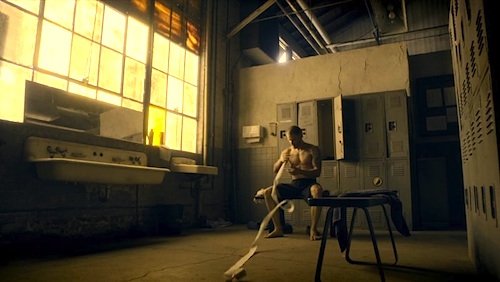
From "Kingdom."

Frankly, given Prince’s proactive nature and the surprisingly high ratio of interpersonal drama to MMA, Kingdom appears to be targeting women as much as men. There are certainly plenty of shirtless guys, but there is also some well staged MMA sequences and the occasional bit of female nudity, in order to establish its cable-satellite edginess.

Not surprisingly, as a blend of MMA and family melodrama, Kingdom is somewhat uneven, but briskly watchable, firmly held together by Grillo’s grizzled coolness. At risk of abusing metaphors, you might argue it wins a split decision. Sort of a slightly guilty pleasure for fans of the sport, Kingdom premieres this Wednesday (10/8) on DirecTV’s Audience Network.

LFM GRADE: B

Posted on October 4th, 2014 at 3:35pm.