LFM Reviews A Love Story, Lindenfeld @ The San Diego Film Festival

A Love Story, Lindenfield – Trailer from San Diego Film Festival on Vimeo.

By Joe Bendel. There are not a lot of Deutsch speaking ethnic Germans left in Romania. The Communists saw to that. Ulli Winkler was fortunate to escape when he could. Decades later, he will return to the ghost town here he once lived, searching for the love of his life in Radu Gabrea’s A Love Story, Lindenfeld, which screened during the 2014 San Diego Film Festival.

Germany was good to Winkler, or “the Chairman” as most of his employees know him. He even adopted a son, but he never married. The memory of his intended, Helga Kerber, simply remained too strong. When the Soviets came to ethnically cleanse Romania’s Banat region, they swept up Kerber in their net, but they missed Winkler through a twist of fate. However, a 2005 television report on the presumably abandoned town of Lindenfeld spurs a flood of memories. Through serendipity, Winkler soon receives reports that his beloved Kerber is still alive. With his health and faculties slowly but steadily declining, Winkler instructs his loyal servant-protector Boris take him back to Lindenfeld (a relatively manageable drive in today’s borderless Europe).

Lindenfeld is an unabashedly and achingly old fashioned film, in the best way possible. There is no unfinished business like first love—and Gabrea takes care of business quite well. The constant strains of Pachelbel’s Canon are admittedly a bit of a cliché, but the recordings featured on the soundtrack are unusually lush and pretty. Even if the audience resists, it does what it is supposed to do.

Victor Rebengiuc and Victoria Cociaş play the senior Winkler and Kerber with wonderfully wise maturity. There are no theatrics, thank you very much, but their ardor feels very real. Yet, the subtlest work might come from Alexandru Georgescu as the poker-faced but stout hearted Boris, with the sort of performance that stealthily sneaks up on viewers.
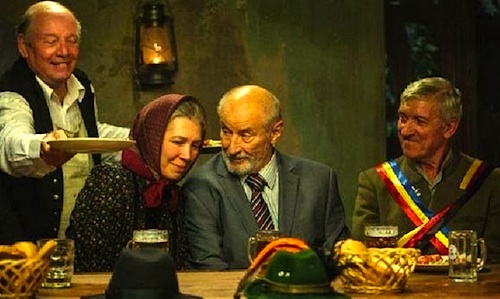
From "A Love Story, Lindenfeld."

Based on a popular Romanian novel, Lindenfeld dramatizes one of the first tragic manifestations of the Soviet oppression in Eastern Europe and its lingering repercussions. It is a perfect story for Gabrea, who really ought to be more widely celebrated on the international festival circuit. However, his choice of subject matter, such as the National Socialist occupation, the Communist experience, and Yiddish culture (see films like Gruber’s Journey, Red Gloves, and Goldfaden’s Legacy) are apt to make European cultural arbiters rather uncomfortable. Throughout Lindenfeld he helms with a delicate touch and a forgiving allowance of human fallibility. Highly recommended, A Love Story, Lindenfeld screened last Saturday (9/27) as part of this year’s San Diego Film Festival.

LFM GRADE: A-

Posted on September 30th, 2014 at 10:06pm.

LFM Reviews Miriam @ The San Diego Film Festival

By Joe Bendel. She is not one of those sugar-and-spice girls. In fact, she is a rather pushy kid. She might even be more than that, but it is hard to tell for sure during the course of Esther Hegarty’s short film adaption of Truman Capote’s story Miriam, which screened during the 2014 San Diego Film Festival.

Miriam Miller is rather taken aback when a precocious young girl approaches her in a cinema. It seems the deceptively innocent lass claimed the widowed Miller as an adult companion to gain entry to the film. They also happen to be namesakes—a fact that little interests the younger Miriam. The elderly woman probably would have forgotten the encounter had the girl not turned up at her flat later that evening. Miller is justifiably put off by Miriam’s unexpected presence, but she is alarmingly difficult to keep out and even harder to eject.

From "Miriam."

Representing Capote’s gothic impulses (transplanted to the UK), Miriam will come as a bit of a surprise to fans of Breakfast at Tiffany’s (although the novel is considerably darker than the film), but it is not exactly In Cold Blood either. In fact, Hegarty’s screen treatment is particularly effective, because it keeps viewers uncertain whether they are watching an outright horror film or simply a rather dark drama of human frailty.

Karen Lewis (daughter-in-law of the late great Richard Attenborough) is terrific as the increasingly panicked Mrs. Miller, vividly conveying her effort to maintain her proper British composure. Young Annabel Parsons is certainly creepy as her unwelcome guest. In his final screen appearance, Harry Potter alumnus Roger Lloyd Pack is also quite ominous, in a distinguished kind of way, as the mysterious old man.

At about half the length of a Twilight Zone episode, Miriam nicely demonstrates the virtues of ambiguity and Hegarty’s command of mood and atmosphere. It would be a great candidate for one of Shorts Interntional’s theatrical packages. Recommended for fans of short films, Truman Capote, and sinister cinema broadly defined, Miriam screened last Saturday (9/27) and Sunday (9/28) as part of The Twist shorts programming block at this year’s SDFF.

LFM GRADE: B+

Posted on September 30th, 2014 at 10:04pm.

LFM Reviews The Boxtrolls

By Joe Bendel. They are total squares, but good guys usually are. The question is whether these subterranean tinkerers can change their nature. They will have to if they hope to survive a rogue exterminator in Graham Annable & Anthony Stacchi’s The Boxtrolls, the latest stop-motion feature from the Laika animation studio, which opens this Friday in New York.

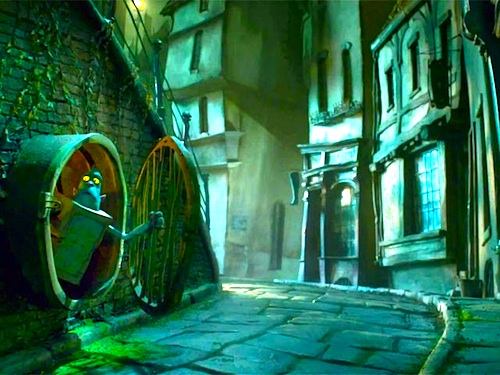
The humans live above, in vaguely Victorian Chessebridge, while the Boxtrolls live in the tunnels below, demonized by the ignorant people above. Only venturing up at nights, the preternaturally handy Boxtrolls survive fixing up cast-off items and scavenging from the garbage. Unfortunately, their numbers are dwindling ever since the Dickensian Archibald Snatcher declared war on the Boxtrolls in hopes of joining the White Hats, Cheesebridge’s ruling elite.

When confronted by humans, the Boxtrolls instinctively play possum, retracting their heads and limbs into their boxes, turtle-like. Eggs is the exception. His body does not work the same way, because he is actually a human boy adopted as an infant by the gentle Boxtrolls. Despite their nurturing, he is still hardwired slightly differently. To avoid extinction, the other Boxtrolls will have to become more like Eggs, before Snatcher finishes his grim business.

From "The Boxtrolls."

Yes, there is a genocide theme running through Boxtrolls, which is always fun stuff in a children’s film. Frankly, the treatment is probably too heavy-handed for parents who try to shelter their children and presented too glibly and off-handedly for those who like to challenge their kids. Tonally, the Boxtrolls is just bizarrely half-pregnant.

Nevertheless, the artistry of the Laika animators is undeniable. The expressiveness of the figures and the richly realized details of their world are quite impressive. It is a shame a little bit more effort was not dedicated to the story, loosely adapted from Alan Snow’s Here Be Monsters! Just once it would be nice to see the adults recognize the glaringly obvious merit of their young ones’ warnings, especially for a total creep like Snatcher, but that will not be happening this time around.

Ironically, some of the cleverest bits in Boxtrolls come toward the end, so if you go, stick with it. As is often the case, the 3D has its moments, but probably is not worth the surcharge. If you appreciate the art of animation than it is quite a feast, but as a discrete film, it is not the most well balanced meal. If animation is bacon, consider it Adkins-friendly. Possibly too intense for small tykes, The Boxtrolls is recommended for stop-motion fans when it opens this Friday (9/26) in a variety of New York theaters, including the AMC Empire.

LFM GRADE: B-/C+

Posted on September 24th, 2014 at 5:26pm.

I’m Sorry Sir, Your Film Has Been Declined: LFM Reviews Plastic

By Joe Bendel. Most of us are willing to risk facing death and dismemberment, but the prospect of having our identity and credit cards stolen scares the willies out of us. Yet, that is exactly what this motley band of protagonists does. To be fair, some members of the crew are better than others in Julian Gilbey’s Plastic, which opens this Friday.

Sam and his circle are some of the sort of disgustingly fortunate college students who always seem to have nice clothes and the latest tech toys. Somebody else always pays for them. How they stay in school is a bit of a mystery, but the source of their funds is not. He runs a small gang of credit card thieves. They are not run of the mill pickpockets. They understand how to steal passwords and build up customer profiles so their spending will not raise red flags. It was all working rather smoothly until Yatesy, the prettyboy jerkweed, and his sidekick Rafa rolled the wrong mark. In this case, wrong means the money man for a ruthless Euro gangster.

Before they know it, all four lads are face to face with the unamused Marcel, who offers them an ultimatum. They can pay him 50,000 pounds restitution every week, or a lump sum of two million. Sam opts for the one-shot deal. Initially, they plan to raise the funds doing what they do best, with the help of Sam’s class crush, Frankie. In addition to her supermodel looks, she also happens to work for a credit card company that done her wrong.

From "Plastic."

The idea of the fab five scrambling to drain the credit cards of three high rollers in Miami is rather subversively appealing, like a thriller version of Brewster’s Millions. Unfortunately, Yatesy the idiot blows the caper before it properly starts. Instead, the lads fall back on a half-baked jewel heist scheme that should be entirely outside their skill set. Pretending to be employees of an obscenely rich sultan, largely through the help spray-on tanners, Sam and company intend to steal a fabulous collection of colored diamonds from Steve Dawson, a Miami jeweler’s over-ambitious international sales manager.

Frankly, the second half stretches credibility to the breaking point, but at least Gilbey has the good sense to step on the gas and never look back. Pacing is not a problem here, but if you need vaguely likable characters in your thrillers, Plastic comes up empty. Arguably, Frankie is a reasonably decent person and at least Dawson’s hot assistant Beth has the good sense to question his sloppy security practices.

As Marcel and his creepy henchman Tariq, Thomas Krestchmann and Mem Ferda chew all the scenery that is not nailed down, which helps quite a bit. Graham McTavish and Malese Jow also bring some attitude and energy as the marks. For her part, Emma Rigby’s Frankie looks good in a swimsuit. However, all the lads are deadly dull, including Downton Abbey’s Ed Speleers (Jimmy Kent in seasons three through five) straining to be the roguish leading man.

Plastic has its guilty pleasures, but instead of embracing its grubby comparative advantages, it tries to become Raffles or Remington Steele midway through. It is all rather frustrating, because there are definitely B-movie elements that could have worked. Maybe worth a look later down the road, British thriller fans can safely wait for cable or Netflix. For diehard fans of the hip Brit TV cast, it launches on iTunes and opens in select markets this Friday (9/26).

LFM GRADE: C+

Posted on September 24th, 2014 at 5:26pm.

LFM Reviews Tazza: The Hidden Card

By Joe Bendel. Just like the old Kenny Rogers song, Kim Go-ni knew when to walk away. He went out on top, retiring from the gambler’s life after winning a large pot. However, he had a nephew. Unfortunately, Ham Dae-gil inherits one of his uncle’s old enemies along with his luck and dexterity in Kang Hyeong-cheol’s Tazza: the Hidden Card (a.k.a. Tazza 2), which opens this Friday in the Tri-State area.

Ham might be comfortable with a deck of cards, but he still has much to learn about human nature. He tasted a bit of success playing for gambling den proprietor Kko-jang, until he is taken by his own mark, the rather merry widow Woo. With his boss flat-busted, Ham tries to raise some cash in loan-shark Jang Dong-sik’s private game, but once again he is set up. This time, it is his hometown crush Heo Mi-na who plays him. Deeply in debt to Jang (and suddenly short one kidney), Ham manages to escape his clutches thanks to Heo’s intervention, but it will cost her dearly.

Regrouping in the exurbs, Ham convinces his uncle’s former mentor to take him under his wing. Returning character Ko Kwang-ryeol knows all the high-rollers, but he prefers to keep a low profile, eking out a modest living in low stakes games. Of course, lying low will not be much of an option, given Ham’s unfinished business with Jang and Heo. Eventually, his path will also cross that of Aw-kwi, a mysterious gambler of almost mythic ferocity, who holds a grudge against Uncle Go-ni.

With not one but two femme fatales and shadowy nemeses in the mix, Taz 2 has no shortage of double-crosses and shifting alliances. There is a lot of picaresque bluffing and cheating, but it is considerably darker than The Sting or even Rounders. It is tough to be a woman in this film, even (or especially) for Woo, the jaded seductress. Frankly, some of the scenes in question kill the buzz of the caperish conning and backstabbing.

From "Tazza: The Hidden Card."

Although he made quite a credible action lead as the North Korean high school sleeper assassin in Commitment, rapper T.O.P. seems far too light weight for a cat like Ham. Fortunately, he is surrounded by a first rate supporting cast, who chew up all the scenery he disdains to touch. Yu Hae-jin is a particularly nice surprise as Ko, Ham’s Obi-wan. While he has played his share broadly shticky characters before (see The Pirates as an example), he balances humor with a good deal of world weary wisdom, while crafty veteran Lee Kyoung-young adds some class as Kko-jang.

Yet, Taz 2 is really all about its villains. Former Miss Korea (Honey) Lee Ha-nui is appropriately sultry and disconcertingly dangerous as Woo, even when her character’s decisions defy all sense. Yet, the real battle is between Kwak Do-won’s Jang and Kim Yun-seok’s Aw-kwi to see which can outdo the other’s stone cold malevolence.

Despite callbacks to the original Korean box-office smash, Taz 2 is easily accessible for audiences walking in cold. Kang keeps it moving along briskly, nimbly juggling the large cast of characters. It is fully stocked with appealingly devious twists and turns, but at times it is a little too gritty for its own good. Recommended for fans of gambler and grifter movies, Tazza: the Hidden Card opens this Friday (9/26) at the AMC Bay Terrace in Flushing and the Edgewater Multiplex in New Jersey.

LFM GRADE: B

Posted on September 24th, 2014 at 5:25pm.

Cheng Pei-pei in the Spotlight: LFM Reviews Lilting

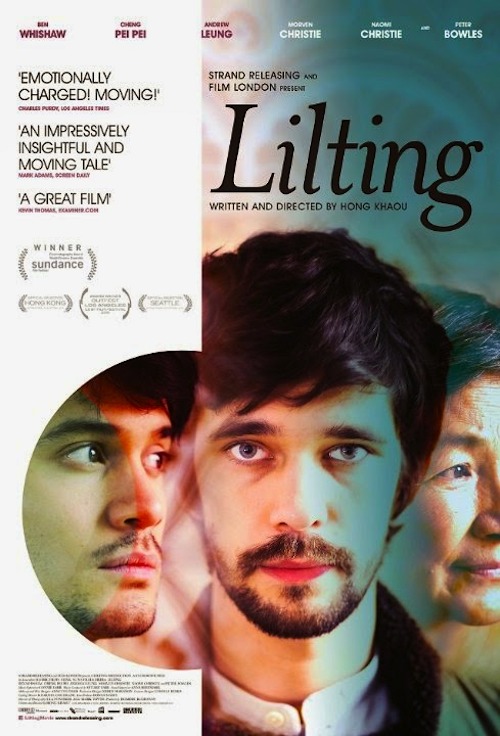
By Joe Bendel. Accurate translations are important in summit conferences and business meetings, but the ethics are a bit trickier on the personal level. A first time translator interpreting for an elderly nursing home couple will grapple with questions of how much and faithfully she should relay their words to each other. However, there are even greater unresolved personal issues lingering between the man who hired her and the Cambodian-Chinese woman utilizing her services in Cambodian-born British filmmaker Hong Khaou’s Lilting, which opens this Friday in New York.

Junn’s time in the nursing home was supposed to be temporary, but her son Kai was tragically killed in a traffic accident before he could arrange a new living situation for her. Unfortunately, she could not have moved in with him, because she never would have accepted his relationship with Richard. After Kai’s death, Richard tries to look after Junn out of a sense of loyalty, but she begrudges his presence, mistakenly blaming him for her current circumstances.

At least the home brought her together with Alan, a British pensioner who cannot speak any Chinese or Cambodian dialects. Nonetheless, they seem to enjoy each others’ company. Wanting to help facilitate their romance, Richard recruits Vann to translate. It works well for a while, perhaps even softening Junn’s attitude towards her late son’s “roommate,” but the mourning mother might be too set in her ways to allow any of her inter-personal relationships to deepen or evolve.

Cheng Pei-pei never flashes her kung-fu moves in Lilting, which is somewhat disappointing, but the Come Drink with Me star’s straight-forward acting chops are impressive enough. It is a restrained but devastating portrayal of grief and resentment. Never sugarcoated, Cheng’s performance shuns sentimentality and theatrics, quietly going to some very deep and dark places.

While many will also focus on James Bond franchise alumnus Ben Whishaw’s co-starring turn, the film’s real discovery is Naomie Christie. Her acutely perceptive work as Vann in many ways functions as the viewer’s entry point. She is even more of an outsider to the proceedings than Richard, yet she too finds herself forming judgments and allowing herself to become emotionally involved.

Lilting represents quite an accomplished feature directorial debut from Hong, who masterfully maintains a mood of exquisite sorrow, nicely abetted by the sensitive, Sundance award-winning cinematography of Ula Pontikos. It is a graceful film with understanding for all and malice towards none. Recommended for Cheng’s fans who wish to see the icon in a whole new light, Lilting opens this Friday (9/26) in New York at the Angelika Film Center.

LFM GRADE: B+

Posted on September 24th, 2014 at 4:04pm.