Do-It-Yourself Shock Treatment: LFM Reviews The Scribbler

By Joe Bendel. Known as “Jumper’s Tower” to residents, Juniper Tower is the Arkham of mental health halfway houses. If you move in, you are unlikely to get much better or live much longer. However, Suki has an advantage over her new neighbors. One of her multiple personalities happens to be uncannily resourceful in John Suits’ The Scribbler, which opens this Friday in select markets.

Considering Suki is undergoing radical therapy to “burn off” her excess personalities, she would presumably be an unlikely candidate for out-patient treatment. Nevertheless, she has been issued a portable burn unit and a room in the friendly tower. Upon arrival, she is met by the grisly spectacle of a jumper. It will not be the last one.

Juniper is entirely populated by female patients, except for Hogan, who takes pride and pleasure in being “the rooster in the hen house.” One of Suki’s multiples had a thing for him when they were formally institutionalized together, so they naturally pick up where they left off. Frankly, he is somewhat saddened by her burn-off regimen, lamenting some of her multiples were his friends. Nevertheless, the treatment seems to work, even though it causes temporary blackouts and states of altered perception. Whenever Suki comes to, it seems like another resident has committed suicide and the so-called Scribbler persona has been busy modifying her décor and the burn unit.

Adapted by Dan Schaffer from his graphic novel, The Scribbler incorporates elements from several genres (science fiction, horror, dark fantasy) and generates some clever disbelief-suspending psychological double-talk. Until the third act collapses into a maelstrom of mumbo jumbo, it is a surprisingly effective noir psycho-thriller.

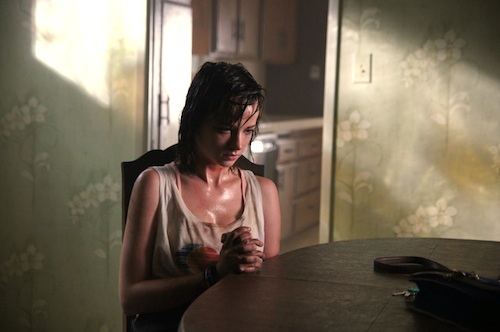
Arguably, the best thing Suits has going for him is the massively creepy Juniper Tower. Production designer Kathrin Eder and art director Melisa Jusufi truly make this film come together, while cinematography Mark Putnam makes it all look suitably ominous, in the tradition of its source material and Grant Morrison’s Arkham Asylum graphic novel.
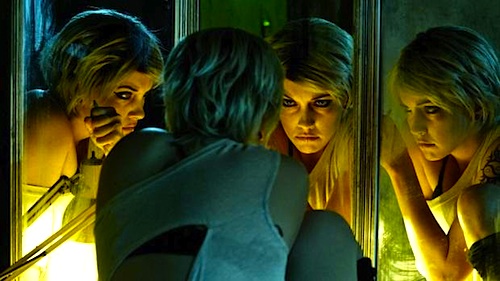
From "The Scribbler."

The cast is generally pretty good as well, particularly Katie Cassidy and Garret Dillahunt as Suki and Hogan, respectively. Their screen chemistry is appropriately weird, but undeniably charged-up. Gina Gershon, Ashlynn Yennie, and Michelle Trachtenberg all chew the scenery with glee as various eccentrically macabre residents of the Tower, but Eliza Dushku and Michael Imperioli seem visibly confused to be playing their scenes as the cops interrogating Suki within the film’s framing device. Fans of Sasha Grey should also take note, her character quickly disappears after her entrance (it’s almost as much of a tease as her prominently-billed cameo in The Girl from the Naked Eye).

Granted, the ending makes little sense, but that is almost always the case in genre cinema. What is more important is how smart and stylishly sinister the film is as it works its way there. Recommended with surprising enthusiasm, The Scribbler opens this Friday (9/19) in limited release.

LFM GRADE: B+

Posted on September 17th, 2014 at 11:01pm.
LFM Reviews At the Devil’s Door

By Joe Bendel. Kids today are dangerously ignorant of the blues. Nobody worth their Robert Johnson box-set would play along if a creepy Aryan cultist told them to walk down to the crossroads and say your name so the boss can find you later. She will do it for five bills, but she will not live to regret it in Nicholas McCarthy’s At the Devil’s Door, which opened last Friday in New York at the IFC Center.

A few years and a deep recession later, people would stand in line to sell their souls for pocket change. Nevertheless, Leigh, a go-getting real estate agent, is convinced she can sell her motivated clients’ house quickly, despite the state of the market. Teetering on the brink of foreclosure, they have also been dealing with their daughter Charlene’s behavioral issues. As Leigh pokes around the nearly empty domicile, she finds evidence of a fire, a twitchy young teen answering Charlene’s description, and wickedly bad vibes in every cupboard and closet, but she remains undeterred.

Frankly, Leigh’s hard-charging Tony Robbins self-help trips are a major reason why her depressive hipster artist sister artist Vera keeps her at arm’s length. However, when Leigh misses the opening of her latest show, she cannot help worrying. Inevitably, she will be drawn into the supernatural business as well.

There are individual sequences in Door that are chillingly effective, but you have to suspect McCarthy’s screenplay was substantially rewritten at several junctures. There are several thirty degree course corrections that are dramatic enough to interrupt the smooth narrative flow, but not wild enough to be jaw-dropping game-changers. At times, it feels like a horror movie built around alternating elements of haunted house and demonic possession films, drawn randomly out of a hat.

Still, McCarthy demonstrates a thorough command of mood and atmosphere, just as he did in The Pact. When the film stays in that house, it works just fine, but whenever it steps outside, it has a lot of explaining to do.

From "At the Devil’s Door."

The sisters’ baton hand-off also looks like a mistake in retrospect. Catalina Sandino Moreno has had an interesting career after her Oscar nomination for Maria Full of Grace, appearing in Soderbergh’s Che on the left and then For Greater Glory on the right, followed by a dubious action turn in A Stranger in Paradise. Regardless, by genre standards, she is quite compelling as Leigh, the responsible sister, always trying please everyone else. Unfortunately, Naya Rivera (who was once on a short-lived show called something like Merriment or maybe Glee) lacks her energy and presence as the dull and dour Vera.

If you want to see horror movie, Door has enough elements, sufficiently executed, to satisfy a fan’s craving. McCarthy again puts some nice twists on familiar genre conventions, but he sort of loses the handle on his narrative. Maybe the next one will be his breakout. Recommended for fans of The Pact and those who want a demonic fix, At the Devil’s Door opened last week at the IFC Center and is also available via IFC Midnight’s VOD platforms.

LFM GRADE: C+

Posted on September 17th, 2014 at 9:59pm.

LFM Reviews Gyeongju @ The 2014 Toronto International Film Festival

By Joe Bendel. It is one of South Korea’s leading tourist destinations, famous for its Silla-era royal tombs and Buddhist temples. Of course, people live there all year round, going about their business in the shadow of the past. Carrying on with life poses its own quiet challenges for a visiting academic and a local teahouse owner in Zhang Lu’s Gyeongju, which screens during the 2014 Toronto International Film Festival.

Choi Hyeon has almost become more Chinese than Korean. For many years the socially awkward expat has taught regional political science at Beijing University. He is fluent in Chinese and married a Chinese woman. In fact, employees of the visitors’ center just assume he is Chinese. After a long absence, he returned for the funeral of an old friend. In the mood for reflection, he subsequently takes a side-trip to Gyeongju hoping to find a particular teahouse that looms large in his memory. He duly finds the establishment, now run by Gong Yun-hui, but she has papered over the obscene folk painting he remembers so well (for obvious reasons).

Initially, Gong assumes Choi is some sort of pervert, given his unhealthy fascination with the painting, but she will change her opinion over time. Choi will return to the one spot in town where he feels somewhat relaxed after a failed attempt to reconnect with an old flame. As he lingers in Gong’s company, we start to see they are somewhat kindred spirits. However, her friends will not take to him, particularly the police detective who has long carried a torch for Gong.

Gyeongju is an exquisitely sad, deeply felt film that has much to reveal about its characters. Steadily and almost stealthily Zhang peels back their protective layers, as their conversation becomes less guarded. Yet, unlike the Linklater “Before” trilogy (which some have compared it with), you really cannot say Gyeongju is a talky film, because of its eloquent silences.

Indeed, you will be hard pressed to find anyone who can say more with so few words as Shin Min-a. As Gong (or the Goddess of Gyeongju as her dedicated friends call her), she is truly radiant. When she slowly divulges her painful history, it is absolutely devastating. In contrast, Park Hae-il deliberately looks genuinely ill at ease with himself and others. Yet, the chemistry he develops with Shin is subtle, but very real.

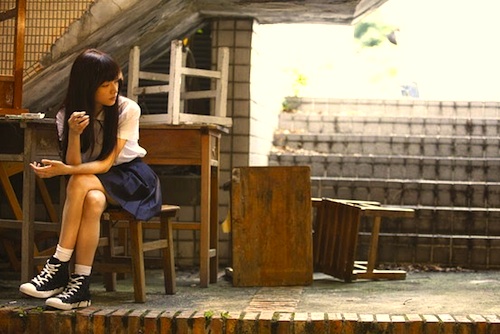
From "Gyeongju."

Aside from the Tumuli Park Belt tombs, Zhang (the former documentarian) does not fully exploit Gyeongju’s historic attractions. Nevertheless, the film has a tactile sense of place. You can practically smell the mustiness after a late afternoon rain and feel the late night breeze as Gong, Choi, and the detective drunkenly clamber up one of the tombs.

Throughout the film, Zhang masterfully commands the mood and tone, but he nearly sabotages himself when we hear of the potential tragic end of two tangential characters met in passing. Wondering if they are really the ones who met such a fate temporarily distracts from the bittersweet business at hand. Nevertheless, Shin and Park quickly bail him out with their smart, mature work. Unusually (and refreshingly) chaste for a ships-in-the-night film, Gyeongju is loaded with understated power and resonance. Highly recommended, it screens again tomorrow morning (9/11) and this coming Sunday (9/14), as part of this year’s TIFF.

LFM GRADE: A

Posted on September 10th, 2014 at 10:36pm.

LFM Reviews Partners in Crime @ The 2014 Toronto International Film Festival

By Joe Bendel. Taiwan must have the worst school counselors in the world. The trauma intervention three teenagers receive after discovering a dead schoolmate is more like detention than treatment, but they are not very disturbed by the experience anyway. In fact, it initially appears to be the beginning of a beautiful friendship before things take a dark turn in Chang Jung-chi’s Partners in Crime, which screens during the 2014 Toronto International Film Festival.

As the poster art makes abundantly clear, there is no mystery regarding the cause of Hsia Wei-chao’s death. Just why she presumably threw herself out of her mother’s upscale apartment is a different matter. Hsia was pretty, rich, reserved, and therefore highly unpopular. When Huang, Lin, and Yeh stumble across her body in the street, they dutifully call the police. Strangely, it is a bonding experience for the trio, especially the constantly bullied Huang. Yet, even Yeh the tough guy-slacker and Lin, a popular kid in a geek-chic kind of way, find they can relax in each others’ company.

Even after their pointless counseling sessions, the boys keep meeting to share the information they turn up on Hsia. Huang is an especially good investigator. Before long, they are clandestinely hanging in Hsia’s room while her sort of grieving mother is away on business. Believing he has identified the classmate who drove Hsia to suicide, Huang hatches an elaborate revenge plot. It will definitely not end as he plans.

It seems student dramas are perennially popular in Taiwan. Some are upbeat and endearing, like Hou Chi-jan’s When a Wolf Falls in Love with a Sheep—and some are not, like Partners. Think of it as a Breakfast Club with dead bodies. It is more of a why-dunit than a whodunit, but there are still some unsettling revelations to ferret out. Yet throughout it all, Chang shows a rather deep and forgiving understanding of the messiness of human nature.

From "Partners in Crime."

There are at least six meaty roles for Chang’s high school-aged cast (or so they certainly look) and he gets solid to hauntingly good performances from them all. Chang is no stranger to young people’s stories, having broken through internationally with Touch of the Light, but this is a far more taut and murky affair than fans of his previous film would expect, despite the occasional stylistic excess here and there. Arguably, it should hold greater appeal for NYAFF/Fantasia patrons than for anyone looking for a date film. However, its tragic nature should lead to some nice local box office change nonetheless.

Ultimately, Partners resists easy sentimentality, reminding viewers how difficult it is to truly understand peoples’ lives from a distant outside perspective. However, it is not a Rashomon-like exercise, problematizing truth as an objective standard. Instead, that might be something that can eventually be sussed out with sufficient time and sensitivity. Recommended for fans of mysteries and teen dramas with savage bite, Partners in Crime screens again tomorrow (9/11) and Friday (9/12) at this year’s TIFF.

LFM GRADE: A-

Posted on September 10th, 2014 at 10:35pm.

The Newlyweds’ Cabin in the Woods: LFM Reviews Honeymoon

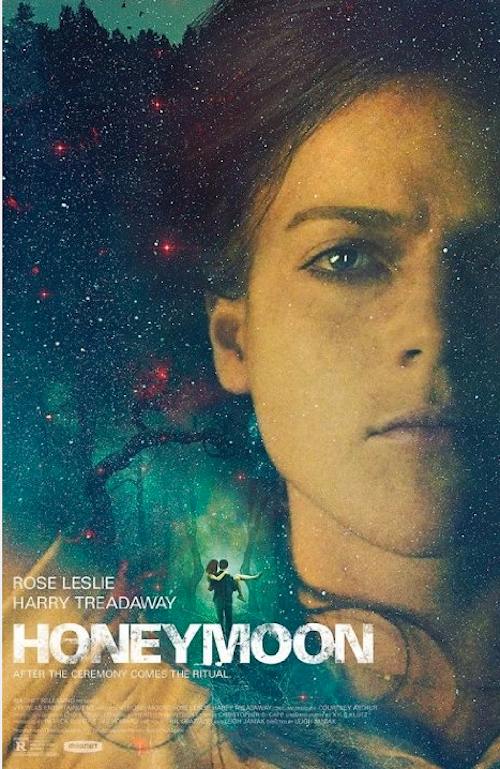
By Joe Bendel. The American dream does not seem to apply to newlyweds Paul and Bea. (They do not have much of a British dream either.) Instead of hoping for a better life than their parents were afforded, they mostly just expect to huddle together as best they can. As a result, it is disappointing but almost fitting when a sinister shadow is cast over their post-wedding getaway in Leigh Janiak’s Honeymoon, which opens this Friday in New York.

It was not exactly a shotgun wedding, but viewers get the sense Paul and Bea’s nuptials were somewhat abrupt. Nevertheless, they are clearly young and in love—but decidedly not rich. Their honeymoon will just be a few days at her family cabin and then it is back to the grind. At least they will have plenty of privacy, even though Paul was a little put out when they ran into Bea’s childhood sweetheart in town. Frankly, he seemed a little . . . weird.

Everything is lovey-dovey for the first twenty minutes or so, until Bea has a strange sleepwalker incident (or something). The next morning she seems distant and decidedly less into Paul. Maybe we can’t blame her for that, but Paul notices other forms of suspicious behavior. He tries to be proactive and engaged, but she is not having any of that.

Spryly straddling the horror and psychological thriller categories, Honeymoon is a tricky film to get a handle on. There is precious little gore, but it insidiously plays to our fears and paranoia regarding postmodern, post-AIDS intimacy. How well can we ever know someone and how easily can they change? Of course, all bets are off when an uncanny agency is at work.

In one hour and twenty-seven minutes, Harry Treadaway and Rose Leslie go from insufferably cute to ominously tragic. While both are up-and-coming British screen thesps (she was Gwen Dawson, the chambermaid who yearned for a secretarial career in season one of Downton Abbey; he brings the creepy clamminess as Dr. Frankenstein in Penny Dreadful) they believably play generic English speakers. Maybe they’re Canadian (they have plenty of cabins up there). Leslie and Treadaway also develop convincing romantic chemistry on the way up the narrative arc and claustrophobic dramatic tension on the way down.

Seriously, when is a cabin in the woods ever a good idea in the movies? Regardless, Honeymoon is almost too subtle for its own good at times. While that might cost it with the midnight movie crowd, it will appeal to more mature genre fans. Moody and unsettling, Honeymoon is an impressive feature debut for Janiak, worth checking when it opens this Friday (9/12) in New York at the Cinema Village.

LFM GRADE: B

Posted on September 10th, 2014 at 10:14pm.

LFM Reviews Men Who Save the World @ The 2014 Toronto International Film Festival

By Joe Bendel. Pak Awang’s Malaysian dream is a lot like the American dream. He wants a better life for his daughter. He hopes to realize his ambitions with the “American House,” so-called because it was originally painted white (White House, get it?). Unfortunately, superstition will thwart him at every turn in Liew Seng Tat’s Men Who Save the World, which screens during the 2014 Toronto International Film Festival.

Pak Awang’s daughter is moving back from the big city to get married and settle down in his provincial village. She will need a house, but he just happens to own a spare. The problem is the American House is buried deep in the jungle and has fallen into a state of disrepair. It also happens to have a reputation for being haunted. Pak Awang needs the help of his fellow villagers to carry it off its foundations and into town. Even given their work-resistant nature, forty or so the men ought to be able to handle the job. Oddly though, as soon as they start the arduous task strange things start occurring, playing into the villagers’ supernatural fears.

Of course, nothing uncanny is really afoot. Most of the unexplained phenomena are actually attributable to Solomon, an undocumented African worker, hiding out in the formerly white house. There are plenty of other subplots to further complicate matters, including the town’s Tom and Huck, who are determined to free the camel designated for the annual sacrifice. Soon the American House is stranded midway, while the men don drag to hunt down the “Oily Man” demon, as per the dubious counsel of a local shaman-confidence artist.

Initially, MWSTW starts out like the sort of low-key slice of life village comedy that used to be the bread-and-butter of indie film distribution. However, it takes a surprisingly dark turn, skewering the superstitious balderdash of the town’s Muezzin and the regional political boss. Islamic faith does not exactly move mountains in Liew’s film and it certainly doesn’t move Pak Awang’s house. Perhaps that is why reviews coming out of Locarno were bizarrely dismissive, roundly criticizing Liew for not politicizing Solomon’s plight as a migrant worker.

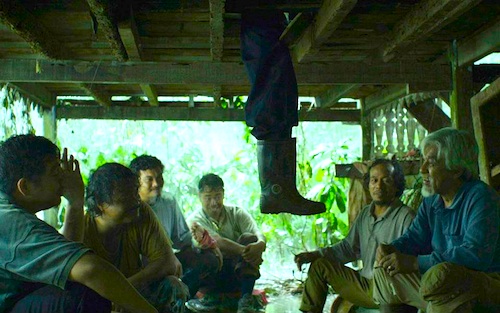
From "Men Who Save the World."

Instead, Liew delves into the dynamic of the not so tight little village, focusing on Pak Awang’s mounting frustrations. Wan Hanafi Su is absolutely terrific as the maybe too-gruff-for-his-own-good father. He brings real dignity to the film that convincingly evolves into visceral anger and bitterness. Frankly, the supporting cast looks a bit shticky in comparison, except the wide-eyed camel-rescuing youngsters, whose energy and innocence represent substantial contributions.

Granted, MWSTW is a bit uneven, but its humor is organically derived from the specific realities of this Malay community. It is true the film is Y chromosome affair, but it is set smack dab in the Southeast Asian Muslim world, after all. Such complaints lose sight of the film’s satiric bite, vivid sense of place, and several cleverly staged scenes that neatly play games with viewers’ perspective. Indeed, it is quite a distinctive package thanks to Teoh Gay Hian’s richly evocative cinematography and Luka Kuncevic’s rhythmic, genre-defying score. Recommended for the somewhat but not overly adventurous, Men Who Save the World screens again this Thursday (9/11), and Saturday (9/13) as part of this year’s TIFF.

LFM GRADE: B

Posted on September 10th, 2014 at 10:14pm.