LFM Reviews 8 Bullets @ The 2014 Toronto International Film Festival

By Joe Bendel. A man who survived a violent attack on his family will seek revenge largely by relying on his sense of smell. That will very likely be as problematic in practice as it sounds. Indeed, the protagonist’s memories and perceptions are all subject to question throughout Frank Ternier’s stylish but unsettling animated short 8 Bullets, which screens during the 2014 Toronto International Film Festival.

Gabriel is a French expat living in Taipei. His backstory remains mysterious, but as we learn from the disembodied bystanders, he was the victim of a red-headed gunman’s vicious assault. Evidently, he wife was killed and his daughter was wounded in the leg, but Gabriel somehow survived a shot to the head, or at least that is the version he believes. Regardless, he has not been the same since that fateful day.

For the last six months, Gabriel has prowled the streets looking for a red-headed gangster who smells of fried food. He carries an equalizer, fully loaded with said bullets for when he finds his prey. It is all very hardboiled, even though Gabriel’s sanity is clearly rather tenuous.

From "8 Bullets."

Ternier’s stylistic approach suggests the sort of films David Lynch makes are better suited to animation rather than live action. Although Ternier tells a strictly linear narrative, his visuals dramatically reflect the warped and unreliable perspective of his protagonist. He also nicely expresses Gabriel’s sense of otherness as a Frenchman in a foreign land.

While Ternier lays on the closing irony pretty heavily, his hip noir sensibility is rather cool overall. Most importantly, the animation is quite distinctive, evoking traditional watercolor techniques as well as contemporary comic art. Recommended for fans of animation and film noir, 8 Bullets screens again this Saturday (9/13) as part of Short Cuts International Programme 4 at this year’s TIFF.

LFM GRADE: B+

Posted on September 10th, 2014 at 6:25pm.
LFM Reviews The Vanished Elephant @ The 2014 Toronto International Film Festival

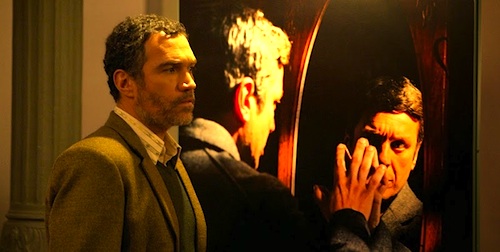
By Joe Bendel. Edo Celeste’s bestselling sleuth Felipe Aranda is supposed to be the good guy, but he might be more akin to Stephen King’s Dark Half. The man who posed for a series of pictures inspired by Celeste’s books seems to take the role way too seriously, especially when the author hints he may soon end the popular series. Celeste begins to suspect the man of crimes both new and old in Javier Fuentes-León’s The Vanished Elephant, which screens during the 2014 Toronto International Film Festival.

The one case the ex-cop turned mystery novelist never cracked was the 2007 disappearance of his fiancée Celia Espinoza. The timing was particular unfortunate, occurring during an earthquake that rocked coastal Peru. It turns out it also coincided with the presumed death of Mara de Barclay’s first husband. Celeste was blissfully unaware of this fact until the remarried Barclay had her strong arm servants arrange a meeting. She was rather baffled to receive an envelope addressed to Celeste bearing her supposedly late husband’s handwriting.

The assortment of cryptic photographs inside does not immediately stimulate Celeste’s curiosity, but he will get to them in good time. However, he is instantly struck by Rafael Pineda, the tough talking model, who is a perfect dead ringer for the Aranda Celeste he always imagined. As he investigates the shady Pineda, events start to parallel his Aranda novels, including the one he is currently writing.

How much viewers will enjoy Elephant depends on what they value most in mystery-thrillers: the structure and conventions, or the trappings and atmosphere. Fuentes-León creates a terrifically moody vibe, but the film evolves into a series of increasingly intricate Lynchian mind teasers, which are quite clever if you enjoy that sort of gamesmanship. More conventional audiences should be warned, Celeste will never gather together his suspects to give them the “I suppose you’re wondering why I’ve called you all together” talk.

Nevertheless, there are really intriguing clues dispersed throughout the film, such as the titular subplot revolving around a pachyderm shaped rock formation in Paracas that supposedly really crumbled into the ocean during the earthquake, but remains unconfirmed by google. There are similarly strange bits and pieces that stick in your head even more than the grand revelation it all builds towards.

From "The Vanished Elephant."

Salvador del Solar might set a new world’s record for jaded world-weariness as the haggard Celeste. He convincingly carries himself like an ex-cop and looks reasonably intelligent doing some reckless things. Likewise, Lucho Cáceres projects the right sort of vague, hard to define menace as Pineda (or should that be Aranda).

While Fuentes-León’s feature debut Undertow was quite a nice little film, nothing about it would lead viewers to expect a follow-up like Elephant. He smoothly stages some remarkably complicated scenes, while maintaining a satisfyingly noir vibe. Cinematographer Mauricio Vidal gives it all a soft, mysterious look, while art director Susana Torres provides a lot of cool stuff, like a painting of the Vanished Elephant. It all makes for quite an effectively strange film. Recommended for mystery fans with a taste for postmodernism, The Vanished Elephant screens again Sunday (9/14) during this year’s TIFF.

LFM GRADE: A

Posted on September 9th, 2014 at 4:32pm.

LFM Reviews In Her Place @ The 2014 Toronto International Film Festival

By Joe Bendel. It is one of the few relationships Hallmark has yet to crack. It is hard to define just what this moody teen represents to her well-heeled visitor, aside from being the mother of her future baby. The two women will share intimate moments, but there will always be a wall dividing them in Korean-Canadian filmmaker Albert Shin’s In Her Place, which screens during the 2014 Toronto International Film Festival.

It is safe to say the Girl is troubled. Frankly, her swelling stomach is only one of her problems, but it is the most conspicuous one. For her Mother, the Woman from Seoul is a Godsend. She will help out during the final months of pregnancy, footing all the bills and providing enough additional money for the Mother to get the run down farm back on its feet again. In exchange, she will leave with the baby, claiming it as her own. This being Korea, social conventions demand they keep everything hush-hush. However, the Girl is the wild card in their best laid plans.

Not surprisingly, boys are a point of contention with her, but she has even deeper issues regarding self-esteem and abandonment. The Woman from Seoul partly understands this, but not fully so. She will take the time to get to know the Girl (as well as the kind of-sort of boyfriend who is quite surprised to learn of her condition), but the management-labor dynamic is hard to shake.

A vibe of foreboding hangs over IHP right from the start and the third act is a bit protracted, yet the film’s ultimate tragedy still hits viewers with the force of a locomotive traveling at full steam. Credit goes to the three principle women, who are each truly devastating, but in a very different ways. Ahn Ji-hye is clearly a young breakout star of the future, who maintains viewer sympathy and credibility despite all her painfully self-destructive acting out. She could easily be the next Kim Go-eun (sort of the reigning Jennifer Lawrence of Korean Cinema).

From "In Her Place."

While many American indie filmmakers would be tempted to portray the Woman from Seoul as a one-percent exploiter, Shin and co-writer Pearl Ball-Harding take great effort to humanize and explain her. She is a complicated character, whose past pain and disappointments are subtly but powerfully conveyed by Yoon Da-kyung. Yet, it is Kil Hae-yeon’s Mother who really sneaks up on the audience and rips everyone’s guts out. In all fairness, it should also be noted two of the guys (Kim Chang-hwan as the clueless Boy and Kim Seung-cheol as the Mother’s farmhand-crony) are also very good, but they are doomed to be overshadowed by the women.

After watching IHP you need a couple days to make peace with it, but in all honesty, it is rare to find films that get under the skin in such a fashion. It is also an usually quiet film that adeptly captures the stark silence and loneliness of its rural setting. Cinematographer Moon Myoung Hwan truly transports us to that hardscrabble locale. It is a demanding film, but it constitutes impressive work all the way around. Recommended for discerning audiences, In Her Place screens again today (9/9) as part of this year’s TIFF.

LFM GRADE: A-

Posted on September 9th, 2014 at 4:31pm.

Taking Down the Brazilian Yakuza: LFM Reviews Falcon Rising

By Joe Bendel. Brazil has one of the largest Japanese expat communities outside of Japan. Unfortunately, that also entails a Yakuza presence—or at least it used to, until the Rio clan nearly killed the wrong ex-Marine’s sister. They will soon learn John Chapman’s martial arts skills and PTSD death wish make him all kinds of deadly. He even has a codename to dig out of mothballs in Ernie Barbarash’s Falcon Rising, which opens tomorrow in New York.

Haunted by his experiences in the Middle East (refreshingly, these seem to be more about what they did to his men than what he did to them), Chapman is essentially trying to booze his way into an early grave. However, he manages to pull himself together when his NGO do-gooding sister Cindy blows into town for a quick visit. She should have stayed longer. Soon after returning to her favela nonprofit, a violent attempt on her life leaves her in a coma.

Somewhat put out by this news, Chapman hastens down to Rio, where his old service buddy Manny Ridley is a senior Foreign Service Officer. Ridley cannot get too involved in the smackdowns, but he can point Chapman in the right direction. Before long he will be shaking the Yakuza’s tree, while their crooked minions on the police force try to finish off both Chapmans. Good luck with that.

Right, we’re talking total B-movie here, but Falcon harbors few illusions about where its comparative advantages lie. Michael Jai White brings plenty of heat as Chapman and develops some pleasant bantering buddy chemistry with the ever-reliable Neal McDonough’s Ripley. However, one would think the film could have better used retired boxer Laila Ali (daughter of Muhammad), who spends most of the film hooked up to tubes.

From "Falcon Rising."

Instead, Hazuki Kato gets to be the action femme fatale, displaying some nice chops and an intriguing presence as Yakuza lieutenant Tomoe. In contrast, Masashi Odate is a little too icy and reserved as her master, Hirimoto, but he swings the samurai sword with credibility and authority. However, Lateef Crowder arguably shows off the best moves as Carlo Bororo (a.k.a. crooked cop #2).

As a journeyman action helmer, Barbarash (whose credits include the similarly entertaining Assassination Games) is clearly in his power zone. He stages some pretty impressive fight scenes (choreographed by Larnell Stovall) that eschew shaky cams in favor of full body shot clarity. Barbarash also soaks up the local color, giving viewers a good feel for the Rio’s teeming sprawl.

This is a small film even in the world of action movies, but it is still a lot of fun, sure-footedly following in the spirit and tradition of the American Ninja franchise. Recommended for fans of White and unpretentious martial arts films, Falcon Rising launches today on VOD (where it should do the lion’s share of its business) and opens today (9/5) in New York at the AMC Empire.

LFM GRADE: B

Posted on September 5th, 2014 at 12:22pm.

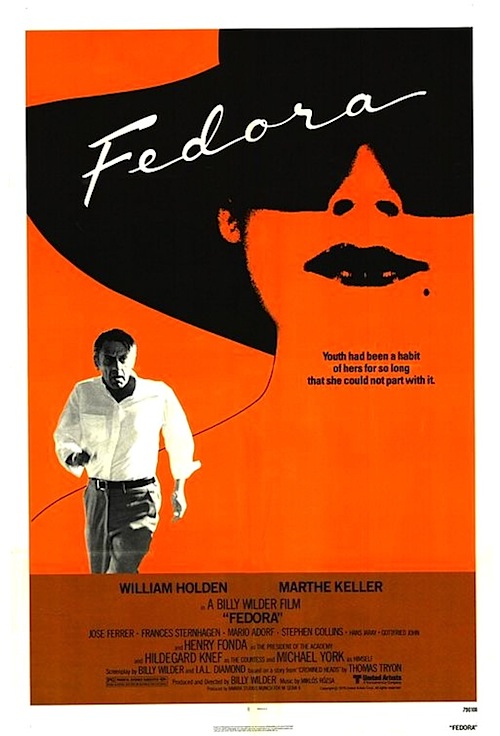
LFM Reviews Billy Wilder’s Newly Restored Fedora

By Joe Bendel. It turns out Norma Desmond was right. By 1978 the pictures had gotten small. One reclusive actress could make them big again, if only she were willing. One scuffling independent producer thinks he has the perfect comeback vehicle for her, but he will have to get past her suspiciously protective entourage in Billy Wilder’s newly restored Fedora, which opens this Friday at Film Forum.

Unlike Desmond, the uni-named Fedora appears truly ageless. Part of the credit must go to Dr. Vando, her personal physician, but he is just as controlling as the rest of her gatekeepers. Fedora is staying at Countess Sobryanski’s villa on the Greek Isle of Corfu, where access is strictly limited. Even though she has rebuffed Hollywood’s overtures for years, Barry “Dutch” Detweiler has come on borrowed money, script-in-hand, hoping to entice her with his modern day remake of Anna Karenina. Since the film starts in medias res at Fedora’s funeral, it is safe to assume the trip will not be a success. In fact, Fedora will dispatch herself in the manner of Tolstoy’s heroine. Of course, there will be a decidedly thorny explanation for her actions.

As we learn in flashbacks, Detweiler has a personal reason to believe Fedora might consider his offer. They once had a fling when she was at the height of her stardom and he was a very junior but very popular production assistant. There will be many more deep dark secrets from the past that Wilder and his celebrated screenwriting partner I.A.L. Diamond clearly enjoyed teasing out.

As a sort of thematic sequel to Sunset Boulevard, starring William Holden as Detweiler, Fedora ought to be beloved or reviled, yet it has been largely overlooked during the succeeding years, instead. Frankly, that is rather baffling, because their dialogue is as snappy as ever and their take on the late 1970s business of moviemaking is drily mordant. There are obvious parallels with Boulevard, but they dress it up with the scandalous trappings of the Harold Robbins novels then in vogue (sex, drug addiction, children secretly born out of wedlock).

Nevertheless, Wilder was still Wilder, so he could secure some really big stars to appear as themselves. Henry Fonda cranks his likability up to superhuman levels to play himself as the president of the Academy, specially delivering Fedora’s honorary Oscar two years before he was awarded his own. On the flipside, Michael York is quite the good sport appearing as a shallow, clueless Michael York.

Holden proves he can still masterfully handle Wilder’s adult banter, but there is also something poignant about Detweiler’s mounting desperation and nostalgia for the good old days. Even in his final years, he was a true movie star. Marthe Keller is also quite compelling in the title role, which turns out to be quite the complicated part, for reasons that would be spoilery to explain. Likewise, it is great fun to watch José Ferrer’s Vando swill his liquor and chew his scenery.

Sure, Fedora is alternatively lurid and campy—all the best films about Hollywood are, at least to some extent. More importantly, it has the wit and the attitude you would hope for. Not exactly a masterwork and certainly not a masterpiece, Fedora is really just a ripping good exercise in storytelling. Highly recommended for fans of classic movies and the people who made them, Billy Wilder’s Fedora opens this Friday (9/5) at New York’s Film Forum.

Posted on September 2nd, 2014 at 10:55pm.

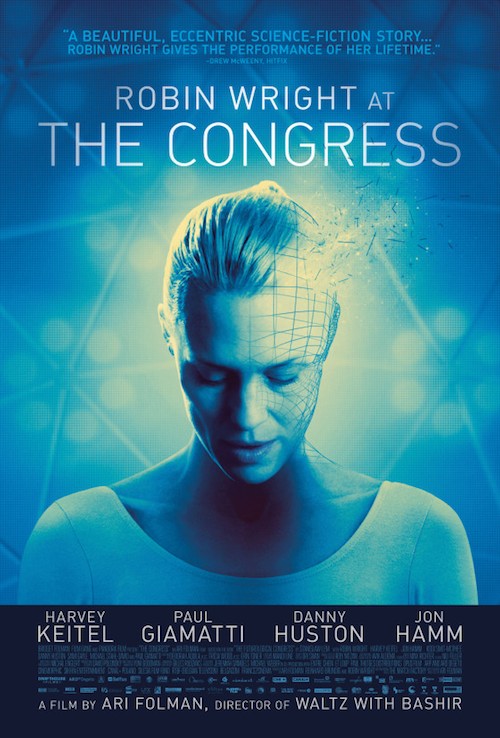
LFM Reviews The Congress

By Joe Bendel. Polish science fiction master Stanislaw Lem deftly satirized Soviet utopianism in The Futurological Congress. For his modernized riff, Israeli filmmaker Ari Folman uses Hollywood as the new evil empire. It is a smooth substitution. In the very near future, the movie business will take exploitation to even greater technological heights, as Robin Wright learns first-hand when she plays herself in Folman’s The Congress, which opens this Friday in New York.

Lem’s novel may have provided the seed of inspiration, but you will not find his well traveled hero Ijon Tichy. Instead, Wright will attend the conference in his stead, but first we will witness the final days of her acting career. Despite her early success in hits like The Princess Bride, Folman’s Wright turned out to be difficult to work with, frequently dropping out of high profile roles at the last minute. While she always claimed it was for the sake of her ailing son Aaron, her frustrated agent really knows it is fear and a lack of confidence that sabotaged her career.

However, Miramount has a final offer to make. For a lump sum payment, they will digitize Wright and program her into all the hit movies she was never shrewd enough to accept. Evidently, this is the way the business is going, so she reluctantly accepts. Twenty years later, she is the biggest star in the business, but nobody recognizes the real Wright. Accepting an invitation to speak at Miramount’s Futurological Congress, Wright plans to challenge their questionable ethical priorities from the podium. However, to get there, she must travel into Miramount’s animated city of avatars. Unfortunately, little things like the nature of time and reality will complicate her plan.

Frankly, the first fifty minutes of live action could have easily been condensed. In fact, by the time the film finally switches over into animation, Folman seems so eager to go off on a fantastical romp he never fully establishes the rules and boundaries of his chemically induced world of cartoon avatars. Still, it all looks spectacularly trippy.

Granted, Folman’s Congress is a bit of a narrative mess and it lacks Lem’s subversive bite, but it is fully stocked with fascinating ideas and surprisingly effective performances. In one of many intriguing side-plots, Folman puts a Matrix-like spin of Otto Preminger’s Laura when Dylan Truliner confesses to Wright he fell in love with her while working as the animator manipulating her digital image.

As Al the agent, Harvey Keitel delivers a monologue to end all monologues, while Paul Giamatti (who could have advised Wright on playing a meta-meta version of herself, having done something similar in Cold Souls) adeptly brings some stabilizing sensitivity and dignity to the film as Aaron’s kindly Dr. Baker. Whether as an animated avatar or in the flesh, Danny Huston also makes a dynamite villain as Miramount (great name) studio boss Jeff Green.

Most importantly, The Congress’ animation is wildly cool and colorful, with enough thinly disguised cameos and visual quotes to reward dozens of repeat viewings. In contrast, the Wright family drama gets tiresome the first time through, especially when it comes to poor, pitiful Aaron, whose bland personality seems to be degenerating along with his sight and hearing. Nevertheless, Folman puts so much crazy ambition up on the screen, it more than compensates for the occasional lapse into Lifetime melodrama. Recommended for fans of cult science fiction and animation, as well as Lem readers who enjoy being scandalized, The Congress opens this Friday (9/5) in New York at the Elinor Bunin Munroe Film Center.

LFM GRADE: B+

Posted on September 2nd, 2014 at 10:55pm.