LFM Reviews The Fives @ The 2014 Fantasia International Film Festival

By Joe Bendel. Life is cheap, organs are expensive. That is the principle driving a woman with a rare blood type and her quest for payback. She is willing to pay quite dearly to avenge her husband and daughter, offering her organs as a reward in Jeong Yeon-shik’s The Fives, which screened during the 2014 Fantasia International Film Festival.

Go Eun-a was once a strict mother and somewhat scoldish wife. Tragically, her life turned upside-down when her pre-teen daughter Ga-yeong recognized an older fellow music student with her so-called “Uncle,” serial killer Oh Jae-uk. After dispensing with his intended victim, Oh tracks down the family, brutally murdering Ga-yeong and her father. However, the mother survives, destined to spend the rest of her days confined to a wheelchair.

Knowing her doctor coveted her heart for his ailing daughter, she strikes a dire bargain: find four other patients or family members with specialized skills to help her track, capture, and execute her family’s murderer in exchange for what they need. It will be deeply-indebted police technician Park Jeong-ha’s job to ferret him out online, engineer-thief Nam-cheol to shadow and verify, former gangster Jang Dae-ho to be the muscle, and the shifty doc will perform their promised transplants. Of course, their undertaking gets considerably more complicated when Oh starts hunting his hunters.

The Fives represents a bit of Korean cinema history as the first film adaptation of a web comic directed by its original creator. Nevertheless, the dark tale of revenge and moral angst follows in a long tradition of Korean thrillers, including recently Lee Jung-ho’s Broken and Kim Kwang-sik’s Tabloid Truth. While The Five is not as emotionally resonant as Broken, it is tough to match its pitch black heart.

Yet, in its way, Fives is more sympathetic in its treatment of Evangelicals, particularly Hye-jin the volunteer trying to minister to Go, than most recent Korean imports. Oh, the metrosexual hipster artist, is also the sort of serial killer you are not likely to see in a Hollywood thriller anytime soon. It is sort of like watching the evil twin of quirky indie comedy—exceptionally evil.
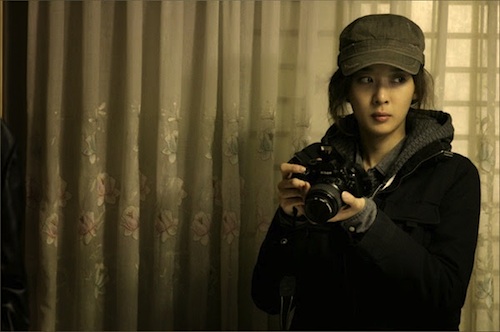
From "The Fives."

Kim Sun-a is all kinds of intense as Go, while Park Hyo-joo is truly heartbreaking as Hye-jin. Ma Dong-seok, Shin Jung-keun, Lee Chung-ah nicely flesh out Jang, Na-cheol, and Park, giving them an identity beyond their plot function. However, Jung In-gi’s craven sawbones is a bit cringy. Oddly, On Joo-wan is so spectral-like as Oh, it is hard to render a full judgment on his work.

Even though Go has a highly cinematic talent for lethal Rube Goldberg constructions, The Fives is pretty down to earth by the standards of the genre. Jeong clearly prefers to keep the action up-close-and-personal rather than mount extravagant spectacles. He keeps viewers looked in, even though its bleak portrayal of human nature is exhausting. Recommended for fans of vigilante and serial killer movies, The Fives is likely to develop legs following its Canadian premiere at this year’s Fantasia, which wraps up today (8/7) with screenings of the ridiculously entertaining Zombeavers and the devastating Han Gong-ju.

LFM GRADE: B

Posted on August 8th, 2014 at 1:53pm.
LFM Reviews The House at the End of Time @ The 2014 Fantasia International Film Festival

By Joe Bendel. Like many Venezuelans, Dulce has spent long years in prison for crimes she did not commit. However, she is not a political prison. She was simply blamed for the supernatural tragedy that unfolded in her house. Considered the first Venezuelan horror movie, Alejandro Hidalgo’s The House at the End of Time had fans sit up and take notice during the 2014 Fantasia International Film Festival.

The audience will get numerous added perspectives on what exactly happened that night, but one thing is certain. Dulce’s husband Juan José was stabbed to death. There were not a lot of other suspects to be found, especially not their eldest son Leopoldo, who seemingly vanished without a trace. Convicted of both their presumptive murders, Dulce eventually is granted a supposedly humanitarian release. However, the terms of her parole require her confinement in the very house where she endured those horrors.

As Hidalgo flashes back in time, we witness an earlier night of terror that thoroughly destabilizes Dulce’s family. Clearly, some strange agency is at work, but Juan José and the cops are quick to dismiss Dulce. Frankly, the only person who ever believes her is the sympathetic parish priest, who tries to counsel the older Dulce her during her house arrest. Researching the evil looking domicile, he discovers it was specially constructed by a mysterious English Mason. Over time, the state took possession of the house, offering it to low income families, but never revealing its macabre history.

House starts out as a decidedly atmospheric horror movie, but it evolves into a genre-defying, reality-bender. It is a far more complex narrative than viewers will initially suspect, but Hidalgo marshals the assorted strands quite adroitly. It is also rather refreshing to see an uplifting portrayal of a Catholic priest, with the ultra-subtle implication of government bureaucratic disregard for public welfare being a nice added bonus.

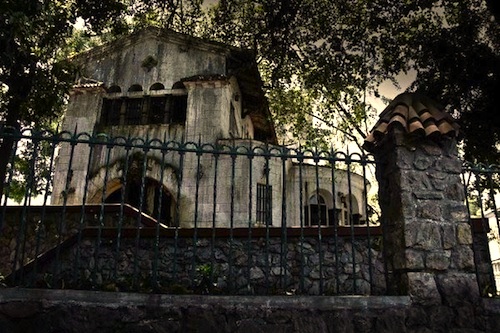
From "The House at the End of Time."

Former Miss Venezuela Ruddy Rodríguez glams down rather boldly to play Dulce. Far from a heroic mother figure, it is a full-fledged, emotionally complicated performance. Guillermo García also raises the good Father above a mere symbol of decency. However, the younger cast-members can be a bit awkward on-camera.

Of course, one of the biggest stars is that creepy old house, which art director Evadne Mullings decks out in lovingly dark detail. There must be more keys in House than any other film playing at Fantasia (all those locked doors seem like a fire hazard, but they well serve Hidalgo’s tense narrative). Cinematographer Cezry Jawkorski’s gives it all a moody, morose look that heightens the foreboding. It all works surprising well, raising the stakes for the old dark house movie. Recommended for genre fans, The House at the End of Time was one of the pleasant surprises at this year’s Fantasia.

LFM GRADE: B+

Posted on August 8th, 2014 at 1:32pm.

Welcome to the Hamptons: LFM Reviews The Maid’s Room

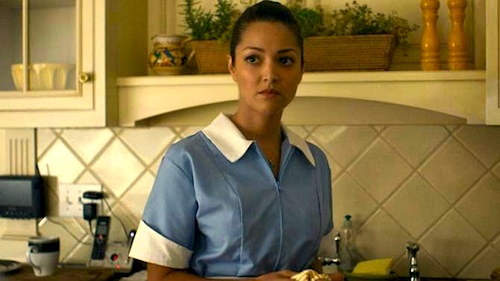
By Joe Bendel. She does the kind of work Americans “just won’t do,” like cleaning up Master Crawford’s vomit. The Crawfords are most definitely one percenters—and writer-director Michael Walker will never let us forget it in the dark morality play/borderline-thriller The Maid’s Room, which opens this Friday in New York.

Drina seems pretty, hard working, and illegal enough not to complain. That is good enough for the Crawfords to hire her as the live-in maid at their Hamptons house. They will only be there over the weekends, but their entitled son Brandon will spend the entire summer there. Of course, he notices Drina, but he is mostly too busy drinking like a fish to do anything horrifically inappropriate. Unfortunately, one drunken mistake will kill his buzz and put Drina in an increasingly awkward position.

Just in case you did not get it, the Crawfords think the rules do not apply to them because of their wealth, whereas the naïve Drina believes everyone is accountable in the eyes of God and the law. Subtle Maid’s Room is not. Still, the first major dark turn is a bit of a surprise, because the film seemed to be conditioning the audience to go in a different direction.

Perhaps Maid’s Room’s greatest inequity is the disparity between characters. Frankly, Drina is sweet but boring. Granted, Brandon Crawford, a sort of Raskolnikov figure, does not have much more going on, either. However, Mr. Crawford is a forceful, surprisingly complicated character, who dominates the film in every sense. Even with the deck completely stacked against him, Bill Camp elevates his performance to classically tragic dimensions.

In contrast, Paula Garcés is unflaggingly earnest as Drina, but mostly she just bites her lip and furrows her brow as she wrestles with her employer’s moral bankruptcy. Annabella Sciorra is also fairly potent as Mrs. Crawford, but the uptight mom routine feels pretty familiar by now.

From "The Maid’s Room."

The Crawford home certainly looks exclusive, but some of the film’s details are a little ridiculous, like the Erin Brockovich movie poster Drina hangs in her titular quarters. Seriously, a Colombian immigrant in her early twenties would choose the 2000 Soderbergh film to brighten her walls? It is almost laughable when Walker uses it as a device to strengthen her resolve, as if asking WWEBD, what would Erin Brockovich do?

There are several nicely staged sequences in the second act that demonstrate how one mistake inevitably begets another. Unfortunately, the film is overly preoccupied with its intended take-aways at the expense of narrative. As a result, the promising moments are smothered by its class consciousness. A misfire despite Camp’s highlight reel work, The Maid’s House opens this Friday (8/8) in New York at the Cinema Village.

LFM GRADE: C-

Posted on August 8th, 2014 at 1:31pm.

LFM Reviews Wolfcop @ The 2014 Fantasia International Film Festival

By Joe Bendel. Usually, it is the police who expect the crazies to come out during a full moon. Now it is the criminals’ turn to worry. Lou Garou was never much of a cop, but he has been changing lately. He still drinks like a fish, but he lays down a lot of law during the night shift. However, there might be more nefarious reasons for his lycanthropic state in Lowell Dean’s Wolfcop, which screened during the 2014 Fantasia International Film Festival.

Garou is a drunk, who apparently only holds his job on a small Saskatchewan town’s police force out of respect for his late father. The captain hates his guts and his hard-charging colleague Tina thinks he is a loser, but Jessica, the hot barkeep, values him as a regular customer. After responding to a report of teenagers engaging in some sort ritual in the woods, Garou wakes up in bed with a pentagram carved into his chest. He also just cannot shave his persistent stubble anymore.

Yes, he is a werewolf, but he exercises a fair degree of control. He actually starts busting the meth gang that needed busting. Of course, he still swills whiskey and binges on donuts. He ought to be more concerned about the forces that caused his metamorphosis, but anticipating the long-term is not his forte.

How can you dislike a town that is home to the Liquor Donuts store and holds an annual “Drink & Shoot?” It all sounds very over the top, but Wolfcop is actually more of a movie-movie than the collection of gags it might look like. This sounds ridiculous, but Garou the Wolfcop has a fairly satisfying character development arc and it nicely brings a lot of the town’s history full circle.

Most importantly for werewolf fans raised on Rick Baker’s American Werewolf in London, Emerson Ziffle’s Wolfcop makeup is terrific. His transformations are satisfyingly gross, but the full wolf still has all kinds of personality to latch onto. It is not hard to see a franchise developing around him.

A game lead, Leo Fafard absolutely feasts on Garou’s degeneracy and revels in the Wolfcop’s fierceness. Clearly, he was also a good sport enduring Z’s make-up. Sarah Lind vamps it up quite entertainingly as Jessica, while Amy Matysio brings unexpected verve and attitude to the straight-laced Tina. Considering all the madness going on, the whole ensemble plays it rather impressively straight, scrupulously refraining from winking at the camera.

Never fear, there is still plenty of outrageous gore, plus the sex scene Universal never gave Lon Chaney Jr. Wolfcop is a tough titular concept to live up to, but Dean pulls it off. Good, gruesome, goofy fun, Wolfcop is likely to take on considerable legs following its screening at this year’s Fantasia.

LFM GRADE: B+

Posted on August 4th, 2014 at 10:02pm.

LFM Reviews Celluloid Dreams

CELLULOID DREAMS Teaser from Jonathan Dillon on Vimeo.

By Joe Bendel. Christopher Nolan and his colleagues saved film production, at least as long as their films stay popular. Much to the relief of Rochester, New York (home of the last surviving Kodak film factory), the practice of threading film stock will not completely disappear from everyday life. It is an act that takes on significant meaning in Jonathan Dillon’s short film Celluloid Dreams, which screens for three Academy-qualifying days this week in Los Angeles.

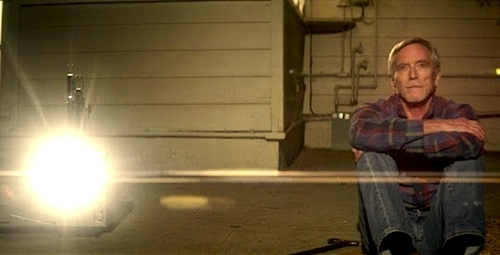
For decades, Robert Thompson has lived alone with his memories and regrets. He was once an avid A-V hobbyist happily married to his wife Deanna, but their wedded bliss was short lived. One day, he impulsively fixes his long broken projector, allowing him to visit their early good times together, as well as the events leading up to tragedy. As Thompson watches the flickering black-and-white home movies, he seems to be physically transported back into the past.

Celluloid immediately brings to mind films like Somewhere in Time and Peggy Sue Got Married, but it maintains a sense of ambiguity regarding its nature, whether it is an excursion into magical realism-time travel or a simple memory play. Either way, it is an effective calling card for Dillon, who nicely manages the two separate timelines taking place simultaneously within the same location.

From "Celluloid Dreams."

Although the dialogue is masked by a highly sentimental soundtrack, Greg Lucey’s powerful performance as the contemporary Thompson is still eloquent without words. Cinematographer Hanuman Brown-Eagle’s black-and-white sequences look spot and perfect, while his color work has an appropriately nostalgic sheen.

Indeed, Celluloid Dreams is a great looking film and its romantic portrayal of moving pictures ought to appeal to the Academy’s sensibilities. Recommended for short film fans, it screens this Tuesday through Thursday (8/5-8/7) at the Laemmle NoHo 7.

LFM GRADE: B+

Posted on August 4th, 2014 at 9:59pm.

LFM Reviews Time Lapse @ The 2014 Fantasia International Film Festival

TIME LAPSE – Official Trailer from TIME LAPSE on Vimeo.

By Joe Bendel. It is too bad the late, great James Garner never got to take this Polaroid camera out for a spin. It has been specially modified. The big bulky mainframe spits out a picture of whatever is in its field of vision, twenty-four hours into the future. Unfortunately, its inventor no longer has a future, which allows his underachieving neighbors to put it to dubious employment in Bradley King’s Time Lapse, which screens during the 2014 Fantasia International Film Festival.

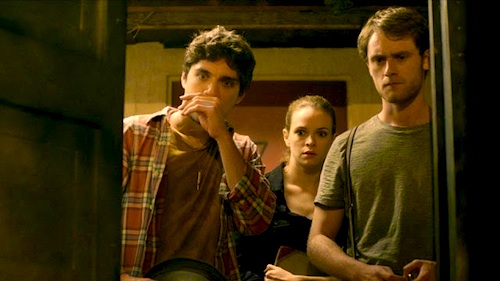
Finn fancies himself a painter, but he is really the super of a suburban condo complex. He is the guy who has to check up on the eccentric Mr. Bezzeredes when the retiree’s papers start piling up. His girlfriend Callie is a writer who works as a waitress and their housemate Jasper is basically a degenerate gambler.

It turns out the former scientist was compulsively snapping photos through their front window before he met with death through some mysterious form of misadventure. From Bezzeredes’ journal and the evidence of the photos, the trio quickly deduces the nature of his breakthrough and concludes he was burned (literally) because he tried to pull a fast one on time. Therefore they resolve they must always conform to whatever future comes spitting out of the machine. Of course, it always seems to provide Jasper the daily winners at the racetrack. It also shows Finn the paintings he had been struggling to produce.

We do not need a crystal ball to predict Jasper’s bookie will get suspicious when he keeps picking race after race. However, that is just the start of the complications for the trio. For one thing, they essentially lose all free will once they commit to conforming to the nightly 8:00 photo. It becomes a compelling dramatic constraint King and co-writer B.P. Cooper wriggle in and out of quite cleverly.

In fact, Time Lapse represents a continuation of the renaissance for low budget, high concept indie science fiction, successfully following the example of James Ward Byrkit’s Coherence, Hugh Sullivan’s Infinite Man (a fellow Fantasia selection), and Darren Paul Fisher’s Frequencies. Like those films, Time Lapse is not about special effects. Instead, they start with a fantastical Macguffin and trace its effects on realistic, everyday people. Arguably, Time Lapse is the most character-driven of the lot, presenting the dark side of a Three’s Company-like situation.

From "Time Lapse."

Danielle Panabaker is terrific as Callie, pulling off some nifty pivots that really make the film. George Finn also relishes Jasper’s increasingly erratic behavior, chewing scenery like a genre pro. Matt O’Leary sort of draws the short straw as the painfully reserved Finn (the painter character), but he holds up his end, keeping the action moving forward.

One of the cool things about Time Lapse is it is the sort of science fiction film you could adapt as a stage production without it suffering from a lack of SFX mumbo jumbo. Tightly executed by King, it is a worthy addition to the growing time travel canon. Recommended with a good deal of enthusiasm, Time Lapse screens again tomorrow (8/2) as part of this year’s Fantasia.

LFM GRADE: B+

Posted on August 1st, 2014 at 6:20pm.