LFM Reviews A Time in Quchi @ The Asian American International Film Festival

By Joe Bendel. There is a different rhythm to life in the Quchi countryside. Chang Tso-chi acclimates viewers to it far quicker than his ten year old protagonist. Kuan Hsiao-pao is used to Taipei’s high speed internet, but a summer spent with his traditional grandfather will have lasting significance in Chang’s A Time in Quchi, which screens during this year’s Asian American International Film Festival in New York.

At this point, Kuan is used to his parents’ chaos, so their likely divorce is not exactly shocking. He will spend his summer vacation with his paternal grandfather, so his folks will have more time to quarrel, but he is rather put off by the old man’s highly structured lifestyle. He is also less than thrilled when his chop-busting younger sister “Seaweed” arrives sometime later.

Since this is Taiwan, kids still go to school even during summer vacation, so Kuan is duly enrolled at the village primary school. Not surprisingly, he is initially rather standoffish, but Kuan soon forms his first real friendship with Huang Ming-chuan, an aboriginal classmate. Unfortunately, just as Kuan embraces Quchi, tragedy strikes.

Quchi is a subtle and wistful coming of age story that showcases some extraordinarily natural young actors. However, it must be completely compartmentalized from Chang, who is essentially the Taiwanese Polanski, except he is not being sheltered from justice by the French government. Frankly, it is a little creepy to realize the incident he was convicted for occurred at a party for Quchi, but that is not the fault of Yang Liang-yu and his co-stars.

From "A Time in Quchi."

While Yang’s work might be too understated for those who like to bring their Fault in Our Stars branded hanky to the movies, he keeps what could have been a saccharine melodrama feel mature and grounded. He also rather graciously allows Lin Ya-jo to steal all of Seaweed’s scenes. Nonetheless, it is veteran actor-screenwriter Kuan Yun-lung (a.k.a. Kuan Kuan) who really gives the film its heart and integrity as the gruff but wise grandfather.

Even at the height of young Kuan’s city slicker culture shock, he can appreciate the natural beauty of Quchi’s rivers and foothills. Cinematographer Yuan Ching-kuo certainly did as well. Visually, it is a much more arresting, big canvas film than you would expect from the coming-of-age genre. It represents nice work from a large cast and creative crew that should not be tarnished by Chang’s subsequent scandal. Recommended for those who appreciate quiet but telling family dramas, A Time in Quchi screens this coming Monday (7/28) at the Village East, as part of the 2014 AAIFF.

LFM GRADE: B+

Posted on July 28th, 2014 at 12:20pm.
LFM Reviews Awesome Asian Bad Guys @ The 2014 Asian American International Film Festival

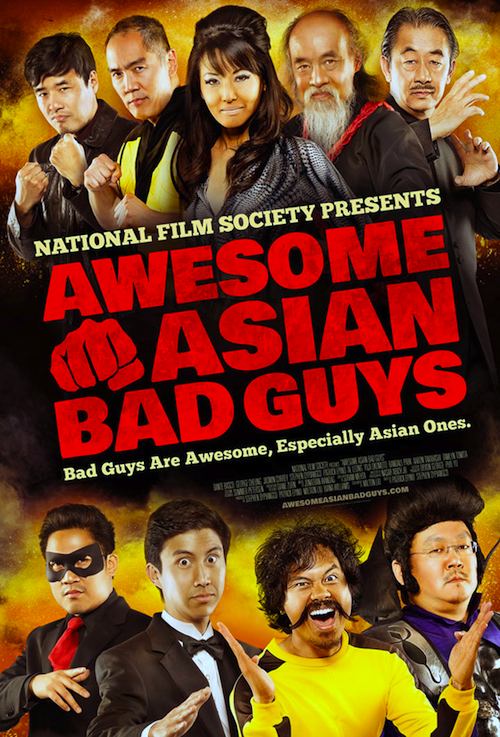
By Joe Bendel. You will definitely recognize Al Leong. He was the henchman Sgt. Riggs strangled with his legs while he was administering electroshock torture in the original Lethal Weapon. That is a typical day at the office for Leong. PBS’s National Film Society set out to pay tribute to Leong and his fellow character actors with a web-series that turned into a festival film. Prepare to show all due respect when Stephen Dypiangco & Patrick Epino’s Awesome Asian Bad Guys screens during the 2014 Asian American International Film Festival in New York.

Internet video producers Dypiangco and Epino are on a mission to assemble an Expendables-like team of Asian action movie heavies, who will finally have the chance to be the good guys. They have two good reasons: they must protect Tamlyn Tomita (from the Karate Kid 2) and prevent commercial actor Aaron Takahasi from trying to permanently eliminate all his casting call competition.

The cool thing about AABG is how it deftly satirizes Hollywood’s Asian stereotyping while still lovingly honoring actors like Leong and George Cheung (Rambo II, Rush Hour) for making the best of a less than optimal job market. It is also mind-blowing to hear Tomita plays somebody’s mom on Glee (is that show still on?). Naturally, she makes a great damsel-in-distress and/or femme fatale. However, there is just too much of Dypiangco and Epino shticking it up as themselves. Frankly, there probably ought to be more action and less comedy, because that is what an Al Leong fan would want to see. Nevertheless, it is entertaining to watch the Awesome Asian Bad Guys finally get a curtain call.

Since AABG clocks in just under an hour, the AAIFF has paired it with a short featuring two fairly awesome bad guys. A pair of Yakuza are driving deep into the Mojave Desert to bury a body in Robbie Ikegami’s Pull Over to Kill. This will be the final errand for Watanabe, the soon to be retired strawberry farmer, but hot-headed Yasumoto is just starting out as a retainer. Needless to say complications ensue.

Viewers might predict the general trajectory of this two-hander, but Ikegami and cinematographer Alan Vidali make it look awfully stylish. Nor can anyone argue with Tatsuya Ito’s world weary steeliness, as Watanabe. The use of Michiko Hamamura’s “Tabu” and Saori Yuki’s “Yoaki No Scat” also vividly evoke the 1960’s vibe of many classic Yakuza pictures. In fact, POTK could even serve as an effective music video for them, inspiring post-screening downloads. It is a satisfying short that nicely fits with AABG. Recommended as a good festival package, Awesome Asian Bad Guys and Pull Over to Kill screened this weekend at the Village East and Saturday at the Made in NY Media Center, as part of this year’s AAIFF.

Posted on July 28th, 2014 at 10:58am.

LFM Reviews A Most Wanted Man

By Joe Bendel. Yes, intelligence gathering sometimes involves cloak-and-dagger work, but there is also a lot of bureaucracy. That has always been a side of the secretive business novelist John le Carré has been closely in touch with. For better or worse, all the hallmarks of a le Carré bestseller are to be found in Anton Corbijn’s adaptation of his A Most Wanted Man, which opens this Thursday in New York.

Hamburg was the city where the September 11th terrorist attacks were planned—a fact German intelligence is keenly aware of. It was not Gunther Bachmman’s territory at the time, but the spymaster is still in need of redemption. He was transferred to the port city after his Beirut network was exposed. The who’s, how’s, and why’s remain murky, but there is no question regarding damage done to his career. However, the world weary scotch drinker has big game in his sights: Dr. Faisal Abdullah, an ostensive philanthropist and advocate of Muslim tolerance, whom Bachmann has reason to suspect is furtively funneling funds to terrorist organizations.

Being old school to his bones, Bachmann eschews interrogations or anything physical. He prefers to trap his prey and then turn them into assets. That is the plan with Abdullah, using the poor hapless Issa Karpov as bait. The son of a Chechen woman and a high ranking (and therefore corrupt) Soviet military officer, Karpov understandably identifies with his mother’s side of the family. Escaping his Russian torturers, Karpov has been branded an Islamist terrorist, but Bachmann is skeptical. Dieter Mohr, a more politically sensitive rival from an overlapping agency, would prefer to arrest the Chechen with great fanfare, but Bachmann sees the newly arrived asylum-seeker as an opportunity.

As it turns out, Karpov’s despised old man had an account in Hamburg—an account large enough to be a chip in Bachmann’s game. However, to play it, he will have to handle Karpov’s immigration attorney, Annabel Richter, and Tommy Brue, the banker holding his funds. Unfortunately, Bachmann is a le Carré protagonist, which means he must spend a great deal of time in boardrooms convincing dim-witted ministers to go along with his plan. For now, Martha Sullivan, the regional CIA string-puller, will give him time, but her patience and Bachmann’s trust are limited.

If you like your thrillers talky, you are already a le Carré reader and therefore thoroughly primed for Wanted. On the plus side, Corbijn’s is fully stocked with intelligent characters and meaty dialogue heavy with meaning. Conversely, le Carré’s moral equivalency between all parties is present in full force, as well as an aversion to cinematic action. Although its running time clocks in just over two hours, the ending still feels unsatisfyingly unfinished, leaving viewers to wonder if everyone would really leave things as they are.

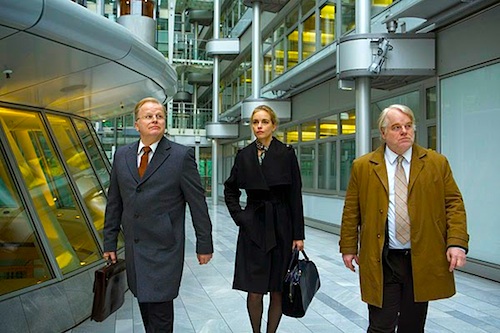
Of course, the primary, if not only reason to see Wanted is the late Philip Seymour Hoffman, who fits into the role of Bachmann like a comfortably rumpled suit. Le Carré has said Hoffman is the only American who could play his iconic George Smiley—and it is easy to see what he means. Bachmann and Smiley are clearly cut from same cloth, while Hoffman, Gary Oldman, and Alec Guinness were/are some of the smartest, most engaging actors in the business.

From "A Most Wanted Man."

Hoffman’s mushy German accent also works rather well in context, but Rachel McAdams is not nearly as convincing as Richter, the slumming daughter of privilege human rights attorney. At least Willem Dafoe certainly looks at home as Brue, the self-loathing banker. Sadly, Nina Hoss does not have much to do as Bachmann’s lieutenant, Irna Frey, but she classes up the joint, nonetheless. Most of the German cast-members largely serve as window dressing, especially Rush’s Daniel Brühl, who is about as easy to spot as Tony Curtis in The List of Adrian Messenger playing one of Bachmann’s surveillance specialists. Arguably, it is Robin Wright who best hangs with Hoffman, warily sparring with his Bachmann as the suspiciously smooth Sullivan.

Wisely, Andrew Bouvell’s adapted screenplay somewhat waters down the criticism of post-9-11 American foreign policy, but anti-Americanism is baked into the fiber of le Carré’s source novel. Yet, it is the film’s brief but explicit criticisms of Putin’s Russia that feel timelier now. Corbijn has a good eye for the project, capturing the cold, cerebral world of intrigue and modernist architecture. There is much to admire about it, but aside from Hoffman’s haggard everyman performance, the film does its best to keep viewers at arm’s length, like a film that does not want to be wanted. Recommended for knowing fans of le Carré and Hoffman, A Most Wanted Man opens this Thursday night (7/24) in New York at the Landmark Sunshine.

LFM GRADE: B-

Posted on July 22nd, 2014 at 11:47m.

LFM Reviews Beneath

By Joe Bendel. As a soon-to-be retired coalminer, George Marsh’s way of life is slowing dying. So is he, but maybe not as slowly as he assumes. Naturally, there is an epic cave-in on his last day in the mine, but there might be more pressing concerns for his stranded party than their dwindling oxygen supply in Ben Ketai’s Beneath, which opens this Friday at the IFC Center.

To celebrate his retirement, Marsh’s daughter Samantha has returned from New York to attend his send-off. Perhaps she shouldn’t have. True, her father’s lungs are as black as, well coal, but he resents being pressured into retirement. After all, he never missed a day’s work in the thirty-one years since the mine opened. He also takes her environmental law practice as a not so subtle rebuke. Despite her new life, she can still relate to the guys relatively well, particularly her former high school sweetheart. She tries to convince them, she is really in their corner. It is the corporations she is against. However, they seem to think they wouldn’t have jobs without the mining company. As the discussion gets heated, she accepts a dare to come down with them the next morning.

That would be her father’s last day on the job, which pretty much guarantees some sort of movie disaster. Add in his fish-out-of-water daughter and a rookie with only a few weeks experience into the mix and you have the makings of a perfect subterranean storm. Indeed, something duly goes drastically wrong. As Ketai’s primary characters hunker down in the shelter awaiting rescue, strange things start to happening, risking their survival.

When it comes to genre films set within mine shafts, Beneath leaves Abandoned Mine in the dust. Ketai certainly creates a claustrophobic mood, but the real strength of the film is his sympathetic grasp of the working class environment. Never condescending, Beneath conveys the pride of the miners, derived in no small measure from the dangerous conditions they face each day. Yet, the film is almost too subtle presenting the question whether supernatural forces are plaguing the survivors or it is a case of rampant oxygen-deprived psychosis.

From "Beneath."

Unfortunately, the film also focuses on the wrong Marsh, following Samantha’s POV and largely sidelining the perennially under-rated Jeff Fahey, as the grizzled George. Kelly Noonan is perfectly fine as the rebellious daughter, but her perspective is pretty standard issue woman-in-horror-movie-jeopardy stuff. Amongst the supporting miners, Brent Briscoe definitely stands out as Marsh’s jovial buddy, Mundy. Witchblade’s Eric Etebari also glowers memorably as the uptight, chauvinistic Masek.

Without question, Beneath is one of the moodiest films acquired by IFC Midnight. While it is certainly a genre film, it never comes across as exploitative. Nevertheless, it leaves an intriguing side-plot regarding a similar 1920’s disaster frustratingly under-developed and closes with the clichéd eye-roller of a denouement. Better than the gruesome poster would lead you to expect, Beneath is recommended for those who horror films that cross-over category labels. It opens this Friday night (7/25) in New York at the IFC Center.

LFM GRADE: B

Posted on July 22nd, 2014 at 11:47am.

LFM Reviews Hello! Junichi @ Japan Cuts

By Joe Bendel. Junichi Hayashida is a naturally empathetic kid. Unfortunately, that does not impress a lot of third graders. However, he might gain a little bit of confidence through time spent with his five friends and their bombshell student teacher. Being a kid is hard, but it still has its moments in Katsuhito Ishii, Kanoko Kawaguchi & Atsushi Yoshioka’s Hello! Junichi, which screened as part of the 2014 Japan Cuts: the New York Festival of Contemporary Japanese Film.

Anna-Sensei makes quite an impression on everyone, especially Hayashida’s romantically frustrated homeroom teacher. However, he still only has eyes for Maeda. During art class, he found himself borrowing a bunny eraser from her, but he has yet to gird up the courage to return it. This is the sort of thing Anna-Sensei picks up on immediately. Initially, this intimidates Hayashida, just like everything else in life, except more so. Yet, he comes to trust her when she defends him and his mates when they get into a tight spot.

Although Junichi’s parents are well to do, he spends more time with more-with-it-than-he-seems grandfather. Unfortunately, his friend Masato Kuramoto’s home life is much more difficult. Money is tight, so his soon-to-be single mother must work multiple jobs. To help him give her special birthday, Hayashida and his friends agree to stage a special concert for her, with Anna-Sensei’s help, of course.

In terms of tone, Hello is reminiscent of Ishii’s The Taste of Tea, but it substitutes moments of wild but terrestrial zaniness for the magical realism of his Tochigi-set family pastoral. Co-directed with two of his workshop graduates, Hello balances a battalion of characters with ease. They mostly maintain a mood of wistful whimsy, but it still forthrightly addresses the issue of bullying.

Hikari Mitsushima, who took no prisoners in Sion Sono’s Love Exposure, once again becomes a force of nature as Anna-Sensei, the Miss Jean Brodie we always wanted. She develops some real chemistry with her young co-stars and looks great beating on the various adults who cross her. Still, young Amon Kabe distinguishes himself, carrying the narrator-chief POV duties like a good little soldier.

From "Hello! Junichi."

Likewise, Yohei Hotta and Rio Sasaki are remarkably compelling as the gruff but sensitive Kuramoto and the forceful aspiring pop idol, Kayo Tanaka. Frankly, the all the third grade supporting players are quite assured. It is some of their adult counterparts who get a bit shticky (but not enough to undermine the film’s good vibes).

Anna-Sensei’s magnetism is undeniable and her kids are all quite endearing. As a result, it is hard to imagine anyone would not be won over by Hello’s charm. Gentle but relatively true to life, it is perfect for family viewing. To that end, the Japan Society is offering a special $6 admission deal for children twelve or younger. Recommended with affection, Hello! Junichi screened yesterday, the closing day of this year’s Japan Cuts.

LFM GRADE: B+

Posted on July 21st, 2014 at 10:26am.

LFM Reviews Man from Reno @ Japan Cuts

By Joe Bendel. Mystery novelist Aki Akahori’s Inspector Takabe is like a Japanese Maigret, but her life is about to turn into a Mary Higgins Clark novel, except darker. A chance encounter with a seductive stranger leads to more intrigue than Akahori bargained for in Dave Boyle’s Man from Reno, the best narrative award winner at the 2014 L.A. Film Festival, screens as part of this year’s Japan Cuts: the New York Festival of Contemporary Japanese Film.

Although Takabe rules the Japanese bestseller lists, Akahori is uncomfortable with her success. Tired of her celebrity status, she deserts her publicity tour, taking refuge in San Francisco, where she once went to school. In her hotel, she meets a handsome Japanese tourist from Reno, or so she deduces. She did not have a tryst in mind, but she eventually yields to his charms. However, just when things start heating up, he precipitously vanishes. Even more disconcerting are the total strangers who suddenly want to take a quick look-see in her room.

Just north of town, Paul Del Moral, the sheriff of San Marco, is also searching for a Japanese man. In this case, it is the individual he accidentally hit during severe fog-in, who up and left the hospital in an equally rash manner. Soon a dead body turns up in San Marco who seems to have some connection to the fellow Del Moral dubbed “Running Man.” Inevitably, Del Moral’s investigation will lead him to the increasingly uneasy Akahori.

Reno represents a quantum step up for Boyle, whose previous films, like White on Rice, have been largely classifiable as romantic comedies. His frequent collaborator Hiroshi Watanabe is also back in the fold, but this time around he plays a strictly serious supporting role. Instead, Ayako Fujitani and veteran character actor Pepe Serna take star turns as Akahori and Del Moral, respectively. Expect to see more of them because they both make major statements with their smart, charismatic, yet understated performances.

From "Man from Reno."

As thrillers go, Reno (co-written by Boyle, Joel Clark, and Michael Lerman) has several fresh twists and it nicely captures the between-worlds vibe of the expatriate lifestyle. Technically polished, Richard Wong’s evocatively noir cinematographer also heightens the tension during several key scenes.

Murkier than one might expect, Reno is an effective, somewhat romantic suspenser that never rushes to tip its hand. However, it even more appealing to see a film anchored by people who look like Akahori and Del Moral. Granted, Fujitani is a beautiful woman, but in a mature, cerebral manner. Likewise, Serna is wonderfully grizzled, in a confidence-inspiring way. They are terrific, carrying the film relay-style during their many solo scenes. Highly recommended, Man from Reno screens tomorrow (7/19) at the Japan Society as part of the 2014 Japan Cuts.

LFM GRADE: A-

Posted on July 18th, 2014 at 11:34am.