LFM Reviews Unforgiven @ Japan Cuts

By Joe Bendel. For Jubei Kamata, it is the end of an era—the Tokugawa Era. The former samurai-assassin used to kill with impunity and then he simply killed to stay alive, but he gave up killing at the behest of his beloved late wife. However, killing is a skill you never forget. Reluctantly, Kamata digs up his sword for a final violent errand in Sang-il Lee’s Unforgiven, an inspired cross-cultural remake of Clint Eastwood’s Oscar-winning western, which screened during this year’s Japan Cuts: the New York Festival of Contemporary Japanese Film.

In a remote frontier village on Hokkaido Island, two ranchers brutally disfigure Natsume, a young prostitute. Rather than prosecute them, local police chief Ichizo Oishi merely requires the former samurai pay restitution to the brothel owner. Outraged by his callous disregard for Natsume’s suffering, her fellow prostitutes pool their money to place a bounty on the offending settlers.

Old Kingo Baba intends to collect that bounty, so he tries to recruit his old samurai comrade Kamata, a.k.a. “Jubei the Killer.” Already haunted by his past carnage, Kamata dearly wishes to keep his promise renouncing violence. Unfortunately, a disastrous harvest leaves him no other option to provide for his young son and daughter. Soon, Kamata and Baba are joined by Goro Sawada, an impulsive would-be outlaw, who also happens to be half Ainu (the indigenous people of Hokkaido and Sakhalin). As it happens, Kamata’s late wife was also Ainu, giving the two men a distant kinship and a shared outage at the Meji government’s repression of Ainu customs.

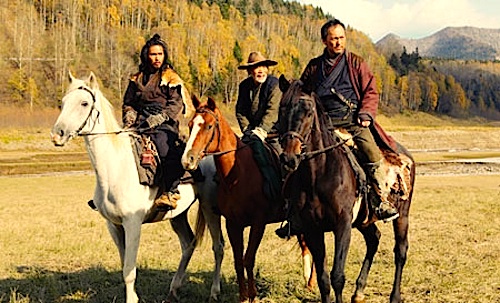
Arguably, the Ainu element further deepens the Unforgiven story beyond the Eastwood’s revisionist critique of a violent, misogynistic American west. Closely paralleling the original, Lee’s adaptation perfectly fits within the rough and tumble early Meiji northern provinces, where many former Shogunate ronin sought refuge.
From "Unforgiven."

Ken Watanabe (who starred in Eastwood’s Letters from Iwo Jima) is impressively hard-nosed and world weary standing in for his former director. Akira Emoto’s nervous energy playing Baba is a bit of a departure from Morgan Freeman’s analog, but it works well in context. Koichi Sato is smoothly fierce in the Hackman mold and Shiori Kutsuna is devastating as the disfigured (but still beautiful) Natsume. Yet, it is evidently still hard to get the balance of exuberance and angst right for Sawada/the Schofield Kid.

Cinematographer Norimichi Kasamatsu gives the Hokkaido vistas the full John Ford treatment, while Lee invests the action sequences with a tragically operatic vibe. It is a gritty period production that represents a triumph return to the tradition of Jidaigeki films and westerns riffing and channeling each other. Frustratingly, it is also a reminder of how rare the contemporary western has become in Hollywood, even though Japanese cinema continues to find creative grist in its national history. Highly recommended for fans of moody westerns and samurai films, Unforgiven screened as part of the 2014 Japan Cuts.

LFM GRADE: A-

Posted on July 17th, 2014 at 9:48am.

LFM Reviews K: Missing Kings

By Joe Bendel. Shizume City appears to be a futuristic metropolis, but beneath the surface, it is like feudal Scotland. Secret clans forge alliances and rivalries, fueled by their unique powers. Kuroh Yatogami and his feline fellow clan member Neko have been looking for Yashiro Isana, the Silver King, who ominously vanished after what fans know as the “Academy Island Incident.” Their fruitless search will be interrupted by more inter-clan conflict in Shingo Suzuki’s K: Missing Kings, the feature length sequel to the hit manga and anime series, which opens this Friday in major markets.

The Silver Clan members are not the only ones struggling with potential losses. The Red Clan, known as HOMRA, has essentially been in hiding, largely out of touch with each other. For some reason, the Green Clan (a.k.a. Jungle) is hunting Anna Kushina, a young HOMRA member with Professor X-like powers. The two Silver Clan members will team up with Kushina’s protector, Rikio Kamamoto as best they can, but they are temporarily overmatched by Yatogami’s old nemesis and his super-charged ninja accomplice. As a result, an unlikely request for help will be made to Scepter 4, the icily efficient Blue Clan.

Unlike many feature incarnations of popular anime franchises, Missing Kings is not an inconsequential side adventure shoehorned into the established timeline. It advances the storyline in significant ways. That means there are real stakes involved. While that makes it a high priority for the existing fan base, newcomers are not given much exposition to get up to speed with. Granted, viewers should be able to pick up on the basic elements of X-Men and various conspiratorial hidden history motifs at play. However, the relationships between the various clans will be richer and far more comprehensible to those who are familiar with their shared histories.

From "K: Missing Kings."

Fortunately, there is a lot of good action in Missing Kings, starting with a highly cinematic raid on the Gold Clan’s corporate headquarters. In quieter moments, it spins out some legitimate character development arcs, particularly for Yatogami and Kushina. Returning writer GoRa also answers some lingering questions from the series, while still leaving plenty unresolved.

A high quality anime production, Missing Kings looks great and sounds surprisingly hip thanks to a jazzy-quiet storm-ish soundtrack. The faithful should be well satisfied, but it is still an awkward entry point for the uninitiated. Recommended for fans or those who just want to see some well executed anime action, K: Missing Kings opens in some markets this Friday (7/18), but screens Saturday and Monday (7/19 & 7/21) in New York at the Village East. Check for local listings at Eleven Arts site here.

Posted on July 17th, 2014 at 9:47am.

LFM Reviews Gaamer @ The Odessa International Film Festival

By Joe Bendel. Really good film festivals are not just an assortment of screenings. They provide a sense of community. Every year, I look forward to fests like Sundance, NYAFF, and the Bosnian-Herzegovinian Festival because of the people I expect to see there. That is why the continuation of the Odessa International Film Festival represents a small but significant victory for Ukraine’s cultural sector. Unfortunately, there is one particular filmmaker who will not be able to attend.

Pro-Ukrainian democracy activist Oleg Sentsov was arrested by the Russian military while attempting to smuggle food to barricaded Ukrainian military personnel in the occupied province of Crimea. He is now being held on trumped up terrorism charges, awaiting a show trial in Moscow. To date, Ukrainian consular personnel have been denied access to Sentsov, in clear violation of diplomatic law and custom. In his place, Sentsov will be represented at this year’s inspiringly defiant OIFF with his 2011 feature directorial debut, Gaamer, which has a special screening this Tuesday.

Ostensibly, there are no political implications to be gleamed from Gaamer. The extra “a” represents a distinctively Slavic pronunciation of “gamer” adopted by video game fanatics in parts of Eastern Europe. Sentsov was once part of the subculture, just like his protagonist. Alex is an unrepentant underachiever. However, under his gamer handle Koss, he is one of the top players of the first-person shooter Quake in his depressed post-industrial town.

Much to his long suffering mother’s frustrations, Alex/Koss has been expelled from his technical school, preferring to idle his time away in a computer gaming parlor, presumably much like the one Sentsov once managed. When he places highly in a local tournament, he is recruited by one of the top national teams. At least he will have free gaming for the near future, but then what?

It is tempting to try to read further political significance into the work of filmmakers like Sentsov or Iranian dissident Jafar Panahi, because you would think it has to be in there somewhere to justify such heavy-handed human rights abuses. However, there is absolutely no commentary on neo-Soviet Imperialism to be found in Gaamer.

Instead, it is a film about lifestyle choices and their consequences. Specifically, it examines the awkward period when gaming loses its thrill. After all, a video game is by its nature fleeting and apparently Quake is one of those games that always ultimately ends with a player’s in-game death. So just what does Alex/Koss have to show for his monitor time?

Frankly, Putin would probably prefer an anesthetized Ukraine, lulled by video games or whatever into a state of extreme myopia. In that limited sense, Gaamer’s get-out-and-get-involved-in-life message is somewhat at odds with his expansionist agenda. However, the truth of the matter is Sentsov was simply rounded up for being a prominent ethnic Ukrainian in the Crimea, with a history of democratic activism.

Clearly, Sentsov also understands the characters of Gaamer and the worlds in which they interact. Vladislav Zhuk is totally convincing as the socially underdeveloped Alex/Koss, but his distant, cipher-like nature is sometimes frustrating. While it is not exactly a showy role, Zhanna Biryuk perfectly calibrates her performance as his mother.

From "Gaamer."

All things considered, Gaamer is a very promising first feature. It has its odd rough edges and pacing issues here and there, but those who see it would be intrigued enough look out for Sentsov’s follow-up film. Unfortunately, production on what was to be called Rhino was postponed due to the Maidan Square protests and the Russian invasion. Any serious filmmaker like Sentsov deserves to have a chance to develop his art over the course of several pictures, but his abduction and incarceration now makes that impossible. Even Putin-approved filmmaker Nikita Mikhalkov has (somewhat boldly) joined the chorus of voices demanding his release.

If you happened to be in Odessa attending the screening of Gaamer on Tuesday (7/15), that was a great way to show solidarity, while seeing a good movie in the process. For the rest of us, light up the social networks and online petitions. Free Oleg Sentsov.

LFM GRADE: B+

Posted on July 16th, 2014 at 10:39am.

LFM Reviews The Snow White Murder Case @ The 2014 Japan Cuts and New York Asian Film Festival

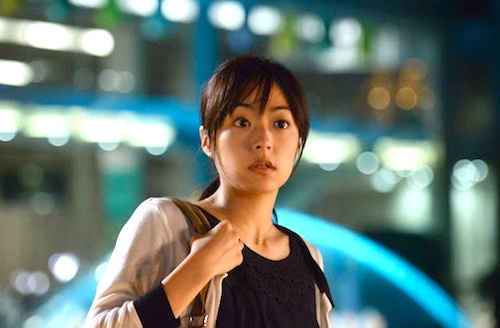
By Joe Bendel. Nobody in their right mind would call Mao Inoue homely and the young actress playing her middle school aged self has to be one of the cutest kids ever. Yet, those caught up in the mob mentality will believe anything. Group think in its many guises, including social networking, scandal mongering journalism, and peer pressure, stands thoroughly indicted in Yoshihiro Nakamura’s The Snow White Murder Case, which screens as a co-presentation of the 2014 Japan Cuts and New York Asian Film Festival.

Noriko Miki was Little Ms. Perfect at her cosmetic company (makers of Snow White soap). Outwardly beautiful and gracious, she was actually manipulative and mean. She also happens to be dead, having been found stabbed repeatedly and then burned to beyond recognition. The media will chose to print the legend, led by TV news part-timer Yuji Akahosi, who sees his relationship with one of the murdered woman’s co-workers as his opportunity to hit the big time. During their interview, Risako Kano not so subtly casts suspicions on Miki Shirono, referred to in his reports as “Miss S.”

In subsequent interviews, their fellow co-workers are eager to follow Kano’s lead, especially since Shirono has conveniently disappeared. Slowly, old high school and college friends emerge to defend Shirono. As they tell their stories in flashbacks, viewers see a pattern of bullying develop in her formative years. Yet, Akahosi doubles down on his narrative, egging on the internet’s baying hounds.

Ostensibly a mystery, Snow White is really the sort of film that rips your heart out and stomps on it. All three actresses playing Shirono are just overwhelmingly endearing and vulnerable. Viewers with any sliver of sympathy will be deeply moved by her/their sensitivity and indomitable faith the future will somehow be better.

From "The Snow White Murder Case."

Snow White was adapted from Kinae Minato’s novel, as was Tetsuya Nakashima’s incendiary Confessions—and it is easy to see a kinship between the two, especially in the way students’ causal cruelty leads to major macro consequences. However, Nakamura’s film does not leave audiences feeling so bereft and numb.

In addition to Inoue and her fellow Sironos, Shihori Kanjiya and her younger alter ego are terrific as Miss S.’s loyal but emotionally stunted childhood friend, Yuko Tanimura. Arguably, Go Ayano is appropriately vacuous and annoying as Akahosi, in a hipster Williamsburg kind of way. Yet, it is TV actress Nanao in her first feature role as Miki, who really gives the film a disconcerting edge.

Considering how intricately plotted Snow White is, the final resolution comes surprisingly quickly and cleanly. Nevertheless, witnessing Shirono’s life is an experience that really gets into your soul. Indeed, its genre trappings are rather deceptive, dressing up an intensely personal drama that steadily expands in scope. Highly recommended, The Snow White Murder Case screens today (7/11) at the Japan Society, as a joint selection of this year’s NYAFF and Japan Cuts: the New York Festival of Contemporary Japanese Film.

LFM GRADE: A-

Posted on July 11th, 2014 at 11:52am.

LFM Reviews Why Don’t You Play in Hell? @ The 2014 Japan Cuts and New York Asian Film Festival

By Joe Bendel. Which is a greater menace to society, the Yakuza or independent filmmakers? It hardly matters, because when they join forces, there will be blood on the floor. We are talking wall-to-wall pooling here. Yes, this is a Sion Sono joint, so get your game face on when Why Don’t You Play in Hell? screens as a joint presentation of the 2014 New York Asian Film Festival and Japan Cuts.

Ten years ago, scruffy would-be teen filmmaker Hirata Don and his two camera-operating chums first met Sasaki, their supposed martial arts star. On that fateful day, they also crossed paths with Jun Ikegami, a profusely bleeding yakuza. He was supposed to assassinate Taizo Muto, a rival clan leader, but they ran into his wife Shizue instead. Only Ikegami survives her wrath, but not before getting a severe dressing-down from her ten year old daughter, Michiko.

Michiko had been well on her way to being Japan’s sweetheart, based on her perversely catchy TV toothpaste commercial, but her mother’s murder convictions derail her career. Feeling understandably indebted to his wife, Muto promises to establish their daughter in the movies before her release. However, the now punky and petulant Michiko walked away from her legit film debut, forcing the studio to recast. With mere days left before Shizue’s parole, Muto needs to find a production for Michiko fast. You see where this is going? Eventually, Don’s dubious crew will hook up with Muto’s clan, but everyone thinks the director is Koji Hashimoto, a poor schmuck on the street Michiko roped into her madness.

From "Why Don’t You Play in Hell?."

With no time to write a proper script, Don opts to film Muto’s war with Ikegama verite-style. Buckle up, because there is going to be a body count. When it comes to over-the-top, outrageously gory comedic violence, Sono’s latest film stands tall, in a field all its own. The sheer level of mayhem Sono unleashes in the third act would even leave Itchy & Scratchy slack-jawed. It is impressive.

Amid all the carnage, there is also something of a valentine to filmmaking and an affectionate eulogy for old school 35mm. It also features one of the greatest and fiercest performances by a child actor, maybe ever, but it will probably be a good eight or ten years before Hara Nanoka’s parents let her see her work as young Michiko. As the older Michiko, NYAFF Rising Star Award winner Fumi Nikaido smoothly picks up the baton and proceeds to bash just about everyone with it. It is a butt-kicking star turn, but nobody can out hard-nose Jun Kunimura (Boss Tanaka in Kill Bill vol. 1, which seems so tame in comparison) as the steely but devoted Muto.

On the Sion Sono spectrum, this is more polished than Bad Film, but more ragged around the edges than Love Exposure. Regardless, whatever you think WDYPIH is, raise it to a power of ten. Highly recommended for cult film connoisseurs who have a general idea what they are getting into, Why Don’t You Play in Hell? screened yesterday at the Japan Society, as a joint selection of this year’s NYAFF and Japan Cuts.

LFM GRADE: A-

Posted on July 11th, 2014 at 11:27am.

Momoa Rides Through the Mojave: LFM Reviews Road to Paloma

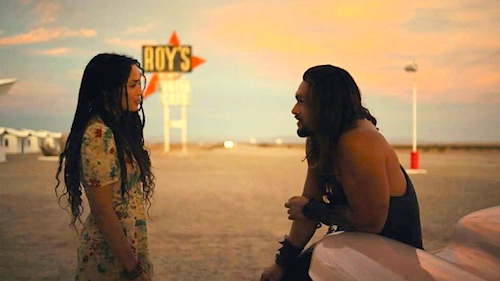
By Joe Bendel. It is like Easy Rider, except there is a reason for the angst and defiance. When Robert Wolf’s mother suffered a brutal attack, the Feds, being Feds, declined to prosecute the case. It was just too much work. However, when Wolf took the law into his own hands, they made his capture a top priority. There will not be a lot of sunsets for the biker and his new traveling companion to ride off into during Jason Momoa’s directorial debut, Road to Paloma, which opens this Friday in New York.

Wolf is a lot better at being a drifter than the self-destructive rocker, Cash Guirgis. Nevertheless, they ride together for a while, sharing some colorful encounters on the road. Wolf has secretly picked up his mother’s ashes from his estranged reservation policeman father, to spread in accordance with her wishes. Anticipating he might do something like that, Special Agent Williams grabs a reluctant local white copper and heads into the Mojave after him.

Wolf and Guirgis will see some scenery worthy of John Ford on their journey, stopping along the way for some bare-knuckle brawling and a little bit of loving. For Guirgis that means lap-dances, but Wolf prefers using his mechanical skill to seduce Magdalena and her broken down vintage car. It is nice for a while, but it the law is never far behind.

Frankly, Paloma is far more sensitive and moodier than you would expect from Jason Momoa’s WWE-distributed motorcycle-powered directorial debut. Small in scope, it is much more closely akin to his Sundance series The Red Road than Game of Thrones or Conan. They both feature Native themes, as well Momoa’s wife, Lisa Bonet. Regardless, Paloma’s cinematic vistas and alienated vibe are surprisingly effective. On the other hand, Momoa largely wastes the timelessly cool character actors Lance Henriksen and Wes Studi (who has a bit more to do than the former).

From "Road to Paloma."

As his own lead, Momoa is a serviceable renegade-brooder. He also generates some decent heat with Bonet, as well they should. Even in his brief scenes, Studi shows everyone how it is done, but it might co-writer Robert Homer Mollohan who makes the strongest impression as the reckless Guigis. Unfortunately, Timothy V. Murphy’s unapologetically serpentine Williams just does not ring true. Feds are nothing if not politically astute, so the degree he goes about antagonizing local law enforcement feels more like a clichéd contrivance.

Although it has some swagger, Paloma is not a meathead movie. It is a rather dark, character-driven affair that has a real point to make. Essentially, Momoa, Mollohan, and co-writer Jonathan Hirschbein suggest federal jurisdiction over crimes committed by outsiders on reservation land has created an incentive for predators to prey on Native victims. That is the good old Federal government at work. Recommended on balance, Road to Paloma opens this Friday (7/11) in New York at the Quad Cinema.

LFM GRADE: B-

Posted on July 11th, 2014 at 11:27am.