LFM Reviews The Face Reader @ The 2014 New York Asian Film Festival

By Joe Bendel. It is not quite fair to lump physiognomy together with phrenology, because the shrewder readers largely supplement the pseudo-scientific analysis with Sherlockian deduction. Kim Nae-gyeong happens to be one of the better ones, but it is not hard to read the ambition written all over Grand Prince Su-yang’s face. Unfortunately, Kim’s family will be engulfed in the ensuing royal power struggle during the course of Han Jae-rim’s The Face Reader, which screened during the 2014 New York Asian Film Festival.

As the son of a disgraced nobleman, Kim prefers to lay low and eke out a modest living with his bumbling brother-in-law, Paeng-heon. However, his renown as a face reader leads super-connected brothel owner Yeon-hong into tricking him into her employment. Fate shifts quickly in the Joseon era, though. A pro bono gig for the gendarmerie attracts the attention of the venerable deputy prime minister, General Kim Jong-seo, who whisks him off to work with the inspection board evaluating new officials. One of the candidates he approves happens to be his son, Jin-hyeong, who has renounced his name for the sake of a career.

Impressed by his work, the general and the king task the face reader with detecting the traitors within their midst. Obviously, the king’s brother is the leading candidate, but the king dies before Kim gets a good hard look at him. As the grand prince consolidates his hold on the military and the nobility, the face reader scrambles to protect the newly crowned twelve year old king and his guileless son.

Evidently NYAFF’s special guest and Korean Actor in Focus, Lee Jung-jae has quite the fearsome countenance. You would not want to trifle with him in Park Hoon-jung’s wickedly entertaining gangster film New World, either (which also screened this week). While there is plenty of Richard III in his ruthless usurper, Lee puts an intriguing spin on the character.
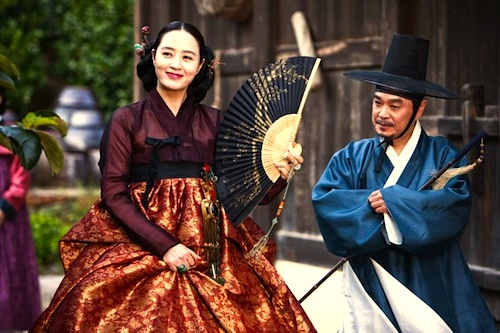
From "The Face Reader."

Although Face Reader is the first costume role for Snowpiercer’s Song Kang-ho, a sad clown like Kim Nae-gyeong is totally in his wheel-house. Yet, it is Jo Jeong-seok who really lowers the emotional boom, despite Paeng-heon’s deceptively rubber-faced demeanor. On the other hand, Lee Jong-seok’s Jin-hyeong has little presence throughout the film, mostly looking like he has just had his stomach pumped. Such is not the case with Baek Yun-shik, who brings all kinds of grizzled gravitas as General Kim (he has the face of a lion, by the way), while Kim Hye-soo’s courtesan functions as the smart and sophisticated witness to the tale of woe.

Face Reader acts as a corrective to many period action epics, in which a handful of motivated swordsmen can easily scythe through an imperial army. It is also unrepentantly tragic, which meant boffo box-office in South Korea, out-grossing Iron Man 3. Yet, for international audiences, the way karma ironically asserts itself during this chaotic era will be the thing that really sticks. Not surprisingly, it clocks in north of two hours, but Han helms a tight ship, with hardly any slack allowed on-screen. Highly recommended for fans of historical intrigue, The Face Reader screened this week as part of this year’s NYAFF.

LFM GRADE: B+

Posted on July 9th, 2014 at 12:01am.
LFM Reviews Cold Eyes @ The 2014 New York Asian Film Festival

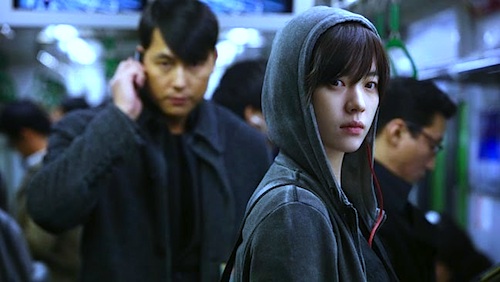
By Joe Bendel. It is not the most social division of the police force, so chief detective Hwang’s ticky, standoffish new recruit should feel right at home. However, the passivity of surveillance will be an issue for her. Nevertheless, her eyes and memory will be needed to take down a master criminal and his crew in Cho Ui-seok & Kim Byung-seo’s Cold Eyes, an inspired Korean remake of Johnnie To’s Eye in the Sky, which screens during the 2014 New York Asian Film Festival.

Ironically, during her rehearsal shadowing assignment, Detective Ha Yoon-joo and Hwang were rubbing shoulders with James, the mysterious mastermind of a gang of armed robbers. He is never personally on-the-scene, preferring to observe from a carefully selected rooftop. Their last bank heist has the force particularly rattled, so Hwang and his boss, director Lee, are under pressure to produce. Scanning surveillance footage, they practice a form of police work resembling a game of Concentration. When they turn up a suspect, Ha will have her initiation by fire, trailing him through the city. Of course, the closer they get to James, the more the stakes rise.

Despite all the time Hwang spends sitting in surveillance vans, Eyes is decidedly action-driven. Co-directors Cho and Kim truly master the near-misses and sudden disappearances involved in tailing suspects. They also have a knack for spectacular shootouts and public safety-defying car chases. Yet, it is the film’s neurotic vibe that really sets it apart from the cops-and-robbers field.

From "Cold Eyes."

Sol Kyung-gu, this year’s NYAFF Star Asia Award recipient, powers the film with slow-burning intensity. His off-kilter wiliness and rumpled soul distinguishes Hwang from just about every other movie copper, except maybe Han Hyo-joo’s socially awkward Ha. They are quite a pair, developing some appealingly eccentric mentor-protégé chemistry. Counter-balancing her oddball colleagues, Jin Kyung adds some class and authority as Director Lee. Although largely impassive throughout, Jung Woo-sung’s shark-like vibe works in context for the ruthless James.

Cold Eyes is one of the few cop thrillers that genuinely values brains, but hand-to-hand combat skills still come in handy. The execution is slickly stylish, while Cho’s adapted screenplay fits all its moving pieces together quite cleverly. It should even satisfy To fanatics, especially considering an amusing cameo linking it to the original source film. Tight, lean, and unusually cerebral, Cold Eyes is highly recommended for action fans when it screens Thursday (7/10) at the Walter Reade Theater, as part of the tribute to Sol Kyung-gu at this year’s NYAFF.

LFM GRADE: A

Posted on July 9th, 2014 at 12:01am.
LFM Reviews Beautiful New Bay Area Project, Seventh Code @ The 2014 New York Asian Film Festival

By Joe Bendel. Romantic clichés require two to tango, but that is usually not a problem in the movies. Instead, rom-com tropes are dashed upon the rocks of genre cinema in a new long short and a short feature by Japanese J-horror auteur turned art-house favorite, Kiyoshi Kurosawa. Sure to have a long shelf life on the international festival circuit, Kurosawa’s Beautiful New Bay Area Project and Seventh Code played as a double bill during the 2014 New York Asian Film Festival.

Prepare yourself for a look at the seedy side of urban redevelopment in Bay Area (originally conceived as part of a themed anthology). Amano’s family has always ruled the Yokohama port and continues to do so, even though he is a mere wastrel, figurehead president of the family development business. They have ambitious plans to transform the waterfront, but he is more interested Takako, a beautiful laborer. Evidently, he has dreamed of her, but this means nothing to her.

Frankly, it is not exactly clear who or what she is, but she takes her work as a longshoreman and her father’s name very seriously. Enraged by her rejection, Amano steals her ID tile and instructs security to forcibly remove her should she come to reclaim it. That she does—far stronger than anyone expects.

In all honesty, the story of Bay Area does not make much sense and it looks like it was filmed with the cheapest digital camera available at Wal-Mart (not to mention grossly violating the principle of Chekhov’s gun, or rather Chekhov’s norovirus), but it is an awful lot of fun when Takako starts taking care of business. Kurosawa considers this his twenty-nine minute foray into action filmmaking and he duly delivers a series of fan pleasing fight sequences. Tasuku Emoto might not be much as Amano, but Mao Mita is likely to become a lot of NYAFF patrons’ new movie crush as the lovely and steely Takako.

At first blush, Akiko seems to have little in common with Takako. She is the ostensibly innocent protagonist of the hour-long Seventh Code, who has followed the mysterious Matsunaga to Vladivostok, because she was deeply taken with him during a chance meeting in Japan. Hardly knowing her, Matsunaga encourages her to return home, but when she persists, his dodgy Russian associates steal her luggage and passport, leaving her in the middle of nowhere.

However, it will take more than that to get Akiko to give up. Eventually, she will find limited work and friendship with an expatriate Japanese restauranteur and his Chinese girlfriend, Hsiao-yen, while continuing her search for Matsunaga. Yet, now and then, Kurosawa drops hints there might be more to this story than meets the eye.

From "Seventh Code."

In contrast to Bay Area, Code looks fantastic. Kurosawa effectively takes viewers on a walking tour of Vladivostok’s back alleys, giving the audience a vivid rough-and-tumble sense of place. He also stages another first-rate fight scene and maintains a general vibe of weirdness. While the big surprise might be easy to anticipate, Japanese pop star Atsuko Maeda turns it quite agilely as Akiko. It is a nice acting debut vehicle for her, even though Chinese television host Aissy steals a number of scenes outright as the ambiguously ambitious Hsiao-yen. Unfortunately, Kurosawa has a hard time wrapping-up Code, tacking on a number of false endings and a completely random performance from Maeda, perhaps intended to satisfy her fans.

While both films are a bit of a mixed bag, they are brimming with energy and spectacularly showcase the talents of Mita, Maeda, and Aissy. They fit well together, but represent another curve ball for cineastes familiar either with his previous genre work, like Pulse, or his more sensitive recent releases, such as REAL or Tokyo Sonata. Recommended for fans of action and espionage films with resourceful leading ladies, Beautiful New Bay Area Project and Seventh Code screened this week at NYAFF, so expect them to pop up at more fests shortly.

SEVENTH CODE : LFM GRADE: B+
BEAUTIFUL NEW BAY AREA PROJECT: LFM GRADE: B-

Posted on July 9th, 2014 at 12:00am.

LFM Reviews The Legend of the 7 Golden Vampires @ The 2014 New York Asian Film Festival

By Joe Bendel. At a time when Hollywood has contracted “co-production fever” in hopes of pandering to the Chinese market, it is worth re-visiting the granddaddy of all co-productions. The fusion of the Hong Kong-based Shaw Brothers’ kung fu and mysticism with Hammer’s gothic British horror was a true Reese’s peanut butter cup of a film. It was also a flop, but it is a highly entertaining flop. As a revered media titan well into his centenarian years, Sir Run Run Shaw (1907-2014) was more accustomed to turning out hits. Still, Roy Ward Baker’s The Legend of the 7 Golden Vampires (co-directed by the uncredited Chang Cheh) is a distinctive and only slightly eccentric choice to screen as part of the sidebar tribute to Shaw at this year’s New York Asian Film Festival.

Prof. Van Helsing is visiting early Nineteenth Century China to research the eastern variations in vampirism, armed with knowledge of the Ping Kwei legend. According to the story, the villagers were constantly terrorized by a cult of seven vampires and their minions, until one peasant finally reaches his breaking point. Heroically, he kills one of the seven, but at the cost of his life. Everyone attending Van Helsing’s lecture assumes he is a crank, except Hsi Ching. He happens to be a descendant of the brave Ping Kwei farmer, who has come to ask Van Helsing’s help in liberating his village from the remaining six.

Showing remarkable cultural sensitivity for a British colonialist in a 1970s film, Van Helsing stresses his inexperience facing China’s undead and the specific traditions and morays that make them different from the Euro-vamps. However, he cannot refuse a plea for help. Indeed, he becomes rather anxious to get out of town when his twit of a son Leyland shows up the local triad boss when putting the moves on a Scandinavian heiress. The adventurous Vanessa Buren is also eager to fund the expedition, so she joins the party over the professor’s objections.

Of course, before they can face the undead hordes, they will have to hack their way through a small army of triads, but that will not be a problem for Hsi, his six brothers (each with a specialized weapon of choice), and his sister, Mei Kwei. However, there is another European visitor to Ping Kwei, whom Van Helsing is well acquainted with—cue ominous thunderclap.

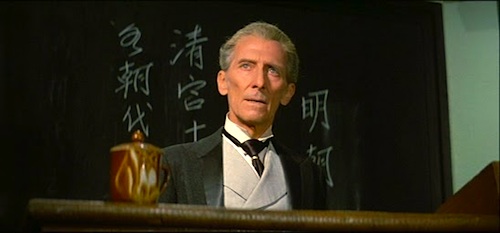
Everyone seems to love to pick on this film, just because it is admittedly an oddball concept. Yet, it deserves considerably more love. Action director Lau Kar-leung stages some very cinematic (and surprisingly bloody) martial arts sequences, presumably in collaboration with Chang. Perhaps inspired by the Hong Kong production, Peter Cushing brought his A-game as Van Helsing, as determined and authoritative as ever, but also protective of the youngsters and smart enough to know what he doesn’t know. In fact, Cushing looks quite comfortable and collegial with Shaw Brothers leading man David Chiang, who has all the right action chops for Hsi Ching and nearly makes his phonetic English dialogue sound natural.

From "The Legend of the 7 Golden Vampires."

Shih Szu (who almost broke out during her time with the Shaws, becoming more of a cult figure instead) is also impressively steely and sensitive as Mei Kwei. Former Miss Norway and Penthouse Pet Julie Ege gives Buren a bit of an edge and a backbone too. Unfortunately, Robin Stewart’s Leyland Van Helsing comes across like Hugh Grant’s ineffectual forefather. Frankly, it is hard to believe he could live through the first act.

As if that were not enough, Golden also holds the distinction of being the only Hammer Dracula film in which Christopher Lee does not play the Count. Let’s just say he was missed. However, Cushing, Chiang, Shih, some cool fight scenes, and a full dose of Hammer atmosphere make up for his absence. Recommended for Hammer Horror and Shaw Brothers fans, The Legend of the 7 Golden Vampires screens yesterday (the Fourth of July) at the Walter Reade Theater, as part of the 2014 NYAFF’s tribute to Sir Run Run Shaw.

LFM GRADE: B+

Posted on July 5th, 2014 at 2:22pm.

LFM Reviews Zero Pro Site: the Movable Feast @ The 2014 New York Asian Film Festival

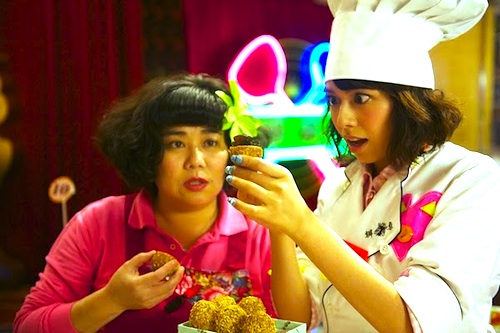
By Joe Bendel. Master Fly Spirit’s food was sort of slow and reasonably local. Most of all, it was entirely traditional, making it difficult to replicate in these times. His daughter Chan Hsiao-wan is learning that the hard way. She had always planned to be an actress or a model, but she is falling back on the old family catering business after tasting the cold hard realities of showbiz in Chen Yu-hsun’s awkwardly titled Zero Pro Site: the Movable Feast, which screens during the 2014 New York Asian Film Festival.

Chan was always better at being cute than responsible, so she would be just the type to innocently co-sign on a deadbeat boyfriend’s loan. When he takes to the wind, two loan-sharks come to collect from her. Fleeing Taipei, she eventually reconnects with her stepmother, “Puffy” Ai-feng who is also evading debt collectors. Unfortunately, “Puffy” earned her new nickname when she sacrificed her savings and her late husband’s reputation in an ill-advised showdown with his faithless apprentice. However, Chan’s sunny personality and a few long forgotten traditional dishes start attracting customers to their greasy spoon.

Not surprisingly, Chan has been a poor steward of her father’s recipes, so she seeks help from a variety of sources, including his happily addled teacher Master Tiger Nose and the itinerant “Dr. Gourmet,” a.k.a. ex-con Yeh Ju-hai. However, just as things start to develop between her and Yeh, he jumps ship to assist his teacher, the gangster caterer Master Ghost Head. Even without Yeh’s help, Chan places her future hopes in a national catering competition, duly impressing the loan-sharks into kitchen service, as could only happen in romantic comedies. Yet, to truly cook in a traditional manner, she will have to fully engage with the past.

Yes, there is a lot of food in ZPS, as metaphors, comedic props, and a way to celebrate Taiwanese cultural identity. Yet, it only serves a limited courtship function. While the film certainly has a dash of romance it is more about familial legacies and finding one’s place in the world. Like Chan’s turtle-stuffed chickens, the film is also bursting at the seams with supporting characters, so if one is too goofy and outrageous for your tastes, just wait for a more understated type to come along.

From "Zero Pro Site: the Movable Feast."

As Chan, Kimi Hsia is relentlessly silly and sweet, without getting viewers’ nerves. She forges some respectable screen chemistry with Tony Yang, even though Dr. Gourmet largely vanishes during the second and third acts. Top-billed Lin Mei-hsiu initially mugs something fierce as Puffy Ai-feng, but she reins it in to some extent as the dramedy starts to develop. Although there is a lot of colorful wackiness going on, the film draws a lot of heart from its senior cast-members, such as the recently reunited old couple, who want Chan to cater their wedding in the manner they remember from their youth.

ZPS is fun, it is endearing—it really could have been ninety some minutes. Over two hours of food and nostalgia is starting to push it. Still, Chen ties up all his subplots fairly neatly. He might have more secondary characters than Around the World in Eighty Days, but he develops a rather high percentage of them. Frothy and pleasing, it delivers some potent wistfulness along with its liberal servings of food and scrappy underdog resiliency. Recommended for fans of generation-spanning culinary cinema, Zero Pro Site—The Moveable Feast screens today (7/5) at the Walter Reade Cinema, as part of this year’s NYAFF.

LFM GRADE: B-

Posted on July 5th, 2014 at 2:08pm.

LFM Reviews Fuku-Chan of FukuFuku Flats @ The 2014 New York Asian Film Festival

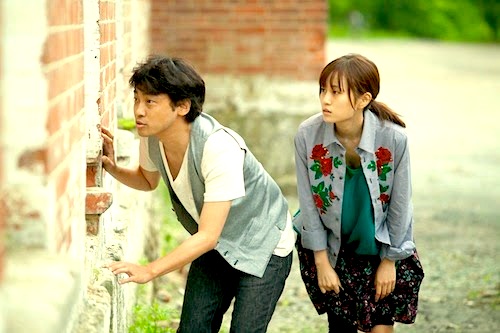
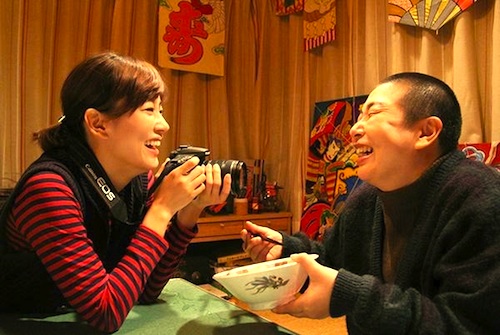
By Joe Bendel. FukuFuku Flats is a low rent complex nobody would ever confuse with Melrose Place. Tatsuo Fukuda, a.k.a. Fuku-chan, does not exactly have the sort of face you usually see on network television either, but an aspiring photographer from his past finds it inspiring. Lead actress Oshima Miyuki represents a rather unconventional casting choice as well, but she poignantly expresses Fukuda’s loneliness and fear of rejection throughout Yosuke Fajita’s Fuku-Chan of FukuFuke Flats (see clip above), which screens during the 2014 New York Asian Film Festival.

As the foreman of a crew of painters, Fukuda always sticks up for the underdog. He also throws a lifeline of friendship to the only tenants in his building more socially awkward than himself. His friend Shimacchi is constantly trying to fix Fukuda up with his wife’s friends, but it never works. The kite-flying enthusiast is simply too intimidated by women—and it is largely Chiho Sugiura’s fault.

While it school, she played a crucial role in a prank that still haunts Fukuda. However, karma has come around. Her decision to quit her job to pursue photography fulltime is not exactly paying dividends. To cover her cosmic overdraft, Sugiura finds Fukuda to apologize, only to be staggered by the character she sees in his face. Initially, he wants nothing to do with her, but it is hard to resist the attention of an attractive woman, despite their complicated history (or perhaps especially because of it).

Clearly, a connection is made, but does it have the same meaning for Fukuda and Sugiura. That is a question that concerns Shimacchi. Yet, Fajita is most forgiving of Sugiura, who is nothing like the mean girl she once was. She is just confused. There are no villains in FukuFuku, just people trying to get by as best they can. It can be especially difficult when you are stark staring bonkers, as is at least one of Fukuda’s neighbors.

From "Fuku-Chan of FukuFuku Flats."

While the casting of Miyuki (a comedic performer known for her old men characters) might sound like broad gender-bending comedy in the tradition of Hairspray, there is no ironic winking. FukuFuku is a comedy, but Miyuki plays Fukuda scrupulously straight. Frankly, a more apt comparison would be Linda Hunt in The Year of Living Dangerously, even though the film’s tone is radically different.

Asami Mizukawa’s Sugiura is also terrifically understated, but completely engaging as she wrestles with her feelings, while trying to figure out how she made a hash of her life. (Unfortunately, her creepy encounter with a would-be photography mentor feels out of place in the otherwise wistful and honest relationship dramedy.)

Aside from that rare misfire, Fajita agilely pirouettes from everyday comedy of observation, to halting romance, and even potential tragedy, while maintaining a deceptively light touch. Endearing but never cloying, Fuku-Chan of FukuFuke Flats is recommended for those who enjoy messy but mature character-driven films when it screens today (7/3) at the Walter Reade Theater, as part of this year’s NYAFF.

LFM GRADE: B+

Posted on July 3rd, 2014 at 11:29am.