LFM Reviews Blind Massage @ 2014 New York Asian Film Festival

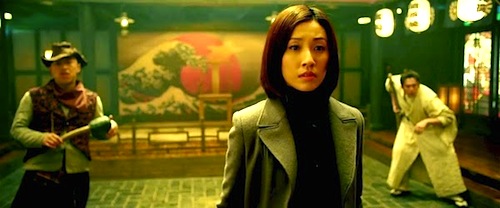
By Joe Bendel. Real massage therapists have anatomical and physiological training to rival doctors, but it remains a widely misunderstood profession. Perhaps in hopes of separating the therapeutic and sensual connotations, it has been one of the few avenues of employment traditionally open to the blind in China. The so-called “doctors” of such a Nanjing clinic are highly skilled, but also deeply human. Their lives will connect and conflict in Lou Ye’s ensemble drama Blind Massage (clip above), which screens during the 2014 New York Asian Film Festival.

The staff is blind, but the patients are entirely sighted, at least as far as we know. That itself is a role reversal. The Sha Zongqi Massage Centre is run by the gregarious Sha Fuming and his reserved partner, Zhang Zongqi, who always try to place new therapists in need of work. Their latest two recruits come with issues. Sullen Xiao Ma gradually lost his sight during his early teen years and has yet to come to terms with his blindness. In contrast, Dr. Wang had once amassed a sizable nest egg, but he lost it all during the financial crisis, forcing him to ask his old friend Sha for a job.

The relationships between staff members will become complicated, like a Chinese massage version of ER. Xiao Ma will be recklessly attracted to Dr. Wang’s partial sighted fiancée Kong, before developing a full-on obsession for local (fully sighted) prostitute Xiao Man. Despite Xiao Ma’s frequent brothel patronage, his beautiful colleague Du Hong nurses an attraction to him, while rebuffing the advances of the desperately lonely Sha.

About a dozen other characters factor into the mix somehow. Frankly, Blind Massage is a bit unwieldy with subplots, but it is hard to say where to cut, because they each work on their own terms. The film was adapted by Lou’s documentary filmmaker wife Ma Yingli from Bei Feiyu’s novel that has already been produced as a multi-part television drama—and it is easy to imagine these characters working in a telenovela format.

However, Lou’s approach is distinctly cinematic, approaching the experimental. His past films have directly raised issues of perception (particularly last year’s NYAFF selection, Mystery), but he takes it in a different direction during Blind Massage, visibly reducing the light and softening the focus during scenes driven by blind characters and reverting to standard levels for sequences involving sighted characters or expository housekeeping. He also employs a narrator to read the unseen credits and provide background information on characters, evoking the experience of enhanced visual descriptions.

Blind Massage captures the arbitrary unfairness of life in vivid terms, but that also offers an opportunity for unlikely cast-members to shine. As a case in point, Guo Xiaodong’s Dr. Wang seems rather unassuming, until blowing the doors off the joint in a confrontation with loan sharks dogging his irresponsible, sighted younger brother. It is a scene and a performance worthy of Shakespeare’s Merchant of Venice.

From "Blind Massage."

Mei Ting also pulls the emotional rug out from under us, as the ostensibly standoffish, Du Hong. She resents the fuss made by her colleagues (especially Sha) over the beauty they can never see, yet experiences some of the film’s greatest heartsickness.

On its face, Blind Massage is totally apolitical, but You is still pushing boundaries with its uncomfortable intimacy and matter-of-fact description of contemporary Chinese life for any sort of underdog population. It seems downright tame by our standards, but considering the Puritanism of Communist censors, many scenes represent no small risk to You’s standing. Yet, they are never gratuitous, well serving the characters’ emotional development at crucial junctures. Despite a bit of narrative messiness, it is an engrossing film that pulls viewers into the lives on screen in a vivid, ambitiously experiential way. Recommended for mature audiences, Blind Massage screens Wednesday (7/2) at the Walter Reade Theater, as part of this year’s NYAFF.

LFM GRADE: B+

Posted on July 1st, 2014 at 11:40pm.
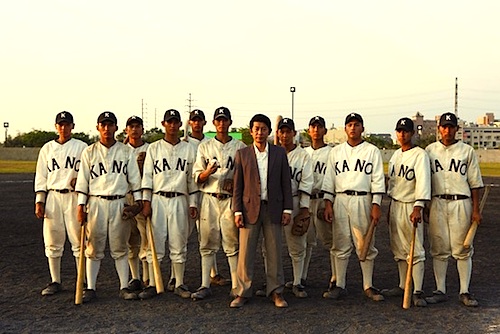
LFM Reviews Kano @ The 2014 New York Asian Film Festival

By Joe Bendel. Sure, a three hour baseball movie might sound like bizarre overkill, but it is still considerably brisker than many of Al Leiter’s outings for the Mets (we’re all fans here, by the way). It is long, but this scrappy underdog story of tolerance and resilience generally makes good use of its time. Taiwanese and Japanese players will indeed come together on the diamond in Umin Boya’s Kano, the centerpiece selection of this year’s New York Asian Film Festival, which screens Sunday, so forget that World Cup noise.

Despite the spectacular revolt dramatized in co-writer-producer Wei Te-sheng’s Warriors of the Rainbow: Sediq Bale, Japan has consolidated its imperialist hold on Taiwan. Despite the increasing (but unequal) economic ties between the two countries, Taiwan is not where the Japanese go when their careers are on the way up. However, for tightly wound account Hyotaro Kondo, it represents a chance to start over following a vaguely defined public humiliation. Yet, against his better judgment, Kondo soon volunteers to coach the Kagi Agriculture and Forestry Public School’s high school baseball team (called Kano for short).

It was Kondo’s intense coaching style that led to so much grief in Japan, but he has never had a team like this. For one thing, it is an ethnically mixed squad, consisting not just of Japanese and Taiwanese players, but aboriginal and Chinese students as well. They also receive next to no material support from their school. Still, Akira Go, the kid on the mound, has a monster arm. Everyone scoffs when Kondo vows to take the team to Koshien, Japan’s national high school tournament, especially given their ‘O-fer record, but guess what happens next year.

Despite its incontrovertible status as a sports movie, Kano neatly sidesteps a number of the genre clichés. The big game will duly choke you up, but in a far more satisfying way than you expect. Coach Kondo even says there is no crying in baseball, but good luck with that.

Masatoshi Nagase is truly the coach of all movie coaches as the strict but fiercely loyal Kondo. He commands the screen just like Kondo commands his players, but when he lets his softy paternal side peak through, it is always heavy. Oddly, perhaps the most distinctive supporting turn amongst the players is actually Ken Aoki as rival pitcher Hiromi Joshiya, whose trip to see Kano’s dirt playing field for himself while on leave from the Imperial Army supplies the film’s framing device. British based Japanese actor Togo Igawa also adds a note of gruff dignity as Kondo’s former mentor, Coach Sato.

From "Kano."

Production designer Makoto Asano’s recreation of 1931 provincial Taiwan looks so real you can practically taste the mud and thatch. It is a high quality period production and probably the most epic baseball movie ever thanks to cinematographer Chin Ting-chang’s sweeping, wide screen visuals. Yet, the on-field camaraderie is not simply a good lesson in sportsmanship. It looks like a conscious attempt at Taiwanese-Japanese rapprochement , strategically coming at a time of high Mainland saber rattling (and frankly that is probably not a bad impulse to act on).

Happily, Kano does not feel like it runs anywhere near its three hours, but there is no getting around the generous helpings of baseball. As great as Nagase is, Kano’s appeal will probably be limited to fans of the game (which includes just about everyone in Taiwan judging from its domestic box-office). Earnest, entertaining, and appealingly old fashioned, Kano is recommended for lovers of baseball and those who follow Japanese and Taiwanese cinema when it screens Sunday evening (6/29) at the Walter Reade Theater, as the centerpiece of this year’s NYAFF.

LFM GRADE: B+

Posted on June 29th, 2014 at 12:14am.

LFM Reviews The White Storm @ The 2014 New York Asian Film Festival

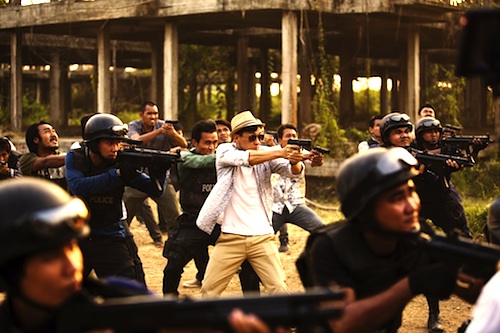
By Joe Bendel. Eight-Faced Buddha is the Al Sharpton of Thai drug lords. That ridiculous coif should be sufficient grounds to throw his butt in jail. However, he also has an extensive body count to his credit and a massive wave of heroin headed towards Hong Kong. The only thing standing in its way is an extremely tired undercover cop, his handler, and their boss and mutual boyhood chum. Their friendship will be severely strained in Benny Chan’s action conflagration The White Storm, which screens during the 2014 New York Asian Film Festival.

So Kin-chau is due for some R&R with his very pregnant wife, but Chief Inspector Ma Ho-tin keeps sending him out for one more sting. They were supposed to finally bust his longtime target Black Chai, but when Ma learns the trafficker has a deal in the works with Eight-Faced, So must engineer a last minute escape for the both of them. So reluctantly goes deep undercover with Black Chai – with only Ma, their third Musketeer Cheung Chi-wai, and another honest HK colleague for back-up.

Frankly, the boundary between cops and criminals in Thailand is rather porous. Ma and his colleagues have to go rogue just to foil the crooked cops trying to rat out So. Unfortunately, when Ma’s game-changing operation goes wrong, it goes massively, cinematically wrong. It will fatally sabotage his career and plague his conscience for years, until a big twist suggests his guilt might be a tad misplaced.

From "The White Storm."

There is nothing subtle about White Storm. It is all about projectile explosions and brooding, but it truly delivers some awesome over-the-top action spectacle. Nothing is off the table including a romance with Eight-Faced’s transgendered daughter, Mina Wei. Arguably, that is the most sensitively rendered element of this delirious gun-down. Evidently, Nick Cheung’s steamy publicity photo shoot with the transgender beauty queen Treechada “Poyd” Malayaporn raised quite a few eyebrows in HK, so mission accomplished.

In fact, all three big name leads are in fine form throughout. Louis Koo’s So slow burns like nobody’s business, while Sean Lau Ching-wan compellingly portrays Ma’s rapid descent from hot shot to a self-loathing shell of a man. However, Cheung takes viewers on the wildest character arc as his rapidly evolving namesake. Vithaya Pansringarm, who stole just about every scene in Only God Forgives, also turns up, playing a far more ethically ambiguous cop, but he is criminally under-employed.

While White Storm indulges in quite a bit of Thai exoticism, Chan never strays too far from an old school hail of bullets. Its super-charged energy level and tragic sensibilities follow in the tradition of some of the best HK action films. Highly recommended for fans of Hong Kong Cinema and the big name cast, The White Storm screens tomorrow (6/29) at the Walter Reade Theater, as part of this year’s NYAFF.

LFM GRADE: A-

Posted on June 29th, 2014 at 12:09pm.

Chinese Opera in the Time of Cholera: LFM Reviews The Chef, the Actor, and the Scoundrel

By Joe Bendel. The Imperial Japanese Army’s notorious Unit 731 has been the subject of several highly controversial docudramas that were sharply criticized for their exploitative use of horrific archival footage. This is not one of them. Instead, two members of the biological warfare research center will find themselves on the business end of an unorthodox interrogation in Hu Gaun’s comedic-tragic action mash-up The Chef, the Actor, and the Scoundrel, which releases today on DVD and Blu-ray from Well Go USA.

A particularly nasty strain of Cholera is raging through China, courtesy of Unit 731. However, their leading biochemist Col. Ogasawara Goro and his aide de camp have been waylaid by a highwayman, who has more or less commandeered an inn to serve as his temporary hideout. However, the chef and his mute wife are not thrilled to have them there, but their Chinese opera singer sort of sides with the Scoundrel (and against his employers), for patriotic reasons. With varying degrees of reluctance, they proceed to grill the officer in hopes of exploiting his valuable formula.

Frankly, you just have to get through the first twenty minutes of buffoonery before Guan tips his hand. It turns out that the four bickering captors are much smarter, disciplined, and unified than they would have the Japanese believe. In fact, we are witnessing an elaborate ruse inspired by Chinese opera, designed to lull Ogasawara into accidentally revealing the formula. The set-up works like a charm, but time is not on their side, especially when the Japanese military finally comes knocking.

Really, you want to stick with this film, because it reinvents itself several times. In a way, it rather shows up the kind of rubber-faced slapstick of co-star Huang Bo’s Lost in Thailand. There are indeed a number of twisty plot reversals and some ripping good action spectacle in the third act. In fact, it wins over viewer affections in surprising (but spoilery) ways.

From "The Chef, the Actor, and the Scoundrel."

Huang and Zhang Hanyu are rather amazing while dialing it up and then cranking it down as the Scoundrel and the Actor, respectively. Liu Ye cannot quite turn on a dime as quickly as his two comrades, but he shows off the strongest action chops as the Chef. Yet, it is Liang Jing who probably undertakes the greatest upstairs-downstairs transformation as the goonish wife. One should also keep one’s eyes on Taiwan-based Japanese actress-model Chie Tanaka, for dramatic reasons, because she nicely turns her own subtle surprises, as well.

Somehow, the misleadingly Greenaway-esque titled Chef manages to be both a traditional homage and an ironic riff on the King Hu-inspired inn period drama. Guan throws just about everything into the mix, except maybe space aliens and cynicism. Highly recommended (but seriously, don’t bail on it early), The Chef, the Actor, and the Scoundrel is now available on DVD, Blu-ray, and digital platforms from Well Go USA.

LFM GRADE: A-

Posted on June 26th, 2014 at 5:56pm.

Revolt of the Eggheads: LFM Reviews Radio Free Albemuth

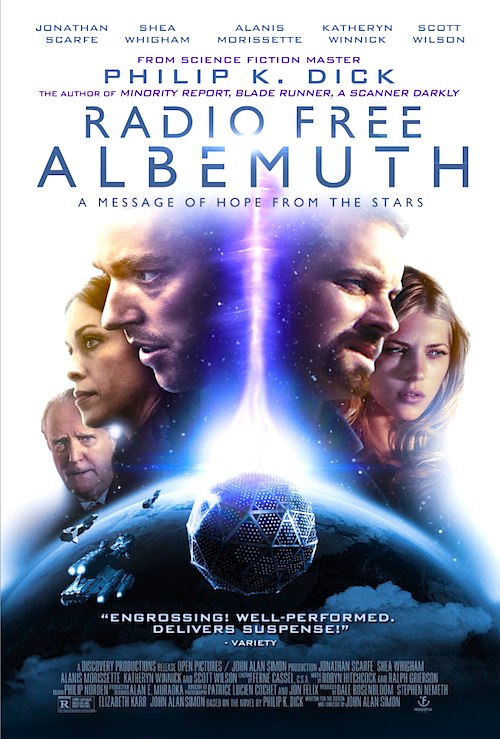
By Joe Bendel. Transrealism is a sub-genre of science fiction in which the author frequently appears as a character in their own work, freely melding the fantastical and the autobiographical. The style has several proponents, but they are all largely swimming in Philip K. Dick’s wake. Amongst his most transreal works were his VALIS trilogy and a related posthumous novel. While many Dick novels have been loosely adapted for the screen, the courageous John Alan Simon took a shot at a comparatively faithful take on the more self-contained latter novel. Things will get all kinds of transreal in Simon’s Radio Free Albemuth, which opens this Friday in New York.

In this alternate world, America is a crypto-fascist state, but ironically there is less intrusive surveillance afoot than under the Obama Administration. President (for life) Ferris F. Fremont (FFF = 666) continues to be re-elected despite his bizarre campaign against “Aramcheck,” a supposed shadowy cabal of Soviet sleeper agents still conspiring against the country, years after the fall of Communism. Science fiction novelist Philip K. Dick will chronicle his pal Nicholas Brady’s ill-fated attempt to foment an uprising against Fremont. We know it will be ill-fated because of the decidedly dystopian framing device.

Frankly, the Orwellian state was working quite well for Brady, at least for a while. Thanks to subliminal messaging sent to him by a hive-mind alien entity he dubs VALIS (Vast Active Living Intelligence System), Brady leaves his Berkley record store gig in favor of a position at a record label, where he quickly advances. Due to his previous visions, he is convinced he should sign the mysterious Sylvia to a recording contract when she applies for a receptionist position. She has no idea what he is talking about, but appreciates any opportunity because of her unfortunate surname: Aramcheck.

Eventually, we learn those who commune with VALIS have an egg implanted in their heads, the Roman Empire never really fell, but continues to be the power behind the curtain, and perhaps Fremont was a Manchurian Candidate-style Soviet plant. Strangely, it all mostly makes sense in context.

Simon goes for a trippy, hallucinatory vibe, but unfortunately he succeeds too well. There is indeed a far-out atmosphere to the proceedings, but that consequently slows the pacing down to a somnambulist shuffle. This also gives viewers more than enough time to fully acknowledge the MST3K-worthy special effects. Frankly, it would be better not to show VALIS’s Satellite of Love than to green screen something that looks cruder than Overdrawn at the Memory Bank.

Clearly, Dick was not holding back the weirdness in Albemuth, yet it now seems somewhat dated, not just in terms of the escalated surveillance. There are weird L. Ronian echoes to the VALIS egg-implants, while Dick’s Cold War disdain seems rather naïve in light of Eastern Europe’s independence movements and Putin’s subsequent  Neo-Soviet imperialism. Frankly, the best thing about Simon’s film is the self-reflexively ironic Dick character and the understated but intense performance of Boardwalk Empire’s Shea Whigham.

Albemuth also boasts Alanis Morissette in her first substantial dramatic role, but it is nothing to write home about. Yet, Jonathan Scarfe is even more dour and dull as Brady. At least Hanna Hall seems to enjoy playing the fascist vixen toying with Dick (that doesn’t sound right, but so be it).

As if it needed any stranger credentials, Albemuth also boasts Robyn Hitchcock’s original song “Let’s Party,” which is bizarrely effective playing a critical role within the narrative. In fact, Simon’s ambition is admirable, but there are just too many disparate parts in conflict with each other. It is easy to see why his Hollywood predecessors opted to crank up the action instead. A noble car crash of a film that “Dickheads” will have to see regardless of mere mortal criticism, Radio Free Albemuth opens this Friday (6/27) in New York at the Quad Cinema.

LFM GRADE: C+

Posted on June 26th, 2014 at 5:46pm.

LFM Reviews Snowpiercer

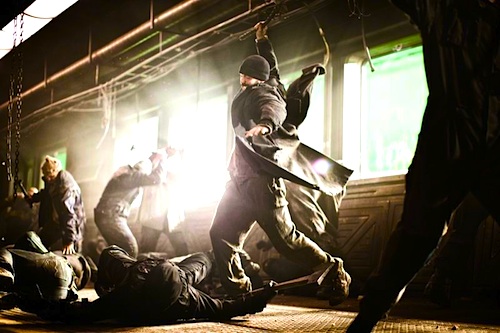
By Joe Bendel. In the future, the world will become a giant allegory. Nothing in this claustrophobic dystopia performs a practical purpose, but serves as a vision of class warfare at its most extreme. At least it all looks cool when the train’s tail-section revolts in Bong Joon-ho’s first English language production Snowpiercer, which opens this Friday in New York.

Seventeen years ago, a climate control experiment went horribly wrong. Now that the Earth is a frozen wasteland, the only surviving humans live in the protection of the globe circling train providentially prepared by the mysterious Wilford. However, instead of assigning productive tasks to each survivor, the Wilford express maintains a rigid and bafflingly bizarre social caste system. The further up you travel, the richer, crueler, and idler the passengers get. It’s all sushi and filet mignon up front, but gelatinous protein bars for the proletarian in the tail-section, who do not really appear to work either, but just sit around waiting to be beaten by the guards (apparently the train’s only productive class).

Curtis Everett has emerged as the leader of the proles in the back of the train, whether he likes it or not. He is still haunted the things he did during his darkest, most desperate hours, but old Gilliam provides encouragement and wise counsel to the budding revolutionary. Everett is biding his time, waiting for a cue from a source ensconced somewhere further up the train, but the arbitrary ruthlessness of Minister Mason, a buck-toothed caricature of an elitist exploiter, forces his hand. Freeing Nam-gung Min-su, the drug-addled Korean security specialist who designed the train’s door locks, and his train-born daughter Yo-na, Everett and his followers plan to fight their way to the engine room. Stopping anywhere short of that will doom their revolt.

From "Snowpiercer."

Frankly, Snowpiercer is even less subtle than it sounds. Tilda Swinton is a great screen thespian, but her portrayal of Mason is embarrassingly cringey. She is also emblematic of the film’s fundamental problem—this simply is not a believable world. People act mean and savage for no logical reason accept to live up to a class-based stereotype. Nonetheless, production designer Ondřej Nekvasil and art director Štefan Kováčik created a distinctively detailed calling card that ought to earn them a gig on the next Terry Gilliam or Tim Burton film.

If you prefer your movie leads on the sullen side then you will probably be okay with Chris Evans’ turn as Everett. He is a brooding machine, but looks respectable during the well-staged action sequences. John Hurt’s Obiwan shtick also works well enough for Gilliam the sage. However, the only real surprises found in the film come from the characters of Nam-gung Min-su and Yo-na—as well as the respective performances of Korean superstar Song Kang-ho and Ko Ah-sung, his juvenile co-star in The Host. Viewers should keep their eyes on this tandem, because together they nearly redeem all of Snowpiercer’s flaws.

Uncut by the Weinsteins, Snowpiercer is so didactic it will give intellectually sophisticated viewers a headache. Yet, there are fascinating Easter Eggs buried throughout it, thanks to a skilled design team and Bong’s Host alumni. Diverting for those who appreciate spectacle and mayhem, but disappointing on any deeper level, Snowpiercer opens this Friday (6/27) in New York at the Angelika Film Center.

LFM GRADE: C

Posted on June 25th, 2014 at 11:06pm.