One Jesse Eisenberg Too Many: LFM Reviews The Double

By Joe Bendel. It was Nabokov’s favorite Dostoevsky work, but he might not have recognized this vaguely British, boldly dystopian adaptation. Simon James is about to meet a new co-worker with a familiar face, who will turn his drab little life upside down in Richard Ayoade’s The Double, which opened today in New York.

James is a mousy Winston Smith toiling away in a soul-deadeningly bureaucratic data processing firm. He works like a mule producing mountains of reports, but the boss, Mr. Papadopoulos, constantly belittles him, never even properly remembering his name. Simon James initially befriends James Simon, his relentlessly confident doppelganger, even completing his paper-pushing assignments in exchange for advice on wooing Hannah, a pale young woman in the copy department. Even though she lives across the courtyard from his Soviet-style apartment building, she has only the barest awareness of James’ existence.
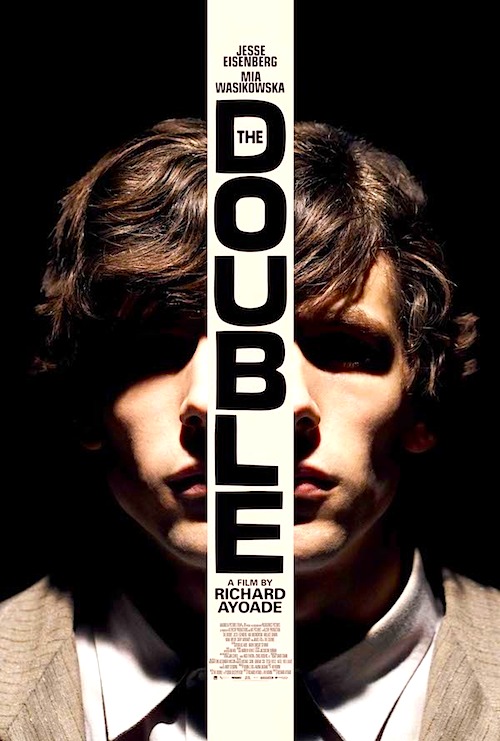
Naturally, Simon soon starts pursuing him for his own satisfaction, while insidiously undermining James’ already tenuous position with the company. As the put upon James’ Orwellian world becomes increasingly Kafkaesque, he starts to act out of desperation.

For those who were less than charmed by Submarine, Ayoade’s sad-eyed moppet coming-of-age tale, The Double will come as a pleasant shock. Even though it often feels like the unauthorized sequel to Terry Gilliam’s Brazil, there is a real vision thing going on here. Specifically, the strategy of recasting Dostoevsky in a dystopian setting is a brilliant way to still connect to the original story’s Russian-ness, while striving for universality. After all, novels like 1984 were conceived as Stalinist critiques, which suddenly seems highly relevant again given Putin’s re-commencement of Russian May Day parades.

Similarly, it is nice to see Jesse Eisenberg step outside his sheepish hipster comfort zone to create two very distinctively pathological personas as Simon and James (or vice versa). His two-handed scenes played single-handedly crackle with tension and bite. Mia Wasikowska’s Hannah is rather drearily demure, but at least she is a convincing blank slate for James to project his yearnings upon. In contrast, Wallace Shawn and Kobna Holdbrook-Smith ham it up something fierce as the company president and security guard, but the effect is much more unsettling than funny-ha-ha.

Ayoade and co-adapter Avi Korine have created a rigorously consistent, dark, and dank vision of an analog future that almost was and maybe will be again. Production designer David Crank and his team did incredible work making it all feel (uncomfortably) lived in. It is an admirably disciplined film that never trafficks in empty surrealism merely to score points with cult movie fanatics. Recommended for devotees of literate urban fantasy, The Double opened today in New York at the Landmark Sunshine.

LFM GRADE: B+

Posted on May 9th, 2014 at 11:52pm.
When the Law Fails: LFM Reviews Broken

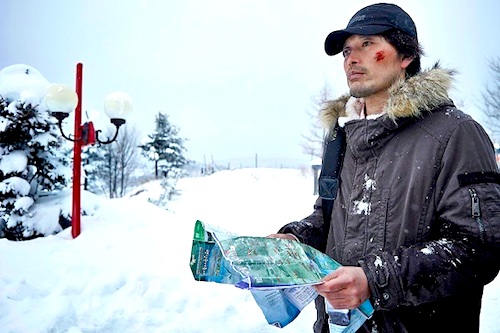
By Joe Bendel. Is it the violent video games or just bad parenting? Regardless, a gang of high school boys has no remorse for the violent crimes they commit and post on video-sharing sites. In contrast, it is no secret why Lee Sang-hyeon resorts to killing. The grief-stricken father is determined to punish his daughter’s under-aged murderers in Lee Jung-ho’s Broken, which opens this Friday in Los Angeles.

Frankly, a good part of Lee already died inside following his wife’s slow death from cancer. Subsequently, he was not able to give his daughter Su-jin adequate emotional support, and now he will never be able to make amends. Jo Doo-sik and Kim Cheol-yong were the perpetrators of her rape and murder, but there was a witness—their socially awkward classmate, Kim Min-ki. Uncomfortable with his accomplice status, Kim texts the grieving father Kim Cheol-yong’s name and address. When Lee finds the privileged thug enjoying the video of Su-jin’s murder, his rage takes over. He then starts following the trail of the oblivious Jo Doo-sik.

Broken is fueled by justifiable anger, but it is a far cry from typically exploitative vigilante films. Frankly, it focuses nearly as much on Detective Jang Eok-gwan, the cop in charge of apprehending Lee and Jo. Dogged by Internal Affairs for his rough treatment of another murderous minor from a prior case, Jang understands Lee’s anguish only too well. While he admonishes his openly sympathetic junior to play it by the book, the extent of his internal conflict becomes increasingly clear as the manhunt closes in.

From "Broken."

Although Jung Jae-young portrayed a similarly driven protagonist in Confession of Murder, he reaches a far higher level of soul-searing anguish as Lee. When unleashed, his fury is palpable, but it is even more chilling to watch his persona collapse in on itself. Yet, it is Lee Sung-min who gives the film its bitterly acidic heart. It is an uncommonly smart and subtle performance from an actor best known for television dramas and smaller feature supporting roles.

Broken also represents a considerable step up from Lee Jung-ho’s solid but relatively conventional genre outing, Bestseller. There are indeed tight and tense thriller elements at work, but the prevailing vibe is one of high tragedy. Lee’s adaptation of Keigo Higashino’s Japanese novel also pointedly critiques a legal system that too frequently compounds the pain of victims, while protecting the guilty. It is a bracing film that takes viewers to some very dark places. Recommended for those who will appreciate the harrowing ride, Broken opens this Friday (5/9) in Los Angeles at the CGV Cinemas.

LFM GRADE: A-

Posted on May 8th, 2014 at 11:34pm.

LFM Reviews A Stranger @ The 2014 Bosnian-Herzegovinian Film Festival

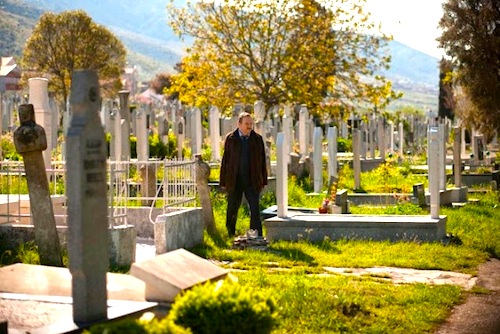
By Joe Bendel. For cineastes, the notion of divided cities conjures images of The Third Man’s occupied Vienna. In contrast, there is nothing particularly mysterious about the effective religious-ethnic cleaving of Mostar. The bridge has been rebuilt but the distrust lingers between Muslim Bosniaks and Catholic Croats. Unfortunately, Slavko is not the sort of man to personally span that gap in Bobo Jelčić’s A Stranger, the closing selection of this year’s Bosnian-Herzegovinian Film Festival in New York.

Slavko has surely seen plenty of funerals by now, yet the death of his Muslim friend Đulaga still represents quite a dilemma. Although they had not seen each other since the troubles began, he knows he should pay his last respects. However, if he is seen attending the Muslim service, there could be very real repercussions in the neighborhood and perhaps even with the local bosses. On the other hand, if he does not go, he will completely lose the respect of his wife Milena, as well as his remaining shreds of self-worth.

Evidently, Jelčić’s character-types have deep resonance with the local audience, but they will not be so difficult for Americans to relate with. Frankly, Slavko is not a bad man. He is simply a small man. This often leads to minor everyday tragedies whenever he might find himself tested.

In a way, Slavko demonstrates how divided cities do not just cause divided peoples, but also fractured people. He is the “Stranger,” a title that evokes Camus and Graham Greene more than a painfully self-conscious, late middle-aged protagonist. At the very least, he is prone to profoundly darker Walter Mitty flights of fantasy. Yet, we start to wonder how firm his grasp truly is when his grim reveries start to jarringly intrude upon the on-screen narrative.

From "A Stranger."

Bogdan Diklić, a Croatian born veteran of cinema across the Balkans, is a nervy screen presence, completely pulling viewers into his neurotic inner turmoil. He makes it dashed tricky to pass judgment on Slavko (lest we be judged under similar circumstances), even though Milena and Jelčić clearly have no problem doing so. In fact, Nada Đurevska undercuts him rather powerfully as the increasingly disappointed Milena. At times, her body language is quite the scathing indictment.

Without question, A Stranger represents art cinema at its least compromising, yet its themes still have resonance, particularly for those with roots in Bosnia-Herzegovina, or so we should hope. As the closing feature, it played to an impressively packed house, with overflow forced onto folding chairs in the aisles.

Regardless, it is nice to see the festival slowly but steadily grow year-by-year. Always a major event for the expat community, its general interest film following is also starting to build. While the themes are often heavy, patrons will find the festival itself to be friendlier and more relaxed than the other New York film happening that typically precedes it. Highly recommended as a New York film tradition, the eleventh annual Bosnian-Herzegovinian Film Festival came to a close recently, but watch their social media for news on next year’s edition.

LFM GRADE: B-

Posted on May 8th, 2014 at 11:29pm.

A Novitiate Nun in Communist Poland: LFM Reviews Ida

By Joe Bendel. In Communist Poland, a vow of poverty hardly mattered. For one nun in training, the most challenging part of her novitiate will be meeting her sole living relative. It leads to some profound soul searching in Pawel Pawlikowski’s Ida, which opens today in New York.

Convent life is all Anna has ever known. Orphaned as an infant, the young woman will soon take her vows, but the mother superior insists she first visit her aunt Wanda. Neither has been pining to meet the other, in part because of what they represent. While Anna identifies with Poland’s strong Catholic tradition, Wanda is a notorious Stalinist era prosecutor and judge. “Red Wanda” as she is known, now lives a boozy, solitary existence, only occasionally relieved by brief “carnal” distractions. When Anna arrives unannounced, Red Wanda reveals the young woman’s true identity, almost as an act of hostility. Anna was actually born Ida Lebenstern to Jewish parents who perished during the war.

Despite her abrasive welcome, Red Wanda quickly warms to her niece, agreeing to set out with her in search of her parents’ remains. It will be a rather tricky task, given their sketchy information. Simultaneously, Red Wanda does her best to play Anna’s devil-on-the-shoulder, trying to convince her to sample some of life’s more adult pleasures before she completely renounces the secular world.

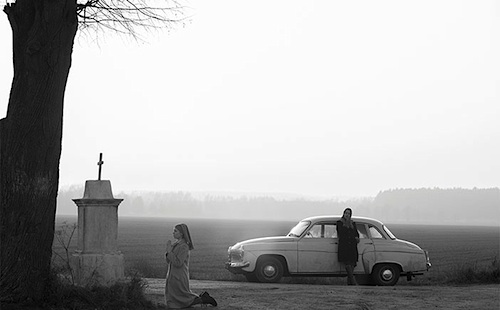
Ida might be opening May 2nd (the day after May Day), but audience members should take a heavy coat to the theater, because it is one of the chilliest films you will ever see. 1962 was a relatively stable period for Communist Poland (compared to the subsequent anti-Semitic campaign and imposition of martial law), but it was still a time of scarcity and drabness. Nonetheless, jazz was on the upswing with the smart set and not yet explicitly on the outs with the authorities. It just so happens, Lis, a talented saxophonist gigging at their provincial hotel, attracts Wanda’s leering stare and the awkwardly demur notice of her niece.

From "Ida."

Arriving on the heels of Władsław Pasikowski’s more confrontational Aftermath, Ida is clearly part of Poland’s continuing effort to process the national WWII experience, long deferred during the Communist era. However, this is a more personal meditation on identity and family. It is also unusually beautiful, in a severe, ascetic way. Ryszard Lenczewski & Lukasz Zal’s black-and-white cinematography is absolutely arresting, while Pawlikowski strikingly composes each shot, dwarfing his figures against imposing backdrops.

Acting within such a frame is quite a challenge, but newcomer Agata Trzebuchowska seems to grow along with her character, Anna/Ida, as the film progresses. Without question though, Agata Kulesza’s Red Wanda is the most successful breaking out of Pawlikowski’s frozen tableaux with her sharp elbows and razor-like tongue. Dawid Orognik also shows flashes of presence as Lis, while Joanna Kulig briefly catches the eye and ear as Lis’s band singer.

The British-based Pawlikowski makes a bold statement with his first Polish production, aesthetically and thematically. His deliberate pace and dark vision will limit Ida’s appeal even within arthouse circles, but it is an ambitious work of auteur level cinema. Recommended for disciplined cineastes, Ida opens this Friday (5/2) in New York at Film Forum.

LFM GRADE: B+

Posted on May 2nd, 2014 at 11:50pm.

LFM Reviews Bright Days Ahead @ The 2014 Tribeca Film Festival

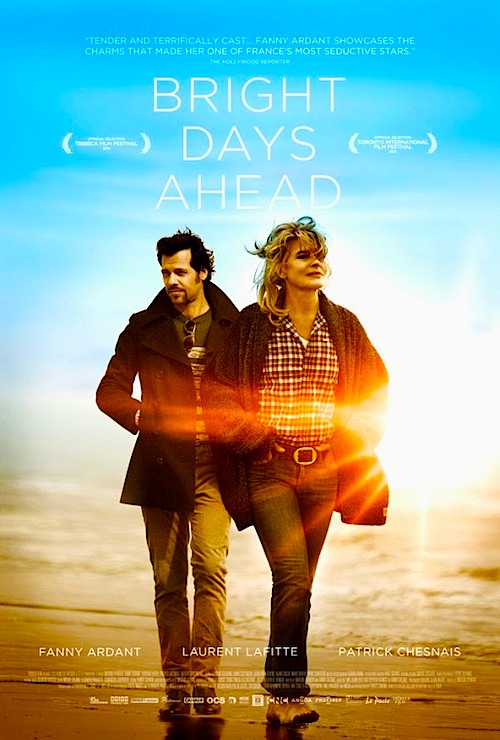
By Joe Bendel. Caroline looks considerably younger than her husband Philippe, but he still practices dentistry, whereas she has retired. That means she has time on her hands. Much to her surprise, she will find things to do at an upscale senior center that happens to employ a much younger but surprisingly receptive personal computing teacher. Fanny Ardant takes a diva turn in Marion Vernoux’s adultery drama Bright Days Ahead, which screened during the 2014 Tribeca Film Festival.

Caroline is not adapting well to retirement. When her grown daughters buy her a trial membership at the Bright Days Ahead senior’s club, she nearly has a fit. You can hardly blame her—a name like that sounds like some sort of rehab clinic. Reluctantly, she starts going to Julien’s computer classes when their home PC goes on the Fritz. Before long, some cougar-himbo hanky-panky commences. Unfortunately, her increasing recklessness leads to inevitable exposure.

Even with the not exactly jaw-dropping age difference between the not-so secret lovers, Bright is a pretty standard exercise in cinematic infidelity. Yes, Ardant still has it, but what distinguishes Vernoux’s otherwise conventional screenplay (co-written with Fanny Chesnel) are a handful of blisteringly honest scenes and a quiet gut-check performance from Patrick Chesnais as the wronged husband.

Philippe is indeed wronged, a fact that Vernoux and Chesnel do nothing to water-down. Refusing to be conveniently submissive, he is a dignified yet emotionally messy rebuke to the of pat empowerment themes often bandied about by adulterous wife movies. Similarly, Caroline goes into the affair remarkably clear-headed, even helping Julien keep up appearances with his younger lovers. However, you might have to be a sixty-some year old French woman to appreciate the charms of Laurent Lafitte’s Julien.

Without question, it is the veterans Ardant and Chesnais who make Bright work to the extent it does, particularly in their scenes together. Rather undistinguished looking, it still has enough incisive moments that pop to make the whole worthwhile. Recommended for Francophiles, Bright Days Ahead has already opened in New York at the Quad Cinema, following its American premiere at this year’s Tribeca Film Festival. It also screens this Sunday (5/4) at the Montclair Film Film Festival in Jersey.

LFM GRADE: B-

Posted on May 2nd, 2014 at 11:21pm.

LFM Reviews The Protector 2

By Joe Bendel. Elephants have long held special cultural significance in Thailand, as symbols of both the royal family and Buddhism. Yet, for Kham, Korhn is no mere pachyderm. He is his spiritual brother. There is no better way to stress him out than kidnapping Korhn. For some strange reason, a shadowy MMA cabal does exactly that—again—in Prachya Pinkaew’s The Protector 2, which opens today in New York.

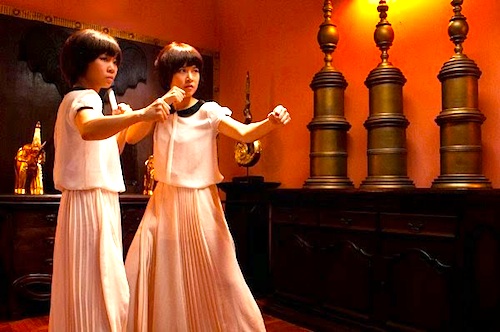
One afternoon, an elephant dealer’s sketchy lackeys drop by, offering what they consider a ridiculously generous price for Korhn. Naturally, after telling them off, Kham pops down to the market, leaving his elephant home alone. Seriously, that practically constitutes negligence. Launching a frontal on assault on the elephant fence’s villa, Kham finds old Boss Suchart already dead and his purloined elephant nowhere to be found. Not only has he obligingly stepped into the frame-job, Suchart’s martial arts proficient, sailor suit wearing nieces are quite upset with him.

Eventually, Kham will try to forge an alliance with the not-really-twins to bring down the man responsible for both their woes. That would be LC, the leader of a gun-running martial arts cult. Supposedly, he wants Kham to be his new #1 fighter, but we know from the daft in medias res opener, there is a larger scheme afoot.

Whatever. At least it all involves a series of massive throw-downs with the almost super human #2. LC’s loyal lover, #20, is no slouch either. As long as people are fighting, P2 works like a charm. However, there are some ridiculously over-the-top action sequences involving a motorcycle gang clearly intended for 3D that blatantly suffer from an unforgiving 2D rendering.

From "The Protector 2."

In case you forgot, the original Protector featured the awesome, long take tracking Kham fighting his way up a spiral Guggenheim-like vice den. His successive face-offs with #2 almost rank at that level, but collectively they last considerably longer. While Tony Jaa is just kind of okay when it comes to the conventional drama, his fight scenes, choreographed with Panna Rittikrai, are spectacular, as is #20’s wardrobe, rocked by Ratha Phongam, who was just about the only watchable part of Only God Forgives.

As the nieces, Chocolate’s JeeJa Yanin Wismitanan and Teerada Kittisiriprasert also show off some pretty amazing synchronized moves. However, despite all the scenery RZA chews as LC, Marresse Crump upstages his villainy as the lethally cool #2 (an absolute force of nature, worlds away from Robert Wagner’s #2 in the Austin Powers franchise).

There are times when both P2 and its hero are pretty dumb. Fortunately, the film is only really about two things: kicking butt and kicking more butt. Pure escapist meathead fun, The Protector 2 is recommended for fans of Jaa, Wismitanan, and Muay Thai films in general when it opens today (5/2) in New York at the Cinema Village.

LFM GRADE: B-

Posted on May 2nd, 2014 at 11:15pm.