LFM Reviews Draft Day

By Joe Bendel. Nobody wants to draft the next Ryan Leaf or JaMarcus Russell, but they often look like sure things at the time. Of course, nobody ever understood the Knicks’ Frédéric Weis debacle, especially when Artest was still available. Granted, that is a basketball digression, from 1999, but the point is we still are not ready to forgive and forget. The stakes are consequently high for Cleveland’s GM when he makes a costly trade for the number one pick. He had better choose wisely, but the clock is ticking throughout Ivan Reitman’s Draft Day, which opens today pretty much everywhere.

Sonny Weaver basically has one season left to turn things around. He largely inherited the current team, but he did little to endear himself to fans when he fired their legendary head coach, who also happened to be his father, now deceased. With the owner pressuring him to make a big move, he reluctantly agrees to a deal, trading away their next three years of first round drafts for the upcoming number one pick. (Ironically, it is your 2014 Super Bowl champion Seattle Seahawks who have that coveted #1 spot.)

Weaver quickly develops buyer’s remorse, but the trade is done. Everyone assumes he will opt for the presumptive number pick, Bo Callahan, the Heisman winning quarterback from Wisconsin. His owner is delighted with the prospects of a marquee player like Callahan, but Weaver cannot shake the Leafy vibe he gets from him. Further complicating matters, Weaver’s front office colleague and not so secret lover has just informed him she is pregnant.

You really have to hand it to Kevin Costner. After some pretty lean years, he has clawed his way back to leading man status in major Hollywood releases. Going back to the sports well obviously makes sense in theory and it works ably enough again in practice. Since it is all about wheeling and dealing, Draft Day is bound to be compared to Moneyball and not unfairly so. The truth is there is something oddly cinematic about watching the respective GMs’ hard bargaining, firing off lines like: “that offer already expired, it’s a different world than it was thirty seconds ago.”

Frankly, the only sports action we see are the teams’ research tapes and there are no surprises there, because Weaver will explicitly tell them to show the footage of Callahan getting sacked. Still, there is something very sporting about Draft Day’s persistent faith in next season.

From "Draft Day."

Without question, Costner is the film’s lynchpin and he still has what it takes. He convincingly gives Weaver darker shades than his Bull Durham, Field of Dreams, and Tin Cup characters, but he remains undeniably charismatic. While they do not burn down the joint with their passion, he and Jennifer Garner develop some relatively likable and believable romantic chemistry together. Denis Leary and Frank Langella both do their shtick as the Browns’ head coach and owner, respectively, but it is the latter veteran thesp who really gives the film some sly zip. Football fanatics will also dig the scores of real life NFL cameos, mostly notably including Jim Brown (as far as old school cineastes are concerned).

Reitman keeps it all moving along briskly, capitalizing on the draft’s constantly ticking clock. While it ends up somewhere not wholly unexpected, getting there is a surprisingly satisfying trip. A well conceived and nicely executed comeback star vehicle, Draft Day is easily recommended for fans of football or Costner rom-dramedies. It opens today (4/11) across the country, including the AMC Loews Lincoln Square in New York.

LFM GRADE: B

Posted on April 11th, 2014 at 9:21pm.

Scarlett Johansson vs. Scotland: LFM Reviews Under the Skin

By Joe Bendel. Fifty-some years after the classic Twilight Zone episode, aliens are still devising ways to serve man, with a little butter and garlic. However, viewers of Jonathan Glazer’s much anticipated new film will be forgiven if they do not realize that this is the extraterrestrials’ reason for visiting Scotland. Mood and composition take precedence over petty bourgeoisie concerns, like narrative and pacing, throughout Glazer’s Under the Skin, which opened Friday in New York.

Fortunately, Skin is ostensibly based on the novel by Michel Faber, so we can infer some exposition from the original source material. It seems aliens have a taste for human muscle, so the woman visitor has been sent to harvest some from the brawniest knuckle-draggers she can entice into the back of her van. Sometimes she appears to have a counterpart escorting her on his motorbike, but he disappears for long stretches (probably because he gets bored).

At first, she seems ruthlessly efficient, but as she encounters the less fortunate, she starts to change. Yet, becoming more “human” leaves her increasingly vulnerable to man’s inhumanity towards his fellow man. Or something like that.

There is not a heck of a lot of plot in Skin, but what there is manages to be both slow and confusing. About the third or fourth time she lures another man-dog into her cosmic pool of black goo, you start to wonder how this film ever got made without Tangerine Dream on-board. There are more wide shots of cloud draped forests than both seasons of Twin Peaks combined. Frankly, it is hard to believe this is the work of Glazer, arguably the most lauded television commercial director of our time and the man who helmed the breakout hit, Sexy Beast.

It is also hard to get one’s head around the wildly unflattering wig Scarlett Johansson sports as the primary alien. Frankly, this is Johansson as we have never seen her before: naked, yet boring. There is no question Skin is more closely akin to experimental cinema than science fiction genre films, but it sounds deceptively commercial: “nude alien chick puts men through the interstellar meat-grinder.” It will surely attract a loyal band of critical champions who will defend it with terms like “hypnotic” and “trance-inducing,” which sounds seductive, but really means you will be paying fourteen dollars to fight off the head-nods.

In many ways, Skin feels like a throwback to the sort of weirdly cerebral 1970s science fiction forays (such as Robert Altman’s Quintet and Nicholas Roeg’s The Man Who Fell to Earth) that were green-lighted by clueless studio heads caught flat-footed by the Star Wars phenomenon, but Skin is more openly contemptuous of mainstream sensibilities. For a while, Daniel Landin’s gauzy cinematography is rather effectively dreary, in a way befitting Scotland’s backwoods, but the film simply becomes a chore to watch. Not recommended for anyone except Johnasson stalkers and the most pretentious hipster cineastes, Under the Skin opened Friday (4/4) in New York at the AMC Empire.

LFM GRADE: D

Posted on April 7th, 2014 at 6:05pm.

LFM Reviews Dream Team 1935 @ MoMI’s 2014 Panorama Europe

By Joe Bendel. Evidently, they come pretty tall and well coordinated in the Baltics, considering their success in the European Basketball Championship (now known as EuroBasket). Lithuania won twice in the 1930’s and took gold again in 2003, but the very first champion was Latvia. Profoundly unheralded, the scrappy long-shots shocked the continent in 1935. It was a great Latvian triumph on the eve of great tragedy for many nations, Latvia included. With Russia once again menacing its neighbors, it is a fitting time to revisit one of the greatest moments of Latvian sporting history in Aigars Grauba’s Dream Team 1935, which screened during Panorama Europe at the Museum of the Moving Image.

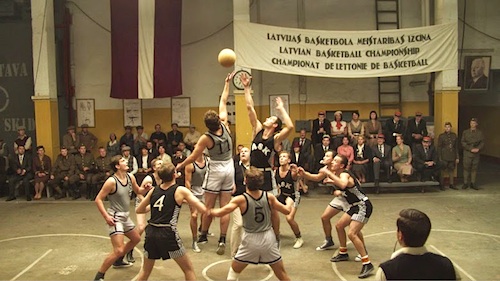
It was a different game in 1930’s Europe. A jump ball followed every successful bucket and free throws were shot granny-style, but it was still handy to have an enforcer on the team. Vlademars Baumanis understands this only too well. Initially, the player-coach loses the Latvian championship because of some thuggish play. However, the victorious coach declines to take his team to the European championship, because the corrupt national sports committee has already squandered the ear-marked funds. While protesting to anyone who will listen, Baumanis accepts an instantly regretted dare to cobble together his own national team, trading in his uniform for a suit and tie.

Bitter rivals from both the Army and University Clubs will come together to represent Latvia, but it will take time to congeal as a true team. At least they will be in the best shape of the careers, thanks to relentless conditioning coach Rihards Deksenieks. Baumanis is a master strategist (at least by 1930’s standards) and the Latvia team has considerable skills, but just getting to Geneva will be an adventure thanks to the obstructionist sports committee.

Dream Team is a reliably entertaining underdogs-triumphant sport story, with some nicely rendered period details and a peppy big band soundtrack. Many basketball fanatics will probably be amused by the decidedly less glamorous style of play. Yet, Dream Team features one of the most devastating series of what-happened-to post-scripts of nearly any film. It turns out nearly every coach and player met a tragic end either as Soviet or National Socialist conscripts (sometimes both) during the war or in Soviet gulags afterward. (Nearly eighty years later, history threatens to repeat itself, as Russia once again casts a covetous eye on the Baltic Republics.)

From "Dream Team 1935."

Janis Amanis is a bit stiff as Baumanis, but he certainly looks earnest. In contrast, Vilis Daudzins plays Deksenieks with hardnosed charisma, while Marcis Manjakovs convincingly portrays the maturation of Latvia’s star player, Rudolfs Jurcins. Unfortunately, there is not much for Inga Alsina to do as Baumanis’s wife Elvira, except for sitting around, having faith in him.

As a sports film, Dream Team is more successful than most. Despite the end never being in doubt, it moves along briskly and captures the tenor of the game as it was then played. It also suddenly feels uncomfortably topical given the ultimate fate of most of the team. It would make a good narrative companion to Marius Markevicius’s uplifting documentary, The Other Dream Team, chronicling the 1992 Olympic run of newly independent Lithuania’s men’s basketball team. Recommended for basketball fans and those who closely follow political and cultural developments in post-Soviet Eastern Europe, Dream Team 1935 screened Sunday at MoMI as part of Panorama Europe.

LFM GRADE: B+

Posted on April 7th, 2014 at 5:41pm.

LFM Reviews Honeymoon @ MoMI’s 2014 Panorama Europe

By Joe Bendel. Usually, couples keep the wedding simple for second marriages, but not Radim Werner and his fiancée Tereza. At least when you keep a low profile, it makes it harder for unwelcomed guests from the past to crash. There will be no ex-spouses arriving uninvited, but one mystery guest will thoroughly destabilize the celebration in Jan Hrebejk’s Honeymoon, which screens during the rechristened Panorama Europe at the Museum of the Moving Image.

As fate would have it, Werner’s thirteen year-old son Dominik breaks his glasses seconds before the wedding ceremony. Fortunately, there is optometrist-in-the-box right on the church plaza. Werner does not think much of the man behind the counter, but he instantly recognizes him. Calling himself Jan Benda, the mystery man crashes the ceremony and hitches a ride to the reception in the country. He claims to be Werner’s old boarding school friend, but the groom pretends not to remember him. The kids take to Benda, but he unnerves both bride and groom.

It will become obvious the lens crafter is not really Benda, but he shares some complicated history with Werner and the real Benda. The truth is pretty ugly, especially when the newly married bride is forced to confront it. Honeymoon is considered the third installment of Hrebejk’s loosely thematic trilogy, begun with the excellent Kawasaki’s Rose, examining how the sins of the past continue to influence the present. While not explicitly political like Rose, it is worth noting Werner’s boarding school indiscretions indirectly involved his teenaged lust for Natassja Kinski during the height of her international superstardom, suggesting the 1980’s, perhaps thereby implying he was the privileged child of Party elites.

Regardless, Hrebejk successfully taps into viewers’ deep ambivalence regarding weddings and similar conventions. Somewhere deep within our inner Mr. Hydes, we resent having to dress up and be on our best behavior for people we only share an accidental relationship with. Like a Wedding Crashers from Hell, Honeymoon delivers the chaos we secretly yearn for at such times.

From "Honeymoon."

Indeed, Hrebejk deftly plays a dual game, creating suspense through not-Benda’s unsettling behavior, while dropping clear hints that he is more worthy of our sympathies. He rather risks undoing the balance act late in the third act, but he certainly keeps us on our toes. Ultimately, the messiness lends Honeymoon further credence.

As the respective nemesis-classmates, Stanislav Majer and Jirí Cerny play a dynamite cat-and-mouse game. They invest both men with sympathetic moments, as well as profound flaws, making it impossible to reflexively align with either one. Anna Geislerova initially seems to be problematically passive as the newlywed bride, but she more than holds her own during a pivotal confrontation with Cerny’s crasher.

Honeymoon is a mature film, in which karma packs a real punch. On one hand, Hrebejk challenges how well one can ever know a prospective spouse, while also questioning whether we can ever out live the moral statute of limitations for our mistakes. Good luck coming up with satisfying answers, but the resulting drama is quite compelling. Recommended for discerning adults, Honeymoon screens this Friday (4/11) at the Museum of the Moving Image, as part of Panorama Europe.

LFM GRADE: B+

Posted on April 7th, 2014 at 5:34pm.

Gina Carano Misplaces Her Husband: LFM Reviews In the Blood

By Joe Bendel. You would think two recovering addicts would go to a tightly controlled “Club Med” environment for their honeymoon. Instead, the Grants visit the most corrupt island in the Caribbean. They stay on the wagon, but even more serious problems develop. When the new Mr. disappears, the new Mrs. will unleash all her street-fighting skills to find him in John Stockwell’s In the Blood, the newest vehicle for MMA star Gina Carano, which opens this Friday.

Ava’s father Casey was an original hardcase, who taught her how to fight good and hard. Even during her strung out days, following his untimely demise, she could take care of her would be predators. She cleaned up when she met the well-heeled Derek Grant in rehab. His father is not exactly thrilled with their union, but has stopped fighting it. Aside from a little dust-up in a club, their honeymoon is all very sweet and romantic—until the zip-line accident.

Unfortunately, that is not even the worst of it. Mysteriously, the ambulance carrying Grant to the central hospital never arrives with the patient. Of course, the fat and lazy police chief is happy to shift suspicion onto his ex-junkie wife, finding a receptive ear in old man Grant. Determined to find her husband, Ava Grant sets out to give the Jack Bauer treatment to every lying witness and corrupt cop in her path.

In the Blood is a pretty straight forward martial arts programmer, but it maintains Carano’s viability as an action star. There are several down-and-dirty fight sequences that nicely showcase her chops. She also gets nice support from a colorful cast of supporting characters, including Luis Guzmán and Danny Trejo (who kills it in his final scene). It is also impressive to see that Stephen Lang continues to get rougher and tougher with age during his brief flashback scenes as dear old dad. As a Twilight alumnus, Cam Gigandet does not inspire much confidence, but he manages to scratch out some okay chemistry with Carano.

For genre fans, In the Blood could be considered the rough equivalent of early Van Damme films. The plots were never extraordinary, but they were serviceable enough to build up his credibility as an action star and a romantic lead. In the Blood serves the same function for Carano, even with its unfortunate and potentially spoilery title. Stockwell does an okay job framing the action, but he is no Isaac Florentine, let alone a Dante Lam or Wilson Yip.

Still, Carano delivers on her end. She has screen presence and chops. In the Blood will not take her to the next level, but it will keep her existing fanbase engaged and ready for more. Enjoyable as a quality B-movie with serious MMA aptitude, In the Blood is recommended for genre enthusiasts when it opens this Friday (4/4) in New York.

LFM GRADE: B-

Posted on April 2nd, 2014 at 11:08pm.

A Talky Apocalypse: LFM Reviews Goodbye World

By Joe Bendel. Rat race dropouts James and Lily live in the place where hippies and survivalists intersect. Given its strategic hilltop position and the well-stocked freezers full of food and medicine, their Mendocino County home will provide refuge to a number of their long lost college friends. Unfortunately, human nature keeps doing what it does in Denis Henry Hennelly’s Goodbye World, which opens this Friday in New York.

Nick and Becky were already en route for an awkward weekend visit to his estranged college pals. He was once engaged to Lily and business partners with James, until the hypocritical hippie forced him out over a philosophical disagreement. That is a lot of shared history, but surely they ought to be able to put it aside once the apocalypse hits, right?

Of course, it is hard to get reliable reporting on the freshly minted end of the world. Fortunately, they can rely on the analysis of Laura, another college chum, who was recently an aide to the chairman of the Homeland Security committee, until a leaked sex tape ruined her career. To further increase tensions, their Bill Ayers-lite college professor pal and his latest coed conquest also make their way to their Northern California refuge. To round out the cast of problematic houseguests, their weirdo hacker pal Lev Berkowitz turns up in state of near catatonia, openly inviting viewers to suspect he might have had a role precipitating the cyber attack.

Somehow, millions of smart phones simultaneously received the same cryptic text: “goodbye world.” Then systems started failing left and right, leading to riots in the street. James believes they can sit tight for several years, presuming they can stomach each other, until ominous outsiders start showing up and making demands.

Frustratingly, the sketchy details Hennelly and co-writer Sarah Adina Smith dole out on the early process of Armageddon are far more intriguing than the post-apocalyptic melodrama. For the most part, these are shallow, self-absorbed creeps. Even James & Lily’s daughter is an entitled princess. Still, making the scandal-tarred Laura an American Revolutionary War re-enactor is a nice bit of character detail.

As in the nearly unwatchable First Winter, the end of the world and the widespread casualties that result do not seem to cause anyone much lasting sorrow. Instead, they are preoccupied with their own petty jealousies and resentments. It is one thing to compartmentalize, but that is just cold. Logically, Gaby Hoffman fares the best amid the large vanilla ensembles, since she is blessed with the most distinctively limned character.

To be stuck in the same house as these people would be a fate far worse than any urban anarchy. The special effects team nicely evokes the end times with some subtle but clever bits of business, but Hoffman cannot single-handedly compensate for the massively boring characters her Laura must deal with. Although it gets out of the blocks quickly, Goodbye World soon loses steam. Best saved for fanatical hippie survivalists, it opens this Friday (4/4) in New York at the Village East.

LFM GRADE: C-

Posted on April 2nd, 2014 at 11:01pm.