LFM Reviews Cesare Mori; Now Available on DVD

By Joe Bendel. To this day, there is a reservoir of good will for Mussolini’s Fascist Party in Sicily, thanks in large measure to the “Iron Prefect.” Although he had a checkered personal history with the Fascists, he pursued the Mafia like an Italian Elliott Ness, getting better results for his efforts. After all, they do not give you a nickname like the Iron Prefect for nothing. Gangs will be busted but not permanently eradicated in the historical crime mini-series Cesare Mori, which is now available on DVD from MHz Networks.

Mori was a hard cop to kill. During his first posting in Sicily, he stepped on all the wrong toes pursuing the Carlino Gang and the murder of Count Chiaramonte. Mori succeeds in routing the Carlinos, perhaps too well, leaving a vacuum open for the Mafia factions responsible for the Chiaramonte homicide. Making a deal with the devil, the widow Elena Chiaramonte forges an alliance with the Mafia’s facilitators. She will regret this, but not before she supplies a bogus alibi to her husband’s murderer.

With his prosecution scuttled, Mori is promoted up and out of Dodge. In Bologna, he became the only Prefect to stand up to Black Shirt thuggery. Yet, Mussolini was still willing to return him to Sicily with greater authority when the Mafia’s power started to eclipse that of the state.

Without question, the most intriguing aspect of Cesare Mori the mini-series is Mori’s ambiguous relationship with Il Duce. Conveniently, the real life Mori died before the onset of WWII, so he cannot be implicated in any Fascist war crimes. Still, he was a Party member, who somehow made his peace with Mussolini. Clearly, Pietro Calderoni and his battery of co-screen-writers portray Mori’s fascism much like a reluctant Democrat assistant district attorney in Manhattan. He is keenly aware of the party’s corruption and incompetence, but it is the only game in town if he wants to pursue a career in justice.

On the other hand, the clunkiest storyline in Mori involves Saro, an orphaned mobster’s son temporarily adopted by the Moris until the ambitious future Don Tano Cuccia re-establishes the Mafia’s custody. Watching his high-strung wife pine for the ingrate Saro gets old fast. The production is also rarely helped by Pino Donaggio’s overwrought music, which makes several perfectly respectable dramatic scenes sound and feel unnecessarily melodramatic.

Still, Vincent Pérez (probably best known for the “red cloak” scene in Queen Margot and succeeding Brandon Lee in The Crow: City of Angels) is suitably commanding as Mori. He can also ride a horse, which is important. Evidently, Mori preferred to make his entrances on horseback rather than clambering out of an auto, to cut a more imposing figure with the criminal element. When he swaggers and seethes, Mori works quite well.

From "Cesare Mori."

Comedic actor Adolfo Margiotta is also surprisingly effective as his deputy, Francesco Spanò, who turns out to be more serious and competent than his hound dog looks suggest. As the Countess, Gabriella Pession generates some flirtatious heat with Pérez, but she is saddled with a problematic character that spends most of the decades-spanning production kidding herself about the state of her affairs.

Mori is a fascinating historical and television figure, whereas Saro is just rather sorry. In fact, it is hard to watch Cesare Mori without analyzing what its respective depictions of Mori, Mussolini, and the Mafia say about current Italian attitudes. In fact, it might be controversial with some audiences because dead-ringer Maurizio Donadoni’s portrayal of Il Duce is unflattering on balance, but not so very different from your average politician on the make. Despite its flaws, director Gianni Lepre keeps the 200 minute mini moving along briskly, while Pérez’s performance provides a steely anchor of conviction. Recommended for fans of gangster dramas with minor aesthetic reservations, Cesare Mori is now available on DVD from MHz Networks.

LFM GRADE: B-

Posted on September 2nd, 2014 at 10:53pm.
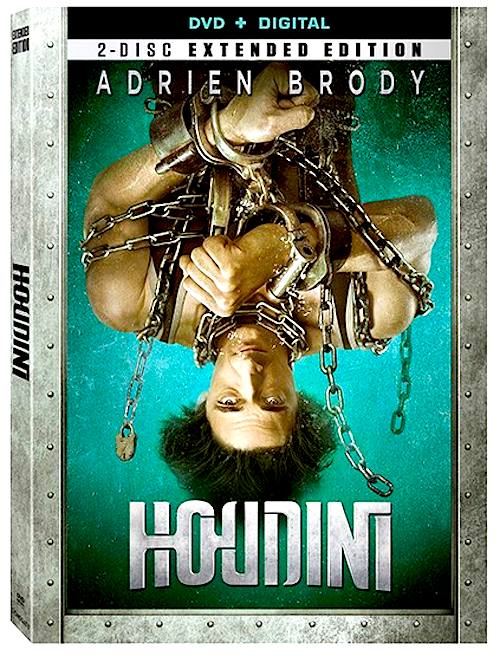
The Man, The Miniseries: LFM Reviews Houdini on The History Channel

By Joe Bendel. He collaborated with H.P. Lovecraft and became the sworn enemy of Sir Arthur Conan Doyle. In the nearly eighty-eight years since his death, nobody has approached Harry Houdini’s fame and accomplishment as an illusionist and escape artist, while perhaps only the Amazing Randi has equaled him as a debunker of psychic phonies. Yet, despite some vintage stills and a brief flirtation with those new-fangled moving pictures, his live performances were almost solely the stuff of memory. Yet, the fascination with Houdini persists. The man in chains takes center stage once again when the two-night miniseries Houdini premieres this Labor Day on the History Channel.

As we meet young Erik Weisz (soon to be Ehrich Weiss and eventually Harry Houdini), it is clear he is a mother’s boy, with deep-seated father issues. These themes will constantly return over the two nights like swallows to San Juan Capistrano. Due to his youthful confidence, the future Houdini is convinced his facility for magic tricks will bear great fruit eventually. Naturally, he spends years scuffling, but at least he meets his future wife Bess through those down-market gigs. However, when Houdini’s handcuff escape starts generating buzz, he re-invents himself as an escape artist and his career ignites.

Screenwriter Nicholas Meyer (The Seven Percent Solution novel and screenplay) takes viewers on a mostly breezy jaunt through Houdini’s colorful life, largely sticking to the facts, or in the case of Houdini’s supposed work with the American and British Secret Services, well reported suppositions. Whether it is true or not, Tim Pigott-Smith looks like he is having a ball playing British spymaster William Melville, the original “M.” It is also allows for some entertaining intrigue, as when Houdini thoroughly befuddles the Czar and his fellow faker, Rasputin.

The second night is necessarily darker, progressing as it must towards the inevitable, with the bulk of the drama devoted to Houdini’s drive to debunk false mediums using parlor tricks to fleece the grieving. There is very little that could be considered truly genre-centric in the séance sessions, but the trappings will still have a bit of appeal to fans.

Although he is considerably taller than the spark-pluggish Houdini, Adrien Brody’s gaunt, sad-eyed persona fits the escape artist rather well. He also looks like he put in the time when it came to the crunch sit-ups. As Bess, Kristen Connolly’s earthy energy plays off him well, even if their chemistry is a little flat. While he has little dramatic heavy lifting to do, Evan Jones’s earnestness also wears well on Jim Collins, Houdini’s assistant and chief co-conspirator.

There are a lot of fun sequences in Houdini (the disappearing elephant is particularly well staged), but the visually stylized punch-to-gut symbolic motif is way over done and the effects look terrible on screen. Still, the mini addresses Houdini’s Jewish heritage in respectful, sympathetic terms, which must have been a strange change of pace for director Uli Edel, whose highly problematic terrorist apologia Baader Meinhof Complex suggests killing Jews is nothing to get upset about.

Fans with a checklist will be able to tick off just about all of the iconic escapes, from straightjackets to milk cans. Overall, it is a nice blend of fact-based fiction and somewhat more fanciful speculation. However, it feels slightly stretched to cover two nights. Recommended for admirers of Houdini the performer and scourge of spiritualists, Houdini the mini-series airs this Monday and Tuesday night (9/1 & 9/2) on the History Channel.

LFM GRADE: B

Posted on August 29th, 2014 at 12:22pm.

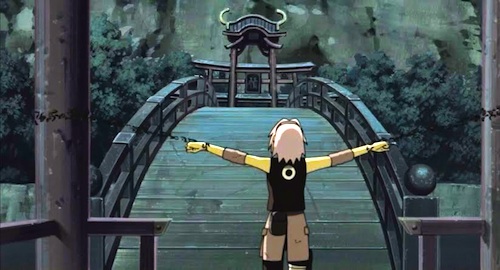
LFM Reviews Road to Ninja: Naruto the Movie

By Joe Bendel. Naruto Uzumaki is a lot like your classic adolescent fantasy protagonist, but the trappings are ninja-related rather than the stuff of sorcery and knight errantry. Growing up as an orphan, he is rash on the outside and sensitive on the inside. Even though fans know his creation story quite well, it will be revisited in detail and perhaps even altered when the junior ninja finds himself whisked into an alternate world in Hayato Date’s Road to Ninja: Naruto the Movie, which opens this weekend in New York.

Uzumaki’s father and mother bravely sacrificed their lives defending Konohagakure from the rampaging Nine-Tailed Demon Fox. Even though his parents are immortalized on the village’s Rushmore-like monument, Naruto is often shunned because they were forced to mystically seal the demon within him. Naruto is usually a pretty plucky kid, but he is going through a rough patch, making the absence of his family particularly acute. In contrast, his crush-rival Sakura Haruno is feeling especially embarrassed of her intrusive, ultra-square parents.

However, before you can say “alternate Star Trek universe,” the malevolent Tobi traps them in the Tsukuyomi world, based largely on their deepest subconscious desires. Much to their surprise, Haruno is now the celebrated orphan of the village heroes, while Uzumaki’s parents are alive and well. Instead of martyrs, they are workaday ninjas and loving parents (who insist on calling him Memna rather than Naruto). Everything looks the same, but most of their friends have reversed their primary character traits. In a way, this makes Road an easy series entry point, since most of the backstory no longer applies.

From "Road to Ninja: Naruto the Movie."

The Naruto franchise is classified as Shōnen manga, which usually means a lot of fighting. Road is no exception, but its themes of sacrifice and parental love give it more Capra-esque sentiment than you might expect. Since it was plotted out by series creator Masashi Kishimoto, you know it is legit. It is a rather self-contained story arc, but it arguably offers fans greater character development. Frustratingly though, like many anime features, the big showdown relies on a lot of flash-and-dazzle spectacle that largely becomes a blur of fireballs and fix-demons. It would be more effective to bring things down to a more personal level, like Mel Gibson and Gary Busey duking it out on Danny Glover’s front lawn.

Under Kishimoto’s watchful eye, Date and company maintain the franchise’s quality control. In fact, there are some great images of Konohagakure and its environs, evoking Edo-era Japan and Tolkien-like fantasyscapes in equal measure. There is more heart to Road than you usually find in well established warhorse properties, which might be why it is the Japanese box-office’s top performing Naruto feature thus far. Nevertheless, it requires a predisposition to teenaged ninjas and all the angst and combat they face. Solidly executed but probably not crossing over from the fan zone, Road to Ninja: Naruto the Movie screens this coming Sunday (8/31) and Monday (Labor Day, 9/1) in New York at the Village East. For a complete list of cities and dates, check the Eleven Arts website here.

LFM GRADE: B-

Posted on August 29th, 2014 at 12:11pm.

LFM Reviews The Calling

By Joe Bendel. It is hard to say which are dumber in this non-mystery: the Christians who willingly sacrifice themselves in rituals that violate nearly every tenet of their faith or the Keystone cops who spend more time chasing their tails than the only suspect we ever see. At least, Detective Hazel Micallef has the excuse of being a pill popping drunk. Nonetheless, she is the only copper smart enough to figure out that a serial killer is on the loose in Jason Stone’s logically challenged The Calling, opening this Friday in select theaters.

Micallef lives with her mother, drinks too much, and openly carries on with a married man in the small Canadian town of Fort Dundas (perhaps that should be Fort Dunderhead). She is currently the town’s acting police chief by virtue of seniority, but her position is tenuous at best. However, when one of her mother’s church cronies is decapitated, Micallef’s atrophied intuition says it must be the work of a serial killer.

With the help of her long suffering deputy and a green transfer from Toronto, she identifies similar facial manipulations in other bodies just outside her jurisdiction. For some reason, she seeks the counsel of Father Price, who immediately confirms each victim’s mouth has been molded to form part of a long forgotten early Christian sacrificial-reincarnation prayer. Gee, that’s not suspiciously convenient at all.

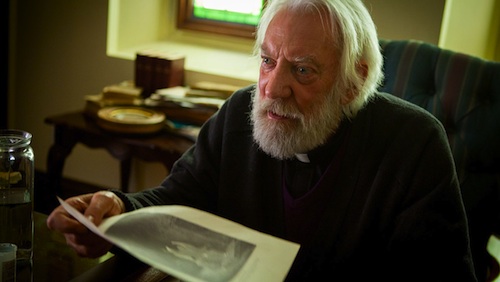
Of course, about ten seconds later we learn the good Father is indeed well acquainted with the killer. While he is morally conflicted (because Donald Sutherland could not possibly play an out-and-out bad guy in a Susan Sarandon movie), he still acquiesces to the mysterious Simon’s dubious scheme.

The Calling is based on the first of three Micallef mystery novels written by Michael Redhill under the Inger Ash Wolfe pseudonym. However, there is not much mystery in the film and common sense is also scarce as hen’s teeth. On paper, the Micallef character sounds promising, but Sarandon is the wrong person for the role. Instead of embracing her degenerate nature, she plays her like some sort of martyr, trying to be a hard drinking Sister Helen Prejean with a badge.

From "The Calling."

Evidently, Gil Bellows is the new go-to-guy whenever a casting agent needs a small town deputy, but he provides a much needed sense of stability for the ludicrous plot. As Father Price, Sutherland manages to say some ridiculous lines with a straight face. Sarandon’s fellow Oscar winner Ellen Burstyn must have owed one of the producers a big favor, because she has absolutely nothing interesting to do as Micallef’s mother. Regardless, she appears natural and credible in all her scenes, unlike the awkward looking Topher Grace, sticking out like a sore thumb as the freshly re-assigned Ben Wingate. However, Christopher Heyerdahl brings real presence and a bit of ambiguity as Simon, the symbolically loaded bogeyman.

Ill conceived and executed in a manner that minimizes any potential suspense, The Calling just doesn’t have much going on. Clearly, Scott Abramovitch’s screenplay fancies itself some sort of Bill Maher critique of faith-before-reason Christianity, but its defining characteristic is its blandness. Not recommended, it opens this Friday (8/29) in select cities.

LFM GRADE: D-

Posted on August 27th, 2014 at 9:10pm.

LFM Reviews Kundo: Age of the Rampant

By Joe Bendel. If the peasants won’t take to their pitchforks, the Chusul Clan will do it for them. They are sort of like Robin Hood and his men, but they aren’t very merry. The Chusul outlaws definitely believe in stealing from the rich. That would be Jo Yoon, a Naju lord’s sociopathic illegitimate son. It is the have-not’s versus the man who has everything except a proper name in Yoon Jong-bin’s smash hit Kundo: Age of the Rampant, which opens this Friday in New York.

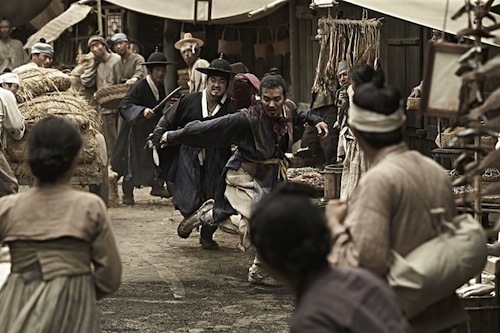
It was sort of the Chusuls’ fault that the death of Lord Jo Won-suk’s son opened up a void to be filled by his new presumptive heir, Jo Yoon. Still, at the time, it was a highly satisfying mission for Dae-ho, the Chusul captain. Indirectly, it also brings Dolmuchi into the picture. The lowly clever-wielding butcher is hired by Jo Yoon to murder his half-brother’s pregnant widow. However, Dolmuchi has an outbreak of conscience at the last moment.

Slightly disappointed, Jo Yoon has the poor butcher’s family murdered, but Dolmuchi is saved at the last moment by his future Chusul comrades. Despite the wise spiritual counsel of Ddaeng-choo, “the Vicious Monk,” Dolmuchi is consumed with a desire for revenge. However, Jo Yoon’s almost superhuman martial arts were nearly the death of him the last time they faced off. Frankly, the Naju usurper might be too powerful for Dolmuchi’s adopted clan, but when he really starts to squeeze the peasantry, Dae-ho resolves to act.

The obvious class warfare themes drive Kundo like the runaway bus in Speed, but it never loses sight of the action. In fact, there are numerous spaghetti western hat-tips, including a big noisy one to the original Django, which is awesome. There is also the Magnificent Seven/Seven Samurai/Seven Warriors dynamic of the rag-tag Chusul action team coming together, including the hulking Chun-bo, Lee Tae-ki, a former aristocratic turned outlaw, and Ma-hyang, the strictly-business archer they both carry a torch for.

It seems like the creepiest villains in Korean cinema are often distinctly androgynous—and Jo Yoon is no exception. Freshly discharged from his mandatory military service, Gang Dong-won’s performance has the grace and menace of a psychotic ballet dancer. He is flamboyantly cruel, but screenwriter Jeon Cheol-hong takes pains to establish the linkage to his miserable childhood.

From "Kundo: Age of the Rampant."

Indeed, Gang chews the scenery quite effectively as the clammy Jo Yoon. Conversely, Ha Jung-woo practically blows smoke out his ears as the massively intense Dolmuchi. Lee Sung-min and Yoon Ji-hye are both steely cool as Dae-ho and Ma-hyang, respectively, while former MMA trainer Ma Dong-seok (a.k.a. Don Lee) is reliably energizing as the Friar Tuck-ish Chun-bo. However, veteran character actor Lee Kyoung-young (practically unrecognizable without his glasses) nearly steals the show as the hardcore but deeply compassionate priest. Unfortunately, viewers who blink might miss Korean indie star Kim Kkobbi fleetingly appearing as Jo Yoon’s fugitive half-sister-in-law.

Kundo literally tells us serfs: “United you are people, divided you are thieves.” It then proceeds to kill a bunch of extras. Frankly, the rhetoric might sound more DPRK than ROK, but Jo Yoon’s tyranny just as easily validates Lord Acton as it does Leon Trotsky. More importantly, the action sequences are pretty spectacular. Dolmuchi even fights like a butcher, which is quite cinematic. Recommended for those who enjoy epic, morally black-and-white, two hour-plus epic historical conflagrations, Kundo: Age of the Rampant opens this Friday (8/29) in New York at the AMC Empire.

LFM GRADE: B

Posted on August 26th, 2014 at 10:51am.

LFM Reviews Canopy

By Joe Bendel. Australia and Singapore enjoy close diplomatic and economic ties. There is a free trade agreement between the two countries and Singapore provided assistance to Australia’s Afghanistan deployment. It is a special relationship forged in WWII by soldiers like the two protagonists of Aaron Wilson’s intimately experiential Canopy, which opens this Friday in New York.

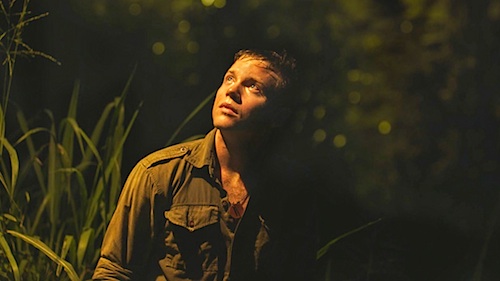
For a pilot like “Jim,” being shot down over the dense jungles of Singapore is a double-edged sword. The thick vegetation provides natural cover, but it is an unforgiving and disorienting environment. It makes it difficult to distinguish friend from foe, which becomes an issue when he encounters “Seng.” Somehow, he conveys to Jim he is a Singaporean-Chinese soldier trapped behind enemy lines. An alliance is quickly forged, but few words are exchanged. Even if they were not stealthily evading the Japanese patrols, they could not understand each other anyway.

With its near complete lack of dialogue, Nic Buchanan & Rodney Lowe’s stunning sound design, and Stefan Duscio’s ominously beautiful cinematography, Canopy is likely to generate comparisons to Terrence Malick. It is a richly crafted film, but it is also a taut viewing experience that packs a real emotional wallop. With incredible subtlety, Wilson implies whoever survives the long dark night will honor the memory of their fallen nocturnal comrade for the rest of his life. Clearly, the length of time is not important in Canopy. Rather it is the intensity that matters.

Frankly, it is quite a complement to contend Canopy’s eighty-four minute run time (including credits) actually feels short, given its quiet wordlessness and the measured deliberateness with which Wilson submerges viewers in the murky setting. Yet, just as it is for Jim and Seng, Canopy is over before you know it.

From "Canopy."

Given Wilson’s approach, Canopy necessarily entails a distinct acting challenge for his two co-leads, but they rise to the occasion quite impressively. For Khan Chittenden, looking like a younger Matt Damon is probably both a curse and a blessing, but such cosmetic matters quickly melt away in Wilson’s jungle. As Jim, he expresses the film’s spirit of solidarity in a way that is genuinely moving. Likewise, the Taiwanese Mo Tzu-yi is silently eloquent and utterly believable as the wounded but resourceful Seng.

Co-productions are all the rage right now, but unlike Hollywood courting China, audiences can feel good about what this Australia-Singapore joint venture represents. Canopy violates nearly every war movie convention, yet it better represents the realities of combat than most of its forerunners. Highly recommended (for disciplined audiences), Canopy opens this Friday (8/29) in New York at the Elinor Bunin Munroe Film Center.

LFM GRADE: A-

Posted on August 25th, 2014 at 10:04pm.