LFM Reviews Zero Pro Site: the Movable Feast @ The 2014 New York Asian Film Festival

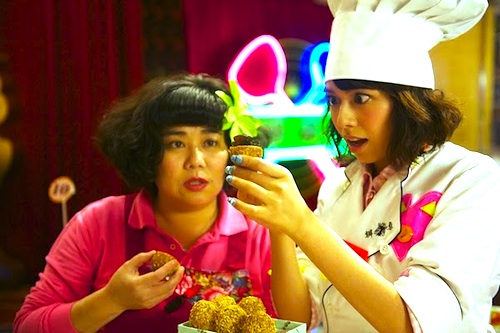
By Joe Bendel. Master Fly Spirit’s food was sort of slow and reasonably local. Most of all, it was entirely traditional, making it difficult to replicate in these times. His daughter Chan Hsiao-wan is learning that the hard way. She had always planned to be an actress or a model, but she is falling back on the old family catering business after tasting the cold hard realities of showbiz in Chen Yu-hsun’s awkwardly titled Zero Pro Site: the Movable Feast, which screens during the 2014 New York Asian Film Festival.

Chan was always better at being cute than responsible, so she would be just the type to innocently co-sign on a deadbeat boyfriend’s loan. When he takes to the wind, two loan-sharks come to collect from her. Fleeing Taipei, she eventually reconnects with her stepmother, “Puffy” Ai-feng who is also evading debt collectors. Unfortunately, “Puffy” earned her new nickname when she sacrificed her savings and her late husband’s reputation in an ill-advised showdown with his faithless apprentice. However, Chan’s sunny personality and a few long forgotten traditional dishes start attracting customers to their greasy spoon.

Not surprisingly, Chan has been a poor steward of her father’s recipes, so she seeks help from a variety of sources, including his happily addled teacher Master Tiger Nose and the itinerant “Dr. Gourmet,” a.k.a. ex-con Yeh Ju-hai. However, just as things start to develop between her and Yeh, he jumps ship to assist his teacher, the gangster caterer Master Ghost Head. Even without Yeh’s help, Chan places her future hopes in a national catering competition, duly impressing the loan-sharks into kitchen service, as could only happen in romantic comedies. Yet, to truly cook in a traditional manner, she will have to fully engage with the past.

Yes, there is a lot of food in ZPS, as metaphors, comedic props, and a way to celebrate Taiwanese cultural identity. Yet, it only serves a limited courtship function. While the film certainly has a dash of romance it is more about familial legacies and finding one’s place in the world. Like Chan’s turtle-stuffed chickens, the film is also bursting at the seams with supporting characters, so if one is too goofy and outrageous for your tastes, just wait for a more understated type to come along.
From "Zero Pro Site: the Movable Feast."

As Chan, Kimi Hsia is relentlessly silly and sweet, without getting viewers’ nerves. She forges some respectable screen chemistry with Tony Yang, even though Dr. Gourmet largely vanishes during the second and third acts. Top-billed Lin Mei-hsiu initially mugs something fierce as Puffy Ai-feng, but she reins it in to some extent as the dramedy starts to develop. Although there is a lot of colorful wackiness going on, the film draws a lot of heart from its senior cast-members, such as the recently reunited old couple, who want Chan to cater their wedding in the manner they remember from their youth.

ZPS is fun, it is endearing—it really could have been ninety some minutes. Over two hours of food and nostalgia is starting to push it. Still, Chen ties up all his subplots fairly neatly. He might have more secondary characters than Around the World in Eighty Days, but he develops a rather high percentage of them. Frothy and pleasing, it delivers some potent wistfulness along with its liberal servings of food and scrappy underdog resiliency. Recommended for fans of generation-spanning culinary cinema, Zero Pro Site—The Moveable Feast screens today (7/5) at the Walter Reade Cinema, as part of this year’s NYAFF.

LFM GRADE: B-

Posted on July 5th, 2014 at 2:08pm.
LFM Reviews Fuku-Chan of FukuFuku Flats @ The 2014 New York Asian Film Festival

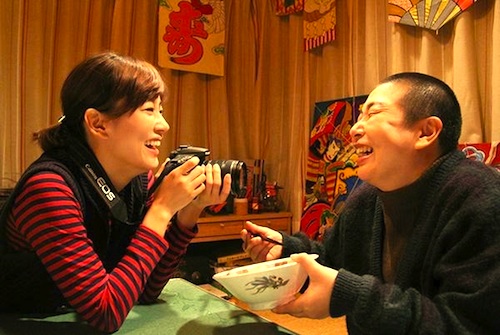
By Joe Bendel. FukuFuku Flats is a low rent complex nobody would ever confuse with Melrose Place. Tatsuo Fukuda, a.k.a. Fuku-chan, does not exactly have the sort of face you usually see on network television either, but an aspiring photographer from his past finds it inspiring. Lead actress Oshima Miyuki represents a rather unconventional casting choice as well, but she poignantly expresses Fukuda’s loneliness and fear of rejection throughout Yosuke Fajita’s Fuku-Chan of FukuFuke Flats (see clip above), which screens during the 2014 New York Asian Film Festival.

As the foreman of a crew of painters, Fukuda always sticks up for the underdog. He also throws a lifeline of friendship to the only tenants in his building more socially awkward than himself. His friend Shimacchi is constantly trying to fix Fukuda up with his wife’s friends, but it never works. The kite-flying enthusiast is simply too intimidated by women—and it is largely Chiho Sugiura’s fault.

While it school, she played a crucial role in a prank that still haunts Fukuda. However, karma has come around. Her decision to quit her job to pursue photography fulltime is not exactly paying dividends. To cover her cosmic overdraft, Sugiura finds Fukuda to apologize, only to be staggered by the character she sees in his face. Initially, he wants nothing to do with her, but it is hard to resist the attention of an attractive woman, despite their complicated history (or perhaps especially because of it).

Clearly, a connection is made, but does it have the same meaning for Fukuda and Sugiura. That is a question that concerns Shimacchi. Yet, Fajita is most forgiving of Sugiura, who is nothing like the mean girl she once was. She is just confused. There are no villains in FukuFuku, just people trying to get by as best they can. It can be especially difficult when you are stark staring bonkers, as is at least one of Fukuda’s neighbors.

From "Fuku-Chan of FukuFuku Flats."

While the casting of Miyuki (a comedic performer known for her old men characters) might sound like broad gender-bending comedy in the tradition of Hairspray, there is no ironic winking. FukuFuku is a comedy, but Miyuki plays Fukuda scrupulously straight. Frankly, a more apt comparison would be Linda Hunt in The Year of Living Dangerously, even though the film’s tone is radically different.

Asami Mizukawa’s Sugiura is also terrifically understated, but completely engaging as she wrestles with her feelings, while trying to figure out how she made a hash of her life. (Unfortunately, her creepy encounter with a would-be photography mentor feels out of place in the otherwise wistful and honest relationship dramedy.)

Aside from that rare misfire, Fajita agilely pirouettes from everyday comedy of observation, to halting romance, and even potential tragedy, while maintaining a deceptively light touch. Endearing but never cloying, Fuku-Chan of FukuFuke Flats is recommended for those who enjoy messy but mature character-driven films when it screens today (7/3) at the Walter Reade Theater, as part of this year’s NYAFF.

LFM GRADE: B+

Posted on July 3rd, 2014 at 11:29am.

LFM Reviews The Newly Restored A Hard Day’s Night

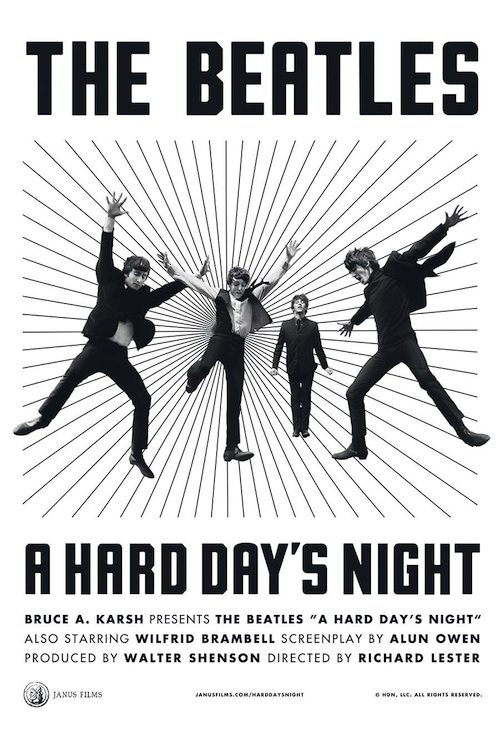
By Joe Bendel. Oddly, nobody actually says the word “Beatles” in their first movie. It’s not like anyone needed to. It was clearly emblazoned across Ringo’s bass drum. Of course, just about everyone knew who they were. Beatlemania was already a full-fledged phenomenon that would be even further stoked with the initial release of Richard Lester’s A Hard Day’s Night. Digitally restored by Janus Films in time for its fiftieth anniversary, Lester’s iconic introduction to the band re-releases this Friday at New York’s Film Forum.

If you are still trying to figure out if the four lads from Liverpool were mods or rockers, you will not get a straight answer in AHDN, but that is all part of its charm. Instead, the Beatles just sort of be themselves as they gracefully deal with the challenges of superstardom, while trying to keep Paul’s grandfather out of trouble (his other grandfather). They run from hordes of screaming fans, play sound-checks, accidentally get arrested, and generally riff off each other. It is all still breezy fun fifty years later thanks to the wit and easy charm of Alun Owens’ screenplay and the Beatles themselves.

Looking back at AHDN, it is remarkable how profoundly it shaped our perceptions of the Beatles’ personas: George is the cerebral one, John is the snarky one, Paul is a bit of a pushover, and Ringo is a goof. It also established a deceptively easy formula that has proved exceedingly difficult to emulate, as a host of meet the band box-office duds proved (Spice World, anyone?). To be fair, it is hard to compete with enduring original songs like the title smash hit, “All My Loving,” “And I Love Her,” “I Should Have Known Better,” and “She Loves You.”

Lester and the Fab Four also had a not-so-secret weapon in veteran comedic character actor Wilfrid Brambell, who was then nearly as recognizable as the Beatles from his leading role in the hit sitcom Steptoe and Son (remade in America as Sanford and Son). He has a way of mugging that seems rather dryly amusing. He also demonstrates perfect timing playing off the Lads. Likewise, Neil Aspinall and Mal Evans do a Mutt-and-Jeff routine as characters based on the Beatles’ personal assistant and road manager that nicely balances broad rubber-faced comedy with a kind of hyper-real sense of what it must have been like to ride the Beatles whirlwind.

AHDN provides a time-capsule of mid-1960s London, where you could buy milk from vending machines and television broadcasts involve transistors and dials. Yet, it still feels fresh and unspoiled. It is rather mind-boggling to suggest this, but AHDN would be a fine way for parents to introduce their children to the Beatles, because despite their mischievous inclinations, they essentially come across as good kids. More importantly, it is just funny in a good-hearted way and rocks (innocently and politely). It is a true classic that looks and sounds great after Janus’s careful 4K restoration. Highly recommended for any serious film lover, A Hard Day’s Night opens this Friday (7/4) at Film Forum.

LFM GRADE: A

Posted on July 1st, 2014 at 11:50pm.

Himalayan Heroics in 3D: LFM Reviews Beyond the Edge

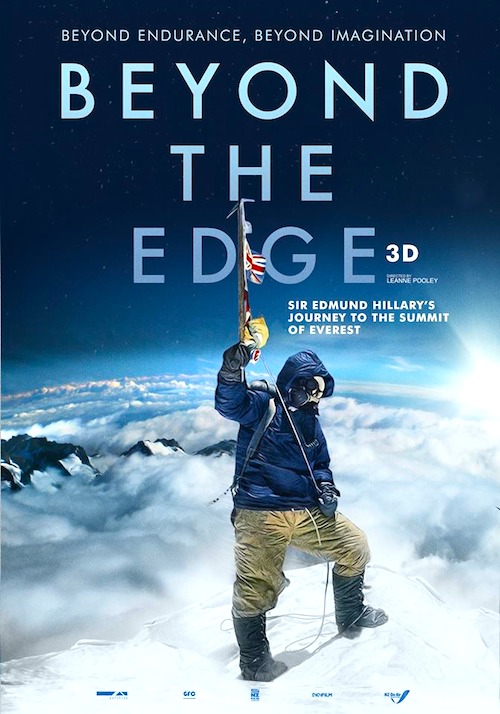
By Joe Bendel. The conquest of Mt. Everest is considered the final crowning achievement of the British Empire, but it was successfully completed by a New Zealander and a Nepali (or possibly Tibetan) Sherpa. It was a nearly impossible climb with early 1950s gear – that was further complicated by the odd logistical error here and there. However, Sir Edmund Hillary and Tenzing Norgay were part of a generation that refused to substitute excuses for success. The story of their summiting is recounted and recreated in Leanne Pooley’s 3D documentary Beyond the Edge, which opens this Friday at the IFC Center.

Before Hillary joined Colonel John Hunt’s 1953 expedition, the Everest statistics told a grim tale: “thirteen deaths and no summits.” Hillary, an unassuming bee-keeper, was one of only two New Zealanders in Hunt’s party, but he truly looked like a mountaineer. He also had the skills and the drive to for the final push. Unlike most of his Sherpa colleagues, Tenzing Norgay also had a climber’s ambition to summit—and summit first. Like good Survivor contestants, they sized each other up, recognized their compatibilities, and formed an alliance. Soon they were a team, hustling to establish a path through the dreaded icefall to impress Hunt.

Yes, there will be setbacks and complications. One of the strangest aspects of Beyond is the way its vocabulary more often evokes horror films than National Geographic specials. There are references to the “Death Zone” immediately below the summit and the “stench of death” asserting itself even before that stage. Nevertheless, Beyond is visually awe-inspiring. The 3D adds depth, but is not absolutely necessary—the spectacle of the Himalayas does not need punching-up. For her hybrid approach, Pooley seamlessly integrated restored 16mm color footage shot by the Hunt expedition with dramatic recreations mostly filmed in New Zealand’s Southern Alps. Just watching the immersive visuals will make viewers feel chilly and light-headed.

There is also plenty of expert commentary in Beyond, but Pooley eschews the traditional talking head approach, opting instead for disembodied voice-overs, sort of like Room 237, except her professionals are insightful and experienced Everest veterans rather than cracked eccentrics. The enthusiastic participation of Hillary’s mountaineering son Peter and Tenzing Norgay’s son Norbu Tenzing also adds apostolic credibility.

Mountain climbing sequences used to be where movies went to die (MST3K’s “rock climbing” riffs for Lost Continent pretty much said it all), but documentaries somehow managed to crack that nut. Like Nick Ryan’s K2 doc The Summit before it, Beyond is tight, tense, and very cinematic. Yet, instead of a tragic cautionary tale of reckless overreach, Pooley’s film celebrates courage, ambition, and sheer will power. No mere Discovery Channel special, it is much more dramatic and entertaining than you would expect. Highly recommended for sporty audiences, Beyond the Edge opens this Friday (7/4) in New York at the IFC Center.

LFM GRADE: B

Posted on July 1st, 2014 at 11:45pm.

LFM Reviews Blind Massage @ 2014 New York Asian Film Festival

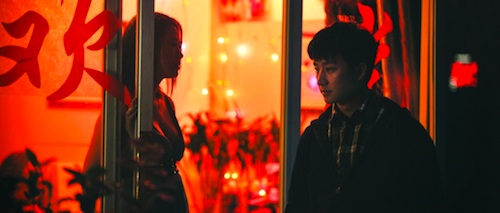
By Joe Bendel. Real massage therapists have anatomical and physiological training to rival doctors, but it remains a widely misunderstood profession. Perhaps in hopes of separating the therapeutic and sensual connotations, it has been one of the few avenues of employment traditionally open to the blind in China. The so-called “doctors” of such a Nanjing clinic are highly skilled, but also deeply human. Their lives will connect and conflict in Lou Ye’s ensemble drama Blind Massage (clip above), which screens during the 2014 New York Asian Film Festival.

The staff is blind, but the patients are entirely sighted, at least as far as we know. That itself is a role reversal. The Sha Zongqi Massage Centre is run by the gregarious Sha Fuming and his reserved partner, Zhang Zongqi, who always try to place new therapists in need of work. Their latest two recruits come with issues. Sullen Xiao Ma gradually lost his sight during his early teen years and has yet to come to terms with his blindness. In contrast, Dr. Wang had once amassed a sizable nest egg, but he lost it all during the financial crisis, forcing him to ask his old friend Sha for a job.

The relationships between staff members will become complicated, like a Chinese massage version of ER. Xiao Ma will be recklessly attracted to Dr. Wang’s partial sighted fiancée Kong, before developing a full-on obsession for local (fully sighted) prostitute Xiao Man. Despite Xiao Ma’s frequent brothel patronage, his beautiful colleague Du Hong nurses an attraction to him, while rebuffing the advances of the desperately lonely Sha.

About a dozen other characters factor into the mix somehow. Frankly, Blind Massage is a bit unwieldy with subplots, but it is hard to say where to cut, because they each work on their own terms. The film was adapted by Lou’s documentary filmmaker wife Ma Yingli from Bei Feiyu’s novel that has already been produced as a multi-part television drama—and it is easy to imagine these characters working in a telenovela format.

However, Lou’s approach is distinctly cinematic, approaching the experimental. His past films have directly raised issues of perception (particularly last year’s NYAFF selection, Mystery), but he takes it in a different direction during Blind Massage, visibly reducing the light and softening the focus during scenes driven by blind characters and reverting to standard levels for sequences involving sighted characters or expository housekeeping. He also employs a narrator to read the unseen credits and provide background information on characters, evoking the experience of enhanced visual descriptions.

Blind Massage captures the arbitrary unfairness of life in vivid terms, but that also offers an opportunity for unlikely cast-members to shine. As a case in point, Guo Xiaodong’s Dr. Wang seems rather unassuming, until blowing the doors off the joint in a confrontation with loan sharks dogging his irresponsible, sighted younger brother. It is a scene and a performance worthy of Shakespeare’s Merchant of Venice.

From "Blind Massage."

Mei Ting also pulls the emotional rug out from under us, as the ostensibly standoffish, Du Hong. She resents the fuss made by her colleagues (especially Sha) over the beauty they can never see, yet experiences some of the film’s greatest heartsickness.

On its face, Blind Massage is totally apolitical, but You is still pushing boundaries with its uncomfortable intimacy and matter-of-fact description of contemporary Chinese life for any sort of underdog population. It seems downright tame by our standards, but considering the Puritanism of Communist censors, many scenes represent no small risk to You’s standing. Yet, they are never gratuitous, well serving the characters’ emotional development at crucial junctures. Despite a bit of narrative messiness, it is an engrossing film that pulls viewers into the lives on screen in a vivid, ambitiously experiential way. Recommended for mature audiences, Blind Massage screens Wednesday (7/2) at the Walter Reade Theater, as part of this year’s NYAFF.

LFM GRADE: B+

Posted on July 1st, 2014 at 11:40pm.

LFM Reviews Kano @ The 2014 New York Asian Film Festival

By Joe Bendel. Sure, a three hour baseball movie might sound like bizarre overkill, but it is still considerably brisker than many of Al Leiter’s outings for the Mets (we’re all fans here, by the way). It is long, but this scrappy underdog story of tolerance and resilience generally makes good use of its time. Taiwanese and Japanese players will indeed come together on the diamond in Umin Boya’s Kano, the centerpiece selection of this year’s New York Asian Film Festival, which screens Sunday, so forget that World Cup noise.

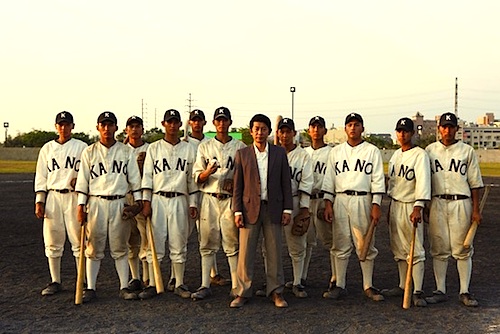
Despite the spectacular revolt dramatized in co-writer-producer Wei Te-sheng’s Warriors of the Rainbow: Sediq Bale, Japan has consolidated its imperialist hold on Taiwan. Despite the increasing (but unequal) economic ties between the two countries, Taiwan is not where the Japanese go when their careers are on the way up. However, for tightly wound account Hyotaro Kondo, it represents a chance to start over following a vaguely defined public humiliation. Yet, against his better judgment, Kondo soon volunteers to coach the Kagi Agriculture and Forestry Public School’s high school baseball team (called Kano for short).

It was Kondo’s intense coaching style that led to so much grief in Japan, but he has never had a team like this. For one thing, it is an ethnically mixed squad, consisting not just of Japanese and Taiwanese players, but aboriginal and Chinese students as well. They also receive next to no material support from their school. Still, Akira Go, the kid on the mound, has a monster arm. Everyone scoffs when Kondo vows to take the team to Koshien, Japan’s national high school tournament, especially given their ‘O-fer record, but guess what happens next year.

Despite its incontrovertible status as a sports movie, Kano neatly sidesteps a number of the genre clichés. The big game will duly choke you up, but in a far more satisfying way than you expect. Coach Kondo even says there is no crying in baseball, but good luck with that.

Masatoshi Nagase is truly the coach of all movie coaches as the strict but fiercely loyal Kondo. He commands the screen just like Kondo commands his players, but when he lets his softy paternal side peak through, it is always heavy. Oddly, perhaps the most distinctive supporting turn amongst the players is actually Ken Aoki as rival pitcher Hiromi Joshiya, whose trip to see Kano’s dirt playing field for himself while on leave from the Imperial Army supplies the film’s framing device. British based Japanese actor Togo Igawa also adds a note of gruff dignity as Kondo’s former mentor, Coach Sato.

From "Kano."

Production designer Makoto Asano’s recreation of 1931 provincial Taiwan looks so real you can practically taste the mud and thatch. It is a high quality period production and probably the most epic baseball movie ever thanks to cinematographer Chin Ting-chang’s sweeping, wide screen visuals. Yet, the on-field camaraderie is not simply a good lesson in sportsmanship. It looks like a conscious attempt at Taiwanese-Japanese rapprochement , strategically coming at a time of high Mainland saber rattling (and frankly that is probably not a bad impulse to act on).

Happily, Kano does not feel like it runs anywhere near its three hours, but there is no getting around the generous helpings of baseball. As great as Nagase is, Kano’s appeal will probably be limited to fans of the game (which includes just about everyone in Taiwan judging from its domestic box-office). Earnest, entertaining, and appealingly old fashioned, Kano is recommended for lovers of baseball and those who follow Japanese and Taiwanese cinema when it screens Sunday evening (6/29) at the Walter Reade Theater, as the centerpiece of this year’s NYAFF.

LFM GRADE: B+

Posted on June 29th, 2014 at 12:14am.