LFM Reviews Manuscripts Don’t Burn

By Joe Bendel. It was a dirty war Iran launched against itself. From 1988 through 1998, over eighty writers and reformist intellectuals are now thought to have been assassinated at the behest of high-ranking clerics and intelligence officials. Eventually, the nebulous outlines of the conspiracy were exposed by journalists subsequently railroaded on dubious criminal charges. Tackling the so-called Chain Murders (or events very much like them) would be a perilous course of action for any Iranian filmmaker hoping for official sanction, but as it happens, Mohammad Rasoulof has already been sentenced to a twenty year filmmaking ban. Produced entirely underground, Rasoulof’s Manuscripts Don’t Burn is a jaw-dropping feat of artistic integrity, which opens a week long engagement at MoMA this Friday.

Khosrow and Morteza are blue collar workers. They abduct, torture, and assassinate intellectuals thought to hold counter-revolutionary ideas by their Islamist masters, especially those looking to publish their work. The memoir of dissident writer Kasra would be particularly incendiary because it addresses the role played by the current intelligence minister in the attempted assassination of twenty-one public intellectuals on their way to a writers’ conference in Armenia.

In an effort to protect his manuscript, Kasra has sent copies to two of his lucky intelligentsia friends. Unfortunately, the secret police already have this intel, so Khosrow and Morteza are soon dispatched to torture the poet Kian and eventually fake his suicide. It is an assignment that comes at a bad time for Khosrow. Unlike the more mercenary Morteza, he fervently believes in the righteousness of the state ideology. However, his wife is convinced their son’s severe health issues are a form of divine retribution for the crimes he has committed. To make matters worse, the apparatus of terror has been slow to make the payments he so desperately needs for his son’s surgery.

The word bold just does not do Burn justice. Rasoulof shines a spotlight on censorship, torture, state-sponsored murder, and religious hypocrisy, all of which look even worse than one would imagine. If he missed a third rail, it would have to be the condition of women under the misogynist regime, but Burn offers more than enough to process as it is. Employing a cast and crew of expatriate Iranians, all of whom remain uncredited for their protection, Rasoulof’s film feels relentlessly authentic. Yet, despite the power of its indictment, Burn still functions as a taut political thriller.
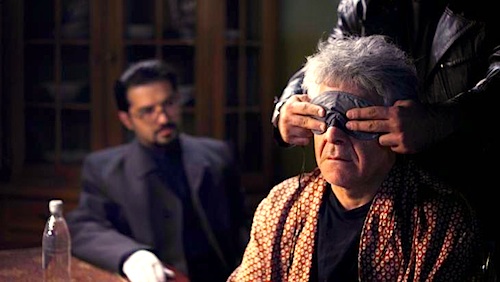
From "Manuscripts Don't Burn."

Hopefully, one day soon we will safely know the identity of Rasoulof’s artistic collaborators. For now, we can only give them a collective ovation, but the fearless actor playing Kian deserves special mention. The Academy and its brethren should review their bylaws regarding anonymous work, because his performance as the suave, world weary poet truly merits award consideration. Likewise, the screen thesp cast as Khosrow creates a deeply riveting portrait of guilt and fanaticism, making it impossible to dismiss the film as mere polemics.

Like the work Jafar Panahi produced in defiance of his own filmmaking ban, Burn is about as independent as a film can get. It is also a masterwork from an accomplished artist. The allusion to Mikhail Bulgakov makes it even timelier, given Russia’s recent military adventurism with respects to its former Soviet era captive nations. Tragically though, the title is rather ironic—manuscripts really do burn—and so do writers. Very highly recommended, Manuscripts Don’t Burn opens this Friday (6/13) at MoMA, as part of their ongoing ContemporAsian film series.

LFM GRADE: A

Posted on June 12th, 2014 at 8:24pm.

LFM Reviews West @ New York’s 2014 KINO! Festival of German Films

By Joe Bendel. During the late 1960s, the New Left popularized the slogan “the personal is political.” They did not do Nelly Senff any favors by doing so. When she crosses over to West Berlin, she cites “personal reasons” as her motivation, but the Allied security services are primed to distrust such evasive answers, for good reason. Senff quickly learns she might be unwittingly caught amidst a wider conspiracy in Christian Schwochow’s West, which screens during the 2014 KINO! Festival of German Films in New York.

Senff was once a leading scientist in East Germany, much like her late Russian partner, Wassilij. He was an erratic presence in her life and that of their son, Alexej, but they still miss him dearly. Therefore, it is a bit of a shock when Senff learns that her roguish lover was also a Stasi courier, who perhaps faked his death to escape their grasp. Keen to find out his whereabouts, the various agencies withhold Senff’s requisite approvals until she gives them answers. That means for the foreseeable future, she and Alexej will be stuck in the gray, institutional Marienfelde Refugee Center and not legally employable.

The respectable West is not nearly comparable to Petzold’s Barbara or Donnersmarck’s The Lives of Others, but it never seeks to excuse or deny the human rights violations of the GDR regime. From what we see and hear in the film, life in the East was pretty bad. There is a fair amount of moral equivalency going on, but the Americans emerge looking the best, thanks to the sympathetic presentation and portrayal of CIA agent John Bird, playing with finely nuanced sensitivity by Jacky Ido.

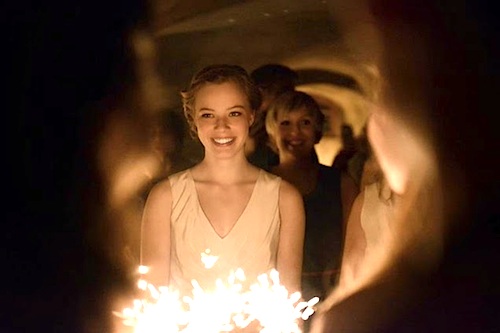
From "West."

For similar reasons, the obvious comparison between Nina Hoss’s Dr. Barbara Wolff and Jördis Triebel is not favorable to the latter. She does a fine job expressing Senff’s mounting paranoia, but she cannot reach the same levels of diffident defiance and quiet vulnerability.

Frankly, in terms of its structure and tenor, West is a bit erratic. Just when it is poised to become a Brezhnev era Third Man, it pulls back from the brink, settling for more domestic dramas. Still, it definitely convinces viewers government buildings are no place to raise a child. It also takes seriously the notion of Stasi persecution targeting GDR defectors.

Ultimately, West works towards a hopeful statement rather than an angry one, making it an interesting film to see in conjunction with Dercourt’s A Pact, also screening during the festival. It is a work of some merit, but it lacks the moral heft and tragic pay-off of its more heralded predecessors. Recommended with minor reservations, West opens this year’s non-MoMA KINO! with an invite only screening at the Museum of the Moving Image today (6/12), in advance of a forthcoming New York theatrical release.

LFM GRADE: B-

Posted on June 12th, 2014 at 8:18pm.

LFM Reviews A Pact @ New York’s 2014 KINO! Festival of German Films

By Joe Bendel. Is a former old East German informer really the Devil? He is rather Mephistophelean. Yet, in their school days, Paul Meier sort of got the better of Georg Schmidt. Meier’s karmic bill comes due years later, with substantial compounded interest, in Denis Dercourt’s A Pact, which screens during the 2014 KINO! Festival of German Films in New York.

The earnest young Meier was so smitten with Anna, he forged a supposed love note from her to him, in hopes of spurring the arrogant Schmidt to dump her. Surprisingly, it works. However, before stealing some other schmuck’s girl, Schmidt extracts a promise from Meier that will loom large. At some unknown point in the future, Meier must return his presumptive new girlfriend, should Schmidt duly request her.

One Unification later, Meier is reasonably happily married to Anna and the proud father of two classically German looking teenagers. Much to his surprise, the new boss of Meier’s investment banking firm turns out to be the very same Georg Schmidt. Initially, things are rather awkward between the two ex-friends. Of course, Schmidt is not exactly a touchy feely sort of fellow. He is, after all, the son of an East German cop, who knew how to drop a dime to further his interests. The doctored blackmail pictures Schmidt received of Meier in an apparently compromising position with his assistant do not help matters. Even worse, the international market turns against copper commodities, after Meier took a bullish position. At least he can still count on the firm’s security chief Daniel as a friend and ally.

Neither Meier nor the audience seriously considers his pal’s suggestion that Schmidt just might be Satan or some sort of djinn, but Meier’s paranoia will entertain just about any other possibility. Frankly, he is such a hapless victim, many viewers will probably start rooting against him. Still, it is hard to root for Schmidt, but Dercourt obliges with a third act, forehead-slapping game-changer.

A Pact is a tonal traffic jam that leaves dozens of question hanging unresolved, but it is never dull. It starts out as an East German Jules & Jim, detours through Jeffrey Archer territory and evolves into a payback thriller. Viewers who are easily annoyed by cinematic head-fakes will probably find more than they can take here. Still, it goes about its murky business with German professionalism. At times, Dercourt (the French expat) takes things over the top, but that is not such a bad thing.

From "A Pact."

As Schmidt, Sylvester Groth is memorably severe and calculating, setting the atmosphere of intrigue quite nicely. Poor Mark Waschke’s Meier is required to be a bit of a doormat, but Sophie Rois brings all kinds of barely submerged crazy as Schmidt’s fateful girlfriend, Yvonne. Likewise, Marie Bäumer is rather credibly ticked off with the disappointing men in her life, while Johannes Zeiler steals scenes in bulk as the resourceful womanizer, Daniel.

As in a great Hawthorne novel, the GDR past continues to exert a malevolent influence on lives in the present. Frankly, this is not a film a former East German apparatchik with a guilty conscience could enjoy. It clearly implies there are many who still remember the Communist era and are not willing to forgive. Recommended for those who enjoy psychological thrillers with the occasional melodramatic indulgence, A Pact screens this Friday (6/13), Sunday (6/15), and next Tuesday (6/17) as part of this year’s KINO! at the Quad Cinema.

LFM GRADE: B

Posted on June 12th, 2014 at 8:12pm.

LFM Reviews Hide and Seek; Now on DVD

By Joe Bendel. For the Occupy crowd and their allies in Congress, “I like it, I’ll forcibly take it” is an economic policy. In South Korea, it is the stuff of horror movies, or at least one very dark thriller. Violent and intrusive squatting has tormented the residents of a shabby tenement, but the terror is about to move on up George Jefferson-style in Huh Jung’s Hide and Seek, which just released on DVD from RAM Releasing, Film Movement’s relatively new genre division.

Baek Sung-soo has a lovely wife, two small children, and a mild case of germ-o-phobia. He also has an older brother Sung-chul, who has apparently gone missing. They were never very close, particularly after Baek inherited their parents’ entire estate, even though he was the adopted one. Of course, there is a good reason for that.

Visiting his brother’s dilapidated building, Baek learns that the tenants have been terrified by a peeping tom, who has a knack for invasive snooping. We also know from the prologue that at least one murder has been committed there. Brother clearly suspects brother, as Baek Sung-chul’s backstory is revealed, but whoever that motorcycle helmet wearing freak might be, he has followed the Baek family home to their tony Seoul high-rise condo.

Granted, most of the second act business is pretty straight forward woman-and-children-in-jeopardy stuff and the big third act revelation stretches credibility to the breaking point. However, it is Huh’s attention to creepy details that really elevates Hide. Shrewdly, he never overplays Baek’s OCD, using it for character development rather than as a major plot device. He also fully establishes the two very different housing complexes as distinct, physical locations, while steadily cranking up the sense of paranoia.

From "Hide and Seek."

Son Hyun-joo’s Baek always looks appropriately haggard, as if he were constantly in desperate need of an aspirin—even if he does just sort of plod along grimly. Although his wife Min-ji initially comes across as a sort of ice queen-trophy accessory, Jeon Mi-sun brings out the mother’s fierce protectiveness quite powerfully. Yet, perhaps the most effective performance comes from young Kim Ji-young, as little Pyeong-hwa, a neighbor of Sung-chul, who always turns up during especially dramatic and dangerous times.

Frankly, anyone down with the so-called “Occupy” movement has no grounds to protest the villainy afoot in Hide and Seek, beyond the aesthetic (“kill less and smile more, because it looks better”). It is a tense and unsettling depiction of a family’s sudden vulnerability to a predator, ironically cloaked by its fringe outsider status. It also gives us a vivid idea of what follows when bourgeoisie principles of property rights and the sanctity of life are thrown by the wayside. Recommended for fans of dark psychological thrillers and k-horror, Hide and Seek is now available on DVD from RAM releasing.

LFM GRADE: B+

Posted on June 12th, 2014 at 6:12pm.

Branagh Storms the Armory: LFM Reviews Macbeth

By Joe Bendel. Much to the regret of cineastes and Shakespeare connoisseurs, we can only speculate about what Olivier’s aborted Macbeth film could have been. At least we have auteurist adaptations from Orson Welles, Roman Polankski, and (sort of) Akira Kurosawa. Sir Kenneth Branagh (who picked up his fifth Oscar nod playing Olivier in My Week with Marilyn) has not yet helmed a big screen version of the Scottish Play, but patrons attending his new staging at the Park Avenue Armory will feel like they have seen it anyway, in widescreen 3D. An extremely cinematic Macbeth directed by Rob Ashford & Branagh officially opened last Thursday night, thoroughly dominating the cavernous Wade Thompson Drill Hall.

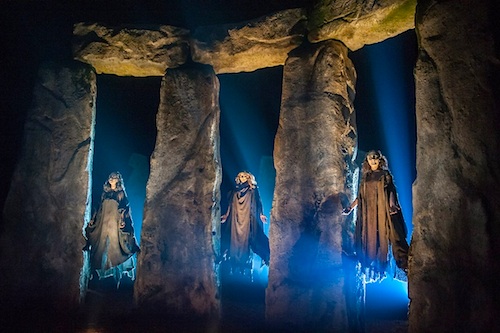
When transplanting their critically acclaimed Manchester International Festival production to the Armory, Ashford and Branagh decided to go large—really, really large. Seriously, we are talking big here. It is hard to describe the initial awe experienced walking to one’s seat through a recreation of Scotland’s moors, illuminated by hooded torchbearers, under the shadow of an enormous druid stone circle. That essentially covers the price of your ticket right there.

The druid stones are at one end of the stage and a massive candle-lit altar stands at the other. In between is a dirt battlefield, where Scotland’s thanes will get muddy, bloody, and dead. Two tiers of risers define the sides of the performance space, but despite their imposing size, it still feels like a surprisingly intimate viewing experience.

It is difficult to overstate the importance of set and costume designer Christopher Oram’s work. Yet, the show starts even before patrons enter, when they are assigned a clan and assemble with their kinsmen in one of the Armory’s historic chambers. There is no audience participation, per se, but it puts you on notice—this will not be a typical night at the theater.

Branagh brings it right from the start, with a full-scale battle sequence that brings to mind the melee of his classic Henry V. As you really ought to know, Macbeth is initially a heroic supporter of the king. Then three witches enter. They offer up a series of cryptic prophecies and soon Macbeth is up to his neck in murder most foul. Even with all the jaw-dropping spectacle on display, Branagh and company have to get down to business at some point, but fortunately he comes to make a statement.

As an old theater pro, Branagh could project to the back row with his head wrapped in gauze. While not a huge man, his Macbeth bristles with power, suggesting a sociopathic Medieval Napoleon. Frankly, most audience members are coming to give him a standing ovation, but he truly earns it. At times, Alex Kingston’s Lady Macbeth might be a bit too quiet for the staging, but her one-on-one scenes with Branagh have a raw physicality that is almost shocking. (Still, probably no one will ever match the sheer force of Roseanne Ma’s psychotic breakdown in the Pan Asian Rep’s Shogun Macbeth.)

From Kenneth Branagh's "Macbeth."

Unfortunately, several of the major thanes are rather overwhelmed by the staging, but Richard Coyle is the standout exception as Macduff. He was quite winning in Grabbers and impressively intense in Pusher, but he takes it to another level here, holding his own with Branagh. Just so we do not forget this is a Branagh show, Jimmy Yuill once again rejoins his frequent comrade as an unusually crusty and battle-hardened Banquo.

You really have to see the Armory Macbeth to fully get its full scope and impact. Ashford & Branagh have mounted what might well be the most ambitious staging of Macbeth, perhaps ever. Yet, they do not neglect the dramatic essentials. There is no need to tip toe around, referring to it as the Scottish Play sotto voce. This is Macbeth and it means business. Highly recommended for anyone who can possibly get to the Upper Eastside, Ashford & Branagh’s Macbeth ends its limited engagement on June 22nd at the Park Avenue Armory.

Posted on June 12th, 2014 at 12:59pm.

LFM Reviews Edge of Tomorrow

By Joe Bendel. You have to feel for the publishers of Hiroshi Sakurazaka’s light novel and manga, All You Need is Kill. They had a recognizable property with one of the coolest titles ever, but the studio changed the title of their live action adaptation to something sounding like a soap opera or an Edgar Cayce tract—and then they wonder why their tracking is soft. It is a shame, because the eternally recurring battle against alien invaders is rather snappily executed in Doug Liman’s Edge of Tomorrow, which opened Friday nationwide.

The so-called “Mimics” (because they are so blasted adaptable in battle) have overrun continental Europe, but somehow mankind held them off at Verdun. Victory was partly attributed to the development of their Iron Man-like exo-war “jackets” and partly to the leadership of warrior-extraordinaire Rita Vrataski, the “Angel of Verdun” (or “Full Metal Bitch” in the source novel). Embolden by humanity’s first battlefield success, General Brigham is poised to launch a D-Day-like counter-invasion of France. It will not go well, as soon to be ex-Major William Cage (formerly green recruit Keiji Kiriya) experiences over and over again.

Deservedly busted down to private for his incredibly stupid comments to Gen. Brigham, the military PR officer is now amongst the first wave of ground troops set to hit the beaches. Unfortunately, the Mimics know they are coming. Cage is indeed killed in rather short order, as are most of his new comrades, but not before he takes out an unusually large “Alpha” Mimic. Eventually, he learns he has been contaminated by their time altering power through its blood. Each time he dies, his incredibly un-fun day starts afresh. It has to be a clean death though. A transfusion will wash out his Mimic connection, whereas incapacitation would be the worst possible scenario.

Even though it is easy to recognize plenty of familiar military science fiction elements, Liman cobbles them together quite sure-handedly, adding the Groundhog Day twist. The action sequences are intense and brutally honest to the realities of any war. Frankly, there are a handful of moments of 3D shock and awe, but it is mostly unnecessary (as you probably already guessed). The battery of screenwriters also convey as decent sense of the soldier’s perspective and attitude. Yet, the film is relatively circumspect drawing D-Day parallels, notwithstanding the June 6th release date.

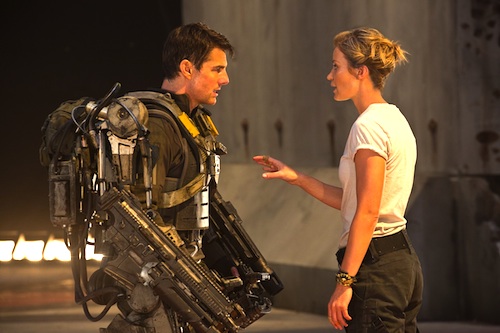
From "Edge of Tomorrow."

Younger readers might be interested to know Tom Cruise was once one of the biggest box office stars in the world, before he started handing out flowers at the airport, or whatever. This is the sort of role that used to be his bread-and-butter in the 1980s: the callow hotshot forced to mature thanks to the help of a more experienced woman. It might be a familiar arc for him, but he does not slack on the energy level. Yet, it is Emily Blunt who really delivers the grit and action cred as Vrataski. Science fiction fans will also enjoy watching Bill Paxton play with and against his Aliens persona as the hard-charging Master Sergeant Farrell Bartolome.

There are a handful of moments in Edge that will make the hair on the back of your neck stand on end. Unfortunately, the ending feels like a tacked on exercise in Hollywood gooeyness, almost undoing the in-your-face integrity of everything that came before. Nevertheless, there is more than enough amped-up genre action and time paradox-tripping to satisfy high concept, big budget science fiction fans. Recommended accordingly, Edge of Tomorrow opened Friday across the country, including the AMC Empire in New York.

LFM GRADE: B

Posted on June 12th, 2014 at 12:54pm.