LFM Reviews A Stranger @ The 2014 Bosnian-Herzegovinian Film Festival

By Joe Bendel. For cineastes, the notion of divided cities conjures images of The Third Man’s occupied Vienna. In contrast, there is nothing particularly mysterious about the effective religious-ethnic cleaving of Mostar. The bridge has been rebuilt but the distrust lingers between Muslim Bosniaks and Catholic Croats. Unfortunately, Slavko is not the sort of man to personally span that gap in Bobo Jelčić’s A Stranger, the closing selection of this year’s Bosnian-Herzegovinian Film Festival in New York.

Slavko has surely seen plenty of funerals by now, yet the death of his Muslim friend Đulaga still represents quite a dilemma. Although they had not seen each other since the troubles began, he knows he should pay his last respects. However, if he is seen attending the Muslim service, there could be very real repercussions in the neighborhood and perhaps even with the local bosses. On the other hand, if he does not go, he will completely lose the respect of his wife Milena, as well as his remaining shreds of self-worth.

Evidently, Jelčić’s character-types have deep resonance with the local audience, but they will not be so difficult for Americans to relate with. Frankly, Slavko is not a bad man. He is simply a small man. This often leads to minor everyday tragedies whenever he might find himself tested.

In a way, Slavko demonstrates how divided cities do not just cause divided peoples, but also fractured people. He is the “Stranger,” a title that evokes Camus and Graham Greene more than a painfully self-conscious, late middle-aged protagonist. At the very least, he is prone to profoundly darker Walter Mitty flights of fantasy. Yet, we start to wonder how firm his grasp truly is when his grim reveries start to jarringly intrude upon the on-screen narrative.
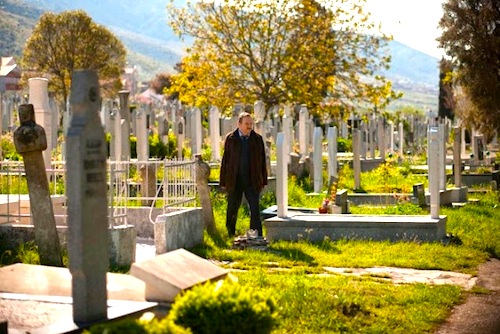
From "A Stranger."

Bogdan Diklić, a Croatian born veteran of cinema across the Balkans, is a nervy screen presence, completely pulling viewers into his neurotic inner turmoil. He makes it dashed tricky to pass judgment on Slavko (lest we be judged under similar circumstances), even though Milena and Jelčić clearly have no problem doing so. In fact, Nada Đurevska undercuts him rather powerfully as the increasingly disappointed Milena. At times, her body language is quite the scathing indictment.

Without question, A Stranger represents art cinema at its least compromising, yet its themes still have resonance, particularly for those with roots in Bosnia-Herzegovina, or so we should hope. As the closing feature, it played to an impressively packed house, with overflow forced onto folding chairs in the aisles.

Regardless, it is nice to see the festival slowly but steadily grow year-by-year. Always a major event for the expat community, its general interest film following is also starting to build. While the themes are often heavy, patrons will find the festival itself to be friendlier and more relaxed than the other New York film happening that typically precedes it. Highly recommended as a New York film tradition, the eleventh annual Bosnian-Herzegovinian Film Festival came to a close recently, but watch their social media for news on next year’s edition.

LFM GRADE: B-

Posted on May 8th, 2014 at 11:29pm.
LFM Reviews Documentary Shorts @ The 2014 Bosnian-Herzegovinian Film Festival

trailer TALES FROM A FORGOTTEN CITY from Amir Grabus on Vimeo.

By Joe Bendel. They are the things that unify a country. Music, culture, humor, and you had better believe sports all very much define a nation’s character. Four short documentaries addressing such aspects of Bosnian cultural identity (to varying degrees) screened last Friday night at the 2014 Bosnian-Herzegovinian Film Festival in New York.

Dragi Šestić’s efforts to assemble and record a sevdah supergroup are not unlike the Buena Vista Social Club record and film, except the producer was working in his own country, documenting a musical form that was very vital in his beloved Mostar not so long ago. Arguably, Sevdalinka songs and the sevdah sensibility are roughly akin to American blues songs and the larger feeling for the blues, but the former is more refined compared to the latter’s earthiness.

Amir Grabus focuses on Šestić’s Mostar Sevdah Reunion, keeping an emphasis on performance throughout the program opening Tales from a Forgotten City (trailer above). While the playing is virtuosic, the mood is rather wistful, befitting Šestić and Grabus’s elegy to the romantic Mostar that no longer exists. Although Grabus had directed straight-up music videos for the MSR, Tales is a proper documentary that deserves further play at musically-focused festivals.

Once again, BHFF regular Nedžad Begović returned with Beško, another short documentary profile. While musician-filmmaker Beško is more prominent than the working class protagonist of Zizi, they both project everyman personas and share raucous senses of humor. Clearly, Beško was a hit with festival patrons, but it might be best enjoyed by those who can fully appreciate the idioms and cadences of his jokes, sans subtitles.

Unfortunately, Mirna Dizdarević’s Vita Mulier is sort of the ringer of the short doc program, documenting the hard times that have befallen classical ballet in Sarajevo. It is earnest, rather pessimistic, but relatively brief.

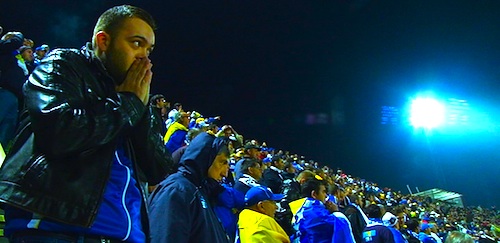
From "Bosnia in Our Hearts."

In contrast, Sixten Björkstrand’s Bosnia in Our Hearts is heartfelt and optimistic. 2014 is the first year Bosnia-Herzegovina qualified for the FIFA World Cup as an independent nation—and don’t you forget it. The Finnish filmmaker followed several expatriate fans as they traveled to Lithuania for what might be the game to clinch their World Cup berth. For the fans that came to Finland as wartime refugees, a Bosnian victory will be especially sweet.

Although forced to serve as a crew of one, Björkstrand always managed to be in the right place to get the right shot. It is the sort of film that captures the extent to which a sports team can carry its nation’s hopes and aspirations. Frankly, ESPN should take a good look at it, because it is considerably more engaging and satisfying than Maradona ’86 and The Opposition, their two very so-so short football/soccer docs that premiered at Tribeca.

It is hard to go wrong with sevdalinka and soccer. Tales from a Forgotten City and Bosnia in Our Hearts were definitely standouts when they screened last week during Program #3. As satisfying, self-contained films with broad popular appeal, they deserve a serious look from other festival programmers.

Posted on May 8th, 2014 at 11:23pm.

A Novitiate Nun in Communist Poland: LFM Reviews Ida

By Joe Bendel. In Communist Poland, a vow of poverty hardly mattered. For one nun in training, the most challenging part of her novitiate will be meeting her sole living relative. It leads to some profound soul searching in Pawel Pawlikowski’s Ida, which opens today in New York.

Convent life is all Anna has ever known. Orphaned as an infant, the young woman will soon take her vows, but the mother superior insists she first visit her aunt Wanda. Neither has been pining to meet the other, in part because of what they represent. While Anna identifies with Poland’s strong Catholic tradition, Wanda is a notorious Stalinist era prosecutor and judge. “Red Wanda” as she is known, now lives a boozy, solitary existence, only occasionally relieved by brief “carnal” distractions. When Anna arrives unannounced, Red Wanda reveals the young woman’s true identity, almost as an act of hostility. Anna was actually born Ida Lebenstern to Jewish parents who perished during the war.

Despite her abrasive welcome, Red Wanda quickly warms to her niece, agreeing to set out with her in search of her parents’ remains. It will be a rather tricky task, given their sketchy information. Simultaneously, Red Wanda does her best to play Anna’s devil-on-the-shoulder, trying to convince her to sample some of life’s more adult pleasures before she completely renounces the secular world.

Ida might be opening May 2nd (the day after May Day), but audience members should take a heavy coat to the theater, because it is one of the chilliest films you will ever see. 1962 was a relatively stable period for Communist Poland (compared to the subsequent anti-Semitic campaign and imposition of martial law), but it was still a time of scarcity and drabness. Nonetheless, jazz was on the upswing with the smart set and not yet explicitly on the outs with the authorities. It just so happens, Lis, a talented saxophonist gigging at their provincial hotel, attracts Wanda’s leering stare and the awkwardly demur notice of her niece.

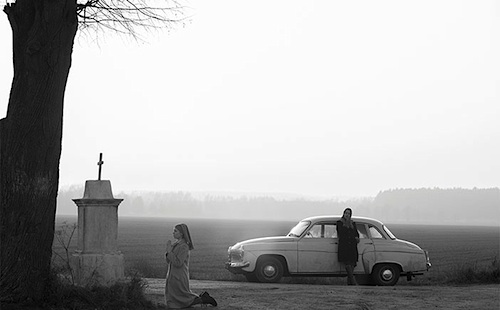
From "Ida."

Arriving on the heels of Władsław Pasikowski’s more confrontational Aftermath, Ida is clearly part of Poland’s continuing effort to process the national WWII experience, long deferred during the Communist era. However, this is a more personal meditation on identity and family. It is also unusually beautiful, in a severe, ascetic way. Ryszard Lenczewski & Lukasz Zal’s black-and-white cinematography is absolutely arresting, while Pawlikowski strikingly composes each shot, dwarfing his figures against imposing backdrops.

Acting within such a frame is quite a challenge, but newcomer Agata Trzebuchowska seems to grow along with her character, Anna/Ida, as the film progresses. Without question though, Agata Kulesza’s Red Wanda is the most successful breaking out of Pawlikowski’s frozen tableaux with her sharp elbows and razor-like tongue. Dawid Orognik also shows flashes of presence as Lis, while Joanna Kulig briefly catches the eye and ear as Lis’s band singer.

The British-based Pawlikowski makes a bold statement with his first Polish production, aesthetically and thematically. His deliberate pace and dark vision will limit Ida’s appeal even within arthouse circles, but it is an ambitious work of auteur level cinema. Recommended for disciplined cineastes, Ida opens this Friday (5/2) in New York at Film Forum.

LFM GRADE: B+

Posted on May 2nd, 2014 at 11:50pm.

LFM Reviews Finding Family @ The 2014 Bosnian-Herzegovinian Film Festival

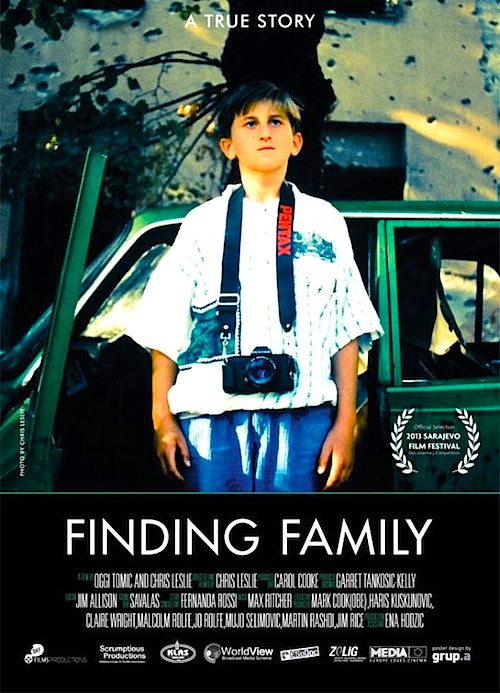
By Joe Bendel. In a cruel twist of fate, Oggi Tomić’s Sarajevo orphanage may very well have been shelled by his Bosnian Serb relatives he had never had a chance to meet. It could have been an ironic tragedy worthy of Sophocles, but somehow Tomić survived the Siege. In collaboration with fellow filmmaker Chris Leslie, Tomić documents his bittersweet Bosnian homecoming and a somewhat reluctant journey into Srpska in search of his roots in Finding Family, which screens during the 2014 Bosnian-Herzegovinian Film Festival in New York.

Born with excess cranial flood, Tomić is arguably lucky to be alive. However, the infant came through emergency surgery with no long term damage, except for a bit of scar tissue on his scalp. The question of how much his birth-mother knew of his prognosis before abandoning him will understandably nag at the British based filmmaker.

Despite his Serbian name, Tomić always identified as Bosnian. After all, he was just as vulnerable to Serb shells as his fellow orphans. Without question, enduring the Siege instilled profound feelings of Bosnian solidarity in Tomić, undiminished by his new life in the United Kingdom.  As a result, he has serious misgivings about meeting his blood relatives, well beyond mere abandonment issues.

Given its structure (including an opening teaser), the hour-long Finding Family was clearly produced with the European television market in mind. Obviously Leslie & Tomić’s film addresses deep issues of identity and family, but its emotional impact is considerable nonetheless. Tomić is remarkably honest and direct expressing his lingering pain and resentments to Leslie and his camera. He also vividly recreates a sense of what it was like to come of age during a time of war.

There are moments in Finding Family that are raw and very definitely unscripted. Yet, it is a surprisingly optimistic film, capturing Tomić’s reunion with his early protector and his reawakened love for the city of Sarajevo. While several of Tomić’s encounters are indeed quite moving, the film never relies on cheap sentiment. Recommended for general doc watching audiences as well as loyal festival patrons, Finding Family screens this Saturday (5/3) as part of programming Block #6 at this year’s BHFF in New York.

LFM GRADE: B

Posted on May 2nd, 2014 at 11:35pm.

LFM Reviews Supermensch @ Tribeca/SFIFF

By Joe Bendel. You have to have a real Zen-like attitude to successfully manage Alice Cooper. The drugs did not hurt either, at least in the early years. Starting with Alice Cooper (the band), Gordon expanded his roster to include clients like Anne Murray. You could call that a career. It certainly provides plenty of anecdotal grist for friend-of-Shep Mike Myers’ affectionate portrait Supermensch: The Legend of Shep Gordon, which had a special Tribeca Talks screening at the 2014 Tribeca Film Festival.

In true 1960s fashion, Gordon started managing Alice Cooper as a cover for his causal but considerable drug-dealing income. When law enforcement started getting nosy, he decided to make management a full time gig. The early years were tough, but Cooper (the man) gives Gordon credit for eventually making good on all the motel bills they skipped out on.

Eventually, Gordon’s long-term strategy—make parents hate Alice Cooper—paid off handsomely. Gordon would subsequently manage Murray, Luther Vandross, Teddy Pendergrass, and Groucho Marx (the latter more as a fan’s act of devotion than as a money-making concern). Perhaps the most eye-opening sequence explains Gordon’s role in kicking off the celebrity chef phenomenon, making Emeril Lagasse and Wolfgang Puck rich and famous in the process. Of course, Cooper plays a central role in Myers’ profile, which makes sense both from a biographical standpoint and as an endless source of good material.

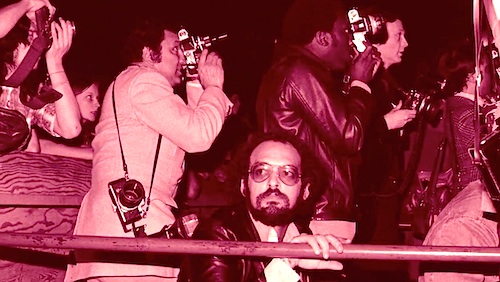
From "Supermensch."

As it happens, Supermensch is one of three interconnecting docs that played at this year’s Tribeca. Obviously, Gordon appears in Super Duper Alice Cooper and vice versa, but Cooper also briefly appears An Honest Liar, explaining the Amazing Randi’s role devising the guillotine routine for his stage show. All three are entertaining, but Super Duper’s rock & roll attitude combined with its Jekyll & Hyde psychoanalysis is ultimately more compelling than the breezy show biz vibe of Supermensch. By the way, if Gordon and Cooper had a connection to Bob Weir it did not come up in The Other One.

Regardless, the first-time director clearly had no trouble getting his fellow FOS’s to talk. Just about all of it is pretty funny stuff. Occasionally, Gordon gets serious, but Myers never lets that last, keeping things snappy throughout. For the post-screening discussion, Michael Douglas (another FOS) interviewed Gordon, eliciting more reminiscences. Frankly, a good number were repeats from the film, but you could say they were observing rock & roll’s “greatest hits” tradition. A pleasant source of bubbly, low calorie laughs and nostalgia, Supermensch is recommended for Boomer rock fans and aspiring talent managers. A crowd-pleaser at this year’s Tribeca Film Festival, Supermensch: The Legend of Shep Gordon also screens tonight (5/2) during the San Francisco International Film Festival.

LFM GRADE: B

Posted on May 2nd, 2014 at 11:28pm.

LFM Reviews Bright Days Ahead @ The 2014 Tribeca Film Festival

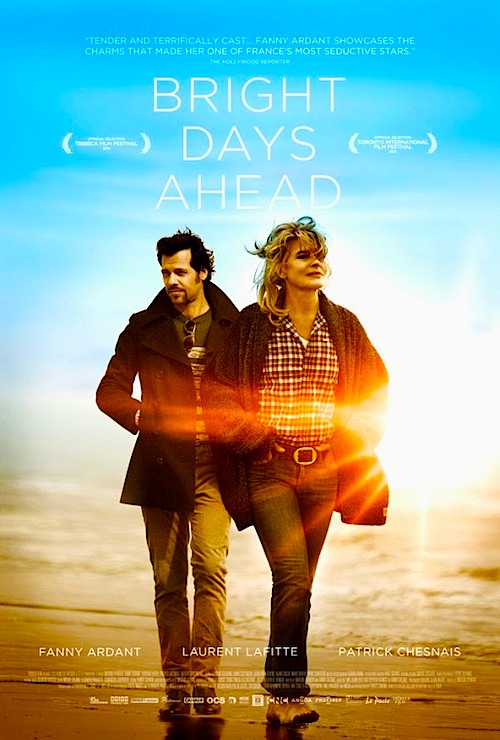
By Joe Bendel. Caroline looks considerably younger than her husband Philippe, but he still practices dentistry, whereas she has retired. That means she has time on her hands. Much to her surprise, she will find things to do at an upscale senior center that happens to employ a much younger but surprisingly receptive personal computing teacher. Fanny Ardant takes a diva turn in Marion Vernoux’s adultery drama Bright Days Ahead, which screened during the 2014 Tribeca Film Festival.

Caroline is not adapting well to retirement. When her grown daughters buy her a trial membership at the Bright Days Ahead senior’s club, she nearly has a fit. You can hardly blame her—a name like that sounds like some sort of rehab clinic. Reluctantly, she starts going to Julien’s computer classes when their home PC goes on the Fritz. Before long, some cougar-himbo hanky-panky commences. Unfortunately, her increasing recklessness leads to inevitable exposure.

Even with the not exactly jaw-dropping age difference between the not-so secret lovers, Bright is a pretty standard exercise in cinematic infidelity. Yes, Ardant still has it, but what distinguishes Vernoux’s otherwise conventional screenplay (co-written with Fanny Chesnel) are a handful of blisteringly honest scenes and a quiet gut-check performance from Patrick Chesnais as the wronged husband.

Philippe is indeed wronged, a fact that Vernoux and Chesnel do nothing to water-down. Refusing to be conveniently submissive, he is a dignified yet emotionally messy rebuke to the of pat empowerment themes often bandied about by adulterous wife movies. Similarly, Caroline goes into the affair remarkably clear-headed, even helping Julien keep up appearances with his younger lovers. However, you might have to be a sixty-some year old French woman to appreciate the charms of Laurent Lafitte’s Julien.

Without question, it is the veterans Ardant and Chesnais who make Bright work to the extent it does, particularly in their scenes together. Rather undistinguished looking, it still has enough incisive moments that pop to make the whole worthwhile. Recommended for Francophiles, Bright Days Ahead has already opened in New York at the Quad Cinema, following its American premiere at this year’s Tribeca Film Festival. It also screens this Sunday (5/4) at the Montclair Film Film Festival in Jersey.

LFM GRADE: B-

Posted on May 2nd, 2014 at 11:21pm.