LFM Reviews Nora Noh @ The Korean Cultural Service

By Joe Bendel. Fashion designer Nora Noh is widely credited with popularizing the mini-skirt in South Korea. Obviously, she deserves the thanks of a grateful nation, if not the entire world. Yet many younger Korean fashionistas were unaware of her trailblazing work until the opening of a special retrospective commemorating her sixty years in the business. Kim Sung-hee surveys Noh’s life and couture while chronicling the mounting of the designer’s special exhibition in Nora Noh, which screens for free this coming Tuesday in New York, courtesy of the Korean Cultural Service.

Noh could be considered the Korean Coco Chanel and Edith Head combined. She was a pioneer designing sleek, elegant “western style” business and casual wear for professional Korean women. A shrewd businesswoman, Noh launched a successful ready-to-wear line before her European colleagues. Yet, she also became the personally designer for many of Korea’s top stars, including pop idol Yoon Bok-hee, who made Korean cultural history sporting Noh’s minis.

Even viewers with little fashion sense will pick out interesting nuggets from Kim’s profile. Noh very definitely lived a feminist Horatio Alger life. Her challenges continued when she refused to kowtow to the arrogant press (likely explaining her under-representation in Korean cultural history). She had her run-ins with the secret police, yet ironically, the film indirectly suggests the liberated simplicity of Noh’s designs was rather compatible with the militarist government’s drive to industrialize (a potentially provocative point that could have been explored at greater length).

From "Nora Noh."

Perhaps the film’s greatest assets are the extensive clips from vintage Korean movies illustrating Noh’s image-making power, which will intrigue cineastes as much or perhaps more than clothes horses. While not exactly chatty, she remains a strong figure of individual stick-to-itiveness and a mostly likable screen presence.

Nora Noh is not the most dramatic film ever lensed, even though Noh’s early life was quite tumultuous. Frankly, the sentimental soundtrack does not sound very Nora Noh. Nevertheless, Kim and editor Lee Hyuk-sang keep it moving along nicely. Recommended for students of fashion as well as those fascinated by the phenomenon of global cultural modernization, Nora Noh screens (free of charge) this Tuesday (4/29) at the Tribeca Cinemas as part of the Korean Cultural Service’s regular Korean Movie Night series.

LFM GRADE: B

Posted on April 27th, 2014 at 9:52pm.
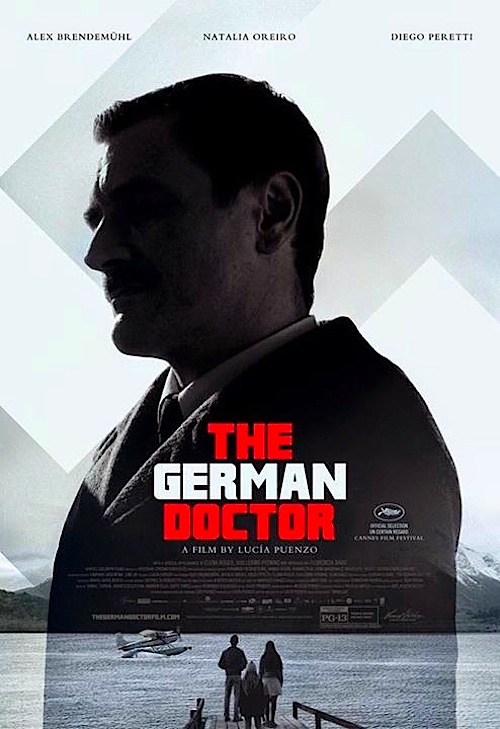
LFM Reviews The German Doctor

By Joe Bendel. Unfortunately, the physician in question is not Albert Schweitzer. It is the monstrous Josef Mengele who has ingratiated himself with young Lilith’s family. Living under an assumed name, the evil “Angel of Death” has resumed his eugenic research with the help of Argentina’s large German expat community. Adapting her own novel Wakolda for the screen, Lucía Puenzo offers some informed speculation about Menegele’s Argentine years in The German Doctor, which opens tomorrow in New York.

Lilith is traveling through Patagonia with her father Enzo and her very pregnant mother Eva, who happens to be carrying twins (if you know anything about Mengele, you recognize that this will become significant later). On the road, they meet a German doctor, who asks to follow them through the forbidding landscape for safety’s sake. Eva happens to be the graduate of Bariloche’s German language school, so she can converse with Mengele in his fatherland tongue. She even has old class photos generously accessorized with swastikas.

Initially, they are only too happy to have the doctor take up residency in their chalet-style hotel. Given his friendly overtures, they are also willing to allow the doctor to prescribe a growth regimen for Lilith. However, as his manipulations become more insidious, Enzo starts to suspect something is profoundly wrong about his family’s new patron. Of course, he is still a beat or two behind Nora Eldoc, a deep-cover National Socialist hunter.

While Puenzo stops short of outright conspiracy thriller territory, she paints a chilling portrait of a monolithically complicit German-Argentine community. Eldoc’s investigation also provides respectable servings of intrigue and suspense. However, the film fundamentally serves as a yin-and-yang character study of the icily fanatical Mengele and the innocent but keenly intuitive Lilith.

Catalonian actor Àlex Brendemühl is thoroughly creepy as Mengele, portraying him with quiet, precise menace. Yet, the bigger story is young Florencia Bado, whose lead performance is unusually mature and assured. Elena Roger (star of both the recent Broadway and West End revivals of Evita) also takes a smart, passionate turn as Eldoc. Unfortunately, Diego Peretti and Natalia Oreiro are standard issue dumb parents, who could have wandered in from an old John Hughes movie.

Even though Puenzo’s pacing is a bit inconsistent, she coaxes some powerful performances out of her multinational cast and convincingly indicts Argentina (and neighboring countries like Paraguay) for either knowingly sheltering war criminals like Mengele, or at least deliberately turning a blind eye to their enterprises. It is a surprisingly compelling work of docu-fiction. Recommended for those who appreciate darkly unsettling coming of age tales, The German Doctor opens Friday (4/25) in New York at the Lincoln Plaza Cinema.

LFM GRADE: B

Posted on April 25th, 2014 at 11:38pm.

LFM Reviews Misconception @ The 2014 Tribeca Film Festival

By Joe Bendel. Overpopulation is an issue that can turn an ostensive philanthropist into an evangelist for draconian controls on the unwashed masses. Should we be concerned about hordes of debased people waging global battles for increasingly scarce resources? Filmmaker Jessica Yu went into her latest project expecting to find a crisis but came away with the somewhat more nuanced perspective informing her self-referentially titled documentary Misconception, which premiered at this year’s Tribeca Film Festival.

It was TED Talker Hans Rosling who first tempered Yu’s alarm and duly serves as Misconception’s guru. According to Rosling, 80% of the world’s population now live in countries with 2.5 child birthrates or less. As a result, global population growth has leveled off. The other 20% are still procreating at rates that would give Warren Buffet conniptions, but corresponding life expectancy also happens to be relatively low in those nations. That is all well and good, but if Yu really wanted to rock viewers’ worlds, she would have introduced them to the work of the late great Julian Simon.

The meat of Misconception consists of a triptych of disparate individuals whose lives have been shaped by population planning policies in some fashion. The first is by far the best. With the help of Chinese filmmaker Lixin Fan (director of Last Train Home and executive producer of China Heavyweight), Yu follows Bao Jianxin’s determined efforts to avoid becoming one of China’s “leftover men.”

The implementation has been severe, but the One Child policy has curtailed China’s birthrate dramatically. Yet, it has come at an enormous social cost. Since boys are prized above girls, many couples opt for gender-specific abortions until they have a son. Like many of his “Little Emperor” generation, Bao faces an uphill challenge in his search for a wife. The numbers are simply against him. Yet, Bao also sabotages his best chance with a quite attractive old flame, because she cannot compete with Shu Qi in his favorite film, Love.

Frankly, Yu and company only scratch the surface of the potential social instability resulting from the One Child policy. Misconception also argues part of Bao’s problem is an increasing trend amongst Chinese women to choose careers over traditional family roles, but this too might partly be a function of the entitled attitudes fostered by “Little Emperor Syndrome.”

Perhaps the most loaded segment follows Denise Mountenay, a pro-life activist, who has found her calling lobbying against legalized abortion at the UN. At least she is from Canada, because in most other respects she fits the least charitable stereotype of evangelical Christians. She is a hard charger, who has had her share of horrific experiences and undoubtedly means well, but she does not serve her cause well on-screen.

From "Misconception."

Contrasting with the ideological charge of the second segment (clearly heightened by deliberate editing choices), the third POV figure is easily the safest. Journalist Gladys Kalibbala does her best to heighten awareness of the staggering numbers of abandoned Ugandan street orphans, humanizing them in profiles and trying her best to re-connect them with extended family members. It is a noble response to a tragic situation.

There is at least one misconception in Misconception. Essentially, Rosling argues fear of a third world population explosion will increase global warming are misplaced, because it is those who live in the developed world that use the most resources. Yes, but the most precipitous increase in fossil fuel consumption is expected in India and China as they pursue aggressive electrification policies (a worthy goal), at the lowest possible cost.

In fact, you can almost feel Misconception holding back, struggling to maintain some sort of class-conscious, environmentally orthodox message. Still, it is admirable Yu was willing to re-examine her assumptions to any extent. A radically mixed bag, the inconsistent Misconception includes provocative arguments and distracting noise in nearly equal measure. For those who closely follow the work of Yu and Fan, it screens again this Saturday (4/26) during the 2014 Tribeca Film Festival.

LFM GRADE: C+

Posted on April 25th, 2014 at 11:32pm.

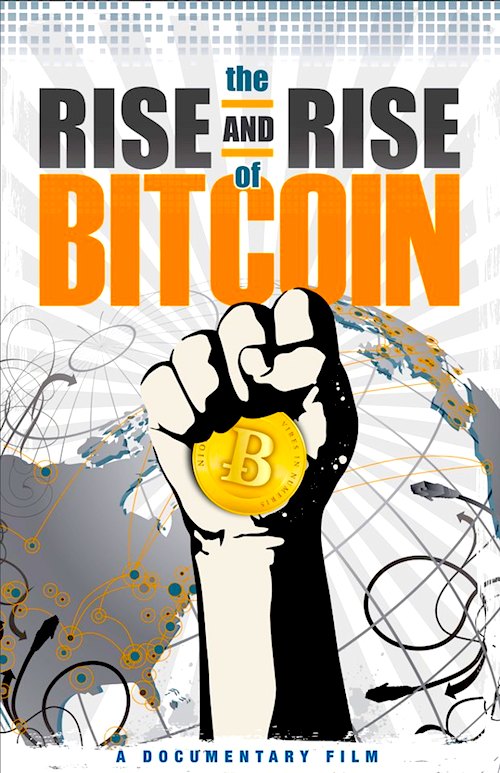
LFM Reviews The Rise and Rise of Bitcoin @ The 2014 Tribeca Film Festival

By Joe Bendel. In the near-ish future, hyperinflation, Gresham’s Law, and even central banking as we know it might become relics of the past. We are not there yet, but the silver bullet might already be out there in cyberspace. It is called Bitcoin and it is not just for Libertarian eggheads anymore. Nicholas Mross documents the genesis and prodigious growth of the digital currency in The Rise and Rise of Bitcoin, which screened today as part of the special Tribeca Talks series at the 2014 Tribeca Film Festival.

Presumably writing under a pseudonym, “Satoshi Nakamoto” sketched out the principles of the decentralized Bitcoin infrastructure, integrating pre-existing technologies in revolutionary ways. Finite in number, Bitcoins would be “mined” by those who lend their computing resources to process Bitcoin transactions. Mross’s brother Daniel was one such early adopter, whose Bitcoin evangelism provided the impetus for Rise.

As director and co-writer, Mross provides a lucid explanation of the Bitcoin system and an authoritative history of its formative years. However, he spends a disproportionate amount of time chronicling the Bitcoin mining experiences of his brother, who seems like a really nice guy, but will probably mostly be remembered in the Bitcoin history books for inspiring the currency’s first feature documentary.

Unfortunately, the news cycle did not do Mross any favors either. He was able to tack on an epilogue addressing several late breaking developments that bear quite directly on the Bitcoin narrative, but it is clearly a rushed job that lacks the depth of the prior segments. You cannot blame anyone, it is just a documentarian’s worst fears realized.

There is still good history and analysis in Rise, but one wishes he had gotten even more fundamental, by measuring Bitcoins against Jevons’ textbook functions of money: a medium of exchange, a measure of value, a standard of deferred payments, and a store of value. Although not universally accepted, you could probably use Bitcoins for all your daily shopping in certain New York and Bay Area neighborhoods, so yes, it increasingly serves as a medium of exchange. Bitcoins are commonly listed in most market reports, so they can technically serve as a measure of value, but the extreme volatility Mross chronicles makes this slightly problematic in practice.

Clearly, the store of value question remains the thorniest and will continue to be so long as Bitcoin holdings are vulnerable to hacking or the collapse of exchanges (as happened in the notorious Mt. Gox case, which factors prominently in the third act). Without that sense of security, it is hard to envision widespread acceptance of Bitcoins as a means of deferred payments.

According Mross’s creation story, the first recorded Bitcoin transaction was 10,000 Bitcoins in exchange for two Papa John’s pizzas. One would think Mross would have revisited the relative price of those pies to illustrate Bitcoin’s dramatic increase in value, but evidently that was too gimmicky for him. There is a great deal of food for thought in Rise, but ultimately Mross strives too hard to humanize the tale. Recommended as a primer on digital currency, The Rise and Rise of Bitcoin screens tomorrow (4/23) as part of the Tribeca Film Festival’s Tribeca Talks programming. Given the stop-press addendum, there should be plenty discuss.

LFM GRADE: B-

Posted on April 22nd, 2014 at 11:27pm

LFM Reviews Ice Poison @ The 2014 Tribeca Film Festival

By Joe Bendel. He is not exactly a budding Walter White. His partner is more daring, but her willingness to sample their goods does not bode well. Thanks to Burma’s economic stagnation, the young protagonists are willing make some very problematic choices in Midi Z’s Ice Poison, which screens during the 2014 Tribeca Film Festival.

When we first meet the former farmer, he is so poor, Midi Z’s screenplay does not even grant him a proper name. With prices for their vegetables tumbling, the man and his father hock the family cow to buy a scooter. The old man seems to think there is good money to be made shuttling people home from the local bus depot, but proper cabs take most of that business. His surly son can only scuffle odd delivery jobs. However, that might be just what Sanmei needs.

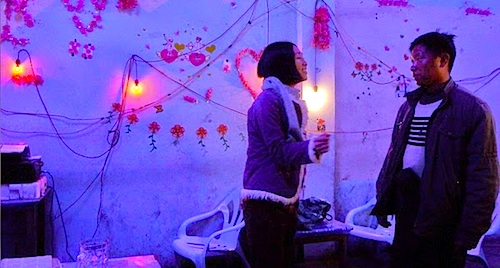
Tricked into an involuntary marriage in China, Sanmei has been granted leave to bury her failing grandfather. Even though she left behind a child in Yunnan, she has no intention of returning. Determined to make some real money, she gets involved with her drug dealing cousin. Her deal with the scooter driver is simple. If he does the driving, she will handle all the exchanges, giving him a healthy cut for his efforts. They might not be Bonnie and Clyde, but we can all assume they are headed in a similar direction. Yet despite their reckless behavior, Midi Z would not have us judge them harshly. After all, they have taken some pretty drastic steps to secure legitimate work, only to be disappointed at every step.

Arguably, Ice is an unusually ambitious film, grappling with at least two and a half hot button issues. Obviously, Midi Z shines a light on Burma’s drug related social pathologies. He also directly addresses the plight of migrant workers, particularly with respects to bait-and-switch white slavery. Finally, Poison drops intriguing, if under-developed, hints regarding the extent secular modernity has challenged cultural and religious traditions. As a case in point, Sanmei’s return from China was delayed so she could retrieve her grandfather’s burial clothes, which had to be secretly buried themselves to survive the Cultural Revolution.

From "Ice Poison."

The Burma-born, Taiwan-based Midi Z is almost a one-man dynamo for the nascent Burmese film business (and they do call their nation Burma, rather than “Myanmar”). His eye for visuals has sharpened considerably since Return to Burma. However, the narrative balance is a bit out of whack. He spends considerably more time establishing the crumminess of the two protagonists’ lives than building suspense around their illicit trade. Still, the closing scene will knock the wind out of audiences, vividly reminding us just who the biggest loser is amidst this tale of woe.

Given her frequent collaborations with Midi Z, Wu Ke-xi probably qualifies as the first lady of Burmese cinema. In a chilling performance, she conveys both desperate vulnerability as well as nihilistic inclinations. In contrast, Wang Shin-hong is almost too reserved as the scooter-driver, even making it rather tricky to discern when he is stoned. Nevertheless, when he loses it down the stretch, it is something fierce to behold.

Ice Poison is not a perfect film, but it is significant, both as a symbol of Burma’s cinematic potential and a documentary like exercise in holding a mirror up to nature. It is a bit slack at times, but the stakes are about as serious as could be. Recommended who those who appreciate challenging social dramas, Ice Poison screened again tonight (4/22) during this year’s Tribeca Film Festival.

LFM GRADE: B

Posted on April 22nd, 2014 at 11:22pm.

LFM Reviews Sammo Hung’s Seven Warriors; Now Available on DVD

By Joe Bendel. Seven is an auspicious number. There are the Wonders of the World and Deadly Sins. It also only takes seven hardnosed mercenaries to rally a small village’s defenses. The template created by Akira Kurosawa and burnished by John Sturges’ classic western is transplanted to Republican China in Terry Tong’s Seven Warriors, notably co-directed by Sammo Hung, which releases today on DVD from Well Go USA.

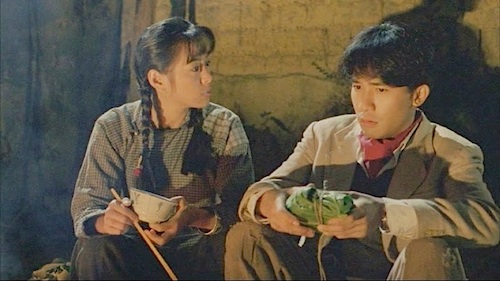
Right, you know how this goes. The women of a provincial village regularly plundered by outlaws shame their men into recruiting some hired guns. They find seven volunteers: Commander Chi, five of his former comrades-in-arms, and the over-eager country bumpkin Wong Way-wu. It quickly gets personal when Chi discovers an old colleague happens to be the chief warlord in question. The stakes also increase for Wong when he secretly shelters the sister of Hung Sap Kan, the leader of an aborted rebellion in a nearby village, who meets a premature end during the prologue.

From "Seven Warriors."

Viewers should have a pretty clear idea what they are dealing with from the old school foley effects and heroic synthesizer music. Compared to its two notable predecessors, Warriors is definitely the lesser of the Trio of Seven, but it still delivers plenty of high spirited period action. Also serving as action choreographer, Master Hung stages some nifty fight scenes. The overall body count is also rather impressive. Yet, what might standout most are the frequency and severity of mistakes made by the home team. You certainly cannot accuse them of comic book invincibility.

Master Hung also shows his moves that defy the laws of physics during his cameo smackdown as his namesake. It is also rather amusing to see a young “Little” Tony Leung Chiu Wai (now so familiar to us as the mature smoothie) as the rustic Wong. Both he and Wu Ma (best known for supernatural fare, like A Chinese Ghost Story) overdo the comic relief, but there will be plenty of tragedy to offset it.

There are some surprisingly striking visuals in Warriors, as well as some genuinely earnest performances. Hung keeps the action gritty and grounded and Tong maintains a respectable pace. Altogether, it works pretty well, especially for those for whom it will appeal to a sense of nostalgia. Recommended for genre fans, Seven Warriors is now available on DVD and Blu-ray from Well Go USA.

LFM GRADE: B

Posted on April 22nd, 2014 at 11:15pm.