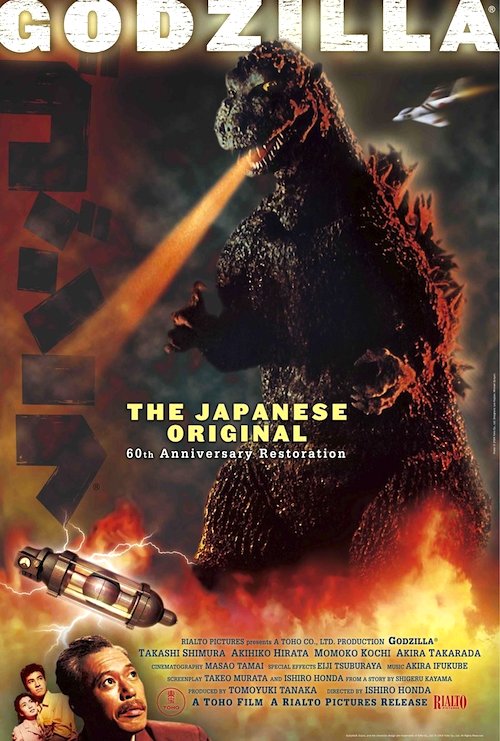
LFM Reviews The Restored Original Godzilla

By Joe Bendel. There was a time when the sight of a mutant lizard leveling the city of Tokyo would have been somewhat traumatizing. It became a campy tradition, but it started as a surprisingly moody expression of national angst. Sixty years later, Godzilla is still the king of the monsters, but his original uncut 1954 Japanese debut (sans Raymond Burr) will be a revelation for many fans. Coming on the heels of its debut at the 2014 TCM Film FestivalFilm Forum pays homage to the granddaddy of all kaiju movies with a special one week engagement of Ishirô Honda’s Godzilla, beginning this Friday.

There are dozens of drastic differences between the version released in the U.S. (with scenes added featuring Burr as American reporter Steve Martin) and Honda’s original high concept apocalyptic morality play. Initially, we do not see Godzilla, but we witness the effects of his handiwork. In an episode reportedly inspired by the Lucky Dragon Incident, a commercial fishing boat has inexplicably disappeared in a remote quadrant of the Pacific. The company responds by sending more ships to the last known coordinates, which only compounds their tragic losses. Of course, we know who is responsible, but Godzilla will not actually show himself, peaking over a mountain ridge in an entrance to rival Harry Lime in The Third Man, until late in the first act.

Dr. Kyohei Yamane suspects the mutant monster dubbed Godzilla (or Gojira) is a nasty by-product of the nuclear age. Destroying such a beast is no easy feat, as the military conclusively proves during their futile defense of Tokyo. As events unfold, the professor’s daughter Emiko finds herself in a uniquely Japanese love triangle, betrothed to the distant Dr. Daisuke Serizawa, but in love with salvage captain Hideto Ogata, who suddenly finds himself all kinds of busy. Serizawa has developed an Oxygen Destroyer that just might be able to stop the rampaging monster, but he refuses to open another Pandora’s Box.
Of course, Godzilla is all about the monster, but Serizawa is a fascinating character in his own right. He adopts western style dress and furnishings, yet he consents to a traditional arranged marriage. Frankly, he often seems oblivious to Emiko, driven by his obsessions and haunted by his mysterious wartime experiences.

There also happen to be real performances in the genuine article Godzilla, including Akihiko Hirata as the brittle and intense Serizawa. Momoko Kōchi also gives an acutely sensitive turn as the conflicted Emiko Yamane. As for screen presence, it is hard to beat Ozu and Kurosawa veteran Takashi Shimura, who would later reprise his role as Dr. Yamane, unless you were a mutant lizard monster.

Yes, most of Godzilla’s scenes were rendered by “Suitmation” (which was exactly what it sounds like), but Honda really focuses in on the human dimension during his now legendary attack. He makes us feel for the people caught up in the terror, rather than glossing over the little people getting stomped on. Obviously, the look of Godzilla caught on, but it is the sound that seals the deal. There is something alarming (even bitchy) about his high-pitched keening roar that gets under the skin. You would absolutely not want to hear anything like it in real life.

By any reasonable critical standard, the original Godzilla qualifies as a good movie—for real. It has far more going on than you would assume for subsequent sequels. Yet, it still delivers the kaiju goods. Sixty years later, Godzilla is still one of the baddest cats to grace a movie screen. If you do not catch him now in his original glory, you risk some profoundly bad karma. Recommended for fanboys and cineastes, the restored, undubbed Japanese Godzilla opens this Friday (4/18) at Film Forum.

LFM GRADE: A

Posted on April 15th, 2014 at 12:04am.

John Turturro, Ladies Man: LFM Reviews Fading Gigolo

By Joe Bendel. You cannot get by in New York with part-time floral arrangement work. Yet, as a vocation, it probably means poor struggling Fioravante is a sensitive soul, who is good with his hands. His cash-strapped former boss hatches an unlikely scheme to capitalize on those talents in John Turturro’s Fading Gigolo, which opens this Friday in New York.

Murray Schwartz’s antiquarian bookstore had been in his family for years, but it did not survive the neurotic Upper Eastsider’s mismanagement. Fortunately, Schwartz’s wife still has a job, but his longtime clerk Fioravante is scuffling to make ends meets. A trip to his dermatologist gives Schwartz an idea so crazy, it just might work. Evidently, the cougarish Dr. Parker and her BFF Selima are looking for a man’s services. Frankly, they would prefer someone who is mature and less intimidating than the stereotypical boy toy type. Reluctantly (and rather skeptically), Fioravante agrees to let Schwartz pimp him out to his high class clientele.

Naturally, Fioravante is a hit with the well heeled ladies, because what woman wouldn’t lust after John Turturro? However, things will get complicated when Schwartz seeks the delousing services of a widow in the Brooklyn Hasidic community. Picking up on Avigal’s loneliness as she picks through his step-child’s hair, Schwartz convinces her to try Fioravante’s services. While their meeting is downright chaste by his recent standards, it would still be considered scandalous within her community. Further complicating matters, Fioravante and his new client start developing confusing feelings for each other. Her out-of-character trips to Manhattan also attract the suspicions of Dovi, the Orthodox neighborhood patrolman, who has long carried a torch for her.

Frankly, Fading is the sort of Woody Allen movie Allen ought to be making, but isn’t. It is a wistfully mature film, deeply steeped in an elegant sadness. The notion of writer-director Turturro casting himself as the illicit lover of Sharon Stone and Sofia Vergara might seem self-serving, but the aging average Joe-ness of Fioravante is part of the point. It is his comfort with intimacy that makes Fioravante desirable. If anything, Fading is old school Alan Alda sensitivity porn rather than a vehicle for people doing it like rabbits.

Turturro shows a remarkably deft touch as a director, patiently letting his scenes unfold. He gets a key assist from the jazz soundtrack, which includes several seductions from boss tenor Gene Ammons. Jug had a seductive sound that could get anyone to say “yes,” but it also perfectly suits the sophisticated New York milieu.

From "Fading Gigolo."

Allen does his shtick as Schwartz, but it is funny more often than not. Yet, it is Turturro who quietly commands the screen as Fioravante, a sad clown incapable of acting less than chivalrous. He develops some achingly powerful chemistry with Vanessa Paradis in her first English language role as Avigal. Their scenes together are a reminder how dramatically potent denial and yearning can be on-screen.

Likewise, Liev Schreiber could not possibly be any more earnest as the lovesick Dovi. Stone and Vergara certainly look the parts of Fioravante’s clients, but never come close to exposing the inner depths of their souls. In a small supporting role, Bob Balaban nearly steals the show as Schwartz’s lawyer, Sol. In fact, Fading is well stocked with brief but neatly turned performances, including Loan Chabanol as a French expat who makes a strong impression late in the game.

Absolutely never smarmy, Fading is an emotionally intelligent film intended for an adult audience. It should satisfy all of Woody Allen’s fans, but Turturro gives it his own distinctive stamp. Highly recommended, Fading Gigolo opens this Friday (4/18) in New York at the Angelika Film Center and the UES’s City Cinemas 1, 2, 3.

LFM GRADE: B+

Posted on April 14th, 2014 at 11:45pm.

Leconte Adapts Zweig: LFM Reviews A Promise

By Joe Bendel. Few understood the pain of involuntary exile as acutely as Stefan Zweig. In his day, the Jewish Austrian was the world’s most translated author, but he took his own life while living as a political émigré in Brazil. In his posthumous novella, Journey into the Past, Zweig’s protagonist is also stranded in Latin America, separated from his love and homeland. For his first English language film, French director Patrice Leconte adapted Zweig’s wistful German tale with a British cast. Whether you consider it reserved or repressed, it is most definitely “Old” Europe that dictates social expectations for the characters of Leconte’s A Promise, which opens this Friday in New York at the IFC Center.

Friedrich Zeitz has done the near impossible. Like a German Horatio Alger hero, the poor orphan worked his way through university as a scholarship student, eventually finding employment in the offices of the steelworks owned and operated by the dreaded Herr Karl Hoffmeister. At least, Zeitz is told to fear his aristocratic boss. However, when Herr Hoffmeister notices the young man’s keen grasp of metallurgy and relentless work ethic, he takes a shine to his new clerk.

With his health slowly declining, the increasingly home-bound Herr Hoffmeister promotes Zeitz to serve as his private secretary and liaison to the corporate office. Of course, that home is more of a castle. As soon as he is admitted into the Hoffmeister estate, Zeitz promptly falls head over heels for his boss’s younger wife, Charlotte (who goes by Lotte, echoing Zweig’s wife and secretary, Lotte Altmann).

Lotte Hoffmeister is unfailingly gracious and welcoming to Zeitz, but she initially seems oblivious to his attraction, despite the way his eyes bug out of his head like a cartoon character whenever she is around. Still, maybe someone notices his torch-carrying. Just as Zeitz is transferred to Hoffmeister’s embryonic mining operation in Mexico, Lotte Hoffmeister confesses Zeitz’s ardor is reciprocated. They vow (or promise, if you will) to do something about it, once he returns from his two year stint abroad. Then World War I breaks out.

From "A Promise."

One of the ironies Leconte and co-adaptor Jérôme Tonnere clearly make, without excessively belaboring it, is the extent to which highly intelligent people can lose sight of the critically important macro events swirling around them – because they are caught up in their own personal dramas. Despite working in the steel industry, Zeitz and Herr Hoffmeister are caught completely flat-footed by the onset of the first World War (you think they might have noticed a slight uptick in government orders). Likewise, the climatic reunion commences just as the growing ranks of National Socialists launch another street protest-riot.

The passionate feelings of Zeitz and Frau Hoffmeister are so chaste and restrained A Promise is likely to frustrate most viewers more accustomed to instant gratification. Yet, the yearn and burn of their thwarted love is quite powerful for those who can appreciate it. Unfortunately, Rebecca Hall and Richard (Game of Thrones) Madden must make the most vanilla couple you will ever see as Zeitz and Frau Hoffmeister. In contrast, Alan Rickman outshines everyone as the sly but not villainous Herr Hoffmeister, showing the sort of erudite charisma he brought to bear in overlooked films like Bottle Shock and Song of Lunch.

Handsomely mounted, A Promise’s period details are elegant but convincingly Teutonic in their chilly austerity, while superstar cinematographer Eduardo Serra gives it all a sensitive sheen superior to the look of your average BBC historical. A mature and emotionally sophisticated literary drama largely waterlogged by its two cold fish romantic leads, A Promise is flawed but still oddly enticing for those who share its Old European sensibilities. It opens this Friday (4/18) at the IFC Center.

LFM GRADE: C+

Posted on April 14th, 2014 at 11:44pm.

LFM Reviews Draft Day

By Joe Bendel. Nobody wants to draft the next Ryan Leaf or JaMarcus Russell, but they often look like sure things at the time. Of course, nobody ever understood the Knicks’ Frédéric Weis debacle, especially when Artest was still available. Granted, that is a basketball digression, from 1999, but the point is we still are not ready to forgive and forget. The stakes are consequently high for Cleveland’s GM when he makes a costly trade for the number one pick. He had better choose wisely, but the clock is ticking throughout Ivan Reitman’s Draft Day, which opens today pretty much everywhere.

Sonny Weaver basically has one season left to turn things around. He largely inherited the current team, but he did little to endear himself to fans when he fired their legendary head coach, who also happened to be his father, now deceased. With the owner pressuring him to make a big move, he reluctantly agrees to a deal, trading away their next three years of first round drafts for the upcoming number one pick. (Ironically, it is your 2014 Super Bowl champion Seattle Seahawks who have that coveted #1 spot.)

Weaver quickly develops buyer’s remorse, but the trade is done. Everyone assumes he will opt for the presumptive number pick, Bo Callahan, the Heisman winning quarterback from Wisconsin. His owner is delighted with the prospects of a marquee player like Callahan, but Weaver cannot shake the Leafy vibe he gets from him. Further complicating matters, Weaver’s front office colleague and not so secret lover has just informed him she is pregnant.

You really have to hand it to Kevin Costner. After some pretty lean years, he has clawed his way back to leading man status in major Hollywood releases. Going back to the sports well obviously makes sense in theory and it works ably enough again in practice. Since it is all about wheeling and dealing, Draft Day is bound to be compared to Moneyball and not unfairly so. The truth is there is something oddly cinematic about watching the respective GMs’ hard bargaining, firing off lines like: “that offer already expired, it’s a different world than it was thirty seconds ago.”

Frankly, the only sports action we see are the teams’ research tapes and there are no surprises there, because Weaver will explicitly tell them to show the footage of Callahan getting sacked. Still, there is something very sporting about Draft Day’s persistent faith in next season.

From "Draft Day."

Without question, Costner is the film’s lynchpin and he still has what it takes. He convincingly gives Weaver darker shades than his Bull Durham, Field of Dreams, and Tin Cup characters, but he remains undeniably charismatic. While they do not burn down the joint with their passion, he and Jennifer Garner develop some relatively likable and believable romantic chemistry together. Denis Leary and Frank Langella both do their shtick as the Browns’ head coach and owner, respectively, but it is the latter veteran thesp who really gives the film some sly zip. Football fanatics will also dig the scores of real life NFL cameos, mostly notably including Jim Brown (as far as old school cineastes are concerned).

Reitman keeps it all moving along briskly, capitalizing on the draft’s constantly ticking clock. While it ends up somewhere not wholly unexpected, getting there is a surprisingly satisfying trip. A well conceived and nicely executed comeback star vehicle, Draft Day is easily recommended for fans of football or Costner rom-dramedies. It opens today (4/11) across the country, including the AMC Loews Lincoln Square in New York.

LFM GRADE: B

Posted on April 11th, 2014 at 9:21pm.

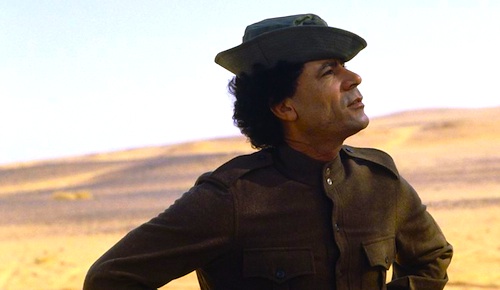
LFM Reviews Mad Dog: Inside the Secret World of Muammar Gaddafi on Showtime

By Joe Bendel. Muammar Gaddafi was responsible for the mass murder of man and camel alike. Never shy about executing those unfortunate enough to have their loyalty questioned, Gaddafi also once ordered the wholesale extermination of all camels within Tripoli, believing they were incompatible with his vision of a modern city. Yet, during his final years, Gaddafi traveled internationally with representative camels along with his ostentatious, bullet proof tent, and extensive entourage of female bodyguards. Even the animals never knew where they stood with the Libyan tyrant. The cruel and erratic nature of his dictatorship is documented in shocking detail throughout Christopher Olgiati’s Mad Dog: Inside the Secret World of Muammar Gaddafi, which premieres on Showtime this Friday.

It was President Ronald Reagan who dubbed Gaddafi a “mad dog” and history has vindicated him once again. Gaddafi initially charmed his neighbors and the regional media, but as the years progressed, his grandiose ambitions to become a modern day Saladin were largely derided within the Arab world. Instead, he tried to “re-brand” himself as the once-and-future “King of Africa,” launching a good will offensive aimed at Africa’s crowned royalty, despite his explicitly racist beliefs. At least, he always maintained mutually cordial relations with just about every terrorist group operating around the globe, including Carlos the Jackal, the PLO, and the IRA.

Nearly everyone will go into Mad Dog with the general understanding that Gaddafi was a bad guy, but the depths of his sadistic perversity are truly shocking. Olgiati thoroughly exposes Gaddafi’s crimes as a sexual predator, targeting young girls and boys alike, in a manner befitting Uday Hussein as immortalized in Lee Tamahori’s The Devil’s Double.

Indeed, Mad Dog uncovers many more truly bizarre revelations that are mystifyingly macabre (you could say he had a habit of keeping his political opponents on ice). To his credit, director-producer-cameraman Olgiati pushes his interview subjects to be precise and supply specifics. He never accepts vague implications, forcing them to spell out each and every incident under discussion. While most of the talking heads are surviving Libyan dissidents, there are a few hidden camera sequences with former regime insiders that are highly illuminating.

From "Mad Dog: Inside the Secret World of Muammar Gaddafi."

Perhaps the least substantiated passages within Mad Dog are the rather gossipy charges of CIA support for Gaddafi during his early days as a mini-mart for terrorists. However, Olgiati is on solid ground criticizing the overly optimistic campaign to rehabilitate Gaddafi (who by the way, was sitting on top of vast oil reserves). He also notably details ways in which Gaddafi exploited Islam to serve his propaganda purposes.

Olgiati paints a comprehensively damning portrait of Gaddafi, but it is also a well paced, compelling viewing experience. He certainly appreciates the spectacle of Gaddafi’s flamboyant vanity, but never loses sight of his brutal despotism. Recommended for anyone seeking insight into the Libyan revolution, Mad Dog: Inside the Secret World of Muammar Gaddafi airs this Friday (4/11) on Showtime.

LFM GRADE: B

Posted on April 9th, 2014 at 11:21pm.

Scarlett Johansson vs. Scotland: LFM Reviews Under the Skin

By Joe Bendel. Fifty-some years after the classic Twilight Zone episode, aliens are still devising ways to serve man, with a little butter and garlic. However, viewers of Jonathan Glazer’s much anticipated new film will be forgiven if they do not realize that this is the extraterrestrials’ reason for visiting Scotland. Mood and composition take precedence over petty bourgeoisie concerns, like narrative and pacing, throughout Glazer’s Under the Skin, which opened Friday in New York.

Fortunately, Skin is ostensibly based on the novel by Michel Faber, so we can infer some exposition from the original source material. It seems aliens have a taste for human muscle, so the woman visitor has been sent to harvest some from the brawniest knuckle-draggers she can entice into the back of her van. Sometimes she appears to have a counterpart escorting her on his motorbike, but he disappears for long stretches (probably because he gets bored).

At first, she seems ruthlessly efficient, but as she encounters the less fortunate, she starts to change. Yet, becoming more “human” leaves her increasingly vulnerable to man’s inhumanity towards his fellow man. Or something like that.

There is not a heck of a lot of plot in Skin, but what there is manages to be both slow and confusing. About the third or fourth time she lures another man-dog into her cosmic pool of black goo, you start to wonder how this film ever got made without Tangerine Dream on-board. There are more wide shots of cloud draped forests than both seasons of Twin Peaks combined. Frankly, it is hard to believe this is the work of Glazer, arguably the most lauded television commercial director of our time and the man who helmed the breakout hit, Sexy Beast.

It is also hard to get one’s head around the wildly unflattering wig Scarlett Johansson sports as the primary alien. Frankly, this is Johansson as we have never seen her before: naked, yet boring. There is no question Skin is more closely akin to experimental cinema than science fiction genre films, but it sounds deceptively commercial: “nude alien chick puts men through the interstellar meat-grinder.” It will surely attract a loyal band of critical champions who will defend it with terms like “hypnotic” and “trance-inducing,” which sounds seductive, but really means you will be paying fourteen dollars to fight off the head-nods.

In many ways, Skin feels like a throwback to the sort of weirdly cerebral 1970s science fiction forays (such as Robert Altman’s Quintet and Nicholas Roeg’s The Man Who Fell to Earth) that were green-lighted by clueless studio heads caught flat-footed by the Star Wars phenomenon, but Skin is more openly contemptuous of mainstream sensibilities. For a while, Daniel Landin’s gauzy cinematography is rather effectively dreary, in a way befitting Scotland’s backwoods, but the film simply becomes a chore to watch. Not recommended for anyone except Johnasson stalkers and the most pretentious hipster cineastes, Under the Skin opened Friday (4/4) in New York at the AMC Empire.

LFM GRADE: D

Posted on April 7th, 2014 at 6:05pm.