The Family that Plays Together: LFM Reviews Brothers Hypnotic on PBS

By Joe Bendel. One would expect the sons of a Sun Ra Arkestra veteran would naturally take to music. Their somewhat unconventional upbringing is hardly surprising either. Yet, the members of the eight-brothers strong Hypnotic Brass Ensemble both honor and reject their father’s musical legacy in ways that generate real tension throughout Brothers Hypnotic, Reuben Atlas’s behind-the-scenes look at the brassy jam-band, which airs this Monday on PBS, as part of the current season of Independent Lens.

After early stints with the Jay McShann and the U.S. Navy bands, Phil Cohran signed up with the Arkestra while it was based in Chicagoland. When Sun Ra continued on his galactic journey, Cohran helped co-found the AACM. For a while, he was also the director of the Phil Cohran Youth Ensemble (which could have passed for the Arkestra’s children’s auxiliary), but as soon as one Cohran brother left the fold, the entire ensemble deflated.

In a sense, they were reborn as Hypnotic, a jazz and funk influenced jam-band somewhat in the tradition of the Hot 8 Brass Band and their New Orleans contemporaries, but utilizing a strictly brass-only instrumentation. They have a great sound (particularly when they are not incorporating just okay raps into the mix). You can hear a bit of their father in there, but there are plenty of other elements in the mix as well.

From "Brothers Hypnotic."

Atlas does an excellent job documenting the ironic realities of a jazz (or jazz-ish) musician’s life. One minute you are eating cold Spaghetti-O’s out of the can, but the very next day you might be off on a seat-of-the-pants European tour. The filmmaker caught the Ensemble at a fortuitous time, when they were still giving street performances (which are highly cinematic), but were also fielding offers from legitimate labels. Musicians who tune in might get a nasty case of heartburn when they turn down Atlantic Records, but you have to give them credit for staying true to the convictions they inherited from their father. Unfortunately, the broadcast edit of Brothers H never allows a musical performance to continue long enough to give viewers a truly vivid sense of the ensemble’s full force.

Atlas captures some intimate moments with a band that is on the way up, but shrewdly trying to avoid a harsh burn-out. The Brothers must have seen their share of music docs before appearing in their own. It is nice to know some musicians are trying to learn from others’ mistakes. While Atlas also includes enough intra-family drama to avoid accusations of PR flakery, the film never feels intrusive or gossipy. Recommended for fans of funky brass (and who isn’t?), Brothers Hypnotic debuts tonight (4/7) on PBS’s Independent Lens.

LFM GRADE: B+

Posted on April 7th, 2014 at 5:59pm.
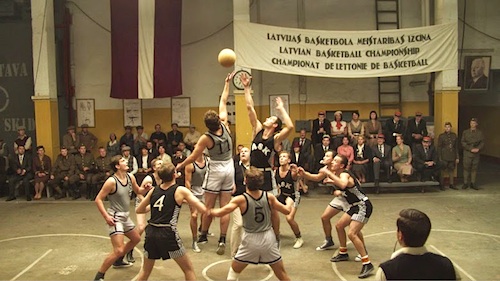
LFM Reviews Dream Team 1935 @ MoMI’s 2014 Panorama Europe

By Joe Bendel. Evidently, they come pretty tall and well coordinated in the Baltics, considering their success in the European Basketball Championship (now known as EuroBasket). Lithuania won twice in the 1930’s and took gold again in 2003, but the very first champion was Latvia. Profoundly unheralded, the scrappy long-shots shocked the continent in 1935. It was a great Latvian triumph on the eve of great tragedy for many nations, Latvia included. With Russia once again menacing its neighbors, it is a fitting time to revisit one of the greatest moments of Latvian sporting history in Aigars Grauba’s Dream Team 1935, which screened during Panorama Europe at the Museum of the Moving Image.

It was a different game in 1930’s Europe. A jump ball followed every successful bucket and free throws were shot granny-style, but it was still handy to have an enforcer on the team. Vlademars Baumanis understands this only too well. Initially, the player-coach loses the Latvian championship because of some thuggish play. However, the victorious coach declines to take his team to the European championship, because the corrupt national sports committee has already squandered the ear-marked funds. While protesting to anyone who will listen, Baumanis accepts an instantly regretted dare to cobble together his own national team, trading in his uniform for a suit and tie.

Bitter rivals from both the Army and University Clubs will come together to represent Latvia, but it will take time to congeal as a true team. At least they will be in the best shape of the careers, thanks to relentless conditioning coach Rihards Deksenieks. Baumanis is a master strategist (at least by 1930’s standards) and the Latvia team has considerable skills, but just getting to Geneva will be an adventure thanks to the obstructionist sports committee.

Dream Team is a reliably entertaining underdogs-triumphant sport story, with some nicely rendered period details and a peppy big band soundtrack. Many basketball fanatics will probably be amused by the decidedly less glamorous style of play. Yet, Dream Team features one of the most devastating series of what-happened-to post-scripts of nearly any film. It turns out nearly every coach and player met a tragic end either as Soviet or National Socialist conscripts (sometimes both) during the war or in Soviet gulags afterward. (Nearly eighty years later, history threatens to repeat itself, as Russia once again casts a covetous eye on the Baltic Republics.)

From "Dream Team 1935."

Janis Amanis is a bit stiff as Baumanis, but he certainly looks earnest. In contrast, Vilis Daudzins plays Deksenieks with hardnosed charisma, while Marcis Manjakovs convincingly portrays the maturation of Latvia’s star player, Rudolfs Jurcins. Unfortunately, there is not much for Inga Alsina to do as Baumanis’s wife Elvira, except for sitting around, having faith in him.

As a sports film, Dream Team is more successful than most. Despite the end never being in doubt, it moves along briskly and captures the tenor of the game as it was then played. It also suddenly feels uncomfortably topical given the ultimate fate of most of the team. It would make a good narrative companion to Marius Markevicius’s uplifting documentary, The Other Dream Team, chronicling the 1992 Olympic run of newly independent Lithuania’s men’s basketball team. Recommended for basketball fans and those who closely follow political and cultural developments in post-Soviet Eastern Europe, Dream Team 1935 screened Sunday at MoMI as part of Panorama Europe.

LFM GRADE: B+

Posted on April 7th, 2014 at 5:41pm.

LFM Reviews Honeymoon @ MoMI’s 2014 Panorama Europe

By Joe Bendel. Usually, couples keep the wedding simple for second marriages, but not Radim Werner and his fiancée Tereza. At least when you keep a low profile, it makes it harder for unwelcomed guests from the past to crash. There will be no ex-spouses arriving uninvited, but one mystery guest will thoroughly destabilize the celebration in Jan Hrebejk’s Honeymoon, which screens during the rechristened Panorama Europe at the Museum of the Moving Image.

As fate would have it, Werner’s thirteen year-old son Dominik breaks his glasses seconds before the wedding ceremony. Fortunately, there is optometrist-in-the-box right on the church plaza. Werner does not think much of the man behind the counter, but he instantly recognizes him. Calling himself Jan Benda, the mystery man crashes the ceremony and hitches a ride to the reception in the country. He claims to be Werner’s old boarding school friend, but the groom pretends not to remember him. The kids take to Benda, but he unnerves both bride and groom.

It will become obvious the lens crafter is not really Benda, but he shares some complicated history with Werner and the real Benda. The truth is pretty ugly, especially when the newly married bride is forced to confront it. Honeymoon is considered the third installment of Hrebejk’s loosely thematic trilogy, begun with the excellent Kawasaki’s Rose, examining how the sins of the past continue to influence the present. While not explicitly political like Rose, it is worth noting Werner’s boarding school indiscretions indirectly involved his teenaged lust for Natassja Kinski during the height of her international superstardom, suggesting the 1980’s, perhaps thereby implying he was the privileged child of Party elites.

Regardless, Hrebejk successfully taps into viewers’ deep ambivalence regarding weddings and similar conventions. Somewhere deep within our inner Mr. Hydes, we resent having to dress up and be on our best behavior for people we only share an accidental relationship with. Like a Wedding Crashers from Hell, Honeymoon delivers the chaos we secretly yearn for at such times.

From "Honeymoon."

Indeed, Hrebejk deftly plays a dual game, creating suspense through not-Benda’s unsettling behavior, while dropping clear hints that he is more worthy of our sympathies. He rather risks undoing the balance act late in the third act, but he certainly keeps us on our toes. Ultimately, the messiness lends Honeymoon further credence.

As the respective nemesis-classmates, Stanislav Majer and Jirí Cerny play a dynamite cat-and-mouse game. They invest both men with sympathetic moments, as well as profound flaws, making it impossible to reflexively align with either one. Anna Geislerova initially seems to be problematically passive as the newlywed bride, but she more than holds her own during a pivotal confrontation with Cerny’s crasher.

Honeymoon is a mature film, in which karma packs a real punch. On one hand, Hrebejk challenges how well one can ever know a prospective spouse, while also questioning whether we can ever out live the moral statute of limitations for our mistakes. Good luck coming up with satisfying answers, but the resulting drama is quite compelling. Recommended for discerning adults, Honeymoon screens this Friday (4/11) at the Museum of the Moving Image, as part of Panorama Europe.

LFM GRADE: B+

Posted on April 7th, 2014 at 5:34pm.

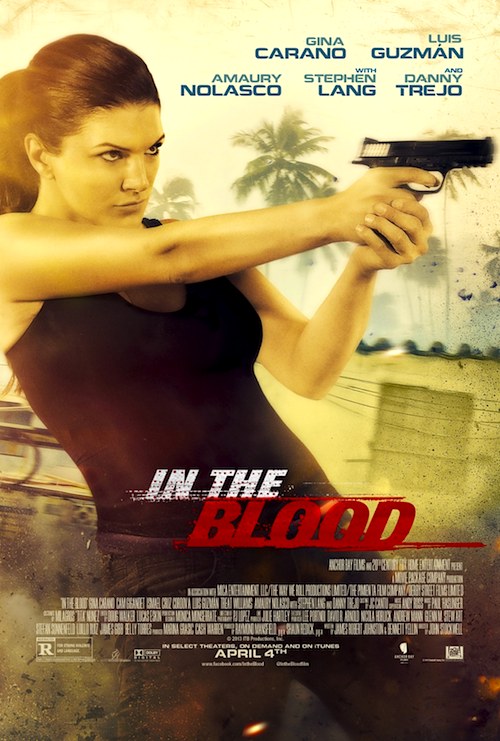
Gina Carano Misplaces Her Husband: LFM Reviews In the Blood

By Joe Bendel. You would think two recovering addicts would go to a tightly controlled “Club Med” environment for their honeymoon. Instead, the Grants visit the most corrupt island in the Caribbean. They stay on the wagon, but even more serious problems develop. When the new Mr. disappears, the new Mrs. will unleash all her street-fighting skills to find him in John Stockwell’s In the Blood, the newest vehicle for MMA star Gina Carano, which opens this Friday.

Ava’s father Casey was an original hardcase, who taught her how to fight good and hard. Even during her strung out days, following his untimely demise, she could take care of her would be predators. She cleaned up when she met the well-heeled Derek Grant in rehab. His father is not exactly thrilled with their union, but has stopped fighting it. Aside from a little dust-up in a club, their honeymoon is all very sweet and romantic—until the zip-line accident.

Unfortunately, that is not even the worst of it. Mysteriously, the ambulance carrying Grant to the central hospital never arrives with the patient. Of course, the fat and lazy police chief is happy to shift suspicion onto his ex-junkie wife, finding a receptive ear in old man Grant. Determined to find her husband, Ava Grant sets out to give the Jack Bauer treatment to every lying witness and corrupt cop in her path.

In the Blood is a pretty straight forward martial arts programmer, but it maintains Carano’s viability as an action star. There are several down-and-dirty fight sequences that nicely showcase her chops. She also gets nice support from a colorful cast of supporting characters, including Luis Guzmán and Danny Trejo (who kills it in his final scene). It is also impressive to see that Stephen Lang continues to get rougher and tougher with age during his brief flashback scenes as dear old dad. As a Twilight alumnus, Cam Gigandet does not inspire much confidence, but he manages to scratch out some okay chemistry with Carano.

For genre fans, In the Blood could be considered the rough equivalent of early Van Damme films. The plots were never extraordinary, but they were serviceable enough to build up his credibility as an action star and a romantic lead. In the Blood serves the same function for Carano, even with its unfortunate and potentially spoilery title. Stockwell does an okay job framing the action, but he is no Isaac Florentine, let alone a Dante Lam or Wilson Yip.

Still, Carano delivers on her end. She has screen presence and chops. In the Blood will not take her to the next level, but it will keep her existing fanbase engaged and ready for more. Enjoyable as a quality B-movie with serious MMA aptitude, In the Blood is recommended for genre enthusiasts when it opens this Friday (4/4) in New York.

LFM GRADE: B-

Posted on April 2nd, 2014 at 11:08pm.

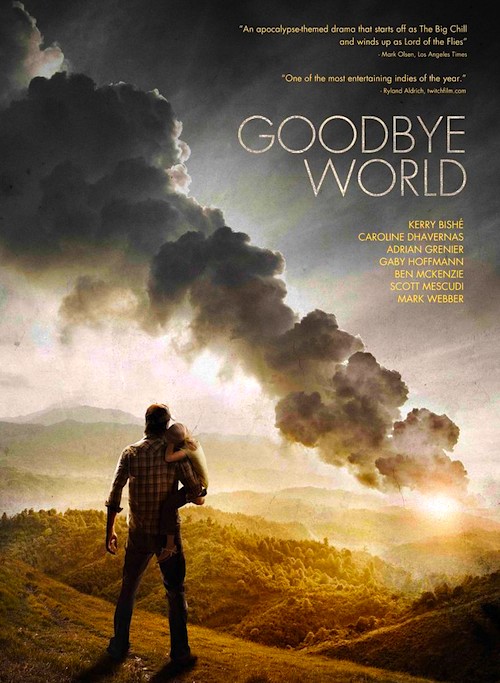
A Talky Apocalypse: LFM Reviews Goodbye World

By Joe Bendel. Rat race dropouts James and Lily live in the place where hippies and survivalists intersect. Given its strategic hilltop position and the well-stocked freezers full of food and medicine, their Mendocino County home will provide refuge to a number of their long lost college friends. Unfortunately, human nature keeps doing what it does in Denis Henry Hennelly’s Goodbye World, which opens this Friday in New York.

Nick and Becky were already en route for an awkward weekend visit to his estranged college pals. He was once engaged to Lily and business partners with James, until the hypocritical hippie forced him out over a philosophical disagreement. That is a lot of shared history, but surely they ought to be able to put it aside once the apocalypse hits, right?

Of course, it is hard to get reliable reporting on the freshly minted end of the world. Fortunately, they can rely on the analysis of Laura, another college chum, who was recently an aide to the chairman of the Homeland Security committee, until a leaked sex tape ruined her career. To further increase tensions, their Bill Ayers-lite college professor pal and his latest coed conquest also make their way to their Northern California refuge. To round out the cast of problematic houseguests, their weirdo hacker pal Lev Berkowitz turns up in state of near catatonia, openly inviting viewers to suspect he might have had a role precipitating the cyber attack.

Somehow, millions of smart phones simultaneously received the same cryptic text: “goodbye world.” Then systems started failing left and right, leading to riots in the street. James believes they can sit tight for several years, presuming they can stomach each other, until ominous outsiders start showing up and making demands.

Frustratingly, the sketchy details Hennelly and co-writer Sarah Adina Smith dole out on the early process of Armageddon are far more intriguing than the post-apocalyptic melodrama. For the most part, these are shallow, self-absorbed creeps. Even James & Lily’s daughter is an entitled princess. Still, making the scandal-tarred Laura an American Revolutionary War re-enactor is a nice bit of character detail.

As in the nearly unwatchable First Winter, the end of the world and the widespread casualties that result do not seem to cause anyone much lasting sorrow. Instead, they are preoccupied with their own petty jealousies and resentments. It is one thing to compartmentalize, but that is just cold. Logically, Gaby Hoffman fares the best amid the large vanilla ensembles, since she is blessed with the most distinctively limned character.

To be stuck in the same house as these people would be a fate far worse than any urban anarchy. The special effects team nicely evokes the end times with some subtle but clever bits of business, but Hoffman cannot single-handedly compensate for the massively boring characters her Laura must deal with. Although it gets out of the blocks quickly, Goodbye World soon loses steam. Best saved for fanatical hippie survivalists, it opens this Friday (4/4) in New York at the Village East.

LFM GRADE: C-

Posted on April 2nd, 2014 at 11:01pm.

Life Under Russian Occupation: LFM Reviews Giovanni’s Island @ The 2014 New York International Children’s Film Festival

By Joe Bendel. If Russia successfully annexes Crimea, what happens to the ethnic Ukrainian and Tartar population? If history is any guide, we should not be shocked by forced deportations. Frankly, they should probably consider themselves lucky if they do not take a detour through a Russian gulag. Residents of the Soviet occupied Kuril Islands were not so fortunate. The Production I.G team best known for the Ghost in the Shell franchise revisits a painful episode of Japanese history with Mizuho Nishikubo’s Giovanni’s Island, which screened during the 2014 New York International Children’s Film Festival.

Giovanni and Campanella are not traditional Japanese names, but they are the main characters of Kenji Miyazawa’s fantastical classic, Night on the Galactic Railroad. Tatsuo Senō is so fond of the novel he named his sons Junpei and Kanta to roughly correlate. At the time of Japan’s surrender, the elder Senō is the island’s civil defense coordinator, but since he is not technically military, he is not rounded up with the other soldiers.

Initially, rumors spread like wildfire of what the Americans would do when they arrive. Unfortunately, it is the Soviets instead. Needless to say, their arrival is quite disruptive for the island community. Many families, including the Senōs, are displaced to make room for the occupiers. Similarly, Junpei’s class is forced to share space with the lower grades to make room for the soldiers’ children. Still, he forms an unlikely friendship with the commander’s daughter Tanya that steadily develops romantic overtones.

Sadly, the Soviets will do no favors for tweener romance. After his father is arrested for distributing rice to needy villagers (so much for “to each according to their needs”), Junpei, Kanta, and their school teacher Sawako (who long carried a torch for dad) are forced to board the supposed repatriation transport without him. Ominously though, they do not seem to be bearing south towards Japan.

Frankly, screenwriters Shigemichi Sugita and Yoshiki Sakurai are remarkably restrained in their depiction of the Russian occupiers, perhaps for fear of reprisals. Nevertheless, the grim realities of the forcible deportations are inescapable. For all intents and purposes, the occupied islands were ethnically cleansed. Those familiar with Miyazawa’s short novel will also realize the Senō family is destined to experience acute tragedy.

From "Giovanni’s Island."

Indeed, the way the Galactic Railroad is weaved into Giovanni’s narrative is quite thoughtful and literate. Hardly stuck in denial, the film forthrightly acknowledges the misfortune of Koreans displaced by the Imperial military, whom the Russians never bothered to repatriate. There are also a few decent Russians in Giovanni (such as Tanya’s parents), but the Stalinist war machine is a brutal, impersonal fact of history.

Much like Jack and the Cuckoo Clock Heart, Giovanni uses poetic imagery to soften the blow of the on-screen heartbreak. Yet, there is a maturity to the film and how its characters (especially the young) resolutely “endure the unendurable” that is quite powerful. Viewers will not feel bereft at the end, despite the grueling journey it takes us on. While it focuses quite intimately on the Senōs and those closest to them, it is a rather epic story. Featuring characters you will care about caught up in historical forces likely to repeat themselves, Giovanni’s Island is the sort of animated film adults will appreciate as much or more than children.

Highly recommended as a legit big screen drama, Giovanni’s Island had its first screening outside of Japan at this year’s NYICFF. Patrons should keep an eye on their website, just in case another screening is added. Regardless, it should have a long life on the festival circuit.

LFM GRADE: A

Posted on March 25th, 2014 at 6:30pm.