Censored (Temporarily) by the Morsi Regime: LFM Reviews Jews of Egypt

By Joe Bendel. Why would a supposedly democratically elected government prohibit any public screening of a film with absolutely no violent or sexual content? In the case of the Muslim Brotherhood-backed Mohamed Morsi administration, a documentary describing how a sizable Jewish community once peacefully coexisted with Egypt’s Muslim majority was evidently not considered fit for public consumption, despite slavishly hewing to an “anti-Zionist” line. Arriving as a modest cause célèbre due to the fallen Morsi government’s misadventure in censorship (they eventually relented), Amir Ramses’ Jews of Egypt opens this Friday in New York.

During the first half of the Twentieth Century, a number of Egypt’s leading citizens happened to be Jewish. To this day, Laila Mourad remains one of the nation’s most popular recording artists, though many are apparently unaware of her Jewish heritage, judging from the brief man-on-the-streets interviews that open the film.

According to surviving members of the community, nearly all Jewish Egyptians self-identified with their country first and foremost, whereas their Jewish religion and culture was of secondary concern—if that. Everyone goes to agonizing lengths to distinguish between Jews and Zionists, clearly pre-supposing there is something fundamentally problematic about the latter. Yet, despite the vehement anti-Israeli sentiment expressed by many prominent Jewish Egyptians, they collectively found Egypt increasingly inhospitable following Nasser’s ascent to power.

From "Jews of Egypt."

Ironically, the experience of the unflaggingly loyal anti-Zionist Jewish Egyptians dramatically proves the Zionist point. Despite their Communist, anti-colonialist political affiliations, they were still arm-twisted into immigrating and, most painfully, renouncing their Egyptian nationality. Some were even imprisoned on the scantest of charges, solely because they were Jewish.

Nonetheless, Ramses and his assembled talking heads are not particularly inclined to ironic self-awareness. As far as historical accuracy goes, JOE is also highly suspect. Frankly, the film works best when examining the interrelations between the various members of the loose-knit Jewish-Egyptian society. Who knew whom and where they all wound up is rather engaging stuff.

The Orwellian impulse to erase all trace of Egypt’s considerable Jewish population is depressing, but not especially shocking. At least Ramses plants a flag that says these people existed. Considerably better at painting a picture of a unique cultural milieu than explaining the wider geo-political forces at play, Jews of Egypt is still a decidedly mixed bag. Viewers should go in already well grounded in the history of the region and Israel’s constant battle for survival. For those intrigued by its rocky pre-release reception, it opens this Friday (3/28) at the Quad Cinema in New York, via Art Mattan Productions.

LFM GRADE: C

Posted on March 25th, 2014 at 6:25pm.
Jackie Chan, Relic Repatriation Specialist: LFM Reviews Chinese Zodiac; now on Blu-ray/VOD

By Joe Bendel. Jackie Chan’s Asian Hawk character from Armour of God is back—sort of. He is known as a “JC” now (a heavy set of initials if ever there was), but he is in the same treasure hunting business. Such details hardly matter. Either way it is Jackie Chan giving his all to please audiences as action star, action choreographer, co-writer, and director of Chinese Zodiac (a.k.a. CZ12), which releases today on DVD, Blu-ray, and digital platforms from Universal Studios Home Entertainment.

During the Second Opium War, the French and British largely razed the Old Summer Palace. (Time, civil wars, and the Cultural Revolution would eventually finish the job.) On that day of Imperialistic excess, twelve Chinese Zodiac statues were indeed plundered. Lost for well over a century, they have suddenly hit the market one-by-one. At least, that is the MacGuffin that swings JC/Hawk into action. The antiquities holding firm MC Corp hires JC and his team to track down the seven heads they have not yet auctioned. They are also the bad guys. No, it does not make much sense, but it gives Chan plenty of opportunity to scamper across roofs, get chased by dogs, and fight pirates.

Whatever, nobody is going to watch CZ12 for the intricate plotting. The whole attraction is the acrobatic action and elaborate stunts Chan can evidently still pull off at a youthful fifty-eight years. He may have slowed down a little, considering that most of the painful outtakes shown during the closing credits come from previous films, but he still looks like the real deal leaping and fighting.

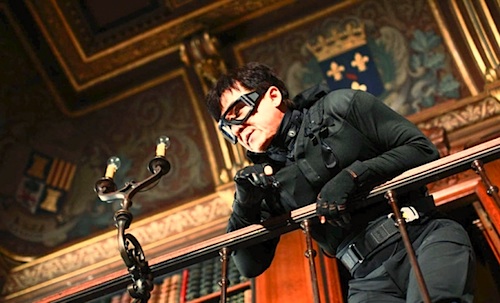
The opening sequence, involving JC’s getaway from a Russian military base through the use of a luge-like human roller-ball suit, might sound a little goofy, but the execution is extremely cinematic (and suddenly timely). It also memorably introduces former Chinese taekwondo champion turned actress and model Zhang Lanxin as CZ12’s secondary action figure. There is also plenty of cat burglary, a huge action spectacle involving a massive shipwreck that serves as the centerpiece, and a climatic skydiving throwdown that looks cool but ends a bit precipitously. However, the best sequence is a good, old fashioned rumble between JC and a small army of henchmen.

From "Chinese Zodiac."

When Jackie Chan mixes it up, CZ12 is on solid ground, even though the villains (led by Oliver Platt) are a bit weak. Since they frequently assure JC they have no intention of killing anyone, it rather minimizes the stakes (but at least as movie businessmen go, they are only mildly nefarious). Chan’s periodic soap-boxing to advocate restitution of national relics is somewhat more distractingly problematic. It all seems a little ironic considering his notorious assertion that the Chinese people are too anarchic and “need to be controlled.” In that case, would not China’s dynastic treasures be better off in a stodgy western institution, like the British Museum?

Regardless of Chan’s muddled politics, he remains a ridiculously likable screen presence. He clearly wants to entertain and continues to take a fall to do so. Frankly, he is probably the one man on Earth who takes more back pills than Chevy Chase, but he still does his thing with verve. Shu Qi also looks radiant but understandably confused in her blink-and-you-missed-it cameo, while Zhang definitely earns her shot at a leading action role in the future. Recommended for Chan fans, Chinese Zodiac is now available for home viewing from Universal.

LFM GRADE: B-

Posted on March 25th, 2014 at 6:14pm.

LFM Reviews Rob the Mob

By Joe Bendel. During 1991 and early 1992, New York was about as depressed as depression gets. The only ray of hope came from a series of high profile organized crime prosecutions initiated by then U.S. Attorney Rudy Giuliani. Yet, somehow John Gotti, the “Teflon Don,” kept wriggling out of the net—at least until Sammy “the Bull” Gravano turned state’s evidence. His testimony would also reveal the locations of several mafia-affiliated “social clubs” in open court. Tommy Uva used this information for the extraordinarily daring but not particularly well thought out crime spree that inspired Raymond De Felitta’s Rob the Mob, which opens today in New York.

Uva is a loser, but Rosemarie loves him anyway. However, the rest of the Uva family still blames him and his lowlife ways for the death of his father. Uva on the other hand, vehemently blames the mafia loan sharks for their family tragedy. You could say he has a bit of a complex when it comes to wiseguys.

After a brief prison stretch, Uva gets a job with Rosemarie’s debt collection agency—probably the only business hiring during the Dinkins years. However, he is preoccupied with the Gotti trial. When he hears Gravano explain that guns are verboten in their neighborhood front clubs, Uva hatches a very dangerous idea explained pretty clearly by the film’s three word title. One night, he takes in a pretty paltry score, but one of the old-timers at the Waikiki Club happened to be carrying something seriously incriminating.

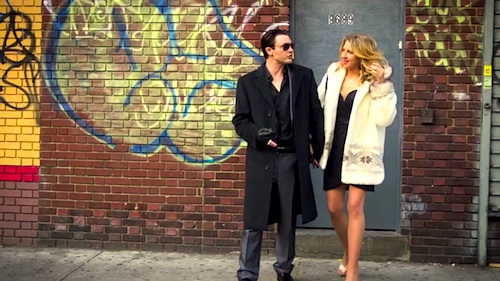
As films go, Rob is about as New York as it gets. The period details are spot-on and the attitude is razor sharp. Nobody cares what the New York Times has to say in their milieu. The journalist who gets the Uvas’ story is naturally the Post’s organized crime beat writer, Jerry Cardozo. De Felitta (better known for dramedies like City Island and docs, such as ‘Tis Autumn), deftly juggles the large ensemble of gangsters, cops, reporters, and Uvas, maintaining an appealingly gritty vibe.

However, the ace up De Felitta’s sleeve is once again Andy Garcia, who plays the composite don of dons “Big Al” Fiorello with tragic dignity worthy of a Shakespearean figure. As Garcia slowly reveals his backstory, we come to understand Fiorello reluctantly reached his current position through a strange twist of fate. He is a complicated figure, but he is about the only ethically nuanced gangster. In contrast, his underlings are a craven lot and just about everyone on either side of the side thinks Gotti is complete pond scum.

From "Rob the Mob."

While he does not quite knock it out of the park like Garcia (partly because De Felitta does not pitch him comparably fat fast balls over the plate), Ray Romano’s characteristic nervous energy and deadpan delivery still nicely serve Cardozo, a substantially straight dramatic role. While their over-the-top outer borough affectations are rather off-putting at first, Michael Pitt and Nina Arianda still develop some rather touching (and convincingly reckless) screen chemistry as the couple ironically dubbed “Bonnie and Clyde” by Fiorello’s gang. However, for real old school street cred, nobody can touch Burt Young doing his thing as aging mob lieutenant Joey D.

Granted, everyone will readily form an educated guess of the general direction Rob is headed, even if they are not familiar with the Uvas’ case, but De Felitta’s sure-footed execution will still keep viewers keyed in from start to finish. Featuring an award-worthy supporting turn from Garcia, Rob is one of the best American gangster films in several years. Particularly recommended for New Yorkers (who might be getting a glimpse of our de Blasio future as well as our Dinkins past), Rob the Mob opens today (3/21) at the Angelika Film Center.

LFM GRADE: A-

Posted on March 21st, 2014 at 11:32am.

LFM Reviews A Spell to Ward Off the Darkness @ FilmLinc/MoMa’s New Directors/New Films

By Joe Bendel. You have to do something to while the time away in the northern reaches of Scandinavia and the Baltics. A Brooklyn based musician will chew the fat in a hipster commune, soak up the wonders of nature, and play a death metal gig in a grubby little club, but less adventurous viewers will still look in vain for narrative hooks throughout Ben Rivers & Ben Russell’s A Spell to Ward Off the Darkness, which screens during this year’s New Directors/New Films, co-presented by the Film Society of Lincoln Center and MoMA.

Any decent sized festival ought to serve up some properly labeled experimental offerings just to prove their depth and breadth. Spell certainly fills that niche, but if you have a taste for hardcore metal, the final segment of the triptych will also give you plenty to bang your head to. Viewers will follow Robert Aiki Aubrey Lowe as he wanders through northeast Europe, starting in an Estonian hippie colony. Amidst the bull sessions, one Finn tells a very funny story that we cannot describe in a family outlet, but could nicely stand alone as an amusing short.

In fact, there are a number of “lucid” moments in Spell, as when said Finn sheepishly prefaces his tale by apologizing for its length. However, his interlocutor insists stories are supposed to be long—that is the whole point of telling them. He has a point. After all, storytelling is a ritual that harkens at least back to the mead-grogged Vikings orally transmitting the epic of Beowulf. Ironically, the nearly narrative-free Spell helps viewers develop the vocabulary to explain why the avant-garde so frustrates them.

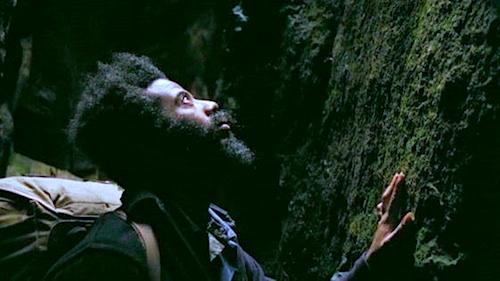
After leaving the commune, Lowe will spend Spell’s relatively short second movement communing with nature in the wilds of Finland. Visually, these are the most striking sequences (bringing to mind vintage ECM album covers), but they are also the most cinematically static.

From "A Spell to Ward Off the Darkness."

Eventually, it is time for Lowe to get down to business in a small Norwegian club. As the Bens pan and re-pan the on-screen audience, we see considerably older cats than we might expect for such a fierce show, but when an out-of-town band comes to play, the locals probably go regardless. It is also worth noting the poster of Sun Ra in the backroom, which speaks well of the club’s hipness.

There is an awful lot of grasping at small details in the above analysis, but a film like Spell openly invites viewers to impose their own meanings where they may. It has some interesting bits, but it is specifically intended for a small, self-selecting audience. Deliberately languid and deliberate, A Spell to Ward Off the Darkness is recommended for those who embrace the lulling effect of video installations more than conventional bourgeoisie narratives when it screens Saturday (3/22) at MoMA and Tuesday (3/25) at the Walter Reade, as part of the 2014 edition of New Directors/ New Films.

LFM GRADE: C+

Posted on March 20th, 2014 at 2:37pm.

LFM Reviews Monsoon Shootout @ The 2014 Cleveland International Film Festival

By Joe Bendel. It’s sort of like Sliding Doors or Kiewslowski’s Blind Chance with a lot more rain and guns. On his first day with Inspector Khan’s special anti-crime unit, a fresh recruit confronts a suspected murderer, sans back-up. He will either freeze, shoot to kill, or possibly split the difference in Amit Kumar’s muscularly moody crime drama, Monsoon Shootout (see clip above), which screens during the 2014 Cleveland International Film Festival.

As the son of a totally above-board cop, the green Adi is a bit shocked by Khan’s borderline vigilante tactics. Mumbai’s top brass makes a show of tut-tutting at the frequency his suspects are shot while trying to escape, but it is clear they are turning a blind eye. Khan is determined to bring down the Slum Lord, Mumbai’s descriptively named vice and extortion kingpin. His best lead is Shiva, one of the Slum Lord’s most reckless and dangerous assassins. After a rocky start, Adi’s brief career goes from bad to worse when he faces Shiva in that classic dark alley setting. Should he shoot or stand there flat-footed letting Shiva escape? Khan will have some choice opinions regarding either decision that he will express as viewers watch Adi’s alternate timelines play out.

One of the cool things about Shootout is the way the competing narratives parallel each other in clever ways, despite the distinctly different choices made by poor hapless Adi. At various times, he seeks treatment from his ex, Anu the nurse with a social conscience. By the same token, he always tracks down Geeta, a prostitute favored by Shiva. Conversely, radically different sides of Khan’s character present themselves during each variation on the theme.

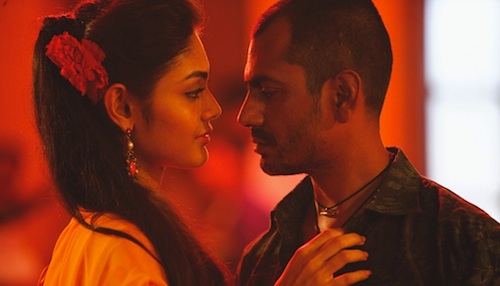
From "Monsoon Shootout."

As Khan, Neeraj Kabi excels at grizzled badassery, while bringing out more human qualities when the various circumstances allow. Nawazuddin Siddiqui’s Shiva also delivers enough glowering menace to satisfy any genre fan. While not a lot of heavy lifting is required of model-turned-indie actress Geetanjali Thapa, the more traditional romantic role of Anu represents something of a departure from her migrant workers advocacy films, such as I.D. She has passable screen chemistry with Vijay Varma, who broods as well as anyone could ask, even though Adi is to a large extent a passive puppet of fate.

Even though Shootout has a somewhat gimmicky structure, Kumar deftly uses each take to build and expand the tragic irony. All three parts also hum along quite nicely as gritty procedurals. It is a quality production with considerable genre appeal, particularly distinguished by cinematography Rajeev Ravi, who makes the rain and nocturnal streets look like visual poetry. Recommended for fans of parallel and popular Indian cinema, Monsoon Shootout screens Saturday (3/22) and Monday (3/24) during this year’s CIFF.

LFM GRADE: A-

Posted on March 20th, 2014 at 2:32pm.

If Only: LFM Reviews Jodorowsky’s ‘Dune’

By Joe Bendel. How do you get from Alejandro Jodorowsky’s trippy cult classic The Holy Mountain to Ridley Scott’s moody blockbuster Alien? The road passes through Frank Herbert’s Dune and the legendary adaptation Jodorowsky failed to realize. It was a valiant effort that assembled much of the then unknown talent that would reconvene for the later science fiction-horror vehicle. The behind-the-scenes story of the greatest film-that-never-was is told in Frank Pavich’s Jodorowsky’s Dune, which opens this Friday at New York’s Film Forum.

Jodorowsky’s Dune boasts some of the greatest and most influential pre-production work maybe ever, but sadly you cannot see the final film. In 1975, Jodorowsky was at the peak of his international success, even though his films were still unevenly distributed in America. Along with the Rocky Horror Picture Show, films like El Topo helped define the Midnight movie as a profitable phenomenon. Looking for a challenge, Jodorowsky and his producer Michel Seydoux corralled the rights to Dune.

Not exactly slavishly beholden to Herbert’s novel (which the Chilean auteur readily admits he had not read until after he committed to the project), Jodorowsky conceived an adaptation that truly boggles the mind. Still, Dune’s mind-expanding spice was perfectly compatible with Jodorowsky’s sensibilities. The prospective cast of Mick Jagger, Orson Welles, David Carradine, and Salvador Dalí alone would have guaranteed the film eternal cult status. However, Jodorowsky also assembled a technical crew of future genre superstars, including H.R. Giger, Jean “Moebius” Giraud, Chris Foss, and Dan O’Bannon, all of whom would contribute their talents to the O’Bannon scripted Alien.

Recognizing their allure, Pavich includes liberal selections of the aborted film’s concept art, even animating small snippets to really torment genre fans. Despite the short term risks, there is no way this film would not have been profitable in the long term. Which would pay more dividends in the post-1970’s VCR era, Jodorowsky’s Dune or a safe studio comedy like I Will, I Will . . . for Now? For that matter, what sort of licensing and residuals does the unwatchable Streisand remake of A Star is Born still generate, even though it was a minor hit in its day?

As a consolation, Pavich clearly suggests Jodorowsky’s efforts indirectly influenced scores of genre filmmakers, even if the experience was detrimental to his own career. Clearly, Jodorowsky is ready to talk about it, because he does so in great length throughout the documentary. Fortunately, he is quite a lively interview subject. Although we also hear from Giger, Foss, Seydoux, and Jodorowsky’s son Brontis (who would have played Paul Atreides), the senior Jodorowsky’s voice dominates the film—not that his considerable fanbase is likely to object.

During the course of the film, Pavich gives viewers a vivid sense of what Jodorowsky unmade film would have looked like and provides helpful context to appreciate the time and professional milieu in which it did not happen. A fascinating and tantalizing “what if,” Jodorowsky’s Dune is highly recommended for science fiction fans and frustrated filmmakers of all stripes when it opens this Friday (3/21) in New York at Film Forum.

LFM GRADE: A-

Posted on March 19th, 2014 at 11:22am.