LFM’s Govindini Murty & Jason Apuzzo at The Huffington Post: On the Waterfront: Eva Marie Saint and Why the 1954 Best Picture Oscar Winner Is Still a Classic 60 Years Later

[Editor’s Note: The post below appears today at The Huffington Post.]

By Govindini Murty & Jason Apuzzo. This year marks the 60th Anniversary of On the Waterfront, the winner of the Best Picture Oscar for 1954. In honor of this weekend’s Oscars, we’re taking a look at what still makes this film such a timeless classic. We had the pleasure of seeing On the Waterfront last year at the TCM Classic Film Festival with star Eva Marie Saint in attendance. It was truly a delight to hear the lovely Ms. Saint talk in person about working with such brilliant talents as Marlon Brando, Elia Kazan, and Karl Malden – and the full interview featuring Ms. Saint’s discussion with Robert Osborne, followed by screenings of three of her films, including On the Waterfront, will air March 31, 2014 on TCM.

For those unfamiliar with the film, On the Waterfront tells the story of Terry Malloy (Brando), an ex-boxer turned longshoreman who struggles with his conscience when a criminal investigation into waterfront crime puts him at odds with a corrupt union boss (Lee J. Cobb) and his own brother (Rod Steiger). Inspired by a tough local priest (Karl Malden), and stirred by a touching, guilt-ridden love affair with Edie Doyle (Eva Marie Saint), Terry eventually turns away from his complicity in waterfront crime and sparks a labor revolt against the corrupt boss.

Embraced by both audiences and critics, the gritty and emotional film was nominated for 12 Academy Awards – eventually winning eight, including the Oscars for Best Picture, Best Actor (Brando), Best Supporting Actress (Saint) and Best Director (Kazan).

Filmed documentary-style in bitter cold on location at the Hoboken docks, On the Waterfront exhibits the kind of earthy realism that many studio-bound productions of the 1950s avoided. As Kazan noted in his autobiography, “[t]he bite of the wind and the temperature did a great thing for the actors’ faces: It made them look like people, not actors – in fact, like people who lived in Hoboken and suffered the cold because they had no choice.”

The film further created a sensation due to parallels between Terry Malloy’s testimony before the film’s waterfront crime commission and Elia Kazan’s controversial appearance before the House Committee on Un-American Activities (HUAC) in 1952, during which he’d been pressured to ‘name names’ of estranged former colleagues alleged to have been communists. Indeed, On the Waterfront in its day not only became a gritty poem of the American working class, but also Kazan’s plea against conformity – both of the communist and McCarthyite variety.

Whatever one thinks of Kazan’s questionable behavior – the true motivation of which remains obscure – the artistry of his film has never been in doubt. Indeed, controversies over the film’s politics have abated in the sixty years since On the Waterfront‘s release, and what remains today is a stark, austere, almost religious masterpiece that derives its strength from the honesty of its emotions – unencumbered by the usual Hollywood trappings of celebrity narcissism, violent action or visual effects.
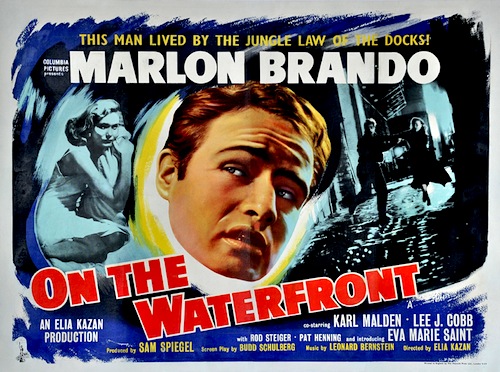
2014-03-02-OntheWaterfrontposter.jpg

Indeed, seeing On the Waterfront on the Chinese Theatre’s gigantic screen during the TCM Classic Film Festival reminded us again of why simple human truth in storytelling – particularly as conveyed by expressive faces in close-up – is always so compelling. On the Waterfront emerged out of the tradition of documentary realism – standing midway between the Italian Neorealism of films like Rossellini’s Rome, Open City and Fellini’s La Strada that arose out of the ashes of WWII, and the later avant-garde realism of the French New Wave films of Truffaut and Godard. On the Waterfront found the ideal, humanistic point between these two styles, and in the process created its own, uniquely American idiom – one featuring strongly defined, heroic characters, expressive film noir photography, and a poignant clash between group conformity and individual integrity. Continue reading LFM’s Govindini Murty & Jason Apuzzo at The Huffington Post: On the Waterfront: Eva Marie Saint and Why the 1954 Best Picture Oscar Winner Is Still a Classic 60 Years Later
Rediscovered and Restored: LFM Reviews A Celebration of Blues & Soul: The 1989 Inaugural Concert

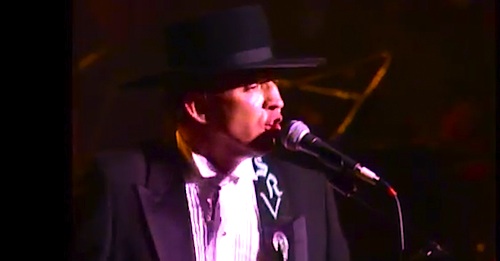
By Joe Bendel. It was a Texas kind of night in D.C. A concert bill that featured the likes of Billy Preston, Albert Collins, Stevie Ray Vaughan, and Delbert McClinton certainly reminds us of Texas’s contributions to blues, soul, and R&B. Ostensibly, the show was part of the inaugural festivities of President George H.W. Bush, another Texan, by choice. Of course, inaugurations are really just an excuse to party, which is definitely the vibe of A Celebration of Blue & Soul: the 1989 Inaugural Concert, which airs nationally on participating PBS stations during the March 1-16 pledge drive.

Long feared lost to the ages, the multi-camera recordings of the inauguration night bash have been rediscovered and restored, with a longer DVD release planned for the future. Naturally, Bush campaign manager and former Percy Sledge sideman Lee Atwater served as the honorary chairman of the concert and the invisible hand behind the scenes bringing it all together. After his greeting, the shorter PBS version launches into Dr. John’s “Right Place, Wrong Time,” perhaps the most perfunctory performance of the evening.  Next, Atwater’s old boss Sledge gives the crowd what it wants: “When a Man Loves a Woman,” for probably the 500,000th time in his career, but he still does his thing with genuine feeling.

Obviously, the 1989 concert has been edited with an eye towards greatest hits to make it pledge drive friendly, but just about everyone brought their A-game for their signature tunes. Eddie Floyd shows the showmanship of an old pro on “Knock on Wood,” while Sam Moore lays down the authority on “Soul Man,” backed by musical director Billy Preston and Stax veterans Steve Cropper and Donald “Duck” Dunn.

Clearly, there is a lot of real deal blues on the program, including legendary Chess Records mainstay Willie Dixon performing “Hoochie Coochie Man,” which represents the height of blues authenticity. Albert Collins also gets his solo spotlight on “Frosty” (along with his protégé, Vaughan) as does McClinton on “Just a Little Bit.” Most of the artists are backed by the funky ensemble led by Preston and featuring Dunn and Cropper (but alas multi-reed jazzman Patience Higgins is not prominently spotlighted in the PBS cut). Of course, Bo Diddley brought in his own band, because that was how he rolled. He also had Ronnie Wood sit-in on the classic “Bo Diddley Beat” strutter, “Hey, Bo Diddley.”

From "A Celebration of Blues & Soul: The 1989 Inaugural Concert."

For understandable reasons, Stevie Ray Vaughan is the only artist allotted more than one number (this is pledge season after all), but he sure could play. He also closes the show with some fittingly nonpartisan, patriotic life-affirming sentiments. It is depressing to think only a year and a half later his own life would be cut short in helicopter crash, while he was still at the absolute peak of his powers. Indeed, the 1989 Inaugural concert captures for posterity many late greats in an appreciative setting, performing the songs that made them famous.

This is a great week for music on PBS. While the 1989 Inaugural Concert does not offer as many surprises as last night’s Jazz and the Philharmonic, it cooks along nicely. The concert itself is a lot of good, clean, soulful fun, but do not be surprised if someone asks you for money at least once during the broadcast. Recommended for fans of blues and Stax-style Memphis soul, A Celebration of Blue & Soul: the 1989 Inaugural Concert aired twice yesterday (3/1) on New York’s Thirteen and can be seen on PBS outlets throughout the country over the next two weeks.

LFM GRADE: B+

Posted on February 2nd, 2014 at 2:51pm.

Russians Still Winning, This Time in 3D: LFM Reviews Stalingrad

By Joe Bendel. Those who question Russia’s commitment to sustainability should at least give them credit for recycling their titles. In 1989, Fedor Bondarchuk received one of his earliest acting credits in Yuri Ozerov’s Stalingrad. Twenty-some years later, the thesp-turned-director has helmed Russia’s first film produced entirely in 3D IMAX—and it happens to have the same title. It essentially ends the same way too, but some weird editorial choices distinguish Bondarchuk’s Stalingrad, Russia’s reining box office record holder, which opens today in New York.

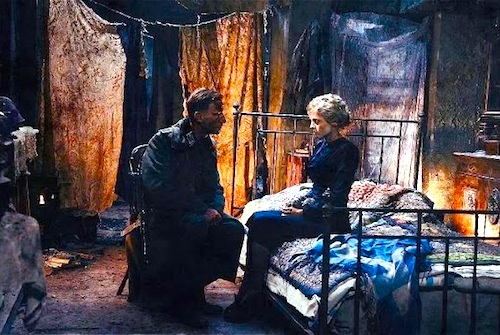
In large measure, Bondarchuk’s Stalingrad is inspired by the heroic exploits of Pavlov’s House, the strategically located apartment complex doggedly defended by Sergeant Pavlov and his men. In this case, it is Captain Gromov and his comrades who have dug into a reinforced tenement right across from pretty much the entire German army. While most civilians have evacuated, the elfin Katia has defiantly remained, to stoke jealousy amongst Pavlov’s men and to give them something personal to fight for.

A few steps away, Captain Peter Kahn is tasked with crushing all pockets of Russian resistance. However, National Socialist war atrocities have dampened the Prussian elitist’s morale. He is more concerned with Masha, another Russian women stuck in the wrong place at the wrong time. In the tradition of bodice rippers, he initially “ravishes” her, but then starts to fall in love with the Russian beauty. She also seems to warm to him as a protector, but fears for the consequences if and when the Soviets expel the Germans.

Perhaps the weirdest element of Bondarchuk’s film is the framing device, in which a Russian emergency responder tells a group of Germans trapped in the rubble of the Tōhoku earthquake how his mother met his five fathers during the siege of Stalingrad, because nothing is more reassuring than episodes from the bloodiest battle in human history. Dude, next time, don’t help. Frankly, the way the film exploits Japan’s 3-11 tragedy would be deeply offensive, if it were not so ludicrous. Seriously, Russian rescue workers digging out Germans in Sendai?

On the plus side, Bondarchuk makes stuff blow-up really well. Obviously, he did not intend to waste his blank check in the IMAX store.  He devises all sorts of dramatic perspectives on the action, while vividly capturing a sense of the claustrophobic nature of close quarters fighting. He is also either surprisingly fair to the Germans or simply lets Thomas Kretschmann run circles around the rest of the cast as the ethically nuanced Kahn.

From "Stalingrad."

Frankly, he represents the film’s most believably complicated character and develops some powerfully ambiguous chemistry with Yanina Studilina’s Masha. In contrast, Gromov and the other four fathers are all either colorless Reds or borderline war criminals. Either way, they make little lasting impression. It almost makes a viewer wonder if Bondarchuk set out to be deliberately subversive.

It seems unfathomable that a Russian WWII epic can make audiences sympathize with the Germans. Yet, if you close your eyes and think of Stalingrad a few days after taking it all in, it will be Krestchmann and Studlina whom the mind’s eye will recall. Nevertheless, Russia duly submitted Stalingrad as its official foreign language Oscar contender. Perhaps it is still preferably in Russia to declare a dubious victory than admit an obvious defeat. Sort of recommended in a confused way for those who appreciate battlefield spectacle, Stalingrad opens nationally today (2/28) including in New York at the AMC Empire and Lincoln Square theaters.

LFM GRADE: B-

Posted on February 28th, 2014 at 11:26am.

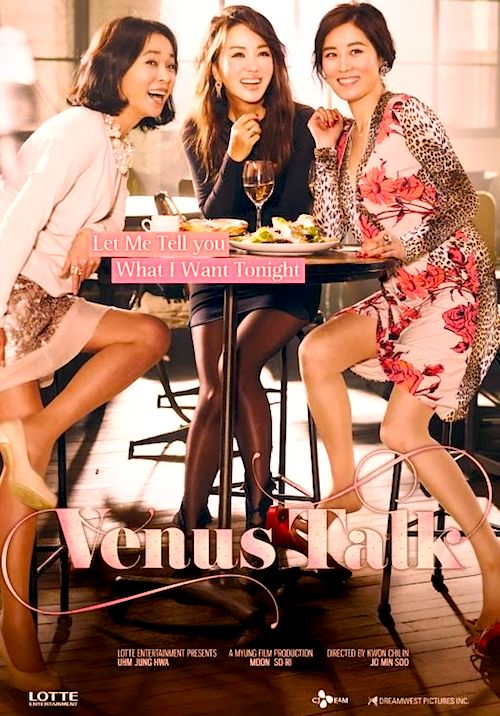
Naughty Coffee Klatching: LFM Reviews Venus Talk

By Joe Bendel. Some critics will reflexively compare this Korean relationship drama to that old HBO show that ended its run a decade ago. However, the three stars of this import were secure enough to allow a cameo appearance from BoA, the young and glamorous “Queen of Korean Pop.” In fact, the forty-something cast looks considerably younger than their long-faced American forerunners. They will still inevitably mismanage their private lives in Kwon Chil-in’s Venus Talk, which opens in select theaters today.

Frankly, this trio of friends is not so interested in talking, but they have to do something when they meet for brunch at Hae-young’s coffee shop. She is a single mother with a grown daughter she can’t get out of the house and the best boyfriend of the bunch. Sung-jae is mature, sensitive, and handy around the house, but harbors been-there-done-that feelings about marriage. Mi-yeon appears to be happily married, but her demands will put a strain on her relationship with her Viagra-bootlegging husband, Jae-ho. Shin-hye is more interested in her work as a television producer than any sort of romance, but a drunken fling with Hyun-seung, a much younger colleague, complicates her carefully calibrated career.

Into these lives great turmoil will fall, but they always stick together—after a bit of judgmental cattiness. Sure, you probably suspect where Kwon and screenwriter Lee Soo-a are headed and have a pretty good idea how they will get there, but it must be said Venus is surprisingly fair to the guys. Frankly, the women are at least as responsible for their relationship angst and their partners, if not more so. This is particularly true in the case of Mi-yeon and the woefully cringey Jae-ho.

While never explicit, Venus is rather saucy, especially by the standards of Korean cinema. Not for no reason, most of the more suggestive scenes feature the photogenic Uhm Jung-hwa and Lee Jae-yoon as the impressively fit Shin-hye and Hyun-seung, respectively. They have okay chemistry together and Uhm nicely mixes attitude and professionalism in her straight forward dramatic scenes.

Yet, Cho Min-su once again steels the picture in a complete change of pace from her soul-shattering turn in Kim Ki-duk’s bracing Pieta. As Hae-young, she brings more dignity, forgiveness, and general humanity to Venus than you would ever expect to find in a cougar-ish chick flick. In contrast, Moon So-ri is stuck with the least sympathetic and most over-the-top of the lot, but she fully commits to the voracious Mi-yeon nonetheless.

There have been films like Venus before and there will be plenty more like it to come. Even so, it is a credit to Kwon, Uhm, and Cho how smooth it goes down, especially for those who do not have a strong affinity for the genre. It is well executed, but never pushes the envelope of women-centric relationship dramas. Mostly recommended as a women’s-night-out movie, it opens today (2/28) in Honolulu at the Consolidated Pearlridge and in Vancouver at the Cineplex Silvercity.

LFM GRADE: C+

Posted on February 28th, 2014 at 11:18am.

Real Jazz on PBS: LFM Reviews Jazz and the Philharmonic

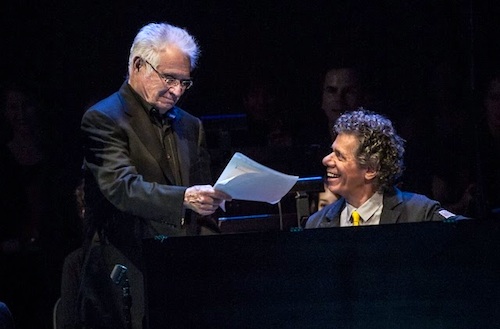
By Joe Bendel. For many ardent listeners, the words “jazz” and “philharmonic” have heavy significance when used in close proximity. It automatically summons images of the all-star concerts and recording sessions the legendary Norman Granz produced in concert halls around the country. This is not a Granz production. The philharmonic reference is more in keeping with the classical tradition. However, the jazz is still for real in Jazz and the Philharmonic, a concert featuring alumni of the National YoungArts Foundation, the Henry Mancini Institute Orchestra, and some of the top names in jazz, which airs on most PBS stations this Friday (yes, real honest-to-gosh jazz on PBS).

Of course, jazz and classical crossover fusions are nothing new. That is exactly what Third Stream Jazz was all about. While many of the program selections feature jazz soloists playing with the Mancini Orchestra (whose namesake would surely have approved of the program, especially the theme from Charade), there are several straight-up solo, duo, or trio jazz performances, which is obviously not a bad thing.

In fact, it is a very good thing when Chick Corea, Dave Grusin, and Bobby McFerrin open the concert with an elegant but persistently swinging “Autumn Leaves” for voice and two pianos. Corea fans really get their money’s worth throughout the concert, with the NEA Jazz Master performing in a variety of settings, mostly notably joining the Mancini Orchestra on his “Spanish Suite,” a composition perfectly suited to the evening. His duet with McFerrin, “Armando’s Rhumba” is not as distinctive, but they clearly enjoy making music together, which is part of the fun of a show like this.

In addition to “Spanish Suite, Terence Blanchard also has feature spots on “Fugue in C Minor” and “Solfeggietto,” probably the two most overtly swinging-the-classics numbers of the evening. However, he is probably best showcased fronting the orchestra for a rendition of “Charade,” a wonderfully lush arrangement that brings to mind his classic Jazz in Film CD. Yet, perhaps the most effective jazz and classical dialogue comes when Elizabeth Joy Roe and Shelly Berg tackle “The Man I Love” as a lyrical but muscular piano duet, from the classical and jazz sides, respectively.

From "Jazz and the Philharmonic."

Nevertheless, the surprise peak of the concert integrates the sounds of deep roots Americana as well as jazz and classical when violinist Mark O’Connor joins pianist Dave Grusin on a sensitive and soulful version of “Simple Gifts,” the Shaker standard subsequently incorporated into Copeland’s Appalachian Spring. Rather fittingly, Grusin’s “Mountain Dance” follows. Purists might dismiss it as too “smooth,” but man, is it ever a pretty melody, sounding almost tailor made for the full orchestral treatment. It also provides a nice launching pad for O’Connor. In fact, Grusin takes two rather impressive solos as well: one fleet and swinging and the second surprisingly adventurous—so take that jazz snobs.

Aside from a weird choice for a closer (Also sprach Zarathustra from 2001, really?), Jazz and the Philharmonic is an extremely welcome dose of jazz on primetime PBS. It ranges from pleasantly entertaining to downright revelatory. It should motivate viewer-listeners to keep an eye out for a talented newcomer like Roe and catch up with the work of accomplished veterans like O’Connor and Blanchard. Naturally, it always sounds great from a technical perspective, thanks to the late, great engineer Phil Ramone, in whose memory it is dedicated. Highly recommended, Jazz and the Philharmonic airs on hip PBS outlets this Friday night (2/28).

LFM GRADE: A

Posted on February 25th, 2014 at 10:22pm.

Koontz’s Cook Finally Makes it to the Big Screen: LFM Reviews Odd Thomas

By Joe Bendel. This Dean Koontz protagonist is not shy when it comes to voice-over narration, but never exactly breaks the fourth wall, per se. He is probably entitled to his own eccentric commentary, considering he has the ability to see ghosts and bodachs, supernatural parasites that feed on fear and suffering. However, his greatest nemesis might be lawyers, given the legal wrangling that long delayed the release of Stephen Sommers’ Odd Thomas, which finally opens in New York this Friday.

Thomas comes from crazy stock and therefore understands the need to keep his dubious gift secret. Only a handful of people know of his power, including Pico Mundo’s chief of police Wyatt Porter, who appreciates the sort of inside information Thomas can provide. His loyal girlfriend Stormy Llewellyn is also in on the truth and a few of their friends vaguely suspect he has the Shine.

Normally, he chases down workaday serial killers before they can murder again, like his former classmate Harlo Landerson from the film’s prologue. However, the alarming number of bodachs converging on Pico Mundo portends a tragedy of grander scale.  They seem particularly interested in “Fungus Bob” Robertson, so dubbed by Thomas and Llewellyn because of his unfortunate grooming habits. Robertson also has an unhealthy interest in Satanism and a couple of mystery friends. Thomas will try to sleuth out Robertson’s plans without alerting the bodachs to his uncanny powers of perception, because they do not take kindly to folks like Thomas.

Frankly, the first half of Odd Thomas feels like a ghost-hunting TV show from the 1980’s, with its quaint small town setting and Thomas’s wholesome courtship of Llewellyn. However, as the stakes and tension start to rise, the film becomes considerably darker. Sommers (best known for The Mummy and G.I. Joe franchises) pulls off some third act sleight-of-hand surprisingly adroitly and the manner in which earthly cults intersect with paranormal malevolence is somewhat intriguing.

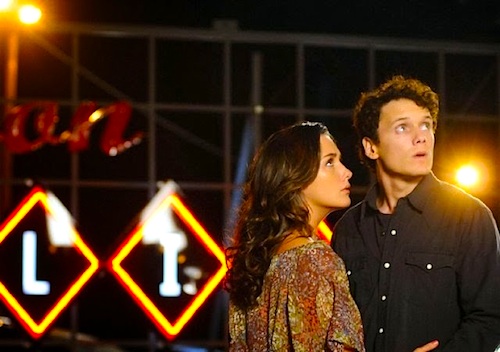
From "Odd Thomas."

Still, Anton Yelchin and Addison Timlin are almost too cute and freshly scrubbed-looking as Thomas and Llewellyn. Frankly, Sarah Michelle Gellar’s Buffy was much edgier, notwithstanding the characters’ dark backstories in the Koontz source novel. Still, Odd Thomas has the distinction of featuring Willem Dafoe as an unqualified good guy, without even the hint of moral compromise, perhaps for the first time since Triumph of the Spirit. He is actually not bad plodding along with all due decency as Chief Porter.

Arguably, the biggest issue for Odd Thomas is the lack of a strong villain. Broadway actor Shuler Hensley is game enough as Robertson, but the character is played more for yucks than scares. Likewise, the bodach effects are serviceable enough, but not especially memorable.

When watching Odd Thomas one can see how it probably works so much better as a novel. There is some pop at the end that presumably has even more kick on the page. Yet, the film as a whole has the feel of an extended pilot that it never shakes off. Better than you might expect, but still better suited to the small screen, Odd Thomas finally opens this Friday (2/28) in New York.

LFM GRADE: B-

Posted on February 25th, 2014 at 10:10pm.