LFM Reviews Easy Money: Hard to Kill

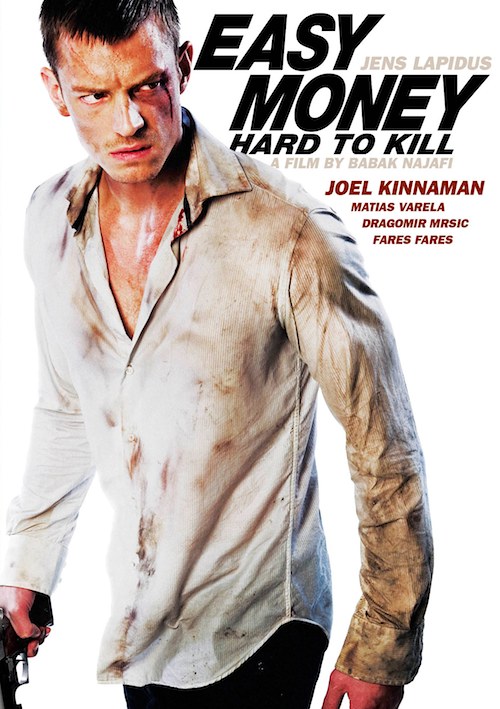
By Joe Bendel. When on work release, convicted cocaine smuggler Johan “JW” Westlund seizes the opportunity to get back to “work.” This was not always his world, but he will find there is no going back to the upright, respectable existence he once led in Babak Najafi’s Easy Money: Hard to Kill, which opens this Friday in New York.

There were a lot of casualties at the end of the first Easy Money film, but somehow Mrado Slovovic survived, despite being run-over by a car and shot at close range by Westlund. One might expect the wheelchair-bound hitman to hold a grudge, but he and Westlund bond when they become cellmates. It must be all that shared history. Once a promising business student, Westlund lent his analytical skills to an up-and-coming coke syndicate to subsidize his extravagant lifestyle. In retrospect, it was not such a great plan for the future. Trying to go straight, Westlund develops a game-changing stock-trading program, only to find during his first furlough his so-called partner has double-crossed him.
Slightly put out, Westlund chucks in the work-release song-and-dance, arranging to break Slovovic out instead. He might be paraplegic, but Slovovic is still one bad cat. He also knows the daily routine of the Serbian mob’s unassuming money launderer. While they work on their hasty caper, small time South American trafficker Jorge and lowly Lebanese enforcer Mahmoud are also making their desperate plays for survival. Naturally all three alumni from the first film will come together in some fashion during the third act.

Viewers should be able to readily follow Hard to Kill even if they did not see the franchise opener, but the constant parade of faces that are supposed to be familiar will be more rewarding to those who have. Regardless, HTK is slick, stylish, and strangely multicultural, but hardly in a way that embraces global fellowship. This is not a film that will have you humming “It’s a Small World,” but it might scare you straight, unless you live in Colorado, where these sorts of things are practically legal.

Joel Kinnaman, the star of AMC’s The Killing and the RoboCop reboot so coincidentally opening just before HTK, is suitably flinty as Westlund, but Dragomir Mrsic out hardnoses everyone as Slovovic, while still expressing his acute disappointment in himself as a father. Likewise, Fares Fares makes a compelling sad sack as the luckless Mahmoud.

Since Easy Money: Life Deluxe has already released in Sweden, it is a safe bet anyone who survives the second cut will be back to try their luck a third time. HTK does not break a lot of new ground, but the intriguing relationship that develops between Westlund and Slovovic elevates it above more routine Scandinavian crime dramas. Recommended for those who enjoy gangster films with healthy doses of violence and irony, Easy Money: Hard to Kill opens this Friday (2/14) in New York at the Cinema Village.

LFM GRADE: B

Posted on February 11th, 2014 at 12:19am.

He Also Does Taxes: LFM Reviews The Attorney

By Joe Bendel. Depending on who you ask, the late ROK President Roh Moo-hyun was either a principled idealist or a corrupt demagogue. A new film unequivocally holds to the former view. A thinly fictionalized Roh will argue a life-altering, inspired-by-true-events case in Yang Woo-seok’s The Attorney, which opens today in New York.

Even though he never graduated from high school, Song Woo-seok became a self-taught bar-certified attorney (sort of like Lincoln). He even briefly served as a judge, but resigned to pursue a more lucrative practice, for the sake of his family. Recognizing an early opportunity, Song becomes one of the first to take advantage of a legal change allowing attorneys to register property deeds in place of a notary. At first, the legal establishment is openly contemptuous of the bounder. Then the business starts pouring in.

Eventually, other attorneys started competing for Song’s real estate business, so Song once again makes a shrewd move into a tax practice. Ironically, when the paper-pushing Song finally litigates a case, the fix is in right from the start. In acknowledgement of a debt from his early scuffling years, Song reluctantly agrees to represent Jin-woo, the son of a forgiving noodle shop proprietor. Unfortunately, this is no ordinary criminal case, but a dubious national security prosecution, with confessions already lined up courtesy of the ruthless Captain Cha Dong-young.

When it gets down to political business, The Attorney is certainly not shy about waving the bloody martial law shirt. However, the first half of the film is actually a rather touching story of hard work and sacrifice rewarded, in the tradition of The Pursuit of Happyness. Song Woo-seok (a fusion of the director and star’s names) is an earnest everyman, who earns his piece of the pie the old fashioned (but unfashionable) way.

Of course, once the sainted Soon-ae’s son is arrested, The Attorney shifts into high moral outrage gear. Korean box office superstar Song Kang-ho leaves it all on the field as his half namesake, wringing all the righteous indignation and heroic sincerity he can out of the courtroom cross examinations. At least Yang and co-writer Yoon Hyun-ho step back from the Few Good Men, acknowledging an experienced government employee like Cha will never cop to ordering a “Code Red” on the stand.

From "The Attorney."

Fans of Song Kang-ho, Korea’s top domestic movie star, should probably seek out The Attorney, despite its excesses, because there is no telling how much of him will be left once Harvey Weinstein finishes editing Bong Joon-ho’s Snowpiercer with a hacksaw. Yet, it is veteran actress Kim Young-ae who really instills the film with dignified sensitivity as honorable gravitas as Soon-ae. It is also amusing to see Oh Dal-su (Oldboy’s sleazy private prison warden) do his shtick as Song-Woo-seok’s sitcomish office manager. Unfortunately, Kwak Do-won (a great villain in A Company Man) largely phones in Cha, the cold fish.

In a way, The Attorney sort of confirms the theory that political liberty inevitably follows economic liberty. After all, Song Woo-seok sure is busy with real estate transactions in the early 1980’s. While the performances are mostly quite impressive, it never really captures the telling period details. Without the narrative reference points, viewers might mistake it for a contemporary legal drama. While it is sure to stoke political debate in Korea, The Attorney is only recommended for American viewers with a crack cocaine level addiction to legal table-pounding melodramas when it opens today (2/7) in New York at the AMC Empire.

LFM GRADE: C+

Posted on February 7th, 2014 at 3:28pm.

Vengeance is Shohei Imamura: LFM Reviews Black Rain

By Joe Bendel. These days, fifty-five is a relatively young age to pass, especially for a former pop idol. For the family and fans of Yoshiko Tanaka, it would be a tragic case of symmetry. Justly lauded for her role as a “hibakusha” Hiroshima survivor, Tanaka succumbed to cancer in 2011. Although not exactly the sort of wrong-side-of-the-tracks noir that made his early reputation, Shohei Imamura’s Black Rain made a fitting capstone to the Asia Society’s Vengeance is Imamura retrospective when it screened this past weekend.

Yasuko was not in Hiroshima proper when the bomb was dropped, so she should be unaffected by “the flash.” However, she was caught in the “black rain” during the immediate aftermath. Despite her beauty, that is enough for most parents to put the nix on inquiries from her marriage broker.

Frankly, her matchmaking woes are more painful for her uncle Shigematsu Shizuma and his wife Shigeko. They had taken their niece into their home for safe keeping during the waning days of the war, promising to arrange her betrothal. Her potential old maid status grieves them personally and represents a potentially loss of face with their family and ancestors. Yet, as Yasuko’s prospects dim, she becomes increasingly devoted to the ailing Shizumas.

Imamura served an early apprenticeship with Yasujiro Ozu, so it is not so surprising to see his mentor’s influence imprinted on Rain. Like many of Ozu’s signature films, which focus on fathers and daughters or uncles and nieces, Rain is defined by the relationship between Yasuko and old man Shizuma. The way their bond steadily deepens is absolutely beautiful and agonizing to behold.

From "Black Rain."

As Yasuko, Tanaka is exquisitely beautiful, profoundly moving, and in retrospect, sadly eerie. Likewise, Kazuo Kitamura is a wonderfully complex figure of strength and pathos. Their screen rapport is real and affecting.

Rain is also impressive on a technical level, vividly recreating the chaos and destruction of Hiroshima. Nevertheless, it is a far cry from an Irwin Allen picture. It is also worlds removed from Ridley Scott’s Black Rain, which was also partly set in Japan and released in the same year. However, it makes much of the criticism leveled at The Wind Rises look largely misplaced. While Miyazaki’s animated feature addresses the repressive tactics of the militarist government’s secret police, Black Rain presents the Japanese war experience entirely in terms of passive victimhood. Yet, its overt anti-nuclear sentiments earn it a pass. Regardless, Black Rain is a mature and engrossing work from a master filmmaker. Highly recommended, it concludes the Vengeance is Imamura series tonight (2/1) at the Asia Society.

LFM GRADE: A-

Posted on February 4th, 2014 at 12:36am.

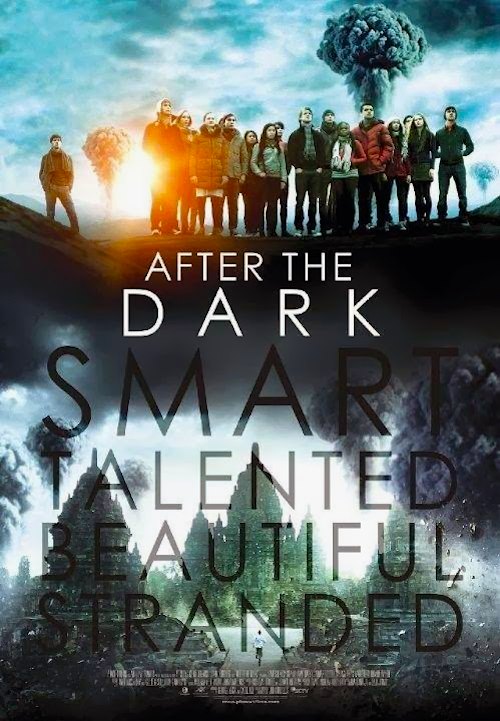
Talking Through the Apocalypse: LFM Reviews After the Dark

By Joe Bendel. In most lifeboat scenarios, it is women and children first. That is not necessarily the case for the hypotheticals one philosophy class will grapple with. Logic will be the first thing thrown over the side in John Huddles’ After the Dark, which opens this Friday in select theaters.

The elite philosophy class of Jakarta’s western school for wealthy expats is a little put out having to do work on the final day of class, but Mr. Zimit is playing hardball with their grades. They will each draw a profession from his box and then vote on who gets a place in the bomb shelter. There are twenty of them and enough air and provisions in the bunker for ten.

As their “thought experiments” play out, we see the survivors interacting, like rats trapped in a cage, but since they are all just jawing back in their Jakarta classroom, where is all this melodrama coming from? It gets rather puzzling at times as when, for obvious reasons of jealousy, Zimit decrees James, the just-getting-by boyfriend of his prized pupil Petra, shall hence forth be gay. To be true to himself, James subsequently starts sleeping with the class’s token gay Adonis in bunker world. That drives Petra into the bunker-arms of Zimit, which in turn disturbs James because he always had a bad feeling about that guy. Frankly, it would be much more interesting to see how that could possibly come out in a classroom conversation than to sit through the dramatic representation.

Dark’s basic premise is intriguing, but the execution is a logical shipwreck, starting at the top with Mr. Zimit. Supposedly he wants his students to think like philosophers, but it is more like he is training them to be actuaries. You’re a gelato maker—sorry not much earnings potential there. In a running gag, Zimit summarily executes the poor shmuck stuck being the poet before selection even begins, because he so obviously lacks utility. Really, that is what a philosophy teacher thinks of poetry? I put it to you Mr. Zimit, any philosophy instructor who neglects the age old philosophic study of aesthetics is a substandard teacher who therefore must relinquish his role in deciding who will live and who will die.

Regardless, Sophie Lowe is surprisingly good as Petra, the sensitive smartie. The whole class is ridiculously attractive, but the girls generally sound more convincingly like members of a gifted-and-talented class than the meathead guys. Yet, the film’s real trump card is the Indonesian locales who add a distinctively surreal wtf-ness that helps forestall all the questions regarding logical inconsistencies.

Have you ever woken up at night with what feels like a brilliant idea, but thought otherwise once you read your scribbled notes in the morning? That probably happened to Huddles, except he still thought it was a fine notion and proceeded to film it. There is a germ of something here, but he should have given his subconscious more time to kick it around. However, Russian audiences evidently disagreed, making it a surprise box office champion over several studio films, which is impressive considering its relatively sympathetic gay character probably makes it illegal under Putin’s “homosexual propaganda” law. A head-scratcher all the way around, After the Dark releases in select theaters and on VOD this Friday (2/7).

LFM GRADE: C

Posted on February 4th, 2014 at 12:33am.

LFM Reviews 2014 Oscar Nominated Live Action Shorts

By Joe Bendel. If you are looking for a unifying theme among this year’s live action short film Oscar nominees, several address the responsibilities of parents and the extent to which the wider society can complement or replace the family unit. Of course, there is also the ringer that cannot be shoehorned into a handy rubric. All five nominees screen as part of the annual showcase of Academy Award nominated shorts, which opens today at the IFC Center in New York.

Frankly, Sini and Jokke are not bad parents. They are just kind of a mess in Selma Vilhunen’s Do I Have to Take Care of Everything? Nearly over-sleeping an important wedding, they still manage to schlep their two young daughters over to the chapel, despite a series of minor disasters. Everything is pleasant and amusing, but only an inch deep and seven minutes long.

In contrast, Esteban Crespo’s That Wasn’t Me seems to expect a round of applause just for dramatizing the child-soldier issue. Married Spanish doctors have come to an African war zone as part of a humanitarian mission, but their safe passage documents do not impress one warlord. The horrific crimes that follow will be done at his behest by young orphans pressed into his so-called army. Discussing his crimes after the fact, one former child-soldier explains how the guerilla commander exploited their need for a sense of family and belonging.

There are scenes in TWM that are genuinely shocking. While it serves as a timely reminder of the appalling lack of human rights throughout the continent, the film feels rather programmatic, like a calculated statement rather than a fully realized drama in its own right.

When it comes to pulling on heartstrings, none of the shorts can compete with Anders Walter’s Helium, but earns its sentiment through honest hard work and artistry. Alfred’s parents are caring and conscientious, but that cannot change the fact he is dying of a terminal disease. His mother constantly tells him he is going to Heaven, but the harps and white robes do not do much for him. Enzo, the clutzy new janitor, has a better conception.

Reminded of his late kid brother, who also shared a love for zeppelins and Jules Vernish hot air balloons, Enzo starts telling Alfred about the world of Helium, a steampunk-Boy’s Life alternative to Heaven. For a while, Enzo’s vision of Helium lifts the boy’s spirits, but his body soon takes a turn for the worse. Helium’s animated fantasyscapes are quite richly rendered, bringing to mind about the only part of the What Dreams May Come movie that actually worked. However, it is the chemistry between Casper Crump, Pelle Falk Krusbæk, and Marijana Jankovic as Enzo, Alfred, and his understanding nurse that really lowers the boom in Helium. Despite the melodramatic aspects, viewers will feel moved rather than manipulated.

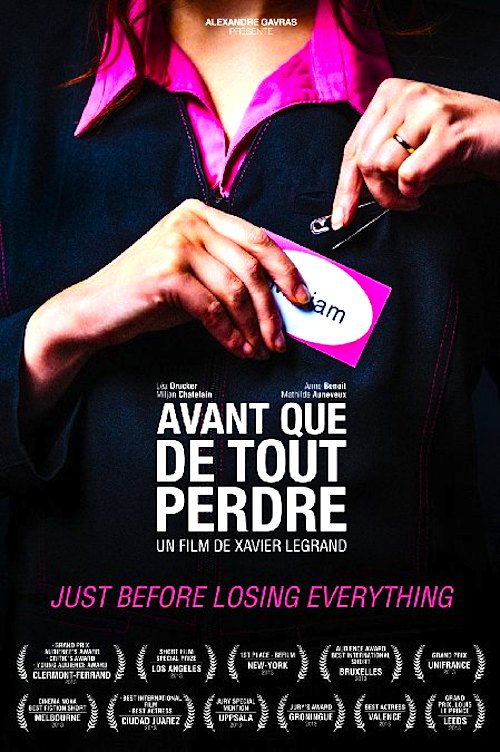
There is also some pretty raw emotion in Xavier Legrand’s Just Before Losing Everything, which is arguably the best of this year’s live action nominees. Miriam is a battered wife, who has finally decided to leave her husband. However, it will not be a simple matter of walking out the door. She must bundle up her kids and collect what money she can from the job she must leave behind. Everyone at her Tesco-like superstore is sympathetic, but uncomfortable and unsure how far they can go to help. Then her husband shows up looking for the checkbook.

If Helium boasts the strongest ensemble of this year’s nominations, Losing features the single strongest performance from Léa Drucker as Miriam. We so get all her fear, vulnerability, and misplaced shame. Instead of yelling “look at me,” it is work that hits you in the gut.

As the odd man out, Mark Gill’s BAFTA nominated The Voorman Problem tells a self-consciously clever tale of an emotionally disturbed prison inmate who thinks he is the almighty and the nebbish shrink sent to evaluate him. There is witty bit of business involving Belgium, but the ironic payoff is forced and perfunctory. Nonetheless, co-star Martin Freeman has helped generate scads of revenue for the industry as Bilbo Baggins in the Hobbit trilogy and Watson in BBC/PBS’s Sherlock, so Voorman might have the inside track with the Academy.

In terms of tone and overall quality, this year’s live action field is less consistent than their animated counterparts. Still, it is well worth seeing for Helium and Just Before Losing Everything, which account for over half the program’s running time. They introduce some international talent worth keeping an eye on. Recommended accordingly, the nominated live action showcase opens today (1/31) at the IFC Center.

Posted on January 31st, 2014 at 2:04pm.

LFM Reviews Select 2014 Oscar Nominated Documentary Shorts

By Joe Bendel. The subjects of this year’s two best Oscar nominated documentary shorts have some pretty unique talents, but Alice Herz-Sommer is in a class by herself. Still playing with verve at the spry age of 109, Herz-Sommer performed over one hundred piano recitals in the Theresienstadt (or Terezin) concentration camp. Taking strength from her music, she lived to tell and continued to find the beauty in life. Her story unfolds in Malcolm Clarke’s The Lady in Number 6, part of the annual two part showcase of Academy Award nominated short docs, which opens today at the IFC Center.

As a young girl, Herz-Sommer’s sophisticated Prague family often socialized with the likes of Gustav Mahler and Franz Kafka. Something of a prodigy, she was widely recognized as one of the world’s top concert pianists by the time she was in her early thirties. Then the Germans invaded.

Obviously Herz-Sommer survived, but she would be no stranger to tragedy. Yet her indomitable spirit is genuinely inspiring—not in a Hallmark card sort of way, but reflecting hard won wisdom and a tenacious love of music. Still razor sharp at 109, she is a forceful screen presence, who never resorts to canned clichés.

No stranger to the subject of Theresienstadt, Malcolm Clarke was previously Oscar nominated for the documentary feature, Prisoner of Paradise, chronicling the life of Herz-Sommer’s fellow prisoner, Kurt Gerron. He includes enough historical context for those unfamiliar with the realities of the Potemkin concentration camp, but keeps the focus squarely on Herz-Sommer. He also has a great voice for narration and incorporates some distinctive original music, performed by Julie Theriault. Altogether, it is a sensitive and classy package, standing head and shoulders above the rest of the field.

While his life circumstances are radically different, Ra Paulette, the subject of Jeffrey Karoff’s Cavedigger is another fascinating artist. Like the title implies, Paulette digs caves. He is sort of a subterranean landscape artist, whose work incorporates elements of architecture and sculpture. Frankly, Paulette comes across as a bit of a flake, but his dedication is impressive and his caves are truly a sight to behold. Some of his work is reminiscent of Granada cave homes, but on a much grander scale. It is real feat of filmmaking, spanning years and transporting viewers to the remote corners of northern New Mexico.

Ordinarily, Yemen would also be considered quite the exotic locale, but over the last two years footage of the Arab Spring uprisings have become almost ubiquitous. Sara Ishaq’s Karama has no Walls adds some particularly graphic images to the public discourse. Drawing on video shot by two remarkably young cameramen, Walls is surprisingly effective breaking down step-by-step how the Change Square massacre escalated. Yet, despite the anguished testimony of two grieving fathers (say, why don’t we see the mothers on camera, as well?), the film has the look and trajectory of an extended BBC report. In contrast, Matthew VanDyke’s Not Anymore feels more cinematic, yet also more immediate.

Granted, Herz-Sommer’s story has been documented in Caroline Stoessinger’s widely translated A Century of Wisdom, but thank heavens Clarke got her oral history on film. Frankly, Paulette is not getting any younger either, but he seems to keep chugging along, just like Herz-Sommer. The best of the five, The Lady in Number 6 screens as part of the annual nominated short documentary showcase’s program A, along with the well intentioned Karama has no Walls. The intriguing outdoorsman outsider art documentary Cavedigger screens as part of program B, both of which open today (1/31) in New York at the IFC Center.

Posted on January 31st, 2014 at 2:01pm.