LFM Reviews 2014 Oscar Nominated Animation Shorts

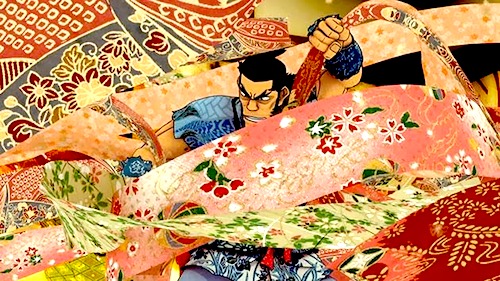
From "Possessions."

By Joe Bendel. Was man free in his original state of nature? Are we enslaved by our stuff? Several of this year’s Oscar nominated animation shorts lend themselves to such Rousseauean questions. There is also a Disney Film (not included in the media screenings) to contend with. Regardless, all five nominees and a few additional short films of note will screen as part of the annual showcase of Academy Award nominated shorts, which opens today at the IFC Center in New York.

Amid the international field, the clear standout is Shuhei Morita’s Possessions, a lush supernatural fable in the tradition of Kwaidan. It is a dark and stormy night in Eighteenth Century Japan. A weary traveler seeks shelter in a shrine, only to find himself in a supernatural repository for broken objects that hold a “grudge.” Fortunately, the man is both handy and spiritually sensitive.

Morita’s richly detailed animation is strikingly elegant, yet it has an appropriate macabre undertone. Possessions evokes scores of classic Japanese movies, but there is also something strangely moving about it. Completely satisfying, it deserves the little gold statuette, but other nominees might be more to the Academy’s tastes.

Clearly, the BBC produced adaptations of Julia Donaldson’s children’s books appeal to many Oscar voters’ sensibilities, since The Gruffalo was nominated in 2011. In the case of Max Lang & Jan Lachauer’s Room on the Broom, a witch’s broomstick and the freedom of movement it represents to a swelling menagerie of forest creatures is the object driving the action. Given its wholesome quality animation and brains-over-brawn themes, Broom is likely to be most parents’ favorite of the showcase. It also boasts the strongest celebrity interest, featuring the voice talent of Gillian Anderson, Rob Brydon, and best supporting actress nominee, Sally Hawkins.

Parenting is a more problematic proposition in Daniel Sousa’s Feral, a dark Kaspar Hauser fable about a boy reintroduced into human society after spending his formative years living with the wolves. Visually, Sousa’s black-and-white animation is starkly powerful, but its extreme stylization keeps viewers at arm’s length emotionally. Nevertheless, it is an accomplished work that should make an impression on animation connoisseurs.

The agoraphobic titular protagonist of Laurent Witz’s Mr. Hublot (co-directed by Alexandre Espigares) might also learn something about nurture. Inspired by Belgian sculptor Stephane Halleux’s figures, Hublot lives in a fantastical industrial world, where the living and the mechanical are partially integrated. One fateful day, he takes in an abandoned robotic puppy, but he never expects it to be such a handful. While Witz’s narrative is pretty straight forward and conventional, he (and Espigares) create a wonderfully distinctive environment, with a real lived-in feel.

Frankly, there are no clunkers among the media-friendly nominees. All four are well crafted films, but Room on the Broom is probably the sweetest and most family-appropriate, whereas Possessions is the most rewarding overall. Recommended for Oscar watchers and animation fans, the nominated short film showcase opens today (1/31) at the IFC Center.

Posted on January 31st, 2014 at 1:58pm.
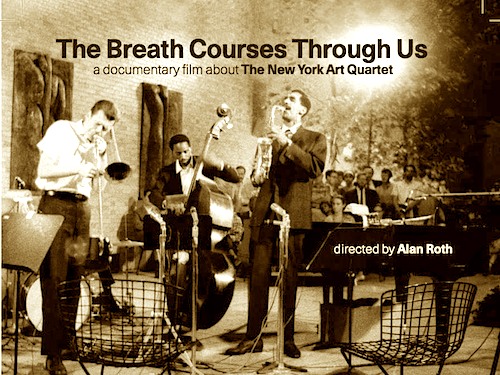
A Curtain Call for the New York Art Quartet: LFM Reviews The Breath Courses Through Us

Trailer – The Breath Courses Through Us (2013) from Asymmetric Pictures –FILMS on Vimeo.

By Joe Bendel. They were arguably the original super group of free jazz. They formed in 1964 and disbanded in 1965, yet they still had turnover on the bass. Eventually, Reggie Workman settled into the role and would return for their special anniversary tour. Despite the brevity of their tenure together, the New York Art Quartet remains enormously influential. Alan Roth documents their history and triumphant reunion in The Breath Courses Through Us, which has its American premiere today at the Library of Congress in Washington, DC.

It all started when Congolese-Danish alto-saxophonist John Tchicai met trombonist Roswell Rudd. Both musicians were exploring the creatively disruptive innovations of Cecil Taylor, recognizing each other as kindred spirits. The next piece of the puzzle was Milford Graves, a former Latin percussion specialist, who had reoriented his perspective on the drums after hearing Elvin Jones. As the New York Art Quartet, they recorded their instantly recognizable eponymous ESP release with Bernie Worrell on bass, bringing Workman on board for Mohawk the following year.

As is usually the case in jazz, the Quartet was short lived, precisely because it was just five minutes ahead of its time. At the time, they were consciously challenging traditional notions of melody, harmony, and rhythm, yet to contemporary ears they do not sound nearly as radical as much of the subsequent free music they blazed a trail for.

Sparingly using WKCR’s Ben Young as the expert commentator, Roth lucidly establishes the Quartet’s musical significance, placing them in the context of their era. We hear from all four musicians at length, all of whom are earnest and reflective about the music they made. However, there is no question Graves is a uniquely spirited and charismatic interview subject. His reminiscences are the sort of gift documentarians only dream of.

Of course, there is also plenty of straight-up music. Indeed, Roth has a nice editorial ear, selecting performances that illustrate the Quartet’s considerable technique. Watching Breath should dispel any uncharitable notions that they embraced freer forms because they could not adequately swing. After all, Rudd started off playing Dixieland and Workman recorded with just about everybody, including Art Blakey, Grant Green, and John Coltrane. At one point, Tchicai even played with a band inspired by Miles Davis’ electric period. The late controversial poet Amiri Baraka also joins the Quartet for some spoken word contributions. Roth wisely opts for his more benign pronouncements, but his interludes are still the only part of their reunion concert that sound dated.

To borrow terminology from Downbeat magazine, it is always great musicians get their overdue ovation. Breath should lead to greater appreciation of the New York Art Quartet, even among viewers not deeply steeped in the free jazz aesthetic. Recommended for open ears, The Breath Courses Through Us screens today (1/31) at the Library of Congress, with a New York premiere in the works.

LFM GRADE: B+

Posted on January 31st, 2014 at 1:54pm.

The Psychic Said What? LFM Reviews The Wait

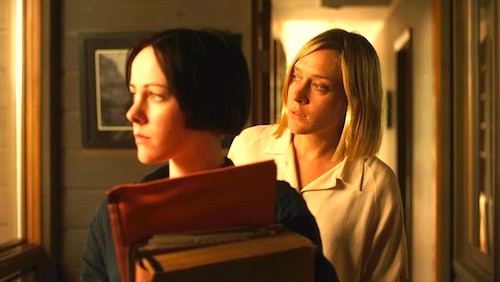
By Joe Bendel. At least the psychic never asks for money. Maybe that is why Emma believes her. It must be admitted her timing is also spot-on, given she calls, unsolicited, immediately after the death of Emma’s mother. Much to her sister’s frustration, Emma insists it will only be a matter of time before their mother returns to the land of the living, because a stranger told her so in M. Blash’s supernatural-ish drama The Wait, which opens today in New York.

Presumably, Angela is the more responsible sister since she does all the things you are supposed to do when a family member dies. Her older sister is clearly a flake, yet everyone seems to defer to her. Instead of grieving, the family just ambles about in a daze, with the air conditioning cranked up to arctic levels. Angela recognizes cracked behavior when she sees it, but her flirtation with a scruffy hipster neighbor distracts her from pushing the issue.

Blash plays up the verdant eeriness of the Pacific Northwest woods for all its worth, simulating the vibe of Twin Peaks, but lacking the distinctive characters and stuff happening with regularity. Kasper Tuxen’s lush cinematography evokes a sense something uncanny must be going on somewhere, but there are simply too many shots of characters staring off into the distance for Wait to sustain any appreciable momentum.

From "The Wait."

After Tuxen, Jena Malone is probably the film’s MVP. As Angela, she actually supplies a real performance, marked by vulnerability and sensuality. In contrast, Chloë Sevigny’s Emma largely fades into the background, which is surprising given the lively impression she made in Jonathan Caouette’s even more surreal short, All Flowers in Time.

With respects to the natural versus the supernatural question, Wait seems to want to have its cake and eat it, too. Blash offers up sequences to support either alternative down the stretch, but they are all so frustratingly underwhelming. There are interesting bits here and there, like the forest fire raging on the horizon, which everyone assiduously ignores, like revelers in Pompeii. Yes, it is a carefully crafted film, but there will be times viewers will want to hook it up to a car battery and give it a jump. For dedicated Malone fans only, The Wait opens today (1/31) in New York at the Cinema Village.

LFM GRADE: C-

Posted on January 31st, 2014 at 1:51pm.

LFM Reviews Wizard’s Way @ The 2014 Slamdance Film Festival

Wizard’s Way trailer from wizard's way on Vimeo.

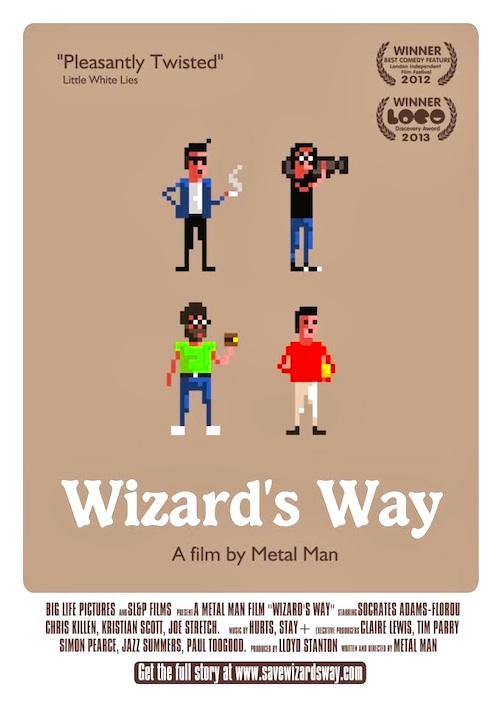
By Joe Bendel. Some legends might stand eternal, but no server lasts forever. When the one hosting one of the earliest surviving fantasy MMO’s is finally decommissioned, it causes great angst for two of the most dedicated players. A pair of snarky documentary filmmakers intend to capture the resulting drama, but the story evolves beyond their control in Metal Man’s Wizard’s Way, which screened at the 2014 Slamdance Film Festival.

Although nothing could upstage Christopher Nolan receiving the inaugural Founder’s Award at this year’s Slamdance, news that Jack Black plans to develop and executive produce the American remake of Way was still pretty big stuff. He could probably star as well, in nearly any of the scruffy roles. Joe Stretch and Chris Killen (played by their namesakes) are recent film school grads, who somehow received early notice of the impending demise of Wizard’s Way. Recognizing a good opportunity for cinematic exploitation, they seek out Julian “Windows” Andrews, a stockroom prole by day, who is the undisputed top gun amongst Wizard’s Way’s dwindling ranks.

As his schlubby roommate Barry Tubbulb explains, Windows is the only player to get married “in-game” to Elin, whom he has never met outside of Wizard’s Way. When the plug gets pulled, Windows is understandably distraught, because he has lost his “wife” along with his life’s passion. Somehow Stretch convinces the gamers to stick with their film, but he has some rather cruel manipulations scripted out for the lads. However, Andrews and Tubbulb might not be as dumb and pathetic as the would-be-documentarians think.

Frankly, Wizard is exactly what Zero Charisma should have been, but wasn’t. There is no question that in the culture war between geeks and hipsters, Metal Man, a.k.a. co-writers Socrates Adams-Florou, Chris Killen & Joe Stretch, line up solidly behind the geeks. Their sympathy for Tubbulb and Andrews is genuine and the eventual comeuppance is satisfying.

As Tubbulb, Adams-Florou lets loose with a fair amount of shtick, but Kristian Scott is surprisingly grounded (and rather reserved) as Windows. While Killen largely avoids the spotlight (which is definitely an issue for his character), Stretch’s slow, creepy evolution into outright villain is frankly quite impressive. This is obviously a zero budget affair, but everyone in front of the camera gamely holds up their end.

You do not often see movies at festivals that tell documentary filmmakers to sod off, which is why Wizard is so refreshing. Similar in tone to Electric Man, David Barras’s affectionate ode to comic readers, Wizard defends geek culture in general, while gently encouraging the addition of an offline component. It all works quite well.Highly recommended for gamers and fans of eccentric British comedies, the news-making Wizard’s Way should have plenty of festival screenings in its future.

LFM GRADE: B+

Posted on January 27th, 2014 at 3:57pm.

LFM Reviews Rezeta @ The 2014 Slamdance Film Festival

By Joe Bendel. Rezeta still calls herself Albanian, but technically that is no longer true. Regardless of her Balkan nationality issues, the fashion model is not fluent in Spanish. Nonetheless, she will have no trouble meeting men in Fernando Frías’s Rezeta, which won the narrative feature Jury Award at the 2014 Slamdance Film Festival.

Things always seem to work out relatively okay for Rezeta, if not spectacularly so. The modeling agency that brought her to Mexico is decidedly on the dodgy side, yet she starts scoring high profile work almost immediately. She gets along reasonably well with most of her roommates in the company’s model crash pad, but frankly she will not be around very much. She is not Blanche DuBois, but Rezeta will knowingly slip into some bad relationships with underwhelming men of means, for obvious reasons. However, things with Alex, the working class punk rock hipster, might be different. He definitely catches her eye when they bond over their tattoos, but he plays bafflingly hard to get.

Highly improvisational, Rezeta the film chronicles the rise and potential fall of a romantic relationship, with some culture clash garnish on the side. Even at its best, Rezeta is never particularly deep and there are long stretches of narrative slack. Still, the Balkan connection lends the Lost in Translation story a fresh angle.

From "Rezeta."

Without question, lead actress Rezeta Veliu is the film’s winning ace-in-the-hole. Not just a pretty face, she is also quite a fine screen performer, blessed with a natural sense of when to dial it up or down. As Alex, Roger Mendoza does not have a fraction of her screen presence, but at least they develop some credible chemistry together during their ambiguous courtship scenes.

The occasional glimpses Rezeta offers of the vagabond lives led by not-quite-supermodels suggests there is more to be mined from this strange world of pseudo-glamour and exploitation. Clearly, Frías is much more interested in the characters transparently based on his co-leads, but their interpersonal dramas are rather hit-or-miss stuff. Regardless, Rezeta obviously made quite an impression on the jury when it screened at this year’s Slamdance Film Festival. The combination of its award attention and Veliu’s striking look (she is not a plastic cookie-cutter type, by any stretch) should secure it plenty of festival play, including at the 2014 Indie Fest in San Francisco, where it screens February 11th, 16th, and 20th.

LFM GRADE: C+

Posted on January 27th, 2014 at 3:49pm.

LFM Reviews The Raid 2 @ The 2014 Sundance Film Festival

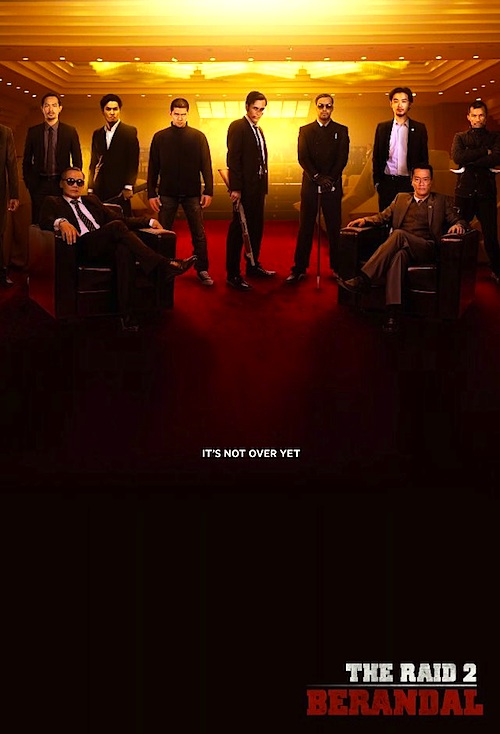
By Joe Bendel. Rama’s last mission was an off-the-books frontal assault. He was one of the few survivors. This time, he will use stealth and deception. Don’t worry, he will generate the same massive body count in Gareth Huw Evans’ The Raid 2, which screens during this year’s Sundance Film Festival.

Ironically, busting his corrupt commanding officer might not be so hot for Rama’s career. It is likely to attract the wrong sort of attention. Fortunately (or not), the leader of the new anti-corruption squad papers over the whole affair, so he can recruit Rama for a deep cover operation. The honest cop and family man will spend two years in prison, where he will become the protector of Uco, the unstable son of Bangun, Jakarta’s top mob boss. His objective is not to take down Bangun, but to expose the cops in his pocket.

Matters get more complicated (as gangster business often does) when Uco hatches a plan to usurp his father and launch an all out war against their Japanese Yakuza allies. With chaos unleashed, Rama forms a de facto alliance with Eka, Bangun’s more rational lieutenant, played by Mr. Sundance, Oka Antara, co-lead of the Mo Brothers’ Killers.

Raid 2 starts a bit slower than the previous film, actually devoting a minute or two to exposition, but it is soon off to the races. In addition to the mega-melees, there are several feature spots devoted to various supporting beat down artists. Yayan Ruhian, Iko Uwais’s co-action choreographer on both films, reappears in the persona of Prakoso, a loyal Bangun assassin done wrong by Uco. However, the sequel’s new fan favorite is likely to be Julie Estelle, who literally tears it up the joint as the aptly named “Hammer Girl.” Watching her go Sears Craftsman on various Yakuza is what the movies should be all about.

Once again, Uwais and Ruhian’s fight scenes are spectacularly violent and wildly cool. Close quarters combat is unquestionably their forte. While their moves are often dazzling cinematic, there is nothing superhuman in Raid 2, except perhaps its characters’ tolerance for pain.

Uwais is an earnest enough screen presence with truly ferocious action chops. Likewise, Ruhian and Estelle should be future cult stars in their own right. Arifin Putra brings plenty of entitled villainy as the recklessly ambitious Uco, while Antara and Tio Pakusodewo’s Bangun nicely hold up the Johnnie To gangster tradition.

Without question, Raid 2 maintains the franchise’s status as the reigning Cadillac of martial arts cinema. Saturated in adrenaline, it is the sort of film that inspires expressions of appreciative shock and awe from the audience. Highly recommended, it screens again this Saturday (1/25) in Salt Lake as part of this year’s Sundance Film Festival.

LFM GRADE: A

Posted on January 24th, 2014 at 5:36pm.