LFM Reviews Commitment

By Joe Bendel. It is hard to get more Zeitgeisty than a film about North Korean purges. You can ask Kim Jong-un’s uncle about it, if you have a Ouija board in your pocket. A teenager recruited out of Yodok prison becomes a pawn in Kim’s brutal succession plan in Park Hong-soo’s Commitment, which screens for free this coming Tuesday in New York, courtesy of the Korean Cultural Service.

Ri Myung-hoon had always done his duty as a sleeper spy, so he expected to return home to his son and daughter, right on schedule. Unfortunately, the Communist regime does not give out gold watches. Instead, they betray Ri’s father and imprison his family. Since he is a real chip chiseled off the old block, a crafty old spymaster offers Ri a chance to save his sister Hye-in. Posing as a defector, he will hunt down the assassin from a rival North Korean spy faction killing members of his sleeper cell.

To maintain his cover, he will also spend some time in high school, where he meets Lee Hye-in. Besides her name, something about her reminds him of his sister. As a disciplined undercover operative, he valiantly resists the urge to lay a beat down on the bullies that torment her, but it is obviously just a matter of time. Likewise, the plots in Pyongyang will soon embroil Ri and nearly every other sleeper.

From "Commitment."

It is easy to see why Commitment’s blend of action and tragic teen angst would be popular with Korean audiences, but it is also a rather astute reflection of the current geopolitical climate. Although Park served as assistant director on Jang Hun’s wishful thinking unification thriller Secret Reunion, Commitment is more closely akin to Ryoo Seung-wan’s neo-Cold War spy drama Berlin File. It clearly implies Kim Jong-un is a ruthless Machiavellian and forthrightly addresses the plight of political prisoners. On the ROK side, the most sympathetic figure is Cha Jung-min, an unreconstructed Cold Warrior, whereas his “keep the lines of communication open” superiors are portrayed as craven opportunists.

Korean rapper T.O.P. (a.k.a. Choi Seung-hyun) is surprisingly credible in his considerable action scenes. When it comes to high school drama, he certainly broods well enough. As Lee Hye-in, Han Ye-ri also projects a somewhat reserved screen presence, so they feel right together, even if they do not burn up the set. Amongst a strong supporting cast, Yoon Je-moon’s Cha hits the right note of rumpled exasperation, while Kim You-jung is arrestingly fragile as sister Hye-in.

Despite several nifty fight scenes, American audiences would probably prefer a higher action to teenage angst ratio. Still, it is probably the best spy film since maybe Berlin File. Often smart and tense, Commitment is a fascinating example of the ever shifting manner the two Koreas are depicted in the cinema of the ROK. Recommended rather highly (especially for free), Commitment screens Tuesday (1/14) at the Tribeca Cinemas, thanks to the Korean Cultural Service in New York.

LFM GRADE: B+

Posted on January 11th, 2014 at 12:31am.

LFM Reviews Amy Winehouse – The Day She Came to Dingle @ The 2014 New York Jewish Film Festival

By Joe Bendel. Tragically, Amy Winehouse passed away only two and a half short years ago. Could she already be due for a critical reassessment? A case could be made based on the stripped down and surprisingly soulful set recorded live for the Irish music television series, Other Voices. Indeed, the intimate setting suited her sensibilities, judging from Maurice Linnane’s Amy Winehouse—the Day She Came to Dingle, which screens during the 2014 New York Jewish Film Festival.

Produced in a small Anglican church in the remote Irish coastal city of Dingle, Other Voices has become an unlikely launching pad for many top UK performers. Saint James is a small space, with a maximum capacity of eighty. There is no avoiding the audience, but the right performer can feed off their energy. Winehouse seemed to get that. In 2006, when still in the process of breaking through internationally, she performed a set of what are now her greatest hits, with only guitarist Robin Banerjee and bassist Dale Davis backing her.

In between the six full numbers, Day cuts to excerpts from the no gossip-all music interview John Kelly conducted with Winehouse that might surprise many people. When asked about her influences, Winehouse primarily discusses jazz artists, such as Thelonius Monk and Sarah Vaughan (who is also seen in a vintage performance of “I Got It Bad,” as a pleasant bonus). She is also clearly knowledgeable about the UK jazz scene, singling out Soweto Kinch as a current favorite, so give her credit for that too. Evidently she started in jazz and even still played private duo gigs with a piano accompanist as late as 2006.

From "Amy Winehouse - The Day She Came to Dingle."

When watching Day, one gets the sense Winehouse might have been happier playing smaller, upscale jazz clubs than arenas and massive festivals like Glastonbury. While her Dingle repertoire is arguably more closely akin to 1960’s soul and girl groups, “Love is a Losing Game” has a bit of jazz rhythm to it, making it one of the highlights of the set. However, the stark arrangement of “Back to Black” is a defining standout and rather spooky sounding in retrospect.

At one point, Winehouse helpfully reminds viewers of her Russian Jewish heritage, thereby explaining why Day is a selection of this year’s NYJFF. It is a bit of a curve ball, but receptive viewers might find the manageable one hour program boosts their appreciation of Winehouse. After all, nobody from Dingle has a critical word to say about her, including Saint James’ Rev. Mairt Hanley and the old fellow who picked her up at the airport.

An entirely positive addition to her recorded legacy, Amy Winehouse—the Day She Came to Dingle is recommended for Winehouse fans and those who follow British pop music in general. While it is surely destined to be released on some format here in America, it has its New York premiere this coming Tuesday (1/14) and Wednesday (1/15), screening with the short film First Lesson in Love at the Walter Reade Theater.

LFM GRADE: B

Posted on January 9th, 2014 at 9:02pm.

The Anime Rebuild Continues: LFM Reviews Evangelion 3.0

By Joe Bendel. There is nothing like partially destroying the world to cause an existential crisis. Shinji Ikari was always a moody kid, but he is in for the mother of all guilt trips. The franchise that rejuvenated mecha anime returns with the third installment of Hideaki Anno’s feature anime “rebuild” series, Evangelion 3.0 You Can (Not) Redo, which screens this Friday in New York.

If you saw 2.0, you might be somewhat surprised to learn that the climactic battle did not turn out so well, but not as surprised as Ikari. He will have quite a rude awakening from fourteen years of suspended animation. His former protector, Misato Katsuragi, is now the leader of WILLE, an outfit explicitly opposed to his father’s NERV—and she apparently hates his guts. A lot of people do, including his former hotshot comrade-in-arms, Asuka Shikinami. Nobody will spell it out for him, but they are all adamant he should never step inside an EVA battle bot again.

As a result, he is more than willing to desert WILLE for NERV when offered the chance, particularly since the getaway EVA is piloted by Rei, whom Ikari thought he had saved at the end of 2.0. She has changed though, whereas his father is the same old cold Machiavellian. At least Ikari makes a new friend in Kaworu Nagisa, with whom he plays four-handed piano and learns the full devastating extent of the Third Impact he inadvertently hastened.

From "Evangelion 3.0."

Given the fourteen year time jump, 3.0 ought to be a convenient entry point to the series, but it actually feels denser than the previous two outings. It is definitely a middle film, ending more with a lull in the action than any sense of closure. While he was never a barrel of laughs, Ikari’s mopiness becomes almost insufferable. On the plus side, Shikinami really comes into her own as an anime action role model for girls. Listening to her tear into Ikari is good, sort of clean, cathartic anime fun.

As usual, the art of 3.0 remains several cuts above the industry standard. This time out, writer-chief director Anno cranks up the apocalyptic elements something fierce, but somehow the religious overtones do not feel as pronounced. The complete lack resolution will frustrate casual viewers, but fans will dig the metal-on-cosmic metal action (they should also stay for the teaser-stinger). Recommended for anime connoisseurs who appreciate the intricate series mythology and Shikinami’s attitude, Evangelion 3.0 screens this Friday (1/10) at the Big Cinema Manhattan, Saturday (1/11) at the Yonkers Drafthouse, and Saturday (1/11) and next Tuesday (1/14) at the Village East, as well as other select theaters throughout the country.

LFM GRADE: B-

Posted on January 8th, 2014 at 11:41am.

Amnesiac Hitmen in Love: LFM Reviews Key of Life, Now on DVD

By Joe Bendel. All movie lovers know amnesia and romance go together like fish and chips. Yakuza not so much, but they are all part of the mix in screenwriter-director Kenji Uchida’s understated rom-com, Key of Life, which releases today on DVD from Film Movement.

The mysterious Shinichiro Yamazaki (professional handle: Kondo) has just taken out an unfortunate businessman. Despite his protective garb, the hitman has a discrete dab of blood on him. He is also somewhat sweaty, so he heads for a public bath, where he promptly slips on a bar of soap and cracks his head. Seizing the opportunity, suicidal loser-actor Takeshi Sakurai grabs his keys and clothes, while an ambulance whisks him off to the hospital. When Sakurai finally resolves to face up to the well heeled Yamazaki, he finds the man has no memory of his past life. Although he still feels a tiny bit guilty, Sakurai continues impersonating Yamazaki, blissfully unaware of the man’s dangerous line of work.

Meanwhile, book publishing executive Kanae Mizushima gives herself a short deadline to find and marry a reasonably respectable man. She has her reasons. Sakurai, as Yamazaki erroneously presumes himself to be, seems like a poor prospect. Yet a chance encounter leads to possible romance for the two meticulous souls. Of course, all sorts of complications are lurking around the corner, many of them involving the Yakuza who has a rather distasteful follow-up gig for Kondo.

From "Key of Life."

On paper, Key sounds like a whizbang screwball comedy, but Uchida’s execution is surprisingly quiet, laidback, and mature. Recognizing a good thing going on, he allows plenty of time for the ambiguously romantic relationship between Mizushima and the real Yamazaki to unfold. He juggles a gracious plenty plot points, yet Key is first and foremost a rom-com that excels at the rom.

Prolific character actor Teruyuki Kagawa is absolutely pitch-perfect as Yamazaki (assuming Sakurai’s identity), conveying all his world weary soulfulness, while still springing all his character’s revelations like the crafty pro he is. Likewise, Ryoko Hirosue (sort of the Japanese Sandra Bullock, probably still best known internationally for her supporting turn in the Oscar winning Departures) is exquisitely demur and sensitive as the reserved Mizushima. Together, they develop some unusually fresh and deep screen chemistry. Unfortunately, Masato Sakai’s real Sakurai looks like quite the weak link in comparison, but at least he delivers one memorable extra-base hit late in the third act.

Even though Uchida maintains an appealingly light and easy-going vibe, Key has far more heft than the average comedy of any sub-genre. It is a film that appreciates the awkward ways people relate to each other. Witty, romantic, and greatly satisfying, Key of Life is highly recommended for general audiences. It is now available on standard DVD from Film Movement.

LFM GRADE: A

Posted on January 7th, 2014 at 8:20pm.

Jet Li Supervises: LFM Reviews Badges of Fury, Now on DVD/Blu-ray

By Joe Bendel. Jet Li’s Huang Fei Hong is sort of the Sergeant Murtaugh of the Hong Kong police. He is definitely getting too old for this sort of thing, but unlike his Lethal Weapon counterpart, he always punches out promptly at 5:00 and disappears for long stretches. That leaves most of the slapstick to his younger colleagues. Seniority has its privileges. Still, whenever Huang returns for a throw down, things perk up dramatically in Wong Tsz-ming’s Badges of Fury, which releases today on DVD and Blu-ray from Well Go USA.

Huang is a crafty old salt who is more interested in his retirement portfolio than office politics. Wang Bu-er thinks he’s all that, but has an uncanny talent for self-sabotage. Their young, insecure team leader has paired them together in the hope some of Huang’s mature risk-aversion will rub off on Wang. So far, it is not taking. Wang just keeps blundering ahead, inadvertently aiding the escape of the wanted criminal Huang nearly captures in the spectacular opening action sequence.

However, Badges is not really about the fugitive Chen Hu. Frankly, it keeps changing its mind, but the preponderance of the narrative involves the investigation of the so-called “Smile Murders.” Each of the victims died with a strange smile plastered across their faces. It turns out they were also all once engaged to low budget starlet Liu Jinshui. Quickly, Liu falls under suspicion, but her half-sister Dai Yiyi appears far more dangerous, given her obvious va-va-voom.

From "Badges of Fury."

When Badges goes for laughs, it can be painful. However, action director Corey Yuen embraces the film’s cartooniness, unleashing his inner Itchy and Scratchy for some absolutely off-the-wall fight scenes. In the big opener and closer, Jet Li shows he still has his mojo. It is too bad there isn’t more of him as the steely Huang. Unfortunately, his Ocean Heaven co-star Wen Zhang kind of stinks up the joint with his shtick. Rising star Michelle Chen (so memorable in Ripples of Desire) is also clearly out of her element as their exasperated superior. At least, Ada Liu vamps it up with gusto as the femme fatale sister.

As if Badges were not inconsistent enough, it also shoehorns in more cameos than the director’s cut of It’s a Mad, Mad, Mad, Mad World. Sometimes it works great, as when action star Wu Jing shows up to rumble as an insurance investigator. Other times, it can be a rather head-scratching distraction for viewers not up on their Hong Kong reality television. Still, it is always pleasant to see Lam Suet, Stephy Tang, Josie Ho, and Grace Huang on-screen.

When it clicks, Badges is a martial arts machine. When it doesn’t, it is usually dabbling in romantic comedy. Still, Jet Li and Wu Jing’s chops, Yuen’s gravity-defying fight choreography, and Liu’s sex appeal should be enough to hold HK action junkies’ interest on DVD. Recommended for fans, but not as a Jet Li entry point, Badges of Fury is now available for home viewing from Well Go USA.

LFM GRADE: C+

Posted on January 7th, 2014 at 8:18pm.

LFM Reviews Lonely Planet @ The 2014 New York Jewish Film Festival

By Joe Bendel. It is easy to see why banishment to Siberia was a favorite method of punishment under the old Communist regime. It still seems like a cold, isolated, economically depressed region, at least judging from the footage shot by an Israeli film crew. Ostensibly, they are looking for Mishka Zilberstein, who as young Jewish boy reportedly took refuge from the National Socialists with the wolves in the Belarus forest. Oddly enough, Zilberstein’s urban legend might be the only thing that is true in Edan Zeira’s docu-drama hybrid, Lonely Planet, which screens during the 2014 New York Jewish Film Festival.

Zeira and his Israeli-French crew are determined to find the mythical Mishka, but each lead turns out to be a dead-end. Supposedly, the real life Zilberstein eventually settled in a remote corner of Siberia. Everyone seems to know his story, but the locals are not exactly welcoming. At least all the trouble Zeira and his colleagues got into was presumably fictional, unless Zeira really did agree to a shotgun wedding to a provincial police chief’s pretty daughter, in which case, Mazel tov.

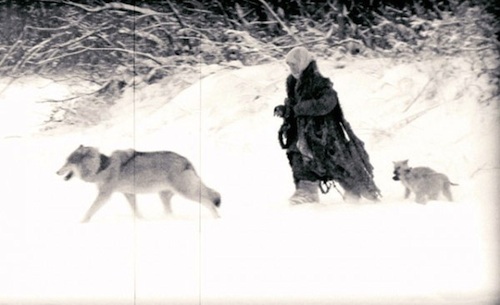
From "Lonely Planet."

This is a very strange film, for obvious reasons. Yet, despite its postmodern gamesmanship, it is worth listening-up when the real Zilberstein finally enters the picture. Indeed, Zilberstein is a fairly well documented historical figure and viewers have no reason to doubt it is really him consenting to tell his story (aside from all the meta-meta business that came before). It is a powerful tale, involving torture at the hands of both the National Socialists and the Soviets. Essentially, Zilberstein was reduced to an animal state, at a time when animals were more humane than humans.

Zeira illustrates Zilberstein’s story with highly stylized black-and-white re-enactments. Clearly, they had a terrific handler for the wolves. While his (presumed) humor is sometimes questionable, it always comes at his own expense. Some might understandably take issue with his mash-up approach in a film that directly addresses the Jewish experience during WWII, but Zeira is unfailingly respectful in his treatment of Zilberstein. Fans of Guy Maddin will probably enjoy his deconstructive and surreal inclinations, whereas general audiences will appreciate Zilberstein’s testimony. Recommended for the somewhat adventurous, Lonely Planet screens twice this coming Thursday (1/9) at the Walter Reade Theater, as part of this year’s NYJFF.

LFM GRADE: B-

Posted on January 6th, 2014 at 11:08pm.